• The Sabotage of Obamacare Is Going Great

    A week ago:

    Blaming the uncertainty over health care reform in the U.S. Senate, insurance carriers will stop offering plans under the Affordable Care Act in nearly all of Nevada’s rural counties, including Carson City and Douglas County….Only Anthem currently sells plans on the exchange in those counties.

    Today:

    After significant dialogue with state leaders and regulators Anthem Blue Cross Blue Shield has made the difficult decision to revise our rate filing for our 2018 Individual plan offerings in Nevada….Planning and pricing for ACA-compliant health plans has become increasingly difficult due to a shrinking and deteriorating individual market, as well as continual changes and uncertainty in federal operations, rules and guidance, including cost sharing reduction subsidies and the restoration of taxes on fully insured coverage. Specifically, Anthem will reduce its 2018 Individual plan offering in Nevada and will only offer an off-exchange catastrophic medical plan statewide

    Nevada now has no insurers in its rural counties. Only two are left in its three big counties following the withdrawal of Anthem. This isn’t because of anything inherently broken about health coverage in Nevada. It’s all thanks to Senate Republicans and Donald Trump, who have deliberately destabilized the insurance market and are now gleefully watching the ensuing chaos. Trump could stop this with just a word, but revenge is more important to him than the health care of thousands. The sabotage of Obamacare continues apace.

  • Chart of the Day: Tax Rates on the Rich and the Rest of Us

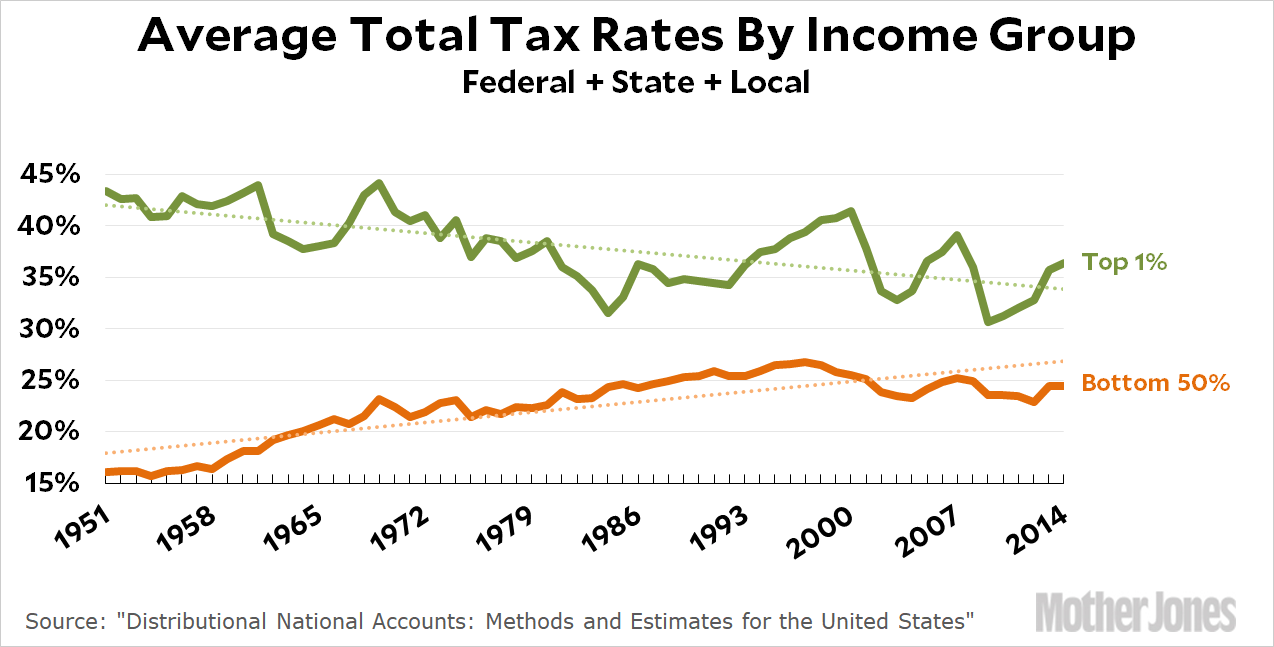
    Over at Slate, Jordan Weissmann notes that the fabled 90 percent top tax rate on the rich back in the 1950s is a bit of a myth. It’s true, he says, that this was the top marginal rate on ordinary income, but the average tax rate on the rich was considerably less. In fact, Scott Greenberg of the conservative Tax Foundation argues that “taxes on the rich were not that much higher” back in the 50s than they are today.

    My first thought was: Great. Now you tell us. I guess we never really needed those huge Reagan tax cuts after all.

    Bygones. However, something else caught my eye. Greenberg relied on data from Gabriel Zucman, Thomas Piketty, and Emmanuel Saez on average tax rates over time. Here’s what that looks like:

    This chart accounts for all taxes: federal, state, local, income, payroll, etc. Everything. And while it’s true that the rich didn’t pay 90 percent of their entire income in federal taxes back in 1951, it’s also true that their average tax rate has gone steadily down in the entire era since World War II. And this has happened at the same time that their share of total national income has nearly doubled.

    Income way up, tax rates way down. Nice work if you can get it.

  • There’s Something Odd About That Google Memo

    Ole Spata/DPA via ZUMA

    A few days ago, a Google engineer named James Damore wrote a lengthy memo that he posted on one of Google’s internal discussion boards. Roughly speaking, it argued that the reason there were so few women at Google wasn’t because of discrimination or bias. It was because women had certain innate characteristics that made them poorly suited for software engineering. Today, Google fired Damore.

    I finally got around to reading the memo this afternoon. What surprised me wasn’t that Damore wrote what he did. I imagine there are plenty of Silicon Valley engineer-bros who are tired of all the SJW diversity lectures and have managed to convince themselves that it’s nonsense on the basis of what they think is rigorously impartial scientific analysis. Throw in a bit of conservative victimology and you have a pretty good taste of Damore’s memo. You can read the whole thing here if you want.

    Like I said, that much didn’t surprise me. But there was something that struck me as a bit off-kilter about Damore’s memo. Maybe I’m over-reading things, but it seemed like Damore very calculatedly went further over the line than he needed to. For example, he didn’t need to argue that women are biologically unsuited for engineering jobs, something that he must have known would be both stupid and galactically incendiary. If he had simply said that women pursue software engineering careers in small numbers thanks to cultural and societal norms, it would have been less contentious and it wouldn’t have hurt his point. In fact, he really didn’t need to argue anything at all about the capabilities of women. He could have written a one-paragraph memo pointing out that, for whatever reason, female IT grads make up only x percent of the total, so it’s just not feasible for Google to employ very many women. He could bemoan this state of affairs, but point out that it has to be addressed starting in primary school, and by the time Google is involved there’s nothing they can do about the pool of applicants. So can we please knock off the sackcloth and ashes routine?

    That still would have been wrong in several ways, but it probably wouldn’t have gotten him fired.

    So why did he write what he did? Maybe I’m overestimating Damore’s sophistication, but something about his writing style made me think he had deliberately chosen not to take this tack. There was something about the amateurishness of his analysis that seemed strained, as if he was playing a role. And that role was simple: not to write about why he thought Google’s diversity programs were misguided, but to write something as offensive as possible in a way that allowed him plausible deniability. In other words, he was trying to get fired so he could portray himself as a lonely martyr to Silicon Valley’s intolerance for conservative views. Maybe he could even go to court, funded by some nice right-wing think tank.

    You should take this as completely speculative. Obviously I’m just guessing. But something about the memo didn’t seem quite authentic, and I’ve read quite a few similar ones. Back in the days of dinosaurs, this kind of thing was one of the staples of the blogosphere. Aren’t you glad you weren’t reading blogs back then?

  • The State of Play on the Debt Ceiling

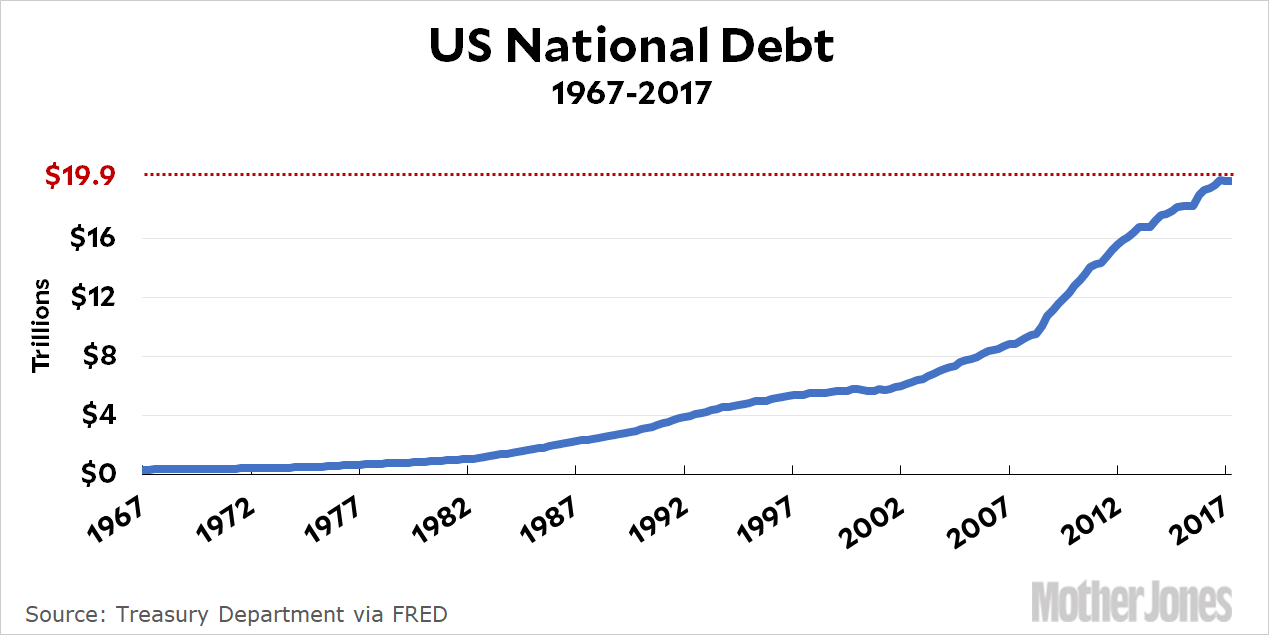
    The debt ceiling, we are told, will be breached in late September if Congress doesn’t raise it.¹ This would spawn widespread havoc because it would cause the US government to stop paying some of its bills. Most likely, interest payments on treasury bonds would be prioritized, which means there wouldn’t be a default on American sovereign debt, but it’s not clear if much more could be done on that score. As a result, Social Security checks could be delayed randomly, payroll checks to federal workers might be held up, and doctors would stop getting Medicare reimbursements.

    So where are we on this? This seems to be the current state of play:

    • In the executive branch: After several months of vagueness, the White House finally announced that it supports a “clean” increase. That is, an increase in the debt ceiling with no conditions attached.
    • In the House: The House Freedom Caucus is insisting that it won’t vote for a debt ceiling increase unless it includes spending cuts. Without the HFC, Paul Ryan doesn’t have the votes to pass anything.
    • In the Senate: The debt ceiling bill needs 60 votes, which means that Mitch McConnell needs a bunch of Democrats to help him out. Democrats haven’t taken a firm position yet, but are generally suggesting that they don’t want to raise the debt ceiling if it just means Republicans can pass a huge tax cut for the rich. McConnell didn’t improve matters when he churlishly announced last week that he wanted no Democratic input on the upcoming tax bill.

    Now, it’s possible that none of this matters. In recent years it’s become SOP to dick around on the debt ceiling for months and then come to some kind of last-minute accommodation around 10 pm on the day the money runs out. Maybe that’s just the way things are these days, and we have to get used to it.

    For what it’s worth, though, I hope Democrats stay sort of vague about all this and don’t start holding hostages. If they just want to give Mitch McConnell ulcers for a few weeks, who can blame them? But when push comes to shove, they need to be the party of grownups, the ones who will approve a clean debt ceiling increase even when a Republican is in office. One party of lunatic hostage takers is enough.

    ¹Technically, it’s already been breached. However, for the past few months the Treasury Department has been using “extraordinary measures” to keep paying the bills, something we never had to do in the past. These days, Congress doesn’t deal with the debt ceiling until even the extraordinary measures have run out and doom is truly only hours away.

    It’s sort of like the gas tank in your car. In the past, Congress filled up whenever the dashboard light came on. Crisis averted! But now they just laugh at the light. They don’t even start to take things seriously until the tank is down to about two ounces of gasoline and the fuel pump is sucking so much wind that it nearly melts.

  • Chart of the Day: How Geriatric Is the US Senate?

    Over at Vox, Harold Pollack writes about a problem: “very old politicians.” I was nodding along until I got to this sentence about the Senate:

    In the body as a whole, 23 senators are at least 70. Seven are 80 or older.

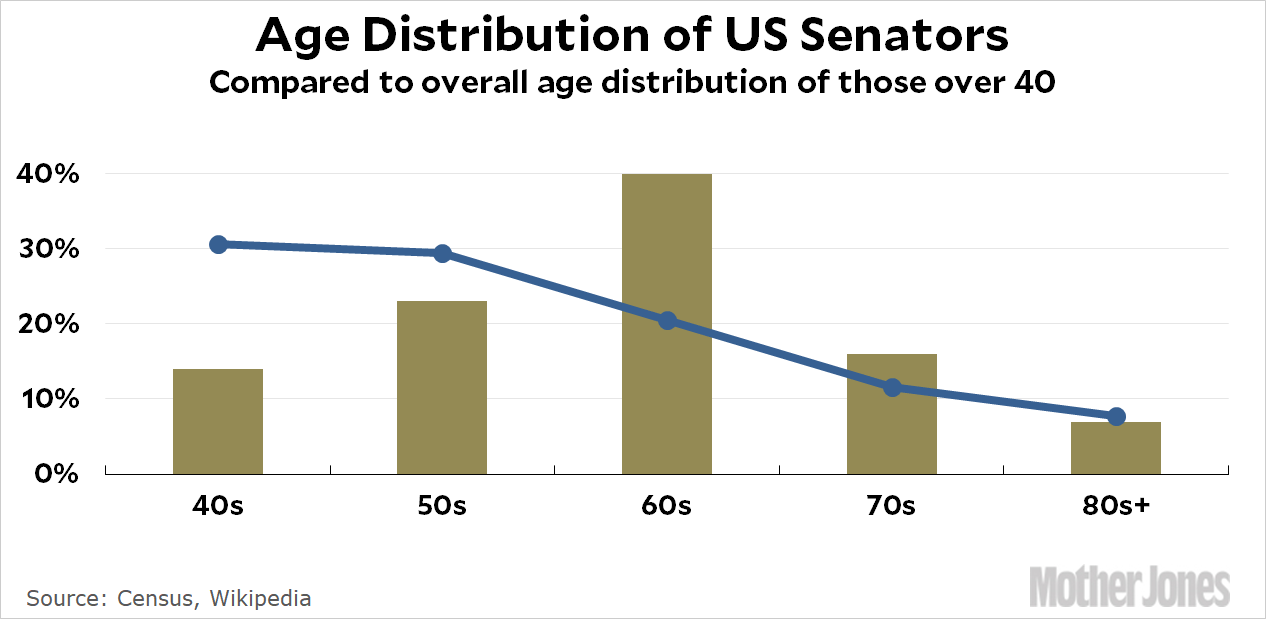
    This doesn’t seem all that old. So I got curious: how does the age distribution of the Senate compare to the country as a whole? Obviously there are no youngsters in the Senate, so we need to compare to a subset of the population. It’s very seldom that anyone becomes a senator before age 40, so here’s a comparison of the US Senate to the overall US population 40 and over:

    It turns out the Senate looks a lot like America. The main difference is too few senators in their 40s and too many in their 60s. But the 70+ crowd is roughly the same as their distribution in the population.

    Now, in the rest of the world, most of those folks who are over 70 are retired, and maybe a lot of these senators should be too. Still, they don’t look an awful lot different than a random group of over-40s plucked off a street corner.

  • Lunchtime Photo

    It’s waterfowl baby season again! This year, for the first time I can remember, we have baby ducks. We always have baby geese, but never ducklings. I assume there must be some treachery involved in this, since ducks naturally have babies unless someone stops them—and I suppose this someone must be our neighborhood association, which doesn’t want thousands of ducks on our lake. Whatever they do to maintain the duck population at reasonable levels, I assume they also do it to our local rabbits, since we continue not to live with wall-to-wall rabbits.

    As for the geese, I suspect they’re protected, so there’s nothing anyone can do about them. I guess I could find out real answers to all these questions if I were really curious, but I’m not.

    Anyway, here are the baby ducks. The duck in front is diving underwater for whatever reason it is that ducks dive underwater. Neither siblings nor mama look very impressed, but mama looks happy and proud. This is because all ducks look happy thanks to the shape of their bills and our happy childhood memories of Donald Duck, but who cares? They look happy, and that makes me happy.

    Tomorrow: baby geese. But no lunchtime photo. What can this mean?

  • Is Twitter Ruining YA Publishing?

    Here’s another entry in the “Twitter is a cesspool” sweepstakes. It’s a piece from Kat Rosenfield about the toxic tweetstorms plaguing the Young Adult book business:

    The Black Witch, a debut young-adult fantasy novel by Laurie Forest, was still seven weeks from its May 1 publication date, but positive buzz was already building….The hype train was derailed in mid-March, however, by Shauna Sinyard, a bookstore employee and blogger who writes primarily about YA and had a different take: The Black Witch is the most dangerous, offensive book I have ever read,” she wrote in a nearly 9,000-word review that blasted the novel as an end-to-end mess of unadulterated bigotry. “It was ultimately written for white people. It was written for the type of white person who considers themselves to be not-racist and thinks that they deserve recognition and praise for treating POC like they are actually human.”

    ….Sinyard [slammed] The Black Witch as “racist, ableist, homophobic, and … written with no marginalized people in mind”…Harlequin Teen, was bombarded with angry emails demanding they pull the book…Positive buzz all but died off, as community members began confronting The Black Witch’s supporters, demanding to know why they insisted on reading a racist book…The result is a jumble of dogpiling and dragging, subtweeting and screenshotting, vote-brigading and flagging wars, with accusations of white supremacy on one side and charges of thought-policing moral authoritarianism on the other…”None of us are willing to comment publicly for fear of being targeted and labeled racist or bigoted.”

    ….In recent months, the community was bubbling with a dozen different controversies of varying reach — over Nicola Yoon’s Everything Everything (for ableism), Stephanie Elliot’s Sad Perfect (for being potentially triggering to ED survivors), A Court of Wings and Ruin by Sarah J. Maas (for heterocentrism), The Traitor’s Kiss by Erin Beaty (for misusing the story of Mulan), and All the Crooked Saints by Maggie Stiefvater (in a peculiar example of publishing pre-crime, people had decided that Stiefvater’s book was racist before she’d even finished the manuscript.)

    This sounds horrible. Twitter is ruining the YA book business. But wait. There’s also this:

    The Black Witch, which took one of the worst online beatings in recent memory, scored a No. 1 rating in Amazon’s department of “Teen & Young Adult Wizards Fantasy” a few days after its release and has been overwhelmingly well-reviewed since….The scandals that loom so large on Twitter don’t necessarily interest consumers; instead, the tempest of these controversies remains confined to a handful of internet teapots where a few angry voices can seem thunderously loud. Still, some publishing professionals imagine that the outrage will eventually become powerful enough to rattle the industry.

    In other words, in terms of emotional energy, a thousand tweets are worth about one letter to the editor. Namely nothing. And while I’d normally say that maybe the adults ought to step into this mess and do something about the bad behavior, it turns out that adults are the problem in the first place:

    In an interesting twist, the teens who make up the community’s core audience are getting fed up with the constant, largely adult-driven dramas that currently dominate YA. Some have taken to discussing books via backchannels or on teen-exclusive hashtags — or defecting to other platforms, like YouTube or Instagram, which aren’t so given over to mob dynamics.

    Twitter is a cesspool. It’s also a lot of fun if you follow the right people, which is why so many of us continue to use it. But it’s also a cesspool. Always keep that in mind when you’re deciding just how deeply you want to engage with Twitter.