• Bitcoin Is a Lousy Form of Money

    Jaap Arriens/NurPhoto via ZUMA

    Is bitcoin a good replacement for money? This is a popular question these days, but it’s poorly framed. “Money” should be thought of more as an adjective than a noun. That is, certain things are more moneylike than others. A dollar bill, for example, is more moneylike than a Krugerrand, which in turn is more moneylike than a corporate bond.

    So what are the attributes that make something useful as money? Here’s a non-exhaustive list:

    1. Not intrinsically useful¹
    2. Easily transportable
    3. Rare and not easy to counterfeit
    4. Widely accepted
    5. Liquid even during panics
    6. Can pay taxes with it
    7. Stable store of value

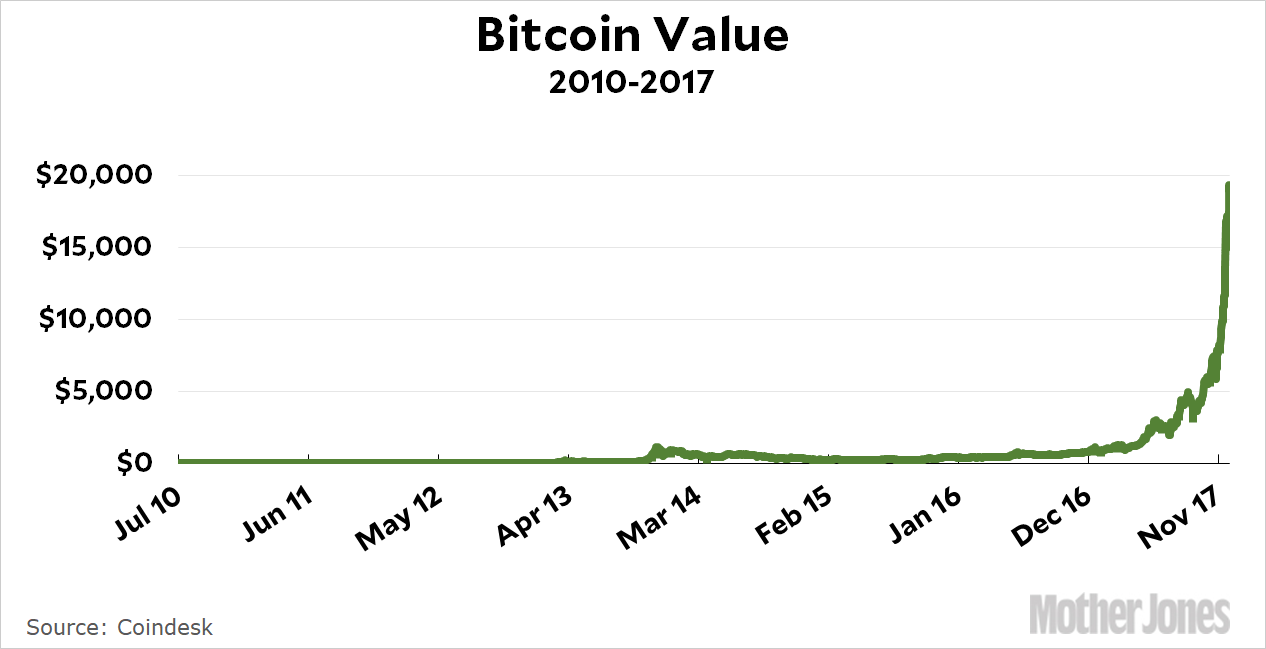
    Bitcoin does well on the first three. However, it does poorly on the next four. It is not widely accepted. It has high transaction costs and hasn’t been tested during a financial crisis. No government accepts it for payment of taxes. And as its recent bubble-esque behavior demonstrates, it’s not especially stable:
    Pay particular attention to #6 on the list of moneylike attributes. It’s often said that although the dollar is no longer backed by gold, it’s still a solid currency because it’s backed by the productive capacity of the United States and the integrity of the US government. And that’s true. Ultimately, though, it’s backed by the willingness of the US government to take dollars as payment of taxes. No matter how skeptical you may be of fiat money, you’ll still accept it if you know that, at the very least, you can pay your taxes with it. And if that’s true of you, it’s true of everyone else.

    Unfortunately for Bitcoin, the first three items on this list are the least important. Old Masters fit the bill, for example. Ditto for meteorite fragments and dinosaur fossils. It’s the last four items that are really key attributes of money, and Bitcoin isn’t anywhere close to satisfying any of them.

    For now, Bitcoin is just a commodity, like tulips or Tokyo real estate, and not even a very good one. At least tulips are pretty to look at. So if you feel like taking a flyer on it, go right ahead as long as you’re using money you can afford to lose. Just don’t do it because you think it’s going to replace dollars or euros anytime soon.

    ¹Chocolate, for example, would be a poor form of money because we would just eat it all. Ditto for salt, which has been a form of money in some civilizations—though not a very good one. The best money is something that has no particular value other than being money.
  • Here’s Why Republicans Are Hellbent on Passing an Unpopular Tax Bill

    The Republican tax bill is massively unpopular. It polls at about 30 percent approval—the worst showing of any major bill in recent history—and doesn’t crack 50 percent even among Republicans. And yet, the GOP leadership is hellbent on passing it. What’s going on?

    Bear with me for a bit. I have an idea of what’s going on, but it’s the endpoint of a story. Here it is.

    Beginning in the mid-60s, the Republican and Democratic parties consciously chose opposing long-term strategies. Democrats became the party of the marginalized, defining themselves in terms of civil rights, immigration, social justice, feminism, gay rights, and so forth. Republicans chose to become the party of whites and the party of the Bible Belt.

    At first, this was mostly a matter of policy choices. Republicans opposed things like school busing and affirmative action and supported private schools. As those things gradually lost salience, they reached out for other, more process-oriented ways of leveraging the white vote. In the 90s it was pack and crack, which shoved black voters into a small number of congressional districts, leaving more white districts for Republicans to pick up. Karl Rove moved the ball forward with more sophisticated ways of driving white evangelical turnout. Fox News amped up its coverage of things like illegal immigration and black crime.

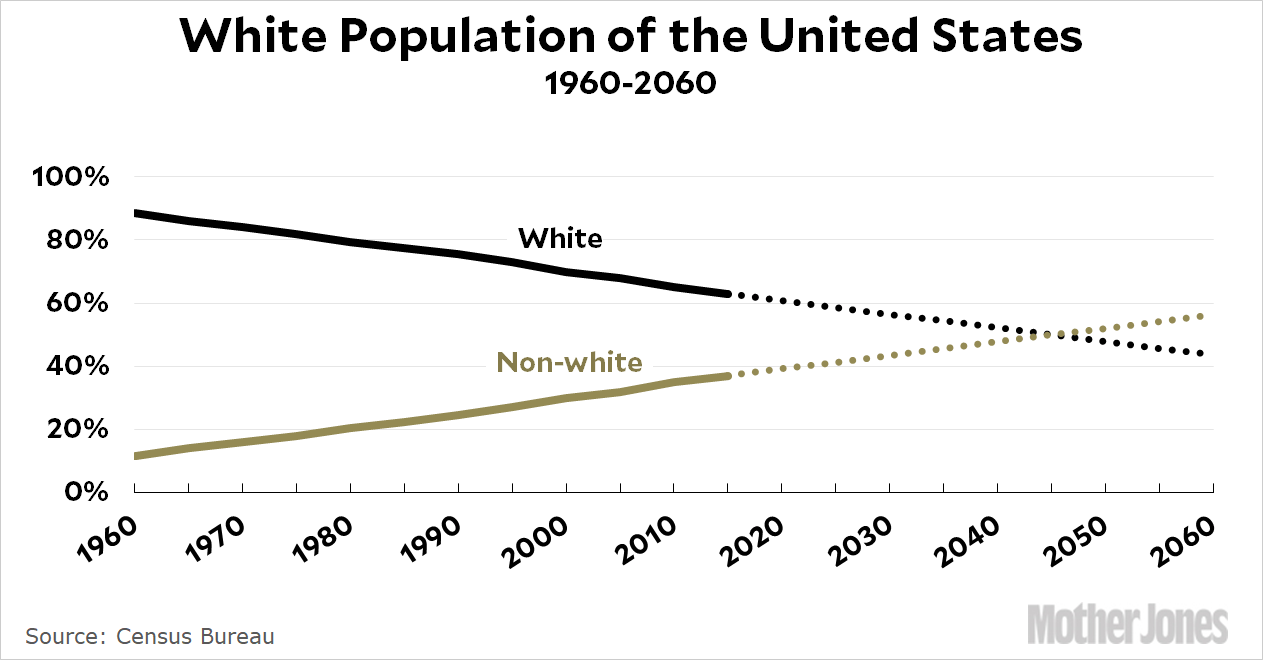
    Over time, the returns from these strategies became smaller and smaller. The white share of the population wasn’t growing, so Republicans became desperate to pick up every possible crumb. Photo ID laws became a big push in the late aughts even though it’s unlikely they affected the vote by more than a percent or so. The post-2010 gerrymandering efforts were good for a dozen seats in Congress. The party got tougher on immigration. Republicans on the Supreme Court gutted the Voting Rights Act. But finally there was little left to do. They lost to a black man in two straight elections, and the 2012 post-election autopsy made it clear that Republicans needed to attract more of the non-white vote. This was based on some simple but brutal arithmetic: There was a limit to how much turnout they could squeeze from the dwindling share of white voters, and that meant they had to reach out to minorities, pass comprehensive immigration reform, and dial down the anti-gay rhetoric.

    Republicans aren’t idiots. They can read a demographic report as well as anyone. They know their white base is shrinking and they know they’ve reached a critical point. The problem is that remaking their party is a long-term project, and while it’s happening they’re going to lose elections. It will take years to regain the trust of communities of color, and efforts to do so will alienate the whites who support them today. They could be in the wilderness a long time while this project is ongoing.

    And so it never got off the ground. It was just too hard. It looked more and more as if Republicans would shamble slowly into minority party status for a long time as they struggled to remake themselves.

    But then a miracle happened. Donald Trump pushed the envelope further than even the hardest-core Republican had dared in decades, appealing all but openly to white voters and shamelessly demonizing minorities. The Republican establishment didn’t support him initially, but he gained the nomination anyway so they made their peace. And he won. And Republicans won the Senate. And they held onto the House. Against all odds, they controlled the entire federal government.

    But again: Republicans aren’t idiots. They recognize just how unlikely this victory was and they know it won’t repeat itself. Demographic trends won’t slow down and midterm elections always go against the party in power anyway. They’re probably going to lose unified control of the government in 2018, and even if they hang on they won’t make it past 2020. This is their last chance to control the levers of power, quite possibly for a decade or two.

    That’s why they’re pushing an unpopular tax bill. That’s why they’re focused like a laser on confirming judges. That’s why they might even take on entitlement reform. They’re going to lose power shortly no matter what they do, so they’re trying to put their stamp on the future while they still have the chance.

  • Friday Cat Blogging and Year-End Fundraising – 15 December 2017

    As usual around this time of year, our fundraising team reached out¹ and asked that I put up a post asking you to support Mother Jones with a year-end donation.

    You know the drill: as a nonprofit, Mother Jones wouldn’t exist without readers who value what we do, and pitch in from time to time to support it. Here’s the official case for our December pledge drive from our CEO, Monika, who calls the combination of economic and political threats to the media a perfect storm for the survival of investigative journalism:

    But there’s a lot more. (One of the documents I update on sleepless nights is a list of current threats to journalism and journalists—it now runs to six pages and counting.) But here’s the bottom line: Unprecedented economic problems for media, or unprecedented political attacks on journalism, would be bad enough on their own. But both at once—that’s a synergy so unusual and dangerous that we haven’t even begun to grapple with its implications.

    ….Yes, the New York Times and the Washington Post have been hitting it out of the park—but the vast majority of newsrooms are unable to follow suit. And how long will the likes of Jeff Bezos be willing to subsidize accountability journalism? We need a different model. And as MoJo readers like you know, we’ve placed our bets on an admittedly radical idea: that journalism is a public service, not a profit center, and that its survival rests with the people it serves. You.

    Give the whole thing a read. Or, just go straight to our donation page and join us with a tax-deductible donation so we can hit our stretch goal of $350,000 by the end of the month. The hot ticket is a monthly donation if you can swing it. And maybe if we make our goal, I can persuade Monika to share her six-page list!

    By the way, I checked with Hilbert and as you can see, he approves this message.

    ¹Translation: Brian sent me an email.

  • Lunchtime Photo

    This is Skellig Michael, aka Ahch-To, home of Luke Skywalker ever since he became disillusioned with the Jedi. Today we get to find out what the deal is with that.

    I also have some extremely rare footage of the Millennium Falcon making its first reconnaissance of the planet. As you can see, the Force initially misled Rey into circling around Little Skellig, which is mostly home to lots of gannets and lots of bird poop. It’s only after realizing her mistake that she headed back toward the right island. However, this scene was suppressed because Jedi try to keep it a secret that the Force likes to play practical jokes once in a while.

  • Alabama’s White Voters Abandoned Roy Moore in Large Numbers

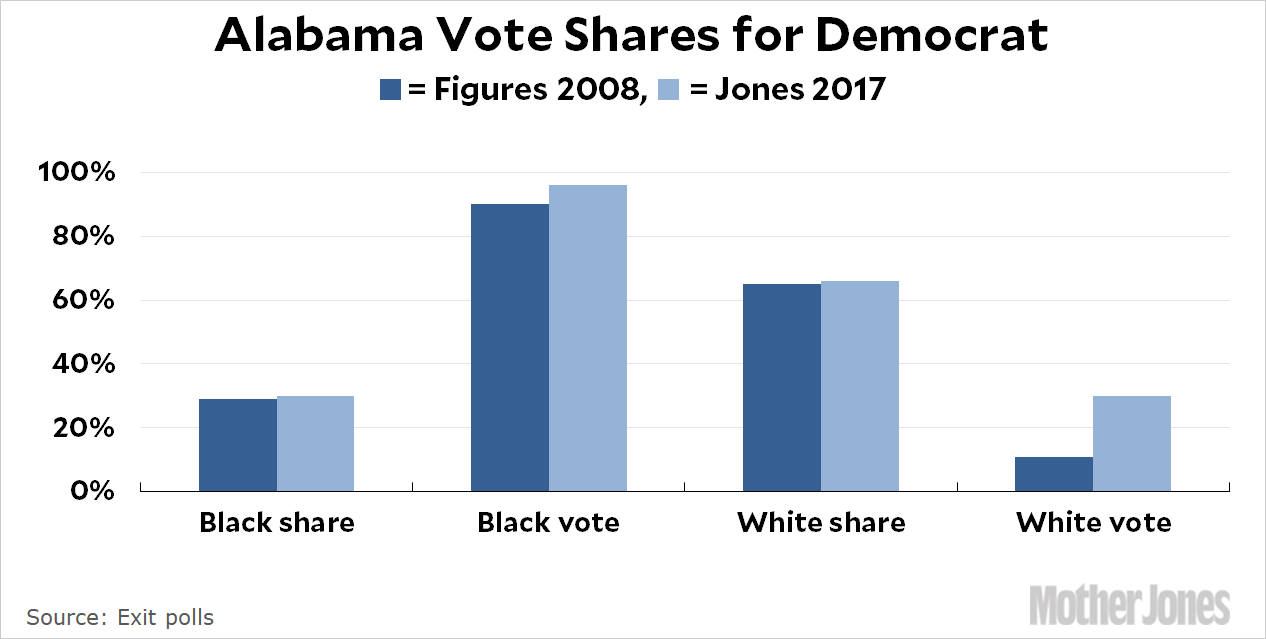
    I’m curious about something, but first a caveat: data from exit polls isn’t always perfect. However, more reliable data from the ACS and ANES surveys aren’t available yet for the 2017 vote in Alabama. And that’s not all: exit polls aren’t even available for Alabama every year, since everyone knows who’s going to win there and it hardly seems worth it. Still, exit polls are all we have right now, and we do have exit polls from both the 2008 and 2017 Senate races:

    There’s not much change except in one category: a whole lot of white voters who voted for Republican Jeff Sessions in 2008 decided to vote for Democrat Doug Jones in 2017.

    Obviously Barack Obama was also on the ballot in 2008, and that makes a difference. At the same time, there doesn’t seem to be anything all that special about either black turnout or the huge share of the vote they gave Jones (98 percent vs. 90 percent for Vivian Davis Figures in 2008). The biggest difference appears to be in the large number of white voters who apparently couldn’t bring themselves to vote for Roy Moore and voted instead for the Democrat (30 percent vs. 11 percent for Figures in 2008).

    Am I missing something here?

  • Lots of Poor School Districts Do Pretty Well, But We Don’t Know Why

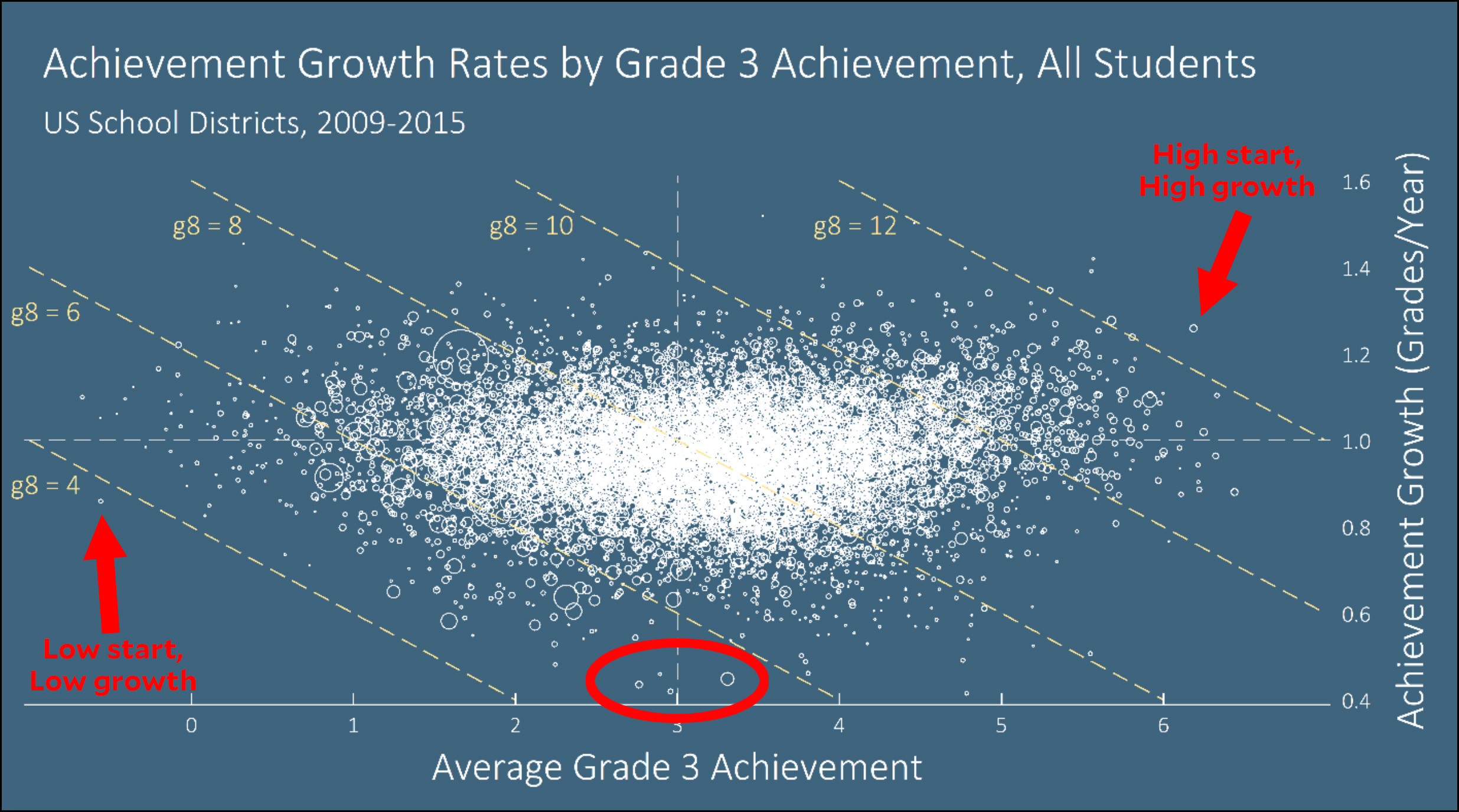
    As we all know, some schools are better than others, and some neighborhoods have smarter kids than others. Here’s a chart that puts these two things together in a way that’s pretty dramatic once you stare at it for a while:

    Take a look at the two school districts I highlighted. On the left, third-grade students are performing at a kindergarten level. On the right, third-graders are performing at a sixth grade level. That’s an enormous difference, but not necessarily one that you can blame on schools.

    But that’s not all. The vertical axis shows progress from third through eighth grade, which is more plausibly related to school performance. In the school district on the left, kids gain only about 0.8 years of achievement for each year of schooling. In other words, they fall even further behind. On the right, kids gain 1.2 years of achievement per year of school. By the time they’re both in eighth grade, one group of kids is performing at a fourth grade level while the other is performing like high school seniors.

    Alternatively, take a look at the schools that I’ve circled. Third-graders are performing at third-grade level, so that’s fine. But then they fall off a cliff. Over the next five years they gain only about 0.4 years of achievement per year of school. By eighth grade they’re performing at the level of fifth graders. They’ve made barely any progress at all.

    Obviously not all of this is the fault of the school districts. But surely some of it is, and it’s a national disgrace that the differences are so stark. However, what’s really striking about this chart is how random it is: third-grade performance is almost completely unconnected to growth between third and eighth grades. And it’s only weakly correlated with the income level of a school district.

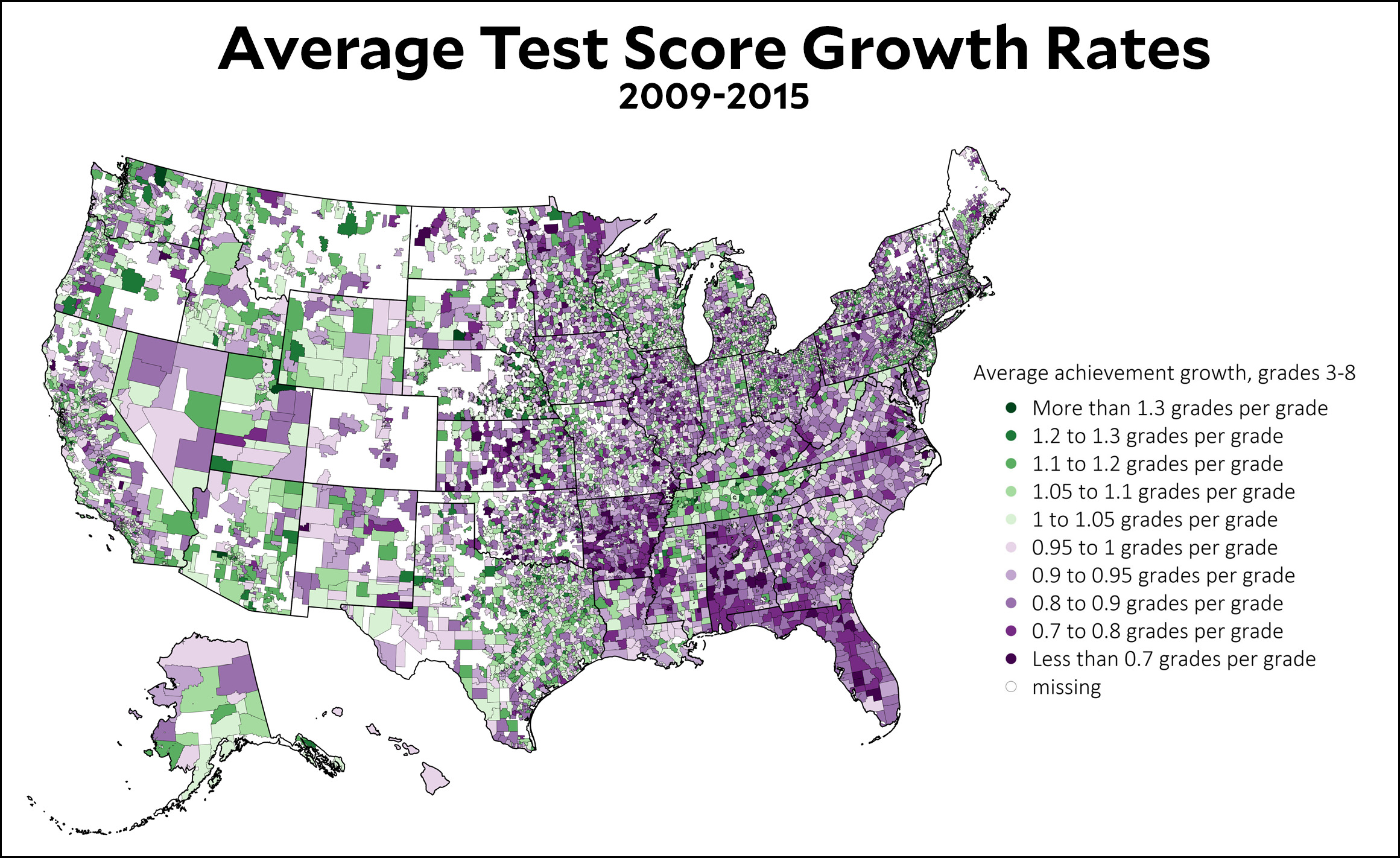
    So which school districts do the best at taking third-graders and turning them into eighth graders? Here’s a map:

    A few things jump out at you:

    • The South does really badly.
    • Florida is an almost insane basket case.
    • Tennessee is a green oasis in the middle of a desert of purple. Someone should figure out what they’re doing right.
    • There are plenty of big-city school districts that also perform strongly. Chicago is bright green. Seattle does well. New Orleans does well. Conversely, Baltimore, Los Angeles, and Atlanta all start off poorly and continue to do poorly between third and eighth grades.

    This all comes from Stanford’s Center for Education Policy Analysis. Sean Reardon has a paper discussing these results here, and he concludes with this:

    What may be surprising, however, is…the fact that these growth opportunities are at best weakly correlated with early opportunities and with socioeconomic status.

    In other words, third-grade scores are probably strongly influenced by poverty and home life, while growth from third to eighth grade is probably more influenced by the quality of schooling. They have little to do with each other:

    Growth rates better isolate the contribution to learning due to experiences during the schooling years. Grade 3 average scores are likely much more strongly influenced by early childhood experiences than the growth rates….Some caution is warranted in interpreting the average growth rates as pure measures of school effectiveness. Nonetheless, relative to average test scores (at grade 3 or any grade), the growth rates are closer to a measure of school effectiveness.

    If we take the growth rates, then, as rough measures of school effectiveness, then neither socioeconomic conditions nor average test scores are very informative about school district effectiveness. Many districts with high average test scores have low growth rates, and vice versa. And many low-income districts have above average growth rates. This finding calls into question the use of average test scores as an accountability tool or a way of evaluating schools.

    And finally, this:

    The findings also suggest that we could learn a great deal about reducing educational inequality from the low-SES communities with high growth rates. They provide, at a minimum, an existence proof of the possibility that even schools in high-poverty communities can be effective. Now the challenge is to learn what conditions make that possible and how we can foster the same conditions everywhere.

    More research, please.

  • Republicans Cave to Marco Rubio

    Tom Williams/Congressional Quarterly/Newscom via ZUMA

    It looks like Marco Rubio is getting his wish. Thanks to his threat to vote against the tax bill, negotiators are increasing the refundability of the child tax credit:

    Taxpayers without income-tax liability will be able to get $1,400 of the $2,000 per-child credit, said Rep. Kristi Noem (R., S.D.), one of the members of the House-Senate negotiating committee. That’s up from $1,100 in the version that passed the Senate.

    Of course, now they have to pay for it, perhaps by having the individual tax cuts expire in 2024 instead of 2025. If that’s what happens, then Rubio will have gotten an extra $300 for six years ($1,800) at the cost of losing the whole thing a year earlier ($1,100). That’s a net gain of $700, or $100 per year. Yippee.

  • The Justice Department Owes Us Answers About Those Texts They Released

    Richard Ellis via ZUMA

    We all know that FBI agent Peter Strzok and FBI lawyer Lisa Page don’t think much of Donald Trump. This is because the Justice Department, for reasons they still haven’t explained, decided to release a whole bunch of private texts they sent to each other during the 2016 campaign season. Republicans have been making endless hay of this to argue that it contaminates the entire Mueller investigation.

    But was it only Trump the pair disdained? Not at all. The Wall Street Journal’s Del Quentin Wilber has done us all the favor of reading through the texts and highlighting the ones that refer to politicians. It turns out that Strzok and Page, like many of us, pretty much hate them all. Here they are in alphabetical order:

    Congress: “i LOATHE congress.”
    John Kasich: “He’s the only sensible man up there.”
    Mitch McConnell: “always reminds me of a turtle.”
    Martin O’Malley: “is a freakshow.”
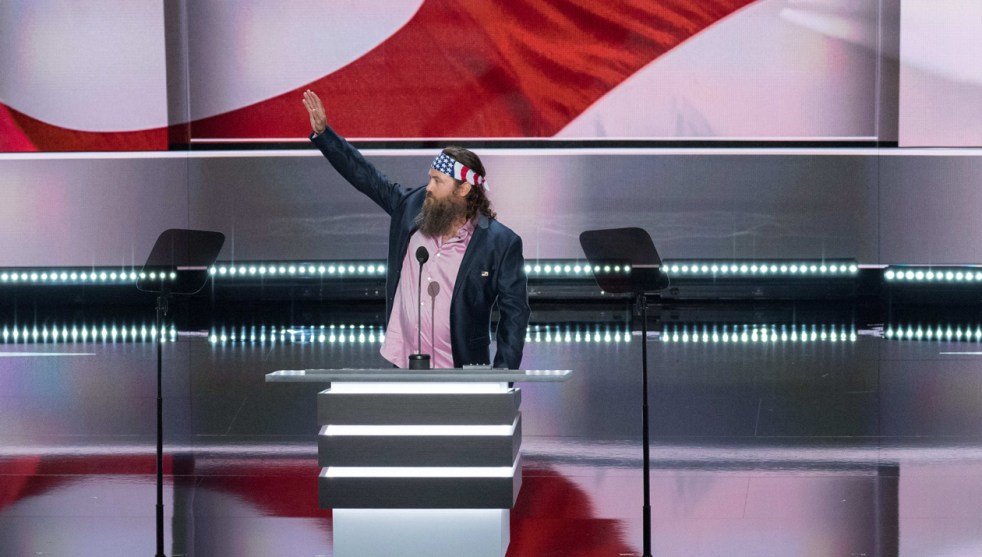
    The Republican convention: “Duck Dynasty now Scott Baio? Ridiculous.” “Charles in Charge?! That’s the best they can do?! Lmfao.”
    Bernie Sanders: “Made me want to key the car.” “He’s an idiot like Trump.”
    Jeff Sessions: “My god.” “Which is the f-ed uppedness of it.”
    Roger Stone: “is horrible.”
    Donald Trump: “OMG he’s an idiot.” “Trump is a fucking idiot.”

    In other words, they’d watch the debates and dump on everyone, a scene repeated in millions of households all over the country. The only difference is that most of us get to keep our cynical remarks to ourselves.

    I’m sure glad I don’t work for someone who can decide to release all my texts to the public just for the hell of it. The Justice Department really owes us all an explanation of who decided to release these texts and why it was done in this case.

    UPDATE: It was someone in the Justice Department who released the text messages, not the FBI. I’ve corrected the text.