
BBC
- Who
- Kildare
- Doom
- McCoy
- Demento
- No
- Strangelove
- Phil
- Dolittle
- Spock

BBC
I finally did it. I got a review copy of a book a few weeks ago and started reading it on Monday. After 50 pages I decided I wanted to read the whole thing, but the experience of reading an actual physical book was so annoying that I went ahead and bought an e-copy. That’s $14 to buy a book I already owned. I am officially a hopeless tablet junkie now.
What happens when you plant a cat in a pot? It ripens! Ours went from light gray to deep black, and is now ready for picking from the cat bush.
As you can guess, what really happened is what always happens. Hilbert saw Hopper in the pot, and suddenly decided he wanted to be in the pot. So he wandered over, circled around, and eventually Hopper left for sunnier climes. Then the pot was all his.

Earlier this year from the Wall Street Journal:
Overall crime fell to an all-time low in Long Island’s Suffolk County last year….The 19,877 crime incidents reported in 2016 were down 5.7% from the previous year’s 21,076 crime incidents and represented the fewest since the department began tracking them in 1975….Violent-crime incidents, including murder, rape, robbery and aggravated assault, fell by 10.9%.
Crime in Long Island’s Nassau County fell to its lowest level in at least 50 years, according to statistics released Thursday….The Nassau County Police Department said the 26,153 crime incidents reported in 2016 were down nearly 2% from the previous year. Major-crime incidents, including murder, rape, robbery and assault, fell 9%.
And here is Donald Trump today speaking in Long Island:
Peaceful Long Island neighborhoods have become “blood-stained killing fields,” says @POTUS. “They’re animals.” pic.twitter.com/IJPbfWAfqj
— Steve Herman (@W7VOA) July 28, 2017
I’m all in favor of taking down the MS-13 gang, although this is something that’s been a priority for many years already. But no, despite the presence of MS-13 on Long Island, it’s not a blood-stained killing field. In fact, it’s a pretty safe place that can boast of an all-time low crime rate. Trump, as usual, is just being Trump.
Inspired by this, here’s an interesting chart:
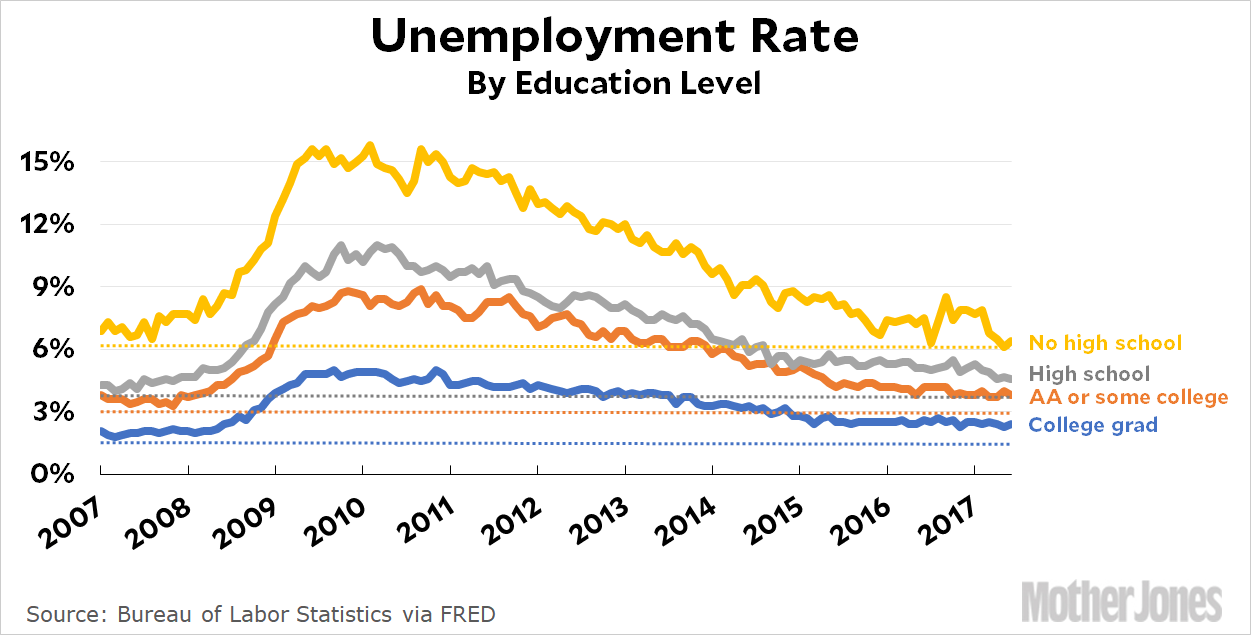
This shows the unemployment rate by education level starting at its low point in 2007 and going through today. For high school dropouts, unemployment is now the same as it was at the top of the housing boom. However, unemployment for everyone else is still about half a point higher than it was in 2007. This suggests that despite the headline unemployment rate being at its 2007 low, there’s still some labor slack in the system.
So how is it that the headline number is the same as it was in 2007 but its constituent parts are higher? It’s all about demographics and disaggregation. There are more college grads and high school grads than there were ten years ago, and they bring down the overall number. However, if you disaggregate, you find that we still have a little ways to go before we truly reach 2007 levels. If you’re interested, there’s more about how disaggregation works here.
I don’t imagine this will make Mitch McConnell feel any better, but McCain, Murkowski, and Collins didn’t kill health care reform. They just put it out of its misery a little sooner so the Senate could move on to other things.
If the skinny repeal bill had passed, the Senate would have spent the next month or two in negotiations with the House. I doubt they could have come up with anything that met the parliamentarian’s requirements and was still acceptable to the House, but maybe they could have. If they did, the result would have inevitably been even more horrendous than the bill that had already failed 43-57. There’s virtually no chance a conference bill could have passed the full Senate.
The last week has made it clear that Obamacare repeal was doomed. John McCain probably understood that and did McConnell a favor by killing it now. I don’t imagine McConnell sees it that way, though.
Atrios channels a common liberal complaint about Obamacare:
I was too pessimistic about Obamacare. The Medicaid expansion — despite Roberts and the evil Republican governors — was very good. The insurance regulations that applied across the board (coverage, pre-existing conditions, etc.) were very good. The exchanges still suck — private insurance is very expensive and not so fun to have and the subsidies are not generous enough and the magic competition doesn’t exist and poor people really wish they were just a bit more poor so they could get that sweet sweet medicaid — but for many people barely affordable shitty insurance is preferable to no insurance at all.
I don’t want to pretend that the exchanges are wonderful. They started off with a crash (remember that?). The subsidies fade out at too low an income. In some areas there aren’t many providers. The website can be difficult to navigate. The low metal levels have deductibles and copays that are too high.
And yet, this still deserves some pushback: Exchanges account for half of Obamacare. Roughly speaking, Medicaid expansion covers about 10 million people and the exchanges cover about 10 million people. At low incomes, the cost of insurance is extremely modest. For the poor, silver plans with CSR subsidies cover about 90 percent of medical expenses, which makes them more generous than most of the single-payer systems we admire so much in the rest of the world. The average subsidized cost of insurance on the exchanges is probably similar to what people in other countries pay in taxes for their universal systems, and the income limits on premiums prevent most people from suffering sticker shock when insurance carriers raise prices. Navigators help people choose the best coverage in their region.
Is it perfect? Nope. Does it suck? Nope. Overall, it’s pretty good. Sure, I’d prefer something simpler, but given the realities of the American health care system, private insurance is what we have to work with. If politics is the art of the possible, Obamacare does a pretty damn good job of delivering what’s possible.
Unfortunately, it turns out there is one fatal problem with the exchanges: they can be sabotaged pretty easily by Republicans. Doing this is so unnecessarily cruel to the poor and working class that I can hardly blame Democrats for not foreseeing this problem, but there you have it. Sabotaging Medicaid is hard, but sabotaging the exchanges is easy. And Republicans have given every indication that this is exactly what they plan to do. Their bitterness over a successful law that helps 20 million people is seemingly without bounds.
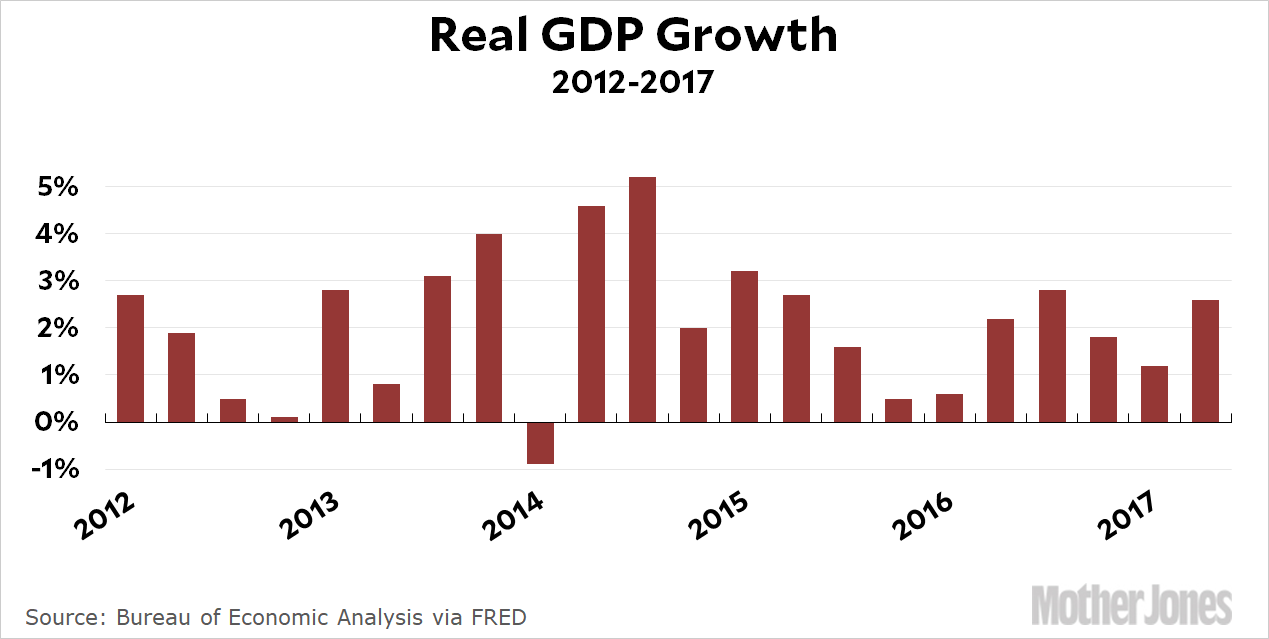
The economy grew 2.6 percent in the second quarter of 2017, slightly better than the average of 2.1 percent over the past four years. Federal expenditures contributed more than usual, especially increases in defense spending. Overall, however, there’s not much of a story here. It’s a decent reading, but the big picture is that the American economy continues to do OK, but not great.
The Senate has voted down the skinny repeal bill. John McCain joined Susan Collins and Lisa Murkowski as no votes, and the bill went down 49-51.
So now what? I’m not sure anyone knows. Maybe yet another bill? That doesn’t seem likely. Most likely, Obamacare repeal is dead and it’s now time to begin Operation Sabotage. One way or another, Republicans are hellbent on taking health coverage away from millions and I don’t think anything is going to stop them.
UPDATE: Mitch McConnell has just delivered a bitter speech, declaring that it’s “time to move on.” It doesn’t sound like he has any stomach for another go-round on health care. Next up are budget bills and tax reform.
Diet health care is here! The New York Times reports that Mitch McConnell has finally released his “skinny repeal” bill, and it has six provisions:
What’s the deal here? Didn’t the Senate parliamentarian already rule that #3 and #6 don’t pass muster in a reconciliation bill and can’t be included? What am I missing? Is there some small change in wording that makes the “skinny repeal” versions of these things more directly related to taxes and spending?
Also, is this revenue neutral? #4 and #5 cost money. #3 and #6 do nothing. So are they assuming that repealing the mandates will save money? It certainly reduces the number of people who will buy insurance, which means that federal subsidies go down. On the other hand, repealing the mandates also causes premiums to go up for everyone else, which means that federal subsidies are increased. Do we know how that pencils out? Can this bill be passed without a CBO score to clear this up?
Nothing matters, I guess. Maybe tonight’s vote is, yet again, “procedural.” If so—and I can’t quite get a straight answer about that—I guess they can put anything they want in the bill. Except for one thing: several senators are worried that if this passes, the House might double-cross them. Instead of using it as a placeholder for negotiation, they might just vote on the thing and pass it into law. Paul Ryan could have cleared this up with a definitive statement this afternoon, but instead he delivered a waffly statement. There’s no honor among Republicans, I guess.

Award-winning photojournalism.
Stunning video. Fearless conversations.


