• Doug Jones Will Be the Most Liberal Senator From Alabama in Recent History

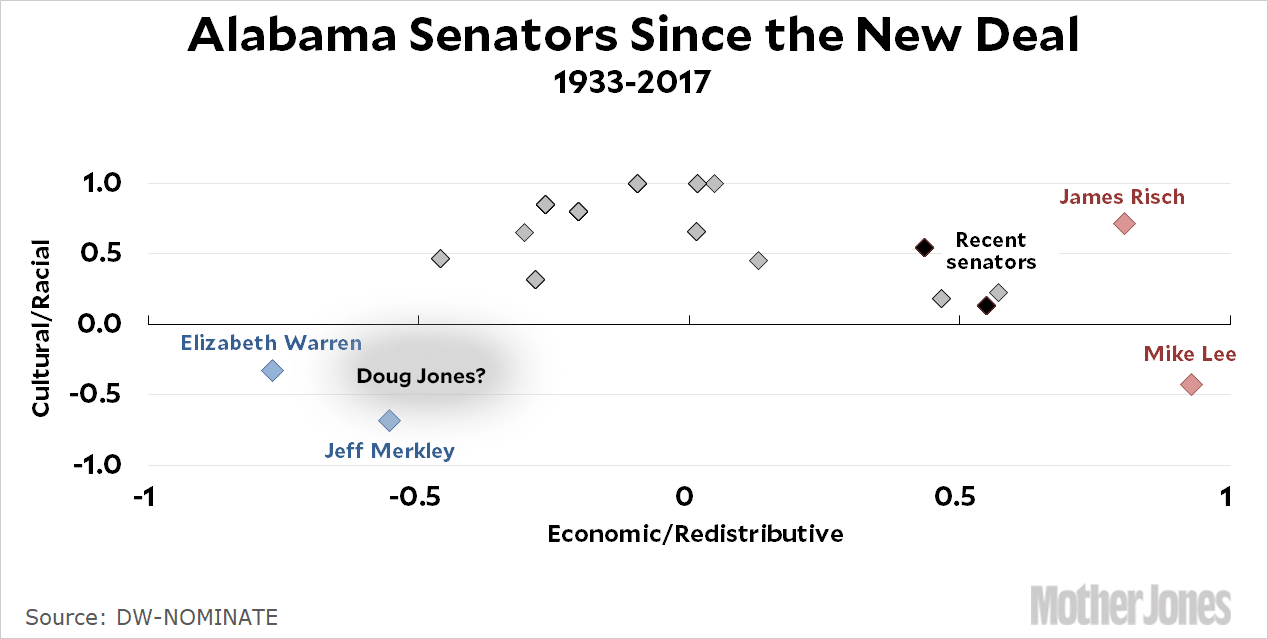
    I guess you can file this under “too much free time on my hands.” But I was curious: will Doug Jones be not just the first Democratic Senator from Alabama since 1992, but the most liberal Alabama senator in recent history? Based on scores from DW-NOMINATE, the answer is almost certainly yes:

    Negative numbers are liberal, so Elizabeth Warren and Jeff Merkley give an idea of the current far-left pole of the Democratic Party, while Mike Lee and James Risch are at the far-right pole of the Republican Party. Doug Jones will clearly be the most culturally liberal senator from Alabama since the New Deal, and depending on how he compares to Hugo Black, the most economically liberal too.

    By the way, if DW-NOMINATE scores are to be believed, Jeff Sessions (the lower black diamond) was the previous record-holder for most culturally liberal senator from Alabama in recent history. Interesting, no?

  • Middle-Class Tax Cuts Keep Getting Paltrier in Republican Bill

    Remember how the Senate version of the tax bill didn’t quite pencil out, so they decided to make the individual tax cuts temporary? In 2025, they go bye bye. But it looks like maybe that still didn’t quite do the job:

    Congressional Republicans are looking at shortening the duration of tax cuts that their plan would give to families and individuals, a leading lawmaker said Thursday….Republicans are now considering having those tax cuts expire in 2024.

    Let’s see…divide by pi, carry the one…and it looks like the individual tax cuts will last for only six years. Then they expire so that the corporate tax cuts can be permanent. The pretense that middle-class families will see much benefit from this tax bill is getting thinner every day.

  • Health Care Companies Are Huge Winners From Tax Bill

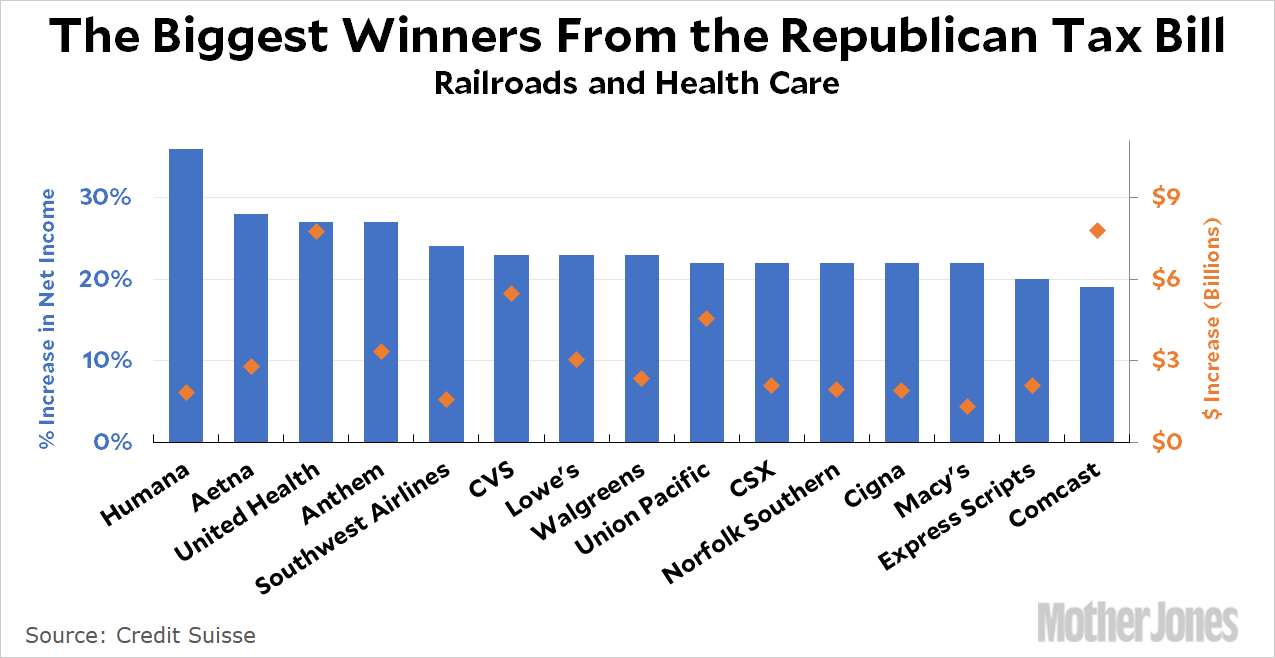
    Bob Herman passes along an estimate from Credit Suisse of the 15 biggest corporate winners from the Republican tax bill:

    The list is dominated by health care companies, which might explain why they’ve been so quiet about Republican efforts to destroy Obamacare. The Obamacare stuff is a pain, but the losses due to Republican meddling and sabotage probably pale compared to the gains from the tax bill. I wonder how much of this tradeoff was made explicit in back rooms and private telephone calls?

  • WaPo: Putin Personally Directed Election Interference

    Aleksey Nikolskyi/Planet Pix via ZUMA

    This is from a Washington Post story about President Trump’s skepticism toward intelligence showing that Russia had interfered with the 2016 election:

    On Jan. 6, two weeks before Trump was sworn in as president, the nation’s top intelligence officials boarded an aircraft at Joint Base Andrews on the outskirts of Washington to travel to New York for one of the most delicate briefings they would deliver in their decades-long careers.

    ….Trump took a seat at one end of a large table, with Vice President-elect Mike Pence at the other. Among the others present were Priebus, Pompeo and designated national security adviser Michael Flynn. Following a rehearsed plan, Clapper functioned as moderator, yielding to Brennan and others on key points in the briefing, which covered the most highly classified information U.S. spy agencies had assembled, including an extraordinary CIA stream of intelligence that had captured Putin’s specific instructions on the operation.

    Is this something we’ve heard before? It’s dropped casually into the story in the 41st paragraph, which suggests the authors didn’t think it was especially important. Maybe I just missed it when it was first reported. But do we really have solid intelligence that shows Vladimir Putin personally directing the various hacks of Democratic email servers?

  • November Retail Sales Were Very Strong

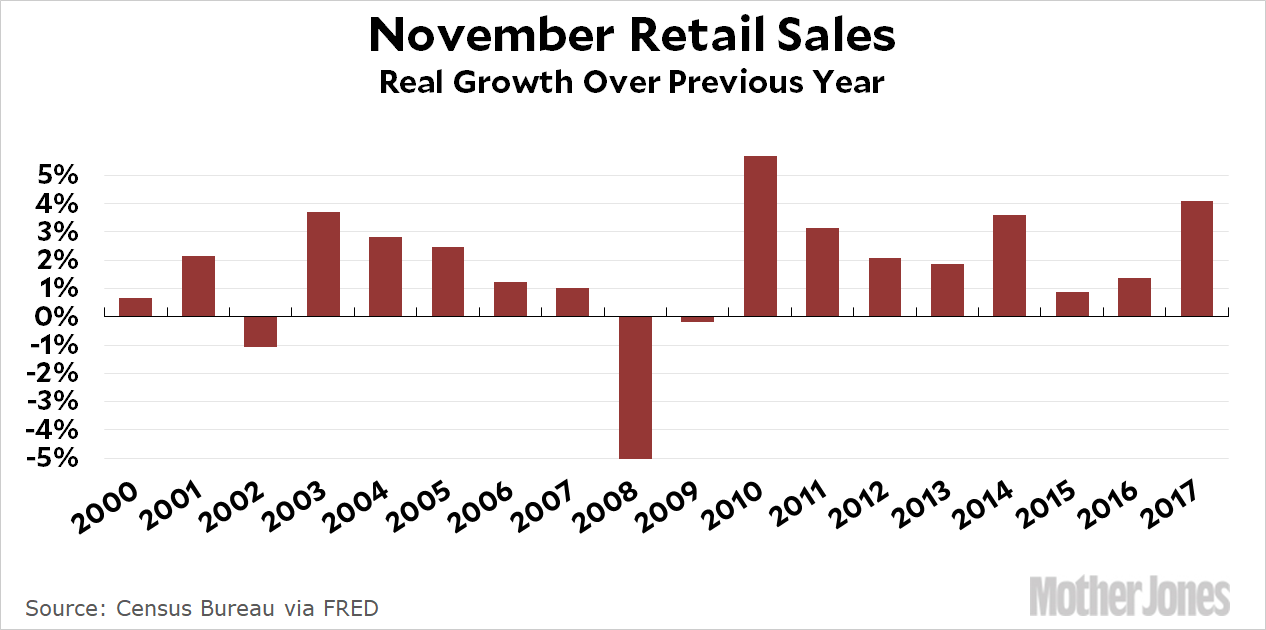
    The Census Bureau announced this morning that retail sales were up strongly in November. However, their numbers don’t account for inflation and don’t provide any context for previous years. So how did we really do?

    Answer: pretty good. Accounting for inflation, November sales were up 4.1 percent over last year. That’s the best showing this century with the exception of 2010, the first expansion year after the Great Recession. And it’s considerably better than the past two years.

    If this is being done out of current income, rather than running up the credit cards, it suggests that the economy is heating up. Considering my fear of a recession in the next year or so, I don’t consider this unalloyed good news, but for everyone else it is.

  • Do Republicans Believe Their Own Lies?

    In early 2010, Republican Scott Brown unexpectedly won a special election for a Senate seat in Massachusetts. Even though this put passage of Obamacare in mortal danger, President Obama urged Congress not to move ahead until Brown had been seated. They didn’t. Now, Democrats are urging Republicans to play equally fair and not move ahead with their tax bill until Doug Jones is seated following his win in the Alabama special election. Donald Trump isn’t buying the comparison:

    A White House official told CNN on Wednesday that the Brown example is different because Democrats passed health care in 2010 using a process that allowed them to do so with only a 50-vote majority — at the time, they had more than 50 Democrats — rendering Brown’s vote less critical.

    The truth is just the opposite. The Senate passed Obamacare under regular order, which meant Democrats needed 60 votes to overcome Republican filibusters. With the election of Brown, their majority was reduced to 59 votes, which means that Brown’s election was more critical than Jones’s.

    But here’s the question: was this just a garden variety lie, or does the anonymous official really believe what he said? The reason I ask is that Republicans have been telling the story of Democrats “jamming” Obamacare down their throats using tricky parliamentary procedures for so long that, as near as I can tell, most of them believe it these days. Even though it was only seven years ago, this story has been repeated so often they’ve literally forgotten that it’s not true. But it’s not. After Obamacare was passed normally by both House and Senate, it was only a small “sidecar” that was added under reconciliation procedures that required 50 votes. But the sidecar was optional. Even without it, the vast bulk of Obamacare had already passed.

    So: was the White House flack lying, or is he just another Republican who’s come to sincerely believe his own lies? Hard to say. So here’s another question: Why would CNN pass this quote along without explaining that it’s wrong? That’s also hard to say.

  • Provisions That Bleed Grad Students and the Sick Are Struck From Final Tax Bill

    Daren Fentiman via ZUMA

    According to the Wall Street Journal, the following items have been left out of the final version of the Republican tax bill:

    • Repeal of the deduction for large medical expenses.
    • Repeal of the tax-free status of graduate-school tuition waivers
    • Repeal of the student-loan interest deduction
    • Repeal of private activity bonds

    The first provision allows people to deduct medical expenses that are greater than 10 percent of their income. The second provision applies to grad students, who aren’t required to pay taxes on the “income” from waived tuition fees. Both benefits will now remain instead of being killed off.

    As far as I know, none of these four ever amounted to much money, so ditching their repeal won’t affect the overall score of the bill. This makes you wonder why they were included in the first place, of course, but for now I guess we can just breathe a sigh of relief that they’re gone.

  • WikiLeaks Go-Between Takes the Fifth

    Over at the mothership, Daniel Friedman reports on the latest in the Trump-Russia saga:

    Randy Credico, a comedian and radio host who Trump adviser Roger Stone claims was his intermediary to WikiLeaks’ Julian Assange, has asserted his Fifth Amendment right ahead of an interview with the House Intelligence Committee that was scheduled for Friday, according to his lawyer.

    ….[Martin] Stolar said he was not aware of anything that Credico has to hide. But for the outspoken Credico, taking the Fifth “is the safest thing,” the attorney said….Stolar said that while Assange, who has been confined to the Ecuadorian Embassy in London since 2012, has called into Credico’s radio show as a guest, Credico wants to protect separate confidential conversations—“stuff that [Assange] didn’t talk about on the air”—that he had with WikiLeaks’ founder.

    ….“If they want to go charge Randy with something, then let them do it, not with his own words,” Stolar said. “I’m not saying he’s a criminal suspect in anything. But that is what the Fifth Amendment is for, to protect against self-incrimination.

    Can I get an attorney to help me out here? I thought the Fifth Amendment could only be invoked on subjects that you genuinely thought might open you up to criminal prosecution. You can’t just invoke it across the board because you’re afraid you might blab something stupid. Nor can you invoke it to “protect confidential conversations.” Nor because it just generally seems like a safe thing to do.

    Do I have this wrong? The House Intelligence Committee, which has released Credico from testifying, seems to be buying Stolar’s explanation pretty casually. What am I missing?

  • New Study Says Climate Change Made Hurricane Harvey a Lot Worse

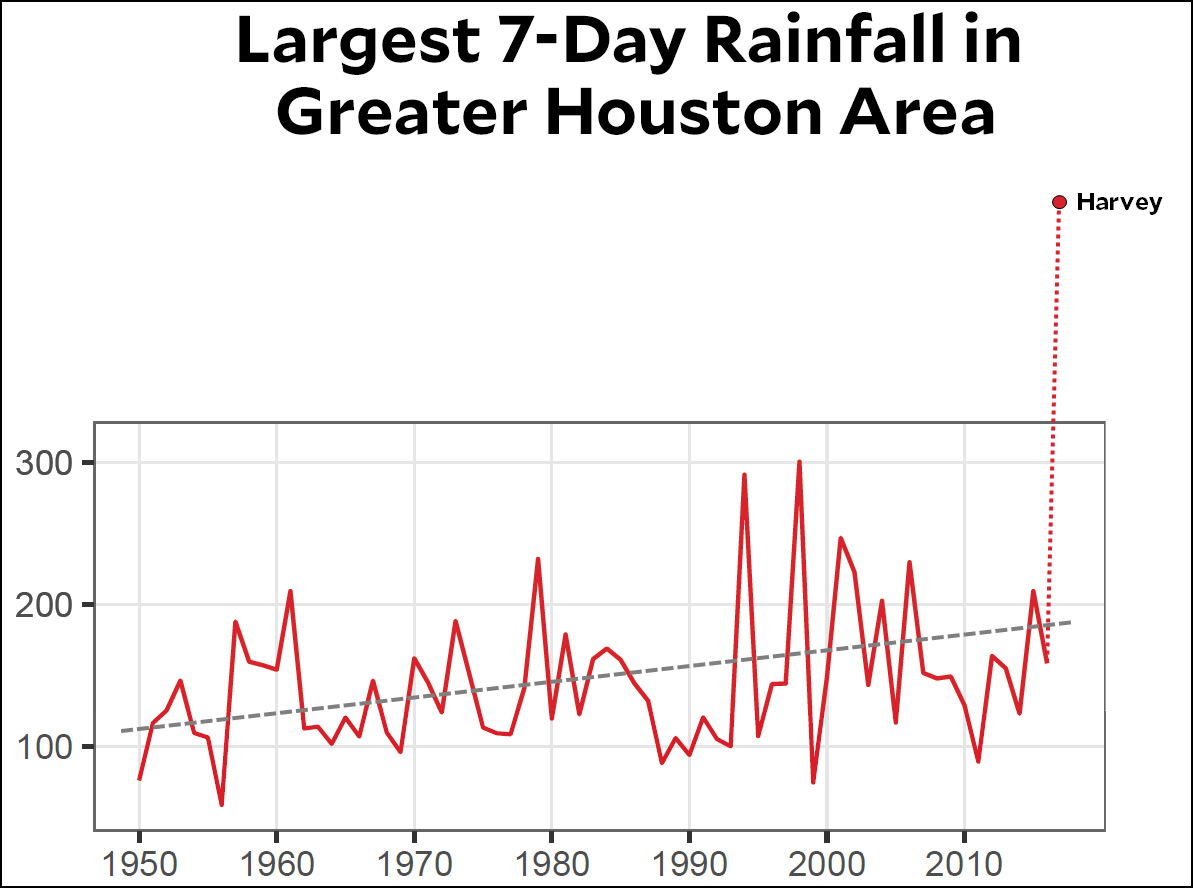
    Spoiler alert: global warming made the destruction of Hurricane Harvey both worse and more likely. In a new paper by Mark Risser and Michael Wehner of Lawrence Berkeley Labs, they first show us the rainfall trend for Houston over the past 70 years:

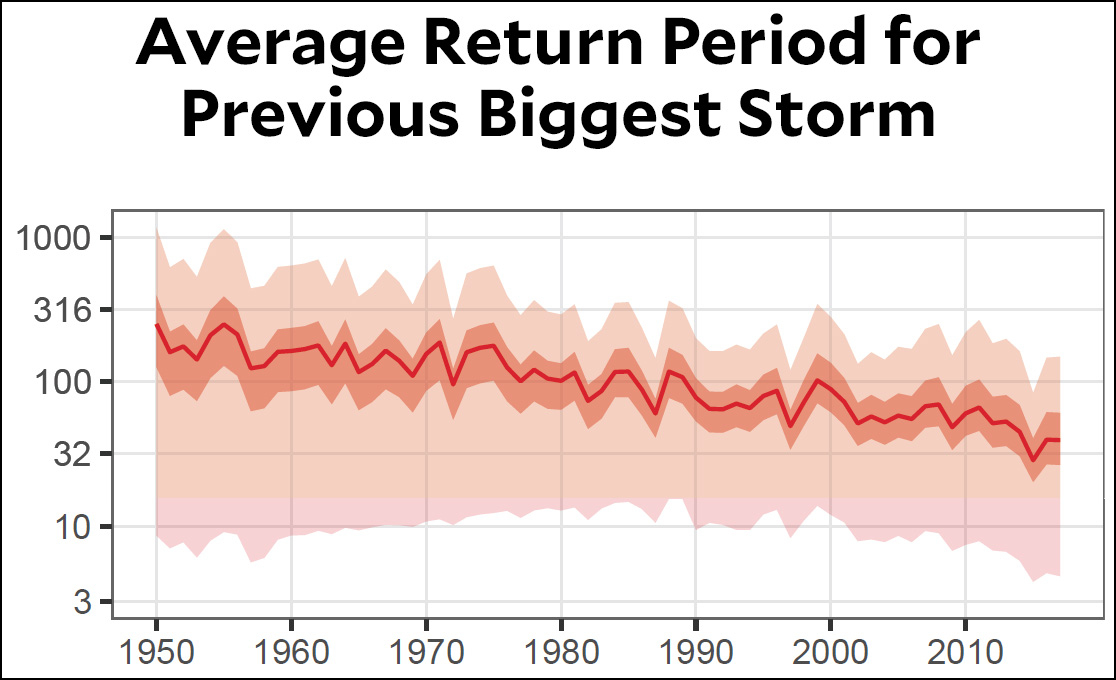
    The upward trend is clear. I’ve added the dashed line showing Hurricane Harvey, which dropped 481 mm of rain over the greater Houston area. Next up, here’s the trend in the likely return period for the previous biggest storm (300 mm):

    In 1950, a storm dropping 300 mm of rain on Houston was likely to occur once every 300 years. By 2016, such storms were expected every 30 years. These trends are partly due to climate change, which leads the authors to this conclusion:

    We find that human-induced climate change likely increased the chances of the observed precipitation accumulations during Hurricane Harvey in the most affected areas of Houston by a factor of at least 3.5. Further, precipitation accumulations in these areas were likely increased by at least 18.8% (best estimate of 37.7%).
    Climate change more than tripled the odds of a huge Harvey-like story hitting Houston, and increased the rainfall by about 38 percent. So can you say that climate change “caused” Harvey? Not quite. But you can say that it probably made it a lot more likely and a lot more damaging.