• Sessions: Trump Never Showed Interest in Russian Hacking

    I have no idea whether Jeff Sessions had any inappropriate contact with Russian officials during the 2016 campaign. My gut tells me there’s probably nothing much here, but then again, my gut has been more like a Magic 8-Ball lately than a crystal ball. So who knows?

    That said, I agree with David Corn that the most telling bit of Sessions’ testimony today was this:

    Sen. Joe Manchin (D-WV) asked about Russian President Vladimir Putin’s covert operation to subvert the 2016 election: “Prior to [the president being inaugurated]—in the campaign up until through the transition—was there ever any meetings that [Trump] showed any concern or consideration or just inquisitive of what the Russians were doing and if they really had done it?”

    Sessions replied, “I don’t recall any such conversation. I’m not sure I understood your question. Maybe I better listen again.”

    ….Manchin continued: “You were part of the national security team, so if [Trump] would’ve heard something about Russia with their capabilities or concern about what they could do to our election process. Was there ever any conversations concerning that whatsoever?”

    Sessions answered, “I don’t recall it.”

    Sessions never heard Trump show any interest in Russian hacking before the inauguration. James Comey never heard Trump show any interest in Russian hacking after the inauguration. If Donald Trump ever showed the slightest interest in a hostile state actor trying to subvert an American election, not a single person seems to remember it.

    I dunno. It sure seems like the kind of thing the president of the United States ought to be upset about. I wonder why Trump isn’t?
  • Health Care Watch, Day 39: GOP Still Hiding From Public

    Jeff Stein explains in a nutshell why Republicans are hellbent on hiding their health care bill from the public:

    As long as Republicans keep everything tightly under wraps, there’s nothing new for reporters to write about. And if there’s nothing new to write about, it won’t get covered.

    This is the same strategy that Donald Trump followed with his tax returns. What are reporters going to do? Write a story every day that tells us Trump still hasn’t released his tax returns? Of course not. So the whole topic disappeared during the campaign except on the rare occasions when something happened to leak out about Trump’s taxes.

    The Senate health care bill will take away insurance from millions. It will slash Medicaid. It will wipe out Obamacare’s promise of coverage for essential benefits. It will gut protections for pre-existing conditions. It will reduce subsidies for the poor and working class. And it will give millionaires a big tax break.

    How do I know this? Technically, I don’t. Like everyone else, I haven’t seen a draft of the bill. I haven’t watched any hearings. I haven’t read a CBO score. I haven’t heard from the Senate parliamentarian about what she plans to allow under reconciliation rules.

    But let’s get serious. I know the bill is going to do these things because it’s a Republican bill. This is what they’ve been promising to do for years. If they had undergone a change of heart, they wouldn’t be keeping their deliberations secret, would they? They’re keeping their bill secret because they know it’s both heartless and massively unpopular, and they want liberals to have as little time as possible to generate any outrage about it. So they’re going to finish the bill, get it on the floor, and vote fast before the working-class public has a chance to realize how badly they’re getting screwed for the benefit of the rich.

    Everyone knows this. It’s shameless. But it’s also working. As long as what Republicans are doing stays off the front page and the nightly news, it’s a win.

  • Jeff Sessions Wants to Crack Down on Medical Marijuana Because….

    Attorney General Jeff Sessions wants to go after medical marijuana suppliers:

    I believe it would be unwise for Congress to restrict the discretion of the Department to fund particular prosecutions, particularly in the midst of an historic drug epidemic and potentially long-term uptick in violent crime. The Department must be in a position to use all laws available to combat the transnational drug organizations and dangerous drug traffickers who threaten American lives.

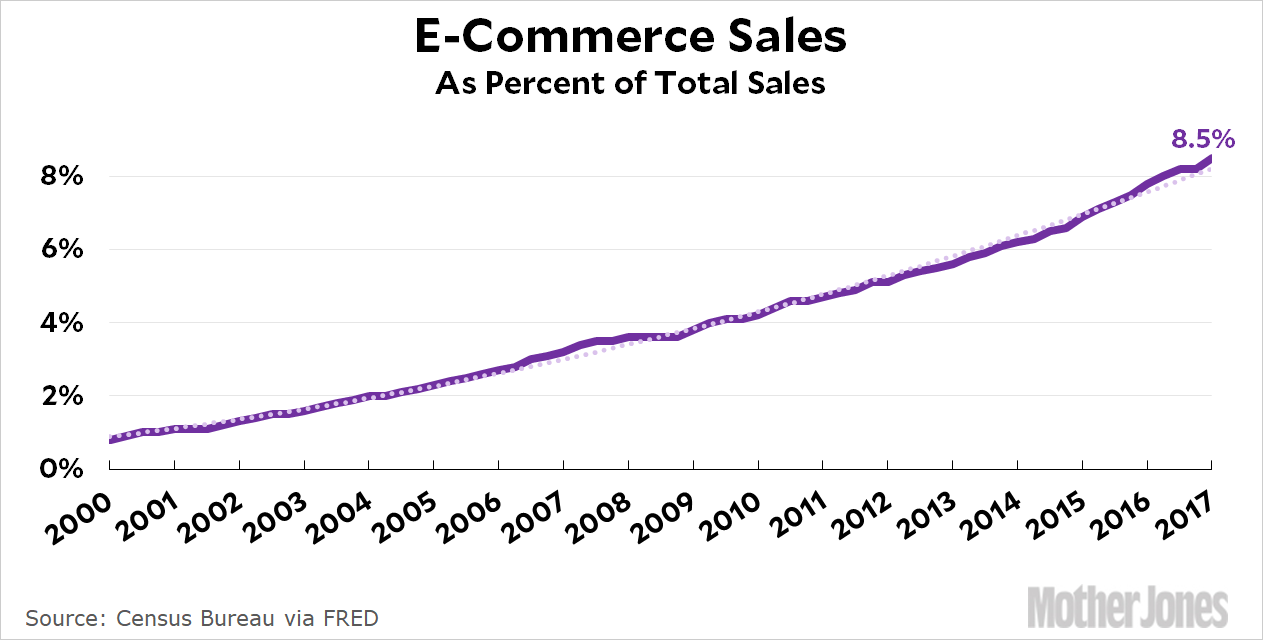
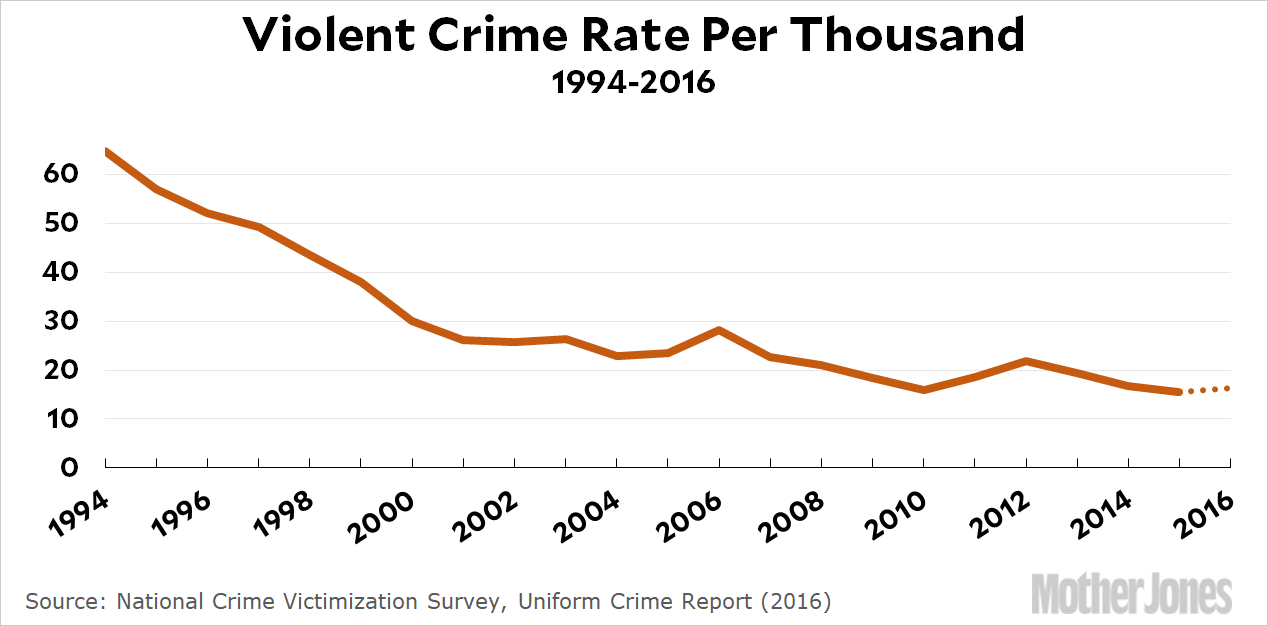
    Uh huh. Let’s check out this “potentially long-term” uptick in violent crime. I’m using numbers from the National Crime Victimization Survey for 1994-2015 (see here for background). The projection for 2016 is based on an increase of 5.3 percent reported by the FBI for the first half of 2016:

    If you think that this plus an opioid epidemic justifies cracking down on medical marijuana, I don’t have anything more for you. This is my best shot. But I’d sure suggest cracking down on drug gangs and opioid manufacturers first.

  • Russian Election Hacking Was Very Serious and Very Widespread

    Alexei Druzhinin/Planet Pix via ZUMA

    A few days ago the Intercept got hold of an NSA document outlining Russian plans to hack directly into voting operations throughout the US:

    Russian General Staff Main Intelligence Directorate actors … executed cyber espionage operations against a named U.S. company in August 2016, evidently to obtain information on elections-related software and hardware solutions. … The actors likely used data obtained from that operation to … launch a voter registration-themed spear-phishing campaign targeting U.S. local government organizations.

    Today Bloomberg reports that this was just the tip of the iceberg:

    Russia’s cyberattack on the U.S. electoral system before Donald Trump’s election was far more widespread than has been publicly revealed, including incursions into voter databases and software systems in almost twice as many states as previously reported.

    In Illinois, investigators found evidence that cyber intruders tried to delete or alter voter data. The hackers accessed software designed to be used by poll workers on Election Day, and in at least one state accessed a campaign finance database. Details of the wave of attacks, in the summer and fall of 2016, were provided by three people with direct knowledge of the U.S. investigation into the matter. In all, the Russian hackers hit systems in a total of 39 states, one of them said.

    ….Such operations need not change votes to be effective. In fact, the Obama administration believed that the Russians were possibly preparing to delete voter registration information or slow vote tallying in order to undermine confidence in the election. That effort went far beyond the carefully timed release of private communications by individuals and parties.

    As we all know, last year the Obama administration tried to promote a bipartisan declaration that voting equipment was “national critical infrastructure,” which would have given the FBI and others more authority to investigate and deter Russian hacking. This failed because Mitch McConnell didn’t care about Russian hacking. He cared only that public acknowledgement of Russian hacking might somehow hurt Republicans. Mitch is quite the patriot, no?

  • Republicans Are Working Hard to Allow Another Financial Crisis

    Last week House Republicans voted unanimously—with one oddball exception—to repeal big swaths of the Dodd-Frank financial reform act. This was, perhaps, not surprising since only six Republicans voted for Dodd-Frank in the first place. Today, the Trump administration weighed in:

    Treasury Secretary Steven T. Mnuchin on Monday proposed sweeping changes to the tough Dodd-Frank regulations put in place after the 2008 financial crisis, including a major reduction in the power of the Consumer Financial Protection Bureau…reducing oversight of large financial institutions, providing even more regulatory relief for smaller banks and loosening new mortgage restrictions designed to prevent a repeat of the subprime meltdown.

    ….“A sensible rebalancing of regulatory principles is warranted in light of the significant improvement in the strength of the financial system and the economy, as well as the benefit of perspective since the Great Recession,” the report said….The report, which included dozens of recommendations, is the first of three ordered by Trump as he looks to fulfill a campaign promise to dismantle the Dodd-Frank Wall Street Reform and Consumer Protection Act.

    Put all this together, and it’s pretty obvious that Dodd-Frank is essentially gone if it all passes. It’s even possible that Wall Street would, on net, end up less regulated than it was before the Great Crash.

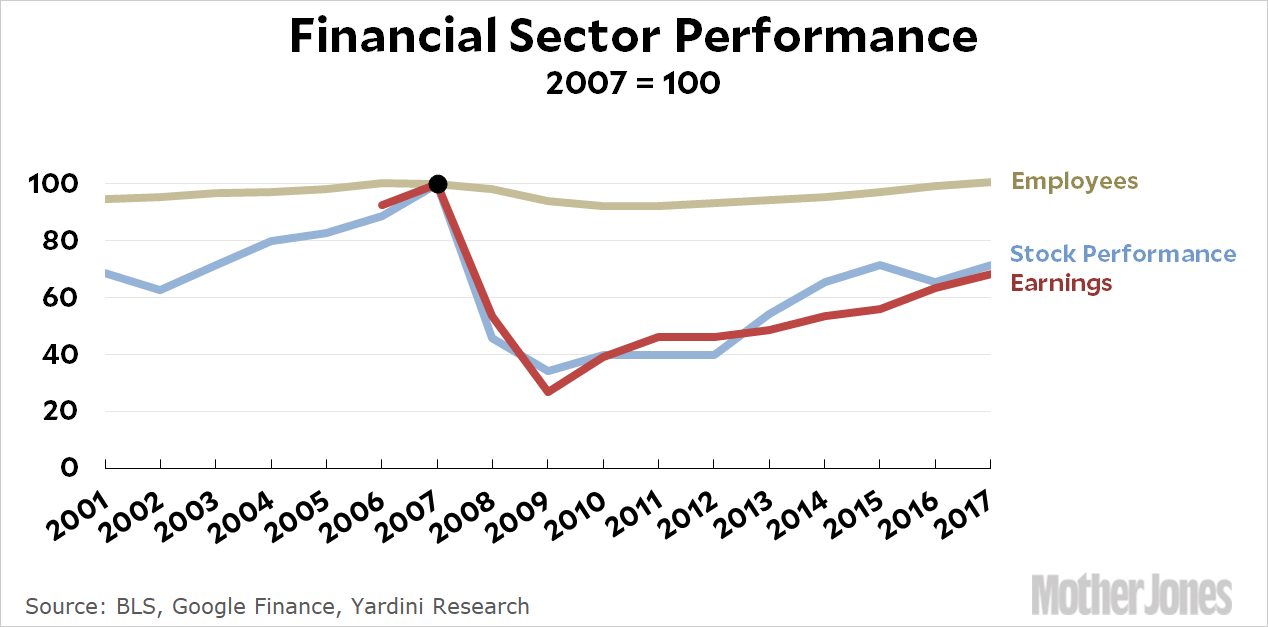
    I don’t expect a serious answer to this, but I have to ask: Do Republicans think any response was warranted to the 2008 financial meltdown? They sure don’t act like it. I mean, Dodd-Frank was hardly a crushing blow to Wall Street. On a variety of measures, financial sector performance is cranking along this year at the very-healthy-but-non-bubble values of 2003:1

    And yet, a mere decade after the Great Crash, Republicans want to repeal pretty much everything we did to prevent 2003 performance from turning into 2007 performance and then 2009 performance. Why? After all, in the long run the Great Crash probably hurt Donald Trump’s working-class supporters more than anyone else.

    There’s no need to answer this. Unless, of course, you’re a conservative with something serious to say.

    1Sources: Employment via Bureau of Labor Statistics; stock performance via Financial Select Sector SPDR Fund via Google Finance; earnings via Yardini Research.

  • In the Future, Will We All Be Geniuses?

    Tiffany Kelly reviews Cory Doctorow’s Walkaway:

    Surprisingly, Doctorow doesn’t see his work as a dystopian novel. In fact, he thinks it’s precisely the opposite. Despite depicting a world that is changed by our own technological advancements and ideologies, Doctorow is optimistic about future generations of humans. Walkaway follows characters who do just that—they walk away from society in search of something better. As the literary world keeps churning out dystopian novels, it’s a relief that they’re not all doom and gloom.

    I guess it’s a matter of taste whether you find Doctorow’s future world dystopian or not. But it’s sure as hell not jetpacks and vacations on Mars. And the inflation rate! Holy cow.

    However, there was one part of the novel that sure was utopian. It was also the part that bugged me the most. As near as I can tell, there’s barely a single character in the entire Walkaway society with an IQ less than 150 or so. OK, maybe 120. How did that happen? What happened to, you know, all the ordinary people? What’s the point of depicting a near-future society where you pretend that the rabble no longer exists and everyone is a genius?

  • Lunchtime Photo

    Congratulations to Jeremy Corbyn and the Labour Party1 for their impressive gain of 32 seats in the recent UK general election. I don’t have a traditional-looking red rose for them, but I do have this: it’s red, and it’s a rose. Hopefully it will do.

    1According to the AP Stylebook, “Not labour, even if British.” Sorry folks.

    2Wait! I have an old copy of the AP stylebook. The current edition has no entry for Labor Party, but does say, “British spellings, when they differ from American, are acceptable only in particular cases such as formal or composition titles: Jane’s Defence Weekly, Labour Party.” So in this case the British spelling would be acceptable, but not required. That means the question comes down to Mother Jones style, and it appears that our house style is Labour Party.