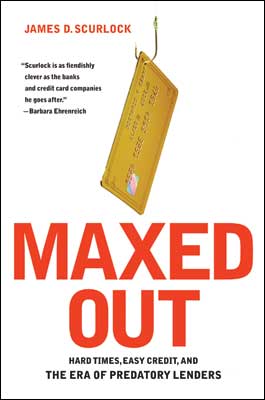
Maxed Out: Hard Times, Easy Credit, and the Era of Predatory Lenders

America’s dangerous love affair with easy credit.

Get your news from a source that’s not owned and controlled by oligarchs. Sign up for the free Mother Jones Daily.


In 1733, James Oglethorpe established Georgia as a haven for the “worthy poor” to work off their debts. If he’d only known that nearly 275 years later, the entire United States would be a giant debtor’s colony, one nation in the red, subject to compound interest, indentured to Citibank.

This is the bleak financial landscape explored in Maxed Out, an enlightening tour of America’s dangerous love affair with easy credit. James Scurlock, a Wharton grad who blew his inheritance on a Boston Market franchise, is an engaging guide to the corporate numbers games and the personal side of financial ruin. As he tours the country filming a documentary (just released under the same title), he meets collection agents, personal finance gurus, families with kids or moms who killed themselves to avoid credit card bills, and Dee Hock, the aptly named visionary who realized Visa could get away with charging 18 percent interest. He also elicits some frightening admissions from people in the credit business, such as the mortgage broker who explains how he helps clients lie about their incomes so they can “afford” $400,000 homes, knowing that the banks turn a blind eye to such tricks.

This kind of enabling by financial professionals infuriates Scurlock. Back in the day, lenders protected clients from loans they couldn’t handle. Today, they aggressively market debt as a product—not a liability, but a lifestyle choice. The rules of sound finance have become so twisted that the industry has nothing but contempt for its “good” customers: Low credit card balances actually hurt your credit rating, and if you’re one of the lucky few who can pay off your bills each month, you’re what’s known in the biz as a “deadbeat.”


DECEMBER IS MAKE OR BREAK

A full one-third of our annual fundraising comes in this month alone. That’s risky, because a strong December means our newsroom is on the beat and reporting at full strength—but a weak one means budget cuts and hard choices ahead.

The December 31 deadline is closing in fast. To reach our $400,000 goal, we need readers who’ve never given before to join the ranks of MoJo donors. And we need our steadfast supporters to give again—any amount today.

Managing an independent, nonprofit newsroom is staggeringly hard. There’s no cushion in our budget—no backup revenue, no corporate safety net. We can’t afford to fall short, and we can’t rely on corporations or deep-pocketed interests to fund the fierce, investigative journalism Mother Jones exists to do.

That’s why we need you right now. Please chip in to help close the gap.

DECEMBER IS MAKE OR BREAK

A full one-third of our annual fundraising comes in this month alone. That’s risky, because a strong December means our newsroom is on the beat and reporting at full strength—but a weak one means budget cuts and hard choices ahead.

The December 31 deadline is closing in fast. To reach our $400,000 goal, we need readers who’ve never given before to join the ranks of MoJo donors. And we need our steadfast supporters to give again—any amount today.

Managing an independent, nonprofit newsroom is staggeringly hard. There’s no cushion in our budget—no backup revenue, no corporate safety net. We can’t afford to fall short, and we can’t rely on corporations or deep-pocketed interests to fund the fierce, investigative journalism Mother Jones exists to do.

That’s why we need you right now. Please chip in to help close the gap.

We Recommend

Latest

Sign up for our free newsletter

Subscribe to the Mother Jones Daily to have our top stories delivered directly to your inbox.

Get our award-winning magazine

Save big on a full year of investigations, ideas, and insights.

Subscribe

Support our journalism

Help Mother Jones' reporters dig deep with a tax-deductible donation.

Donate