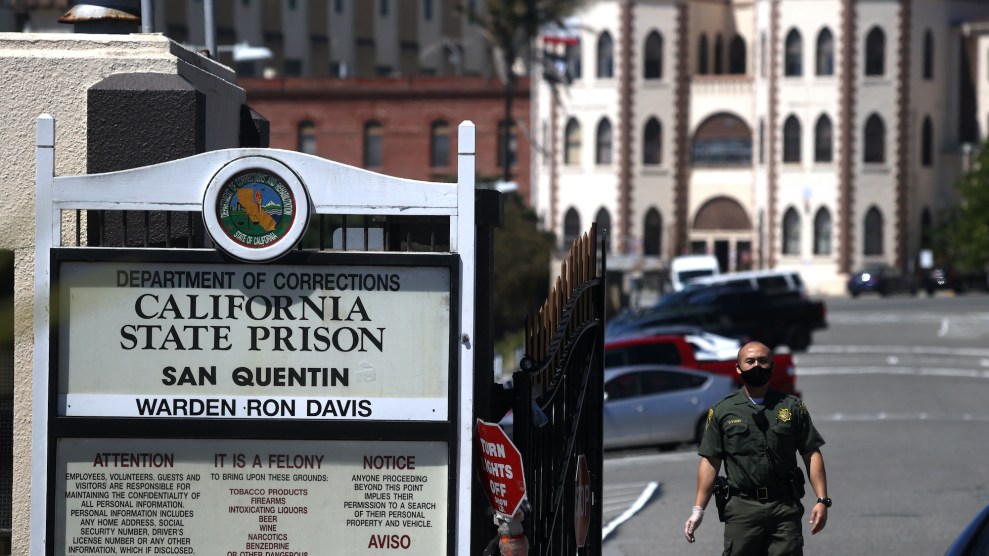

The COVID-19 outbreak at California’s San Quentin State Prison last summer was a catastrophe of epic proportions. Twenty-eight people serving prison sentences and one correctional officer died. Nearly two in three prisoners tested positive over three months; many were transferred out for treatment, straining San Francisco Bay Area hospitals. “It’s like a horror movie,” one San Quentin prisoner told me at the time.
Now California’s Office of the Inspector General is out with a scathing new report that lays the blame for the outbreak squarely at the feet of the state corrections department and its health care division. The report confirms the findings of an investigation by the San Francisco Chronicle that attributed the outbreak to officials’ decision to bring in people with outdated coronavirus tests from the COVID-stricken California Institution for Men to San Quentin at the end of May. The California Department of Corrections and Rehabilitation and its health care division “caused a public health disaster” when they transferred these prisoners “without taking proper safeguards,” including ignoring concerns from health care staff, the OIG wrote in a letter to the speaker of the state Assembly.
Strikingly, alongside its other findings, the OIG created a time lapse to visualize data on just how rapidly the coronavirus spread from cell to cell and building to building inside the San Quentin complex.
We created a time lapse showing how quickly the virus spread at San Quentin State Prison between June 1, 2020 and August 31, 2020, after patients from CIM arrived at the prison. 28 incarcerated persons and 1 staff member died during this 3-month period. 2/3 pic.twitter.com/4tYI2SACvA
— Office of the Inspector General (@CaliforniaOIG) February 1, 2021
That map perfectly illustrates what experts have been saying for nearly a year about rapid coronavirus transmission behind bars, where people with high rates of preexisting conditions and limited access to health care are confined in crowded spaces, sometimes without basic sanitary supplies. In San Quentin, the OIG concluded, the coronavirus spread so quickly because the prison did not quickly test, isolate, or trace the contacts of infected prisoners; because of the prison’s use of open-barred cells; and because staff were allowed to work different shifts throughout the facility.
As of the end of 2020, 130 incarcerated people and 11 staff members in the California prison system had died from COVID.