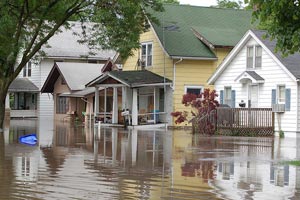
The pacific island nation of Kiribati is well aware of the looming threats that climate change poses to the small atoll. Increased flooding from storms and rising seas are already problematic for the 100,00 citizens of the nation, or i-Kiribati as they call themselves. A sea-wall improvement project for the country recently cost $2 million, President Anote Tong said at the Cancun climate summit this week.
The nation’s GDP is just $152 million a year—meaning the investment in sea walls is significant for the country. “If we had to cover the whole country, we’re talking hundreds of millions of dollars,” said Tong. The republic is made up of 32 atolls and one island, spread over 1.3 million square miles—roughly the size of the United States. Tong has said previously that the government is already considering evacuation plans as another way to deal with the rising seas, which would also come at great cost.
Tong and other island nations, organized within the UN as the Alliance of Small Island States (AOSIS), and other vulnerable countries have argued for the inclusion of a loss-and-damage plan in the context of an agreement here, one that would cover effects linked to climate change that were not prevented or could not be adapted to. The Cook Islands, on behalf of AOSIS, submitted a proposal that would create an international mechanism to deal with loss and damage, in addition to funding programs for adaptation and mitigation efforts. The provision also calls for assistance in improving risk-reduction assessment and management, and planning for the likely impacts.
The point of the provision is, of course, that even if countries set and follow through on their pledges to cut emissions, the world is still on a path to substantial warming. And that warming is going to have significant effects—sea level rise, loss of glaciers, diminished biodiversity, ocean acidification, and decline of forests. Many of those will have very real economic costs for countries. And that’s before you even get to more dramatic costs like relocating an entire population or rebuilding a village destroyed by a cyclone—or the cost if an island community is someday completely submerged by the sea.
As they note, many of these countries have trouble getting insured for losses, Samoan Prime Minister Tuilaepa Lupesoliai Sailele Maliegaoi, tells Mother Jones, further increasing the need for an alternative way to deal with potential losses. The country suffered a tsunami in September 2009, which he said caused an estimated $300 million in damage—to a country with an annual GDP of just $567 million. Of course, the tsunami was not caused by climate change, but the island has also faced more frequent cyclones as well. But the events have made insurance premiums exceptionally high for the country, he said. “It is almost impossible even for government to insure its own properties, let alone the damage sustained by a cyclone or by a tsunami,” he said.
The countries at least want the provision included, so that parties can begin assessing what such a mechanism would look like, as well as answer crucial questions like how to determine the extent to which changes or events are directly caused by climate change. Their proposal would start the process of setting up that program, ideally by the next major climate summit in 2011. It’s among their top negotiating priorities—an element they see as critical given the slow movement on plans to cut planet-warming emissions. The proposal could also build some trust that developed countries recognize the situation of the most vulnerable countries, say observers. “Vulnerable countries have been betrayed multiple times, so this is an opportunity for them to get something from the international process in their favor,” says Sandeep Rai, adaptation policy coordinator for the World Wildlife Fund.
The current draft of the agreement includes less firm commitments on the issue than the proposed text AOSIS put forward, noting that the parties should begin engaging stakeholders on the subject, identifying and estimating risk factors, and providing recommendations about how to proceed; it would not necessarily mean that the program would actually be created to start compensating for losses and damages. Developed countries have argued that they should do the assessment before agreeing to set up an actual mechanism, which the text currently reflects.
At this point, though, it does not look likely that a stronger provision will make it into the text here in Cancun. “The science is saying there is an urgency, but it’s hard to move the process in this forum,” said Rai.
Island states argue, though, that assurances that the damage they sustain will be covered is the least developed countries can do. “It’s not about whether it’s convenient to you, it’s about survival,” said Tong. “Here we are trying to survive.”