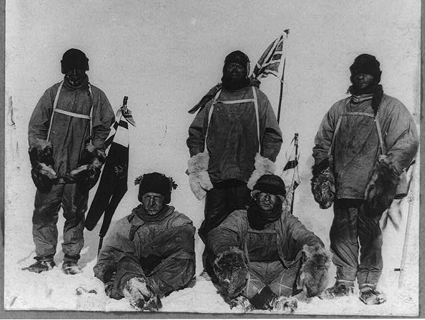
Members of the Terra Nova expedition at the South Pole: Robert F. Scott, Lawrence Oates, Henry R. Bowers, Edward A. Wilson, and Edgar Evans.<a href="http://www.loc.gov/pictures/item/2009633365/">Library of Congress</a>
This post courtesy BBC Earth‘s Race to the South Pole series. For more wildlife news, find BBC Earth on Facebook and Posterous.
One hundred years ago two teams set off on an epic race across the Antarctic wilderness. Led by Roald Amundsen from Norway and Captain Robert Scott from Great Britain, the men set out to conquer this vast icy continent and to become the first to reach the South Pole. For one group the adventure would end in triumph, for the other it would end in tragedy.
This year marks the 100th anniversary of Scott and Amundsen’s separate attempts to be the first to the South Pole. In this series we will explore how these men found themselves racing across one of the most inhospitable environments on the planet.
We will look at how their different approaches, from the equipment they carried to the polar travel techniques they employed, led to wildly contrasting outcomes. The adventure began more than 10 years earlier, in 1897, when a great, global effort to uncover the mysteries of Antarctica began.
People knew that a huge, frozen continent lay beyond the wild seas at the southern end of the earth, but it wasn’t until 1820 that explorers first laid eyes on Antarctica. Before then ships had failed to penetrate far enough through the frozen ocean to carry their passengers within sight of land.
During the winter of 1897, a Belgian ship carrying a crew of explorers, called the Belgica, was trapped in the ice off the coast of the continent. The crew became the first people to endure an Antarctic winter and sparked a period of exploration that would last for 25 years.
During that time scientists, geographers, and adventurers would compete to become the first to explore uncharted territories and claim the credit for their respective nations. But it was the parallel journeys of Scott and Amundsen that would capture the imaginations of people across the world.
Scott had been planning his Terra Nova Expedition for years. His aim was to be the first to the South Pole after Ernst Shackleton had narrowly failed during an earlier expedition. Scientific research was also an important part of Scott’s expedition to Antarctica.
But when the American adventurers Frederick Cook and Robert Peary laid claim that achievement, Amundsen turned his attention towards the other end of the earth. Only his brother Leon and second-in-command Thorvald Nilsen knew of Amundsen’s plan until after his ship, the Fram, had set sail.
Scott only learnt of this change of direction months later when his ship, the Terra Nova, docked in Melbourne, Australia. There he was handed a telegram from the Norwegian. It read:
‘Beg to inform you Fram proceeding Antarctic—Amundsen.’
Even though Scott publicly insisted that this news would change nothing, the reality was that he was now locked in a race to the South Pole.