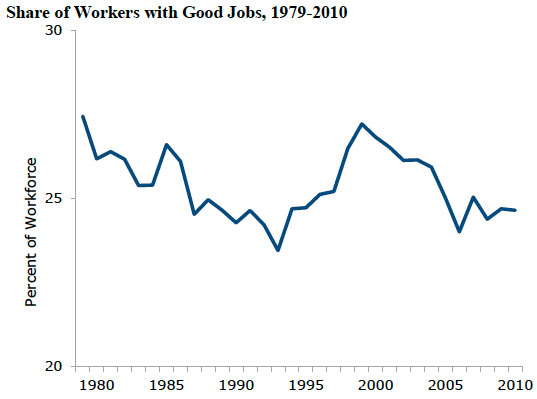
 Center for Economic and Policy ResearchFor the purposes of this graph, the Center for Economic and Policy Research defines a “good job” as one that includes health insurance and retirement benefits and pays at least as much as the median wage, adjusted for inflation, earned by a male worker in 1979. ($12,300 per year back then and $37,000 per year today.) Kind of sad, isn’t it?
Note that there is a conspicuous partisan trend in the graph: The number of good jobs fell during the Reagan and George H.W. Bush years, rebounded during the Clinton years, and fell again during the administration of George W. Bush. Good jobs haven’t made much of a comeback during the Obama administration, but he inherited an economy from his predecessor that’s still fighting it’s way out of a catastrophic meltdown.
Democrats and Republicans tend to agree that creating more good jobs requires building a more educated workforce. Unfortunately, the fortunes of college-educated workers haven’t really improved over the past 30 years either; they’ve just eroded more slowly:
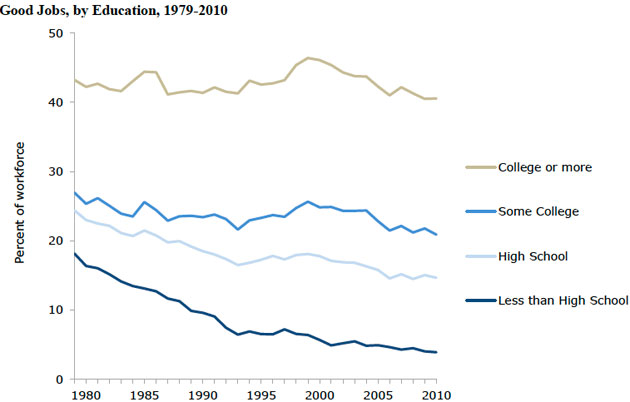 Center for Economic and Policy ResearchSo what’s going on here? As we’ve often pointed out on Mother Jones, the travails of the American middle class hinge on a variety of interrelated factors, including automation, the decline of labor unions, globalization, and the Federal Reserve‘s monetary policy, to name a few. The Center for Economic and Policy Research also points out out that the minimum wage today, adjusted for inflation, is 15 percent below what it was in 1979. Who ever thought that the era of bell bottoms and the Bee Gees would be considered the good old days?