Poor residents in cities and suburbs, 1970 – 2010 (millions)
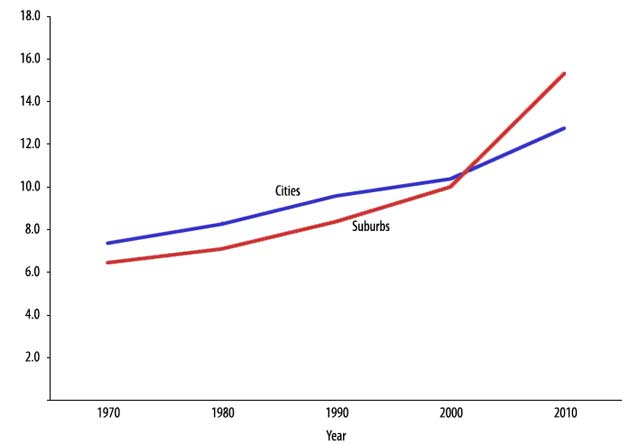
Suburbs such as Highland Park (Detroit), Carol Stream (Chicago), and Forest Park (Atlanta) once stood for escape from the hard times of the inner city. Now their deceptively bucolic names conceal a national epidemic of suburban poverty. According to a report released today by the Brookings Institution, the suburban poor now far outnumber the rural and urban poor: Their ranks grew by 64 percent during the aughts to 16.4 million—a rate of increase more than twice that seen in America’s cities.
What’s going on here? Well, for one, Ward and June Cleaver’s house wasn’t exactly built to last. And as retiring baby boomers downsize and young millennials flock to hip inner cities, not that many people want to live in a half-century-old suburban tract home—except people with no other options.
But that’s not all. Manufacturing is concentrated in the suburbs, and it has has been bleeding jobs for decades. Add in the recent foreclosure crisis and slow-to-recover housing market and you end up with a lot of unemployed factory and construction workers, most of whom live in the suburbs.
Over the course of the past decade, almost every major metro area saw jobs move away from the urban core towards the outer suburbs. And while you’d think that would be good news for the suburbs, a lot of those tend to be low-paying service-industry jobs (think Walmart or McDonald’s). The result: The suburbs have seen an increase in the share of working poor.
Compared to the urban poor, the suburban poor more often tend to be white, homeowners, and married with children (mouse over bars for the numbers):
The cloistered nature of the suburbs makes their poorest residents less visible and in some ways harder-pressed than the homeless who panhandle on city sidewalks. Some 700,000 suburban households in the nation’s largest metro areas don’t have a vehicle, and they also don’t have decent access to public transportation. And despite the ubiquity of suburban poverty, most of the $82 billion in annual federal anti-poverty spending targets urban communities, according to Brookings.
This video released with the Brookings report outlines some possible solutions.