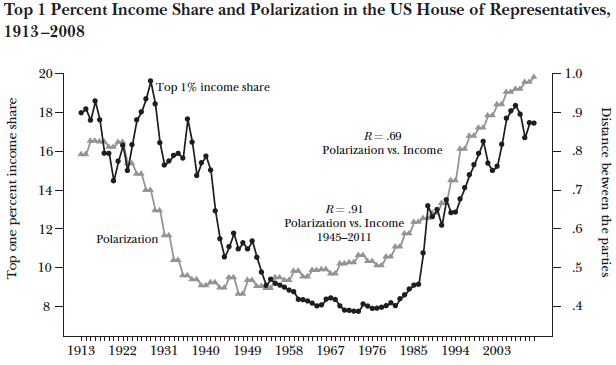
Chart: Washington Gridlock Linked to Income Inequality

Source: "Why Hasn't Democracy Slowed Rising Income Inequality?" <ital>Journal of Economic Perspectives</ital>, Summer 2013 edition

Get your news from a source that’s not owned and controlled by oligarchs. Sign up for the free Mother Jones Daily.


To the long list of problems linked to income inequality, you can now add another: political gridlock. As illustrated above, the dramatic fall and rise of income inequality over the past century correlates remarkably closely with the level of political polarization in the US House of Representatives.

On its face, this correlation seems incredibly counterintuitive. As a greater share of wealth concentrates in the hands of the top 1 percent of income earners, you’d expect the other 99 percent of Americans to act as a more-unified voting block, electing politicians who’d level the economic playing field.

But that hasn’t happened. And nobody really knows why.

The creators of this chart, which accompanied a paper in the most recent issue of the Journal of Economic Perspectives, float a laundry list of explanations: the ideological influence of free market capitalism, falling rates of voter turnout among the poor, higher standards of living, gerrymandering, and the influence of money in politics.

Of course, correlation isn’t causation—we can’t say whether inequality fuels political polarization or vice versa. The widening ideological chasm in Congress has certainly prevented Washington from correcting the sort of policy mistakes—tax cuts, financial deregulation, “free trade” deals—that continue to enrich the few at the expense of everyone else. The question is whether the further growth of inequality will eventually change that, or, as it has in countries such as Egypt, fuel a politics ever more defined by extremes.

BEFORE YOU CLICK AWAY!

December is make or break for us. A full one-third of our annual fundraising comes in this month alone. A strong December means our newsroom is on the beat and reporting at full strength. A weak one means budget cuts and hard choices ahead.

The December 31 deadline is closing in fast. To reach our $400,000 goal, we need readers who’ve never given before to join the ranks of MoJo donors. And we need our steadfast supporters to give again today—any amount.

Managing an independent, nonprofit newsroom is staggeringly hard. There’s no cushion in our budget—no backup revenue, no corporate safety net. We can’t afford to fall short, and we can’t rely on corporations or deep-pocketed interests to fund the fierce, investigative journalism Mother Jones exists to do.

That’s why we need you right now. Please chip in to help close the gap.

BEFORE YOU CLICK AWAY!

December is make or break for us. A full one-third of our annual fundraising comes in this month alone. A strong December means our newsroom is on the beat and reporting at full strength. A weak one means budget cuts and hard choices ahead.

The December 31 deadline is closing in fast. To reach our $400,000 goal, we need readers who’ve never given before to join the ranks of MoJo donors. And we need our steadfast supporters to give again today—any amount.

Managing an independent, nonprofit newsroom is staggeringly hard. There’s no cushion in our budget—no backup revenue, no corporate safety net. We can’t afford to fall short, and we can’t rely on corporations or deep-pocketed interests to fund the fierce, investigative journalism Mother Jones exists to do.

That’s why we need you right now. Please chip in to help close the gap.

We Recommend

Latest

Sign up for our free newsletter

Subscribe to the Mother Jones Daily to have our top stories delivered directly to your inbox.

Get our award-winning magazine

Save big on a full year of investigations, ideas, and insights.

Subscribe

Support our journalism

Help Mother Jones' reporters dig deep with a tax-deductible donation.

Donate