California Just Had Its Warmest Winter on Record


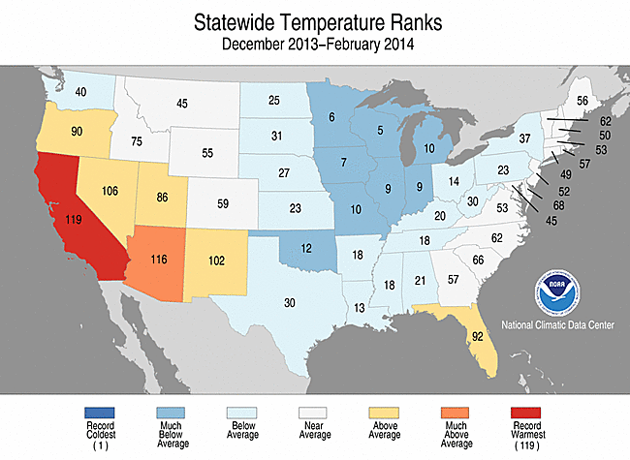
temperature map

NOAA

This winter has been a tale of two Americas: The Midwest is just beginning to thaw out from a battery of epic cold snaps, while Californians might feel that they pretty much skipped winter altogether. In fact, new NOAA data reveal that California’s winter (December through February) was the warmest in the 119-year record, 4.4 degrees Fahrenheit above the 20th century average.

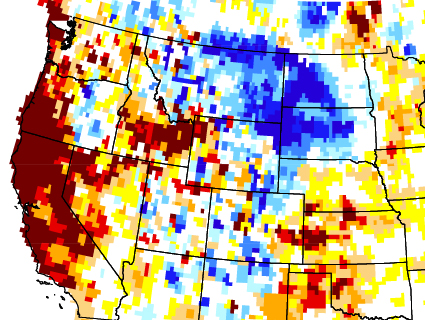
The map above ranks every state’s winter temperature average relative to its own historical record low (in other words, relative to itself and not to other states). Low numbers indicate that the state was unusually cold; higher numbers mean it was exceptionally warm. As you can see, the Midwest was much colder than average, while the West was hotter than average (despite a season-long kerfluffle about polar vortexes, the East Coast wasn’t exceptionally cold, after all).

As we’ve reported, there’s currently a scientific debate over whether climate change in the Arcitc is making the jet stream “drunk,” and thereby increasing the likelihood of extreme cold spells; the exact role of climate change in California’s record heat is still unclear.

As anyone working in California’s farming industry could confirm, the state also had an exceptionally dry winter, the third-lowest precipitation on record. Other interesting facts from the NOAA report:

  • At the beginning of March, 91 percent of the Great Lakes remained frozen, the second-largest ice cover since record keeping began in 1973.
  • With reservoirs in central and northern California at 36 to 74 percent of their historical average levels, these regions would need 18 inches of rain over the next three months to end the drought, much more than the state normally gets in that time period.
  • Alaska’s winter was the eighth-warmest on record, 6.2 degrees F over the 1971-2000 average.
More Mother Jones reporting on Climate Desk

DECEMBER IS MAKE OR BREAK

A full one-third of our annual fundraising comes in this month alone. That’s risky, because a strong December means our newsroom is on the beat and reporting at full strength—but a weak one means budget cuts and hard choices ahead.

The December 31 deadline is closing in fast. To reach our $400,000 goal, we need readers who’ve never given before to join the ranks of MoJo donors. And we need our steadfast supporters to give again—any amount today.

Managing an independent, nonprofit newsroom is staggeringly hard. There’s no cushion in our budget—no backup revenue, no corporate safety net. We can’t afford to fall short, and we can’t rely on corporations or deep-pocketed interests to fund the fierce, investigative journalism Mother Jones exists to do.

That’s why we need you right now. Please chip in to help close the gap.

DECEMBER IS MAKE OR BREAK

A full one-third of our annual fundraising comes in this month alone. That’s risky, because a strong December means our newsroom is on the beat and reporting at full strength—but a weak one means budget cuts and hard choices ahead.

The December 31 deadline is closing in fast. To reach our $400,000 goal, we need readers who’ve never given before to join the ranks of MoJo donors. And we need our steadfast supporters to give again—any amount today.

Managing an independent, nonprofit newsroom is staggeringly hard. There’s no cushion in our budget—no backup revenue, no corporate safety net. We can’t afford to fall short, and we can’t rely on corporations or deep-pocketed interests to fund the fierce, investigative journalism Mother Jones exists to do.

That’s why we need you right now. Please chip in to help close the gap.

We Recommend

Latest

Sign up for our free newsletter

Subscribe to the Mother Jones Daily to have our top stories delivered directly to your inbox.

Get our award-winning magazine

Save big on a full year of investigations, ideas, and insights.

Subscribe

Support our journalism

Help Mother Jones' reporters dig deep with a tax-deductible donation.

Donate