NASA Just Found the Most Earth-Like Planet Yet

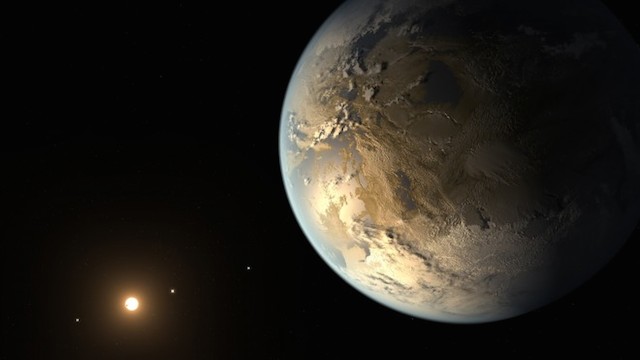
An artist's concept of Kepler-186f. NASA Ames/SETI Institute/JPL - Caltech

Get your news from a source that’s not owned and controlled by oligarchs. Sign up for the free Mother Jones Daily.


Hello. Good day.

NASA just announced that astronomers have discovered the most Earth-like planet yet. Kepler-186f is the first Goldilocks planet—not too hot for water, not too cold for water—ever identified that is roughly the same size as Earth. (It’s a bit larger.)

So, is there life on that planet? It hasn’t been disqualified yet. So, maybe! But probably not. But maybe! But almost certainly not. But maybe! And even if there’s not its mere existence means there are very likely more planets like it out there, meaning Earth is maybe not necessarily unique, meaning life is maybe not necessarily unique to Earth. But basically, we don’t know much about this new planet. Take it away, WIRED:

[S]cientists have fairly little information about this new exoplanet, including its mass and composition. From what they can tell, the place is similar to our own world, though not quite Earth’s twin. 

“We consider it more of an Earth cousin,” said astronomer Elisa Quintana of NASA’s Ames Research Center, lead author of a paper about the finding appearing today in Science. “It’s got the same size and characteristics, but a very different parent star.”

The planet is about 500 light years away, so it’s close, but not that close. This is all fun and exciting, but here’s the annoying bit: It was discovered by the Kepler space telescope which means we’re in for a cliffhanger:

Though Kepler is out of commission and won’t be able to provide any more information about this newest exoplanet, future telescopes could give us new insight. NASA is planning to launch the Transiting Exoplanet Survey Satellite (TESS) in 2017, which will watch bright nearby stars, including M dwarfs, for more exoplanets and be able to determine their masses. Follow up observations with the agency’s James Webb Space Telescope, currently slated to launch in 2018, could even look at the atmospheres of these worlds, providing definitive proof that they have chemicals like oxygen and water on their surfaces.

See you in 2017, possible Earth cousin!

DECEMBER IS MAKE OR BREAK

A full one-third of our annual fundraising comes in this month alone. That’s risky, because a strong December means our newsroom is on the beat and reporting at full strength—but a weak one means budget cuts and hard choices ahead.

The December 31 deadline is closing in fast. To reach our $400,000 goal, we need readers who’ve never given before to join the ranks of MoJo donors. And we need our steadfast supporters to give again—any amount today.

Managing an independent, nonprofit newsroom is staggeringly hard. There’s no cushion in our budget—no backup revenue, no corporate safety net. We can’t afford to fall short, and we can’t rely on corporations or deep-pocketed interests to fund the fierce, investigative journalism Mother Jones exists to do.

That’s why we need you right now. Please chip in to help close the gap.

DECEMBER IS MAKE OR BREAK

A full one-third of our annual fundraising comes in this month alone. That’s risky, because a strong December means our newsroom is on the beat and reporting at full strength—but a weak one means budget cuts and hard choices ahead.

The December 31 deadline is closing in fast. To reach our $400,000 goal, we need readers who’ve never given before to join the ranks of MoJo donors. And we need our steadfast supporters to give again—any amount today.

Managing an independent, nonprofit newsroom is staggeringly hard. There’s no cushion in our budget—no backup revenue, no corporate safety net. We can’t afford to fall short, and we can’t rely on corporations or deep-pocketed interests to fund the fierce, investigative journalism Mother Jones exists to do.

That’s why we need you right now. Please chip in to help close the gap.

We Recommend

Latest

Sign up for our free newsletter

Subscribe to the Mother Jones Daily to have our top stories delivered directly to your inbox.

Get our award-winning magazine

Save big on a full year of investigations, ideas, and insights.

Subscribe

Support our journalism

Help Mother Jones' reporters dig deep with a tax-deductible donation.

Donate