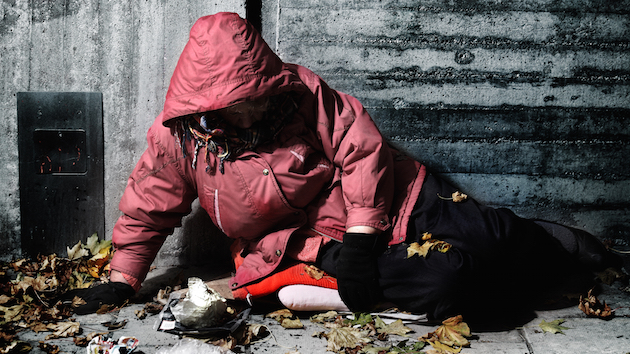
<a href="http://www.shutterstock.com/pic-158762576/stock-photo-a-woman-lying-against-a-brick-building.html?src=pd-same_model-158492999-8">Mikael Damkier</a>/Shutterstock
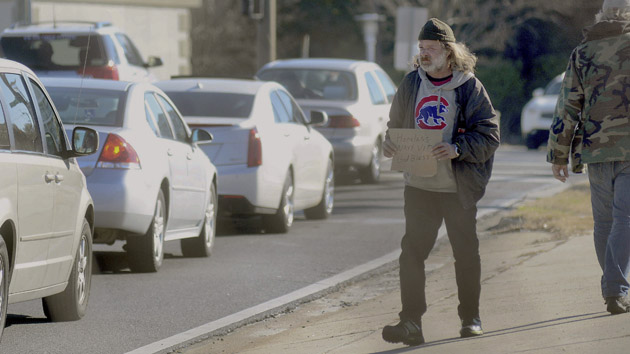
Researchers have identified a new risk factor for homelessness among veterans: military sexual trauma. Nearly 1 in 10 veterans who experienced sexual assault or harassment in the military became homeless within five years—a “staggering number,” noted an editorial in JAMA Psychiatry, which published the study Wednesday.
The research, funded by the US Department of Veterans Affairs, drew on a national sample of 601,892 veterans of Iraq and Afghanistan who were discharged between 2001 and 2011. Those who reported experiencing sexual assault or harassment while they were in the military were twice as likely to become homeless within five years as those who did not, and the results held true even after controlling for PTSD, alcohol and drug addiction, and serious mental illnesses.
The trauma of violence during a military deployment can make returning to civilian life more difficult, the study’s authors point out, with homelessness exemplifying “an extreme case of poor reintegration.” Military sexual trauma, or MST, includes forcible and coerced sexual assault, as well as harassment (uninvited or unwanted sexual attention, including cornering, touching, pressure for sexual favors, or verbal remarks). According to the VA, around 22 percent of women and 1 percent of men in the military have experienced some form of MST.
Interestingly, the researchers found a slightly higher rate of homelessness among male veterans who experienced sexual violence as compared to women. “Men with a positive MST screen are a particularly vulnerable group,” the authors wrote. “In addition to the burden of issues regarding masculinity, sexuality, and self-concept among males who have experienced sexual trauma,” they also may be less likely to seek mental-health treatment than women—potentially leading to worsening psychiatric symptoms and homelessness.
The link between homelessness and the experience of different kinds of traumatic events—childhood abuse, domestic violence, even homelessness itself—is well documented. The study also adds homelessness to an already long list of MST’s public health consequences. Past research has found that experiencing MST increased a person’s odds of mental illness by two to three times—most notably post-traumatic stress disorder, but also alcohol and drug addiction, anxiety disorders, depression, dissociative disorders. That’s not to mention the links between MST and certain medical conditions: liver disease, chronic pulmonary disease, obesity, hypothyroidism, and HIV/AIDS.
According to researcher Adi Gundlapalli, an associate professor at the University of Utah medical school, potential consequences of military sexual violence include low social support, poor interpersonal relationships, and revictimization. “These types of problems may compromise employment and put one at risk for financial instability,” Gundlapalli says. “Ultimately, this may lead to homelessness.”