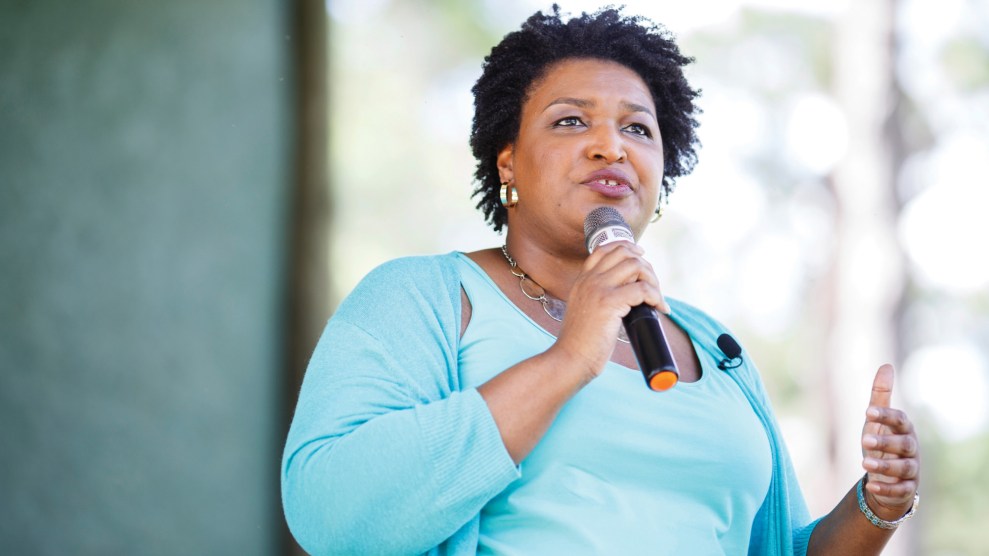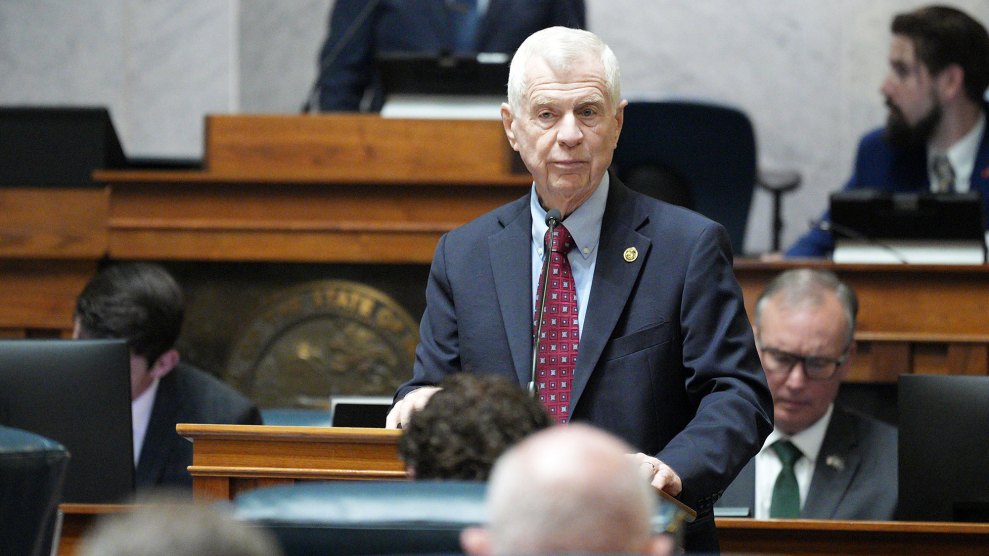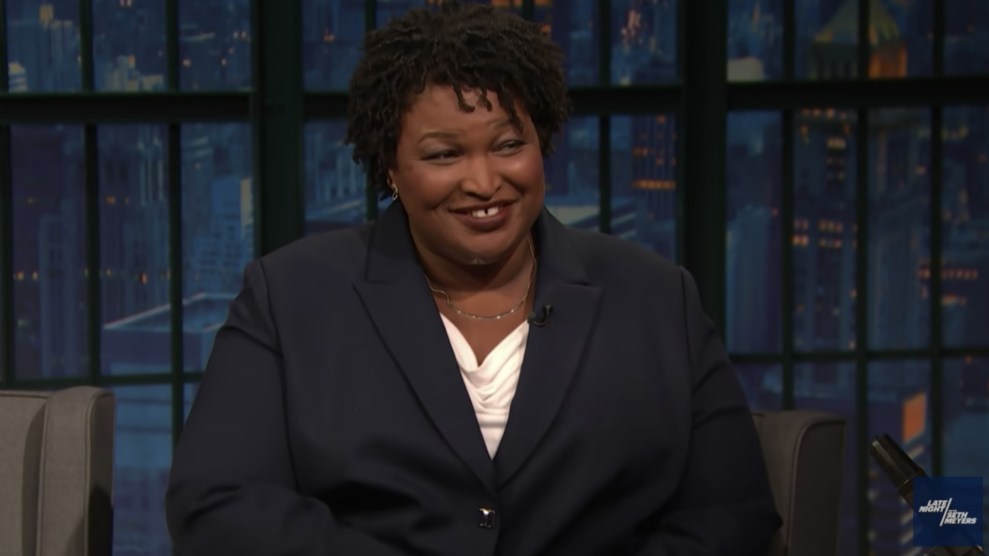
While the race to become Georgia’s next governor pits two polar opposites—progressive Democrat Stacey Abrams and Trump-backed firebrand Republican Brian Kemp—against each other, polls show them in a dead heat.
A survey of 1,020 likely voters from August 26 to September 4—taken by the University of Georgia’s School of Public and International Affairs for the Atlanta Journal Constitution and Channel 2—shows they’re both polling at 45 percent, reinforcing a few other polls from over the summer that show a very tight race. It’s also the latest sign that Abrams could continue to buck historical precedent and seriously contend, if not outright win, as a black woman in the Deep South, and be the first black woman to ever do so. Abrams handily beat Stacey Evans in the Democratic primary back in July, becoming the first black woman to win a major party nomination for governor in the United States.
Nationally, Democrats have long given lip-service to wanting to turn Georgia blue. But the state hasn’t sent a Democrat to the governor’s mansion in almost two decades. That Abrams—a relative outsider to Georgia’s monied Democratic establishment and the former minority leader in the statehouse—is the one knocking on the door is emblematic of the changes that are afoot in the state’s electorate, particularly in its increasing diversity. But Georgia is so deeply polarized, much like the country at large, and perhaps no race in the country better signifies that than Abrams versus Kemp.
Abrams touts endorsements from liberal favorites like Sens. Bernie Sanders and Kamala Harris. She talks openly about her own experiences growing up poor, her family’s experiences with incarceration and mental illness, and the government’s responsibility to create safety nets to prevent both. She’s built a national profile, and raised millions of dollars along the way, by positioning herself as a sort of millennial everywoman, writing in her recently-released memoir about struggling to find mentorship in the workplace and learning to manage crushing amounts of student loan debt. And, as I wrote in a profile of her early in 2018, she’s offered up Georgia as a potential laboratory for re-shaping the Democratic party as a whole—not by trying to convert moderate Republicans, but by activating new voters altogether.
Kemp, on the other hand, thinks Georgia’s traditionally white, conservative-leaning electorate is just fine. He describes himself as a Republican who’s so conservative that he’ll track down undocumented immigrants all by himself in his pickup truck. “If you want a politically incorrect conservative with a track record of fighting and winning for our values, then stand with me,” his campaign wrote in one ad during the Republican primary against his more moderate Republican opponent, Lt. Gov. Casey Cagle.
While a lot could change over the next two months, the poll shows that Kemp may need to find new lines of attack on Abrams; his arguments about her debt—pointing to the $54,000 in back taxes owed by Abrams as proof that she’s fiscally irresponsible—clearly have not done the damage Kemp’s campaign hoped for. Abrams’s camp has countered that her debt actually makes her more relatable to the younger voters she’s trying to court, many of them saddled with debts of their own. When Abrams was on a live recording of the popular podcast Pod Save America, she made light of it with the audience, telling them, “You may have heard that I have some debt,” and saying that she spent it on others, not herself. To that, the audience cheered.