The Supreme Court Just Expanded States’ Power to Prosecute Crimes on Tribal Land

The case is a crucial one in the fight over tribal sovereignty.

STRMX/AP

Get your news from a source that’s not owned and controlled by oligarchs. Sign up for the free Mother Jones Daily.

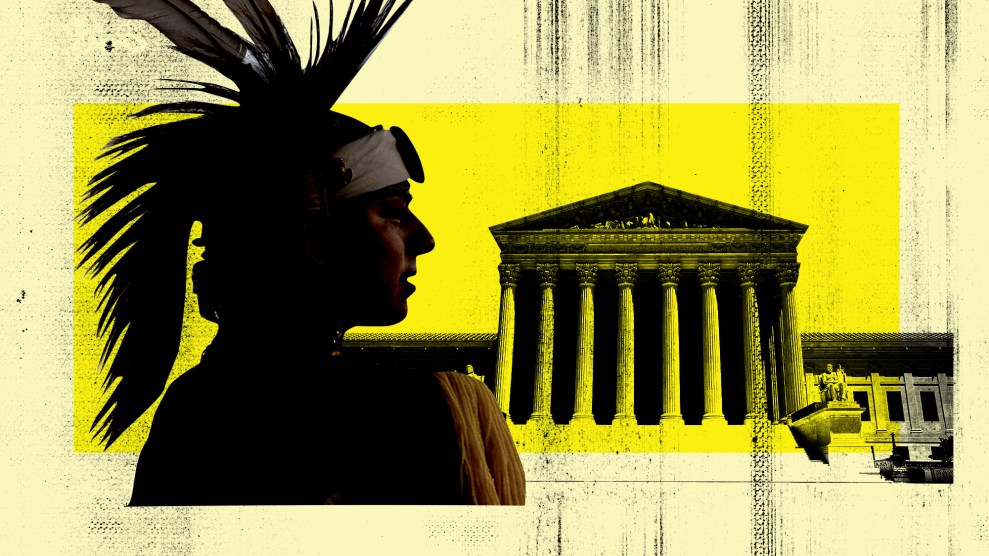
The Supreme Court on Wednesday ruled that Oklahoma has the authority to prosecute non-Native people who commit crimes against a Native person on tribal lands. 

The justices, in a 5-4 decision, said that both the state and federal government have jurisdiction to prosecute these crimes. The case, Oklahoma v. Castro-Huerta, had been viewed as a pivotal one that cuts right into the heart of the fight over tribal sovereignty. Justice Brett Kavanaugh wrote the majority opinion. 

Neil Gorsuch, who was joined by the three liberal justice in his dissent, wrote that when the Cherokee were exiled to Oklahoma, they were promised that they would be free from state interference. “Where this Court once stood firm, today it wilts,” Gorsuch wrote. “Where our predecessors refused to participate in one State’s unlawful power grab at the expense of the Cherokee, today’s Court accedes to another’s.”

In 2015, Oklahoma state prosecutors charged Victor Castro-Huerta for the malnourishment and neglect of his five-year-old disabled stepdaughter. He was eventually sentenced to 35 years in prison. Castro-Huerta is not Native, but the victim, his stepdaughter, is a citizen of the Eastern Band of Cherokee Indians, and the abuse took place on the Cherokee Reservation. Castro-Huerta challenged the decision by arguing that under the 2020 Supreme Court ruling in McGirt v. Oklahoma, he can only be federally prosecuted. McGirt held that nearly half of Oklahoma is tribal land, and as such, under the Major Crimes Act, Oklahoma cannot prosecute crimes by Native citizens on tribal lands without federal approval. 

In this case, Oklahoma argued that McGirt does not apply because the defendant was Native. The Oklahoma Court of Criminal Appeals had previously ruled that the state does not have the right to prosecute non-Native people for crimes with a Native victim on tribal land, but the Supreme Court disagreed. 
Keep us relentless, independent, and free to read.

This past week was our Spring Membership Drive, and we had an ambitious goal of raising 1,000 new donations to fund journalism that doesn’t hold back. We missed that goal. So we’re extending the drive, and we need your help.

For 50 years, Mother Jones has offered honest, investigative reporting you can rely on:

    • Relentless in the pursuit of truth, unafraid to hold the powerful to account

    • Independent from influence or agenda from oligarchs and corporations

    • Freely accessible to every reader, never behind a paywall

But we can’t do any of this without you. Reader support powers our newsroom to stay nimble and fearless, ready for whatever story comes next. If you can, make a donation today.

Keep us relentless, independent, and free to read.

This past week was our Spring Membership Drive, and we had an ambitious goal of raising 1,000 new donations to fund journalism that doesn’t hold back. We missed that goal. So we’re extending the drive, and we need your help.

For 50 years, Mother Jones has offered honest, investigative reporting you can rely on:

    • Relentless in the pursuit of truth, unafraid to hold the powerful to account

    • Independent from influence or agenda from oligarchs and corporations

    • Freely accessible to every reader, never behind a paywall

But we can’t do any of this without you. Reader support powers our newsroom to stay nimble and fearless, ready for whatever story comes next. If you can, make a donation today.

We Recommend

Latest

Sign up for our free newsletter

Subscribe to the Mother Jones Daily to have our top stories delivered directly to your inbox.

Get our award-winning magazine

Save big on a full year of investigations, ideas, and insights.

Subscribe

Support our journalism

Help Mother Jones' reporters dig deep with a tax-deductible donation.

Donate