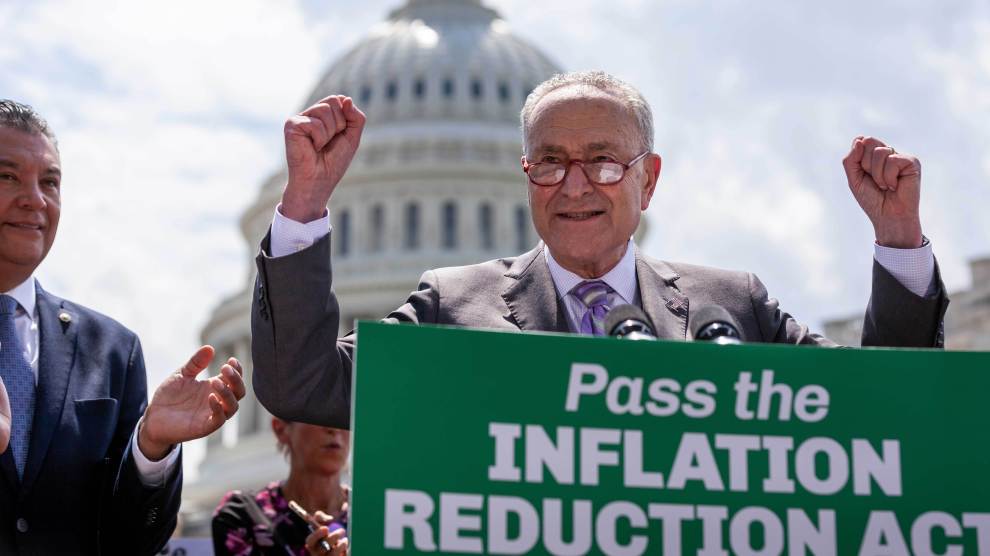
Senate Majority Leader Chuck Schumer (D-NY) speaks at a press conference in which Democratic Senators were demanding passage of the Inflation Reduction Act.Allison Bailey/AP
After years of stagnant climate policy, months of excruciating political negotiations, and a marathon weekend of back-to-back voting, the Senate passed the Democrats’ sweeping climate and health care bill on Sunday.
The estimated $740 billion package, entitled the Inflation Reduction Act, includes close to $400 billion in climate spending—by far the largest climate investment in the nation’s history. The plan would be largely paid for by new taxes, including a 15 percent minimum tax on the handful of corporations with annual profits about $1 billion.
The bill represents a fraction of the climate investment that Democrats dreamed of when Joe Biden took office, but it includes policies that are expected to help America cut its climate pollution by 40 percent by 2030. (As Vox notes, that’s a bit less dramatic than it sounds: The baseline for the reduction is 2005, when emissions peaked, and the nation was on track to reduce its emissions by 20 percent by 2030 without the legislation.) If enacted, the policy will fund tax credits and rebates for renewable energy, energy efficiency technology, and electric cars. It will also fund climate resilience and pollution monitoring projects in vulnerable communities, and penalize fossil fuel companies for excess methane emissions.
Though the package has made news for its climate measures, it also includes important healthcare reforms, including policies that would enable Medicare to negotiate certain prescription drug prices for the first time, extend expiring subsidies that help millions of people afford health insurance, and cap out-of-pocket drug costs for seniors on Medicare to $2,000 a year.
After overcoming initial opposition from Sen. Joe Manchin and last-minute pushback from Sen. Kyrsten Sinema, Democrats were united in the 51-50 vote, with Vice President Kamala Harris casting the tie-breaking vote. The legislation now heads to the House.
“It’s been a long, tough and winding road, but at last, at last we have arrived,” said Senate Majority Leader Chuck Schumer, just before the final vote.