Rutgers Faculty Unions Suspend Historic Strike After Securing Major Victories

The win shows what can happen when tenured professors unite with adjuncts and grad workers.

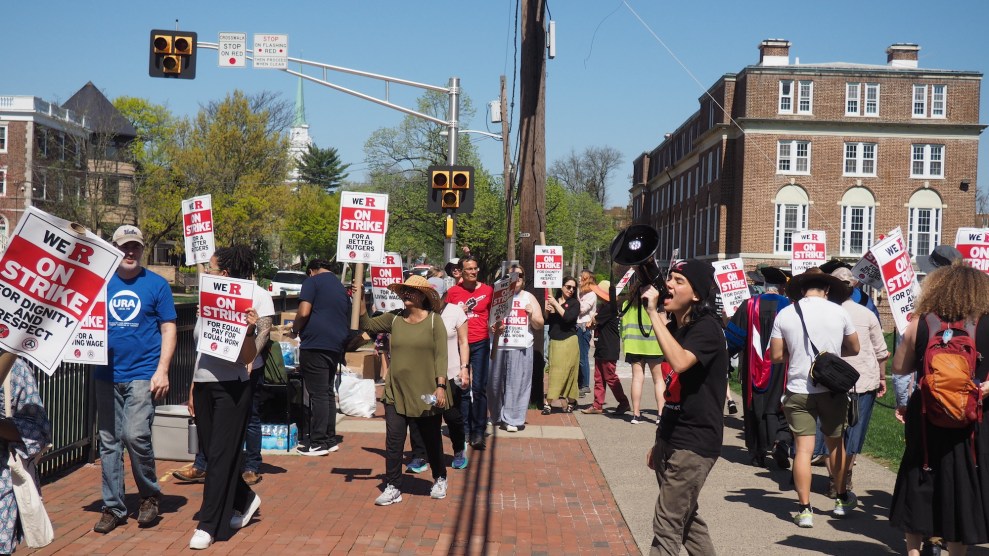
Rutgers faculty and supporters on the picket line on Thursday.Noah Lanard/Mother Jones

Get your news from a source that’s not owned and controlled by oligarchs. Sign up for the free Mother Jones Daily.

Three unions representing 9,000 faculty members at Rutgers University are suspending their strike after reaching a tentative framework on Friday night with Gov. Phil Murphy (D-NJ) and his staff.

After more than nine months without a contract, faculty unions and the Rutgers administration worked out the deal in marathon negotiations in Trenton. The framework secures major pay increases for union members, along with improvements in job security, working conditions, and other areas. Classes will resume on Monday. 

Rutgers faculty had never before gone on strike in the university’s 257-year history. In a show of cross-faculty solidarity, unions prioritized improving conditions for the poorly paid adjunct faculty and graduate student workers that Rutgers relies on to teach many of its courses. Their success could serve as a model for faculty at universities across the country.

“This was a campaign…where those in our community at Rutgers who have the most on the faculty, who get paid the highest, who have the most job security, were in this fight not for themselves but those who have the least,” Rutgers Adjunct Faculty Union President Amy Higer said during a virtual town hall meeting on Saturday. “That is really important and we should all know that.” 

Rutgers University President Jonathan Holloway called the framework “fair and equitable.” Union leaders told members they “believe we have secured profound victories.” Among other wins, Rutgers AAUP-AFT President Rebecca Givan said during the town hall that graduate student workers would see their pay go from about $30,000 today to $40,000 starting in 2025.

Carla Katz, who represents non-tenure track faculty, said the framework provides tenure-like job protections for NTTs—a “radical improvement” over the status quo. “I don’t believe there is a university in the United States that has the degree of job security that our non-tenure-tracks will have going forward,” she added. 

Adjunct faculty would have increased job security and receive a more than 40 percent increase in pay over the course of the contract. The next step is for the unions’ executive boards to approve the tentative framework. 

Higer told union members and the media on Saturday that a key lesson of the strike is that contingent faculty can be organized. “We were told it was impossible. We’ve been doing this for four years. It’s hard. It takes a long time. But it is possible,” she explained.

“So, anybody out there who is involved in anything in their future or present time where you’re told you cannot organize contingent people who are working part-time: It is not true,” Higer continued. “You can. It’s possible. We did it.”


From the desk of Mother Jones CEO, Monika Bauerlein...

Newsrooms can be funded in many ways. One of the most controversial (and volatile) ways is by a for-profit corporation or a billionaire owner. We see it across the headlines on a weekly basis: the claw backs in public media, the gutting of The Washington Post, the bending over backwards to appeal to Trump and his allies.

But not here.

When Mother Jones first started publishing 50 years ago, our founders made a critical decision: to be a reader-supported nonprofit. They knew that no corporate owner would be interested in a muckraking newsroom; they also knew that no muckraking newsroom would be interested in following the agenda of a corporate owner.

And so, we’ve been reader-funded for half a century. We rely on contributions from our readers—readers like you—whether it’s $50, or $15 a month, or whatever fits your budget. People give what they can, and every donation makes a difference for our newsroom, which has grown tremendously—in size and reach and renown—since its inception in 1976.

You may be wondering: What does it take to publish an investigation? And what does my donation actually fund? The answers are one and the same: It takes people, resources, and time. And that’s what your donation funds directly.

Every donation Mother Jones receives from readers fortifies our newsroom, whether we’re covering underreported scandals out of Washington, DC, or the most important news of the day. And right now, each donation will be doubled because of our $50,000 match. So when you make a donation—$5, $50, any amount—it’ll go twice as far.

Your support keeps us going. If you’re able, donate today.

Thanks for reading.

—Monika

From the desk of Mother Jones CEO, Monika Bauerlein...

Newsrooms can be funded in many ways. One of the most controversial (and volatile) ways is by a for-profit corporation or a billionaire owner. We see it across the headlines on a weekly basis: the claw backs in public media, the gutting of The Washington Post, the bending over backwards to appeal to Trump and his allies.

But not here.

When Mother Jones first started publishing 50 years ago, our founders made a critical decision: to be a reader-supported nonprofit. They knew that no corporate owner would be interested in a muckraking newsroom; they also knew that no muckraking newsroom would be interested in following the agenda of a corporate owner.

And so, we’ve been reader-funded for half a century. We rely on contributions from our readers—readers like you—whether it’s $50, or $15 a month, or whatever fits your budget. People give what they can, and every donation makes a difference for our newsroom, which has grown tremendously—in size and reach and renown—since its inception in 1976.

You may be wondering: What does it take to publish an investigation? And what does my donation actually fund? The answers are one and the same: It takes people, resources, and time. And that’s what your donation funds directly.

Every donation Mother Jones receives from readers fortifies our newsroom, whether we’re covering underreported scandals out of Washington, DC, or the most important news of the day. And right now, each donation will be doubled because of our $50,000 match. So when you make a donation—$5, $50, any amount—it’ll go twice as far.

Your support keeps us going. If you’re able, donate today.

Thanks for reading.

—Monika

We Recommend

Latest

Sign up for our free newsletter

Subscribe to the Mother Jones Daily to have our top stories delivered directly to your inbox.

Get our award-winning magazine

Save big on a full year of investigations, ideas, and insights.

Subscribe

INDEPENDENT. BECAUSE OF YOU.

Mother Jones has no billionaires calling the shots—just readers like you making fearless reporting possible

Donate