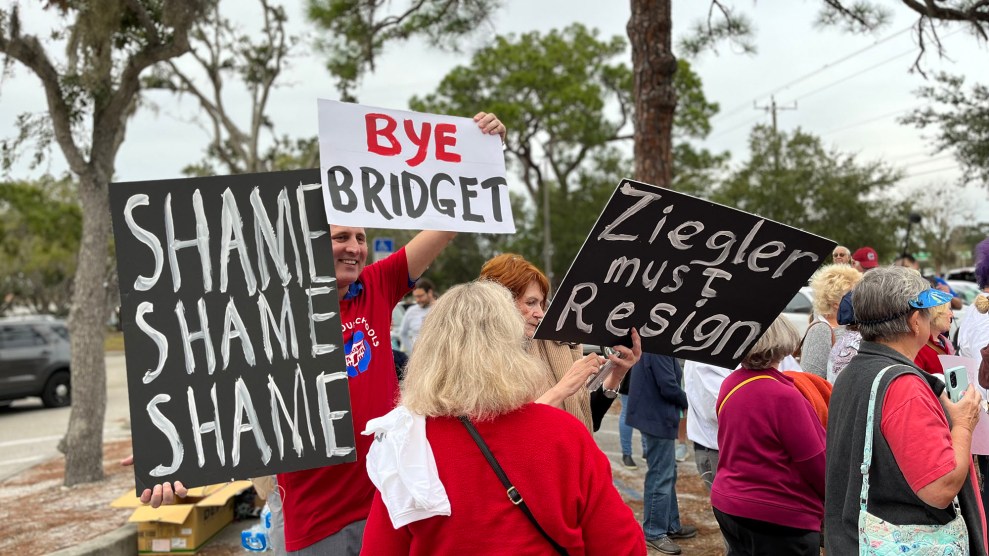
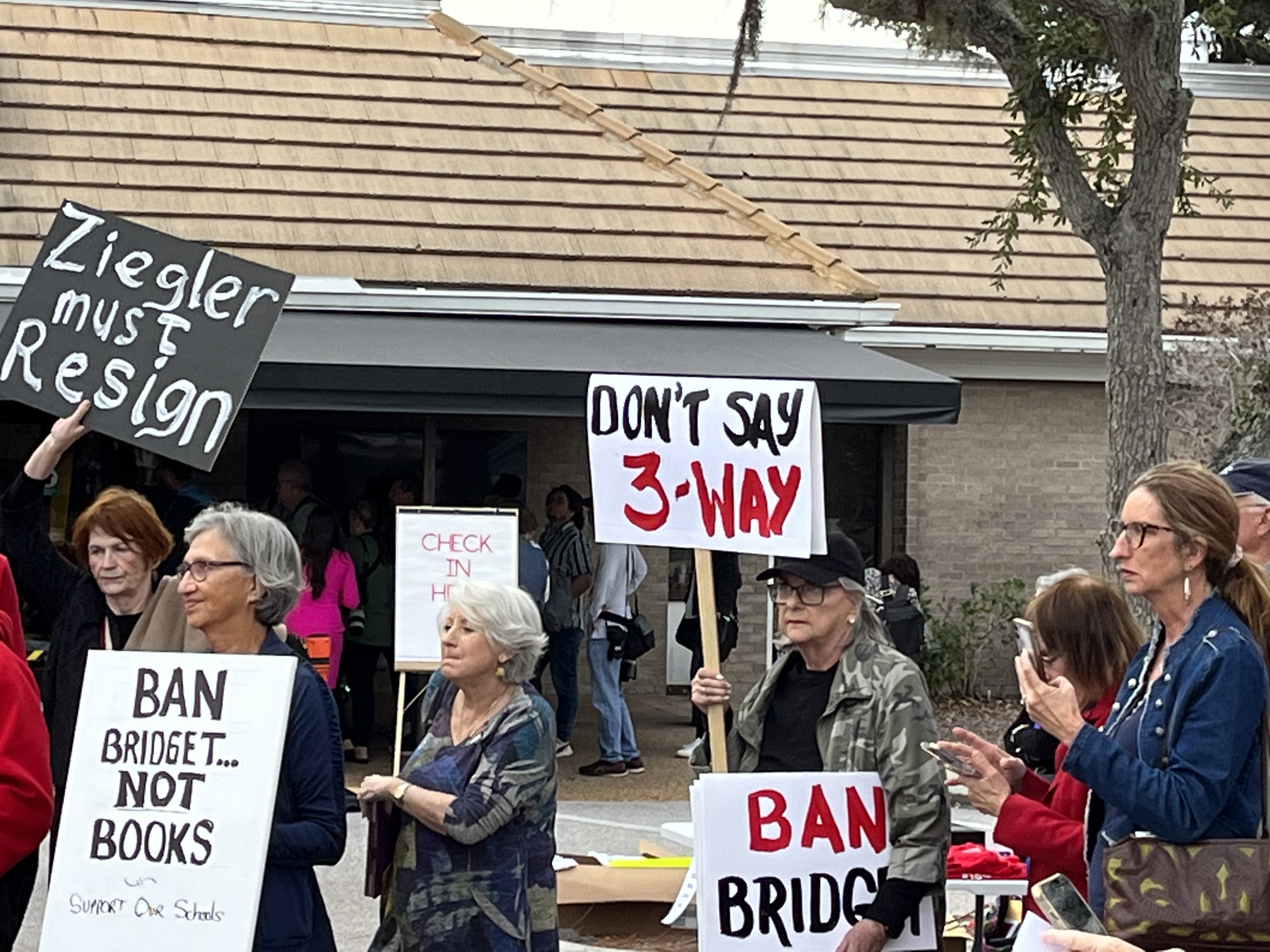
Protesters gather outside the Sarasota School Board building to urge board member Bridget Ziegler to resign. Kiera Butler
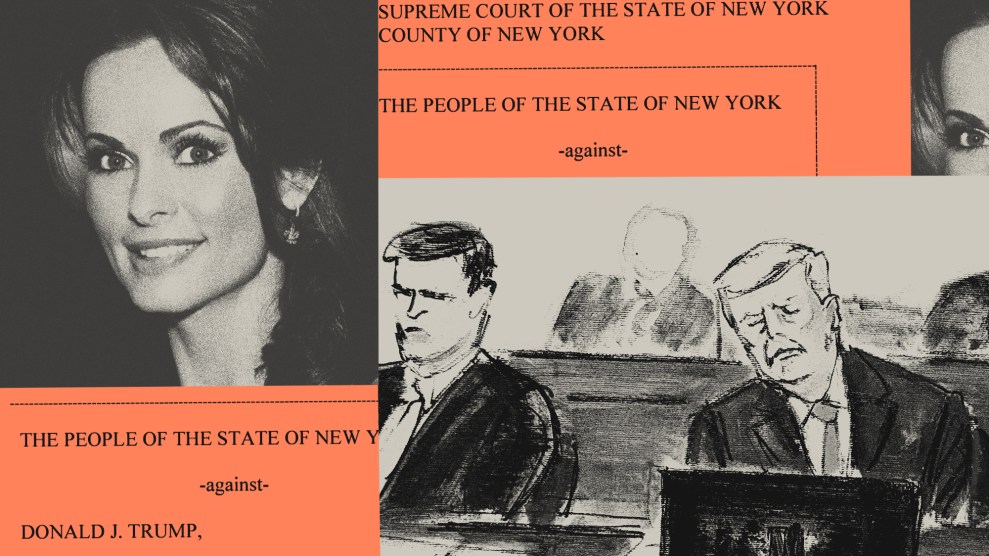
On Tuesday evening, I watched as the Sarasota School Board voted four to one in favor of the resolution to recommend that Bridget Ziegler resign in the wake of a sex scandal that has rocked the community since news of it broke earlier this month. Bridget Ziegler’s husband, Florida Republican Party chair Christian Ziegler, has been accused of raping a woman who had been involved in a previous sexual encounter with him and Bridget. Christian Ziegler has denied the accusations against him, and no charges have been made.
While the more serious criminal allegations pertain to Christian, Bridget has come under fire too because of what some perceive as hypocrisy. As I wrote in a post last week:
Bridget Ziegler, who admitted that she had been involved in a sexual encounter with her husband and the alleged victim, has been widely criticized for her outspoken opposition to LGBTQ-inclusive curriculum and books—while also being involved in a bisexual relationship. Bridget was instrumental in the creation of Florida’s so-called “Don’t Say Gay” bill, which forbids teachers in the state from talking about gender identity, and in some cases, same-sex relationships.
On Monday, before arriving in Sarasota, I spoke to teachers and parents who noted the irony. “[It’s] crazy because you have this woman and her husband who are so concerned with preventing children from hearing anything that doesn’t totally align with their values,” said Jessica Thomason. “And then it’s like, I’m having to explain a three-way to a 12-year-old this week.”
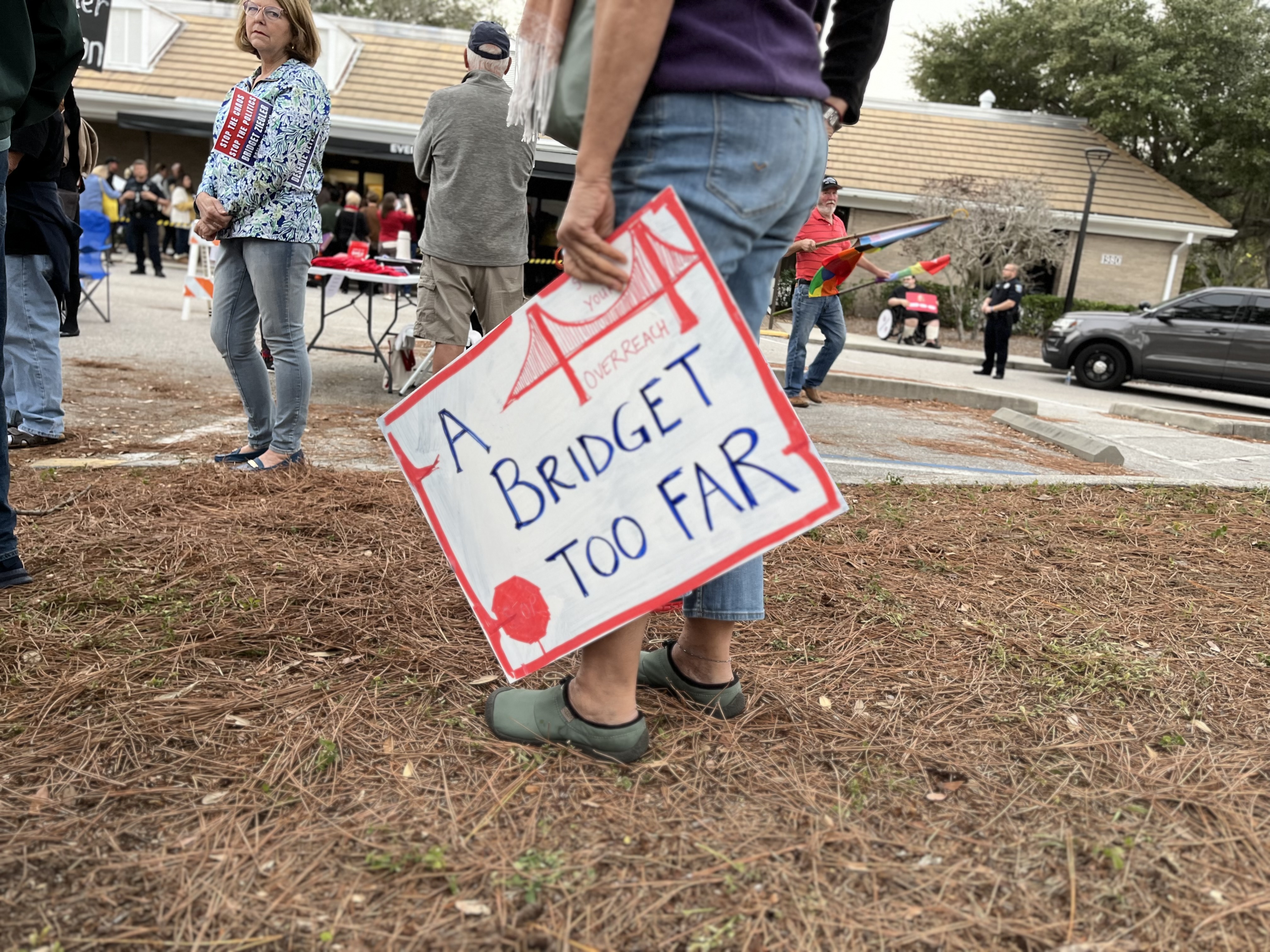
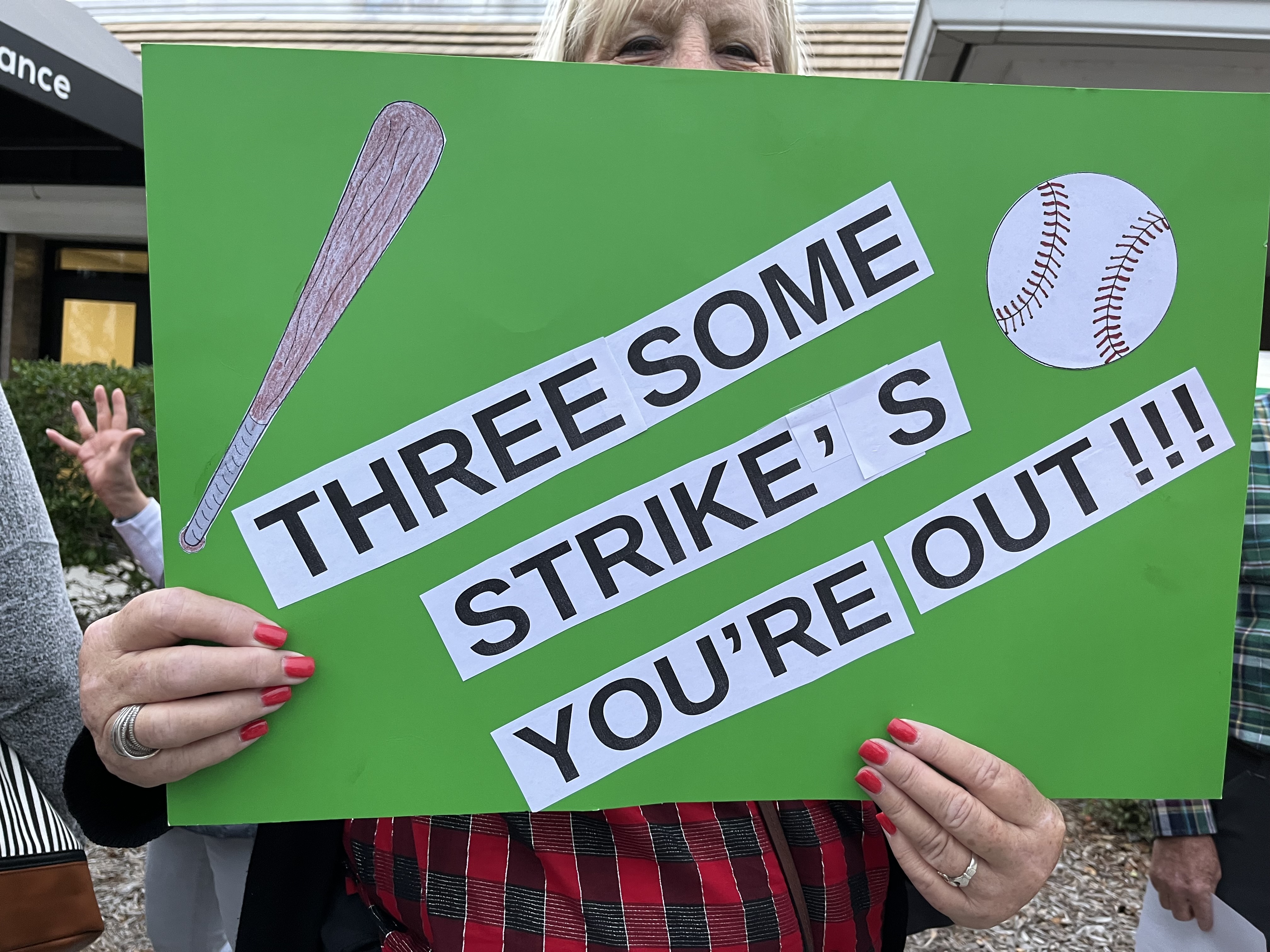
When I pulled up to the school board building about an hour before the meeting, the crowd of about 200 in the parking lot outside was jubilant. Gray-haired ladies in cardigans gleefully carried signs that read “Don’t Say Three-Way!” and “Threesome strikes, you’re out!” One jovial, bearded guy wore a T-shirt that said “Real women aren’t transphobic bigots!”
A few Bridget supporters were there, too. I spoke with a woman carrying a Bible who told me that she planned to read a verse to encourage the crowd not to pass judgment on Ziegler, and a guy with a bullhorn who told me that Bridget “wasn’t the one who illegally masked our kids during Covid.”
As the crowd lined up to register to speak during the public comment session, I drove to the home of Gail Foreman, a social studies teacher at Sarasota’s Booker High School. When I arrived, Foreman was watching the livestream of the meeting with her wife and two other teachers. We sat in the living room, which was festooned with evergreen boughs, two Christmas trees, and at least 11 Santa figurines. Foreman, clad in a rainbow tie-dye T-shirt, sat closest to the TV, cracking wise when the occasion seemed to call for it. When one of the board members offered a few mealy-mouthed words of support for Ziegler, she rolled her eyes. “Yeah, because his happy ass wouldn’t have been sitting here if not for her,” she quipped. When another guy got up to cheer Ziegler on, urging he crowd to “spare a thought for a mother of three” and bragged that he had been “canceled twice,” she yelled, “They should have canceled him a third time!”
The previous day on the phone, Foreman had told me that the “Don’t Say Gay” law had created a culture of silence among queer kids at Booker High School. Teachers felt powerless to equip students with information about sexuality and identity. On my way to the school board meeting, I stopped by Booker, which serves about 1,200 students in the North Sarasota district where Bridget Ziegler lives. Nearly three-quarters of Booker’s students are Black or brown, and more than 60 percent come from low-income families. Outside the school, as students filtered out for the day, I asked a boy with a mouthful of braces if he had been following the Ziegler drama. He had heard she had been involved in a “sex threesome,” and that she had spoken out against LGBTQ people.
“It’s hard for me as a teacher when [students] ask a question,” Foreman remarked to me on the phone. “I pause and think about it, and I say, ‘I’ll tell you what, I’m not sure if I’m gonna get in trouble.’”
From Foreman’s living room, we watched as one speaker after another took the podium. “I am here for my pound of flesh,” one speaker began her comment. “I celebrate the collapse of the Ziegler reign!” Another teared up when she spoke about her gay child, accusing Ziegler of “creating laws that ostracize, shame, and vilify” kids like hers. Another speaker demanded of Bridget, “What else are you hiding?” Foreman smirked. “Bridget’s up there going ‘blah, blah, blah,” she said.
But when a young man used his three minutes of public comment to come out as bisexual and talk about the importance of the queer role models he found at his Sarasota high school, Foreman was quiet, nodding at the screen. After he finished speaking, Foreman’s wife handed her a tissue so she could wipe her eyes.
Despite the strong criticism aimed at Bridget Ziegler during Tuesday’s meeting, she showed no sign of being ready to call it quits. During the meeting, she reminded her fellow board members that the resolution “has no teeth.” She’s right—only the governor has the authority to force her to resign. But midway through the public comment session, the two teachers who were watching the meeting with Foreman (who asked that I not use their names) told me that for the first time in years, they felt hopeful.
“We’re just starting to expose the corruption,” one said. “Stuff is finally starting to come out. Finally, the teachers aren’t the villains in the story.”
“It feels like maybe we could be going in a good direction where all of this coming to light, and all of these people who are speaking in favor of the LGBTQ community now—it’s like a moment of relief,” said the other. “Finally people might be looking at her saying, you know, maybe we went too far.”