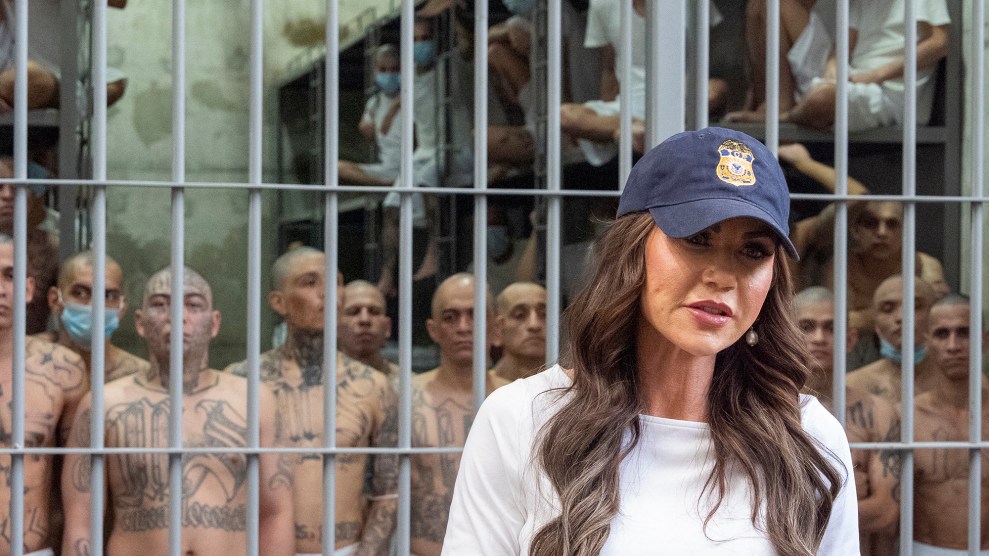
US Secretary of Homeland Security Kristi Noem speaks during a tour of the Terrorist Confinement Center (CECOT) as prisoners stand, looking out from a cell, in Tecoluca, El Salvador, on March 26, 2025.Alex Brandon/Pool/AFP/Getty
The image was grotesque.
In March, a camera-ready Kristi Noem posed in front of a group of shirtless, shaved, tattooed men crammed inside a metal holding cell in a foreign prison. The photo-op (and video message) was taken during the Homeland Security secretary’s tour of El Salvador’s Terrorism Confinement Center, where the Trump administration had sent more than 230 Venezuelan migrants on flimsy evidence. Noem’s performance at CECOT was a triumphant show of ruthlessness as well as a warning: If you’re an immigrant unlawfully present in the United States, you too could end up shipped off to another country and held in one of the world’s worst prisons—perhaps indefinitely.
The message is clear: No immigrant living in the United States is to feel safe or welcome. No one will be spared.
The administration’s apparent satisfaction in arranging the CECOT ordeal has been emblematic of the second Trump term’s ever-increasing callousness toward immigrants and willingness to treat the constraints of the law as mere suggestions. Last month, Human Rights Watch and the watchdog organization Cristosal documented evidence that the Venezuelans removed to El Salvador endured “torture” and “enforced disappearance.” (As we reported after their release, and confirmed by the report, men said that following Noem’s visit, they received more beatings and had their food taken away by the prison guards.)
That image of Noem and the saga of the Venezuelans the US government exiled to a notorious gulag—without a semblance of due process—should be seared into America’s collective memory. But in the months since it happened, and as those men are made to live with the trauma inflicted on them, I’ve wondered whether it will.
Displays of inhumanity were a normalized phenomenon in 2025. A peril of having punitive theater as a central tenet of governance is that, eventually, the shock factor and public outrage risk wearing out. The horror may never fully register. When there’s a barrage of previously-unbelievably-unconscionably-legally dubious acts and brutal policies, how does one begin to wrap their head around each uniquely reprehensible episode, let alone a year’s worth of anti-immigration cruelty?
Think of all you’ve seen this year. The same month as Noem’s video, a Tufts University student was descended on by masked men and sent to detention for the grand offense of co-writing an op-ed critical of Israel. An unknown number of people have been dragged out of cars, chased down streets, and forced to the ground during immigration raids. We’ve all watched the videos. But there are simply too many examples to keep track of; the recordings start blending into each other. The impact of individual stories starts to dilute in an overwhelming news cycle where everything is “unprecedented” and too horrific to contend with. We look away.
But the sheer volume does not stop Trump’s war on immigrants from raging on in full force. And it is vital to look at just how wide and encompassing this assault has been: This year, the White House routinely made the lives of immigrants—all immigrants—and their families in the United States hell.
This is an imperfect attempt to take stock of it.
As previously mentioned, the Trump administration disappeared hundreds of Venezuelan men to CECOT—a gulag that has elicited comparisons to a concentration camp—in brazen defiance of court orders. Noem admitted in a declaration filed last week in response to an ongoing inquiry by a federal judge in Washington, D.C. into possible criminal contempt that she made the decision to continue to fly the men to El Salvador despite a ruling blocking their transfer. (The Justice Department all but dared the judge to pursue a referral for prosecution.)
Then there is US Immigration and Customs Enforcement. The administration enabled ICE—now the most well-funded police force in the country—to snatch people up with little accountability and authorized the agency to make arrests at and near hospitals, churches, and courthouses. Masked agents began to show up at hearings and routine check-ins. The agency started recruiting so-called “Homeland Defenders” to go after immigrants for a $50,000 signing bonus. (The FBI recently issued a warning about instances of criminals impersonating ICE agents.) “Collateral arrests” of people who have lived in the United States for decades became common occurrences.
At the same time, Trump stripped immigrants of legal protections, making them newly deportable. The administration has taken away protected status from hundreds of thousands of people in what amounts to the largest de-legalization push in recent US history. They arrested, detained, and deported Dreamers—immigrants brought to the United States as children—despite valid protection from said deportation.
It goes on: Trump further gutted refugee resettlement, with the notable exception of South Africa’s white Afrikaners; banished immigrants to third countries and nations where they face potential harm (in flagrant violation of the international law principle of non-refoulement); purged the immigration courts and weaponized them as a deportation-first tool; tried to take away the citizenship of American-born children; dispatched a militarized border patrol and other federal agencies with camera crews to terrorize Democrat-led cities; and instituted a policy of mandatory detention designed to break people’s will to fight their cases. (One lawyer I talked to recently recounted a client telling him he would rather spend 10 years in prison in Venezuela than another 10 days in US immigration detention.)
Many of those measures made headlines and elicited outcry. (I’ve failed to list other events of note, I am sure.) But there are countless other ways immigrants across the United States are quietly bearing the brunt of an administration that—fighting a self-perceived battle for the survival and presevation of a blood-and-soil idea of America as a nation—demonizes entire communities and casts foreign-born people as an existential threat. (An exception? If you have $1 million lying around to purchase a “Gold Card” fast-track visa and path to residency to “unlock life in America.”)
Looking at the immigration system as a whole, virtually every part of it has been made harder and riskier, as if repurposed only to punish people for one of the most universal experiences there is: migration.
Every day, immigrants are being penalized for interacting with the legal immigration system. The Trump administration has gotten out of its way to make the citizenship civics test harder to pass while also increasing scrutiny through the expansion of a values-based “moral character” standard. They have eliminated the automatic extension of employment authorization for people renewing their work permits. Under the guise of restoring “integrity” to the system and making the country safer, they expanded the enforcement authorities of US Citizenship and Immigration Services, the agency in charge of visas and other immigration benefits, empowering special agents to make arrests.
The State Department has revoked thousands of student visas and is tightening vetting for fact-checkers and workers in the disinformation field. Following the shooting of two National Guard members in D.C. by an Afghan immigrant, the administration halted all asylum decisions, shortened the duration of work permits for various groups from five years to 18 months, ordered the review of approved green cards for immigrants from “every country of concern,” and began canceling naturalization ceremonies. Unsurprisingly, a growing share of immigrants with legal status, and even naturalized US citizens, report worries about immigration enforcement.
The message is clear: No immigrant living in the United States is to feel safe or welcome. No one will be spared. Not a college freshman visiting family on Thanksgiving. Not even the mother of the White House press secretary’s nephew. “The distinction between legal and illegal immigration becomes meaningless when both can destroy a country at its foundation,” a spokesperson for USCIS said in a press release email that landed in my inbox in November.
Much of the current immigration policymaking—if this rampant clampdown and unleashing of brutalizing force can be called that—seems to be now distilled to a simple modus operandi: we do it because we can. Little does it matter if families are separated again or if US children with cancer end up being removed from the country. Any means fit for this end: to get as many people out as possible and stop others from coming.
Every disturbing news report about a wrongful deportation or military-style raid of an apartment building should come as a reminder that the US government is using its prosecutorial discretion—it is choosing—to normalize casual cruelty and overt racism. And it’s doing so ostensibly in the name of “protecting” the American people.