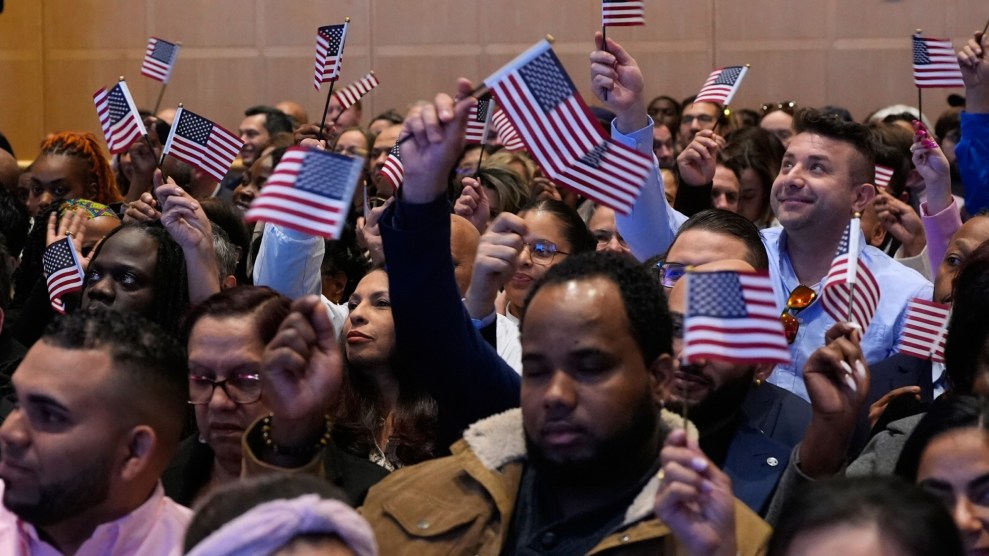
New citizens wave flags during a naturalization ceremony. Charles Krupa/AP
Not long after the shooting of two members of the National Guard in Washington D.C., Elora Mukherjee found herself contacting her clients with bad news. Mukherjee, the director of the Immigrants’ Rights Clinic at Columbia Law School, needed to tell several asylum seekers that their applications had been put on hold—indefinitely.
“These policies don’t just disrupt paperwork. They derail lives.”
Many of them had been “eagerly waiting for years to have an interview” in their cases, Mukherjee said. They hoped to finally be allowed to stay in the United States and freed from the fear of deportation, she said. But this pause “shattered” their “sense of safety and hope.”
In response to the attack—in which an Afghan immigrant has been charged with killing US Army Specialist Sarah Beckstrom and wounding Air Force Staff Sgt. Andrew Wolfe—the Trump administration moved fast, stopping the issuance of visas and asylum for nationals of Afghanistan. Then, it went a step further: indefinitely halting all asylum decisions, regardless of nationality, “pending a comprehensive review.” The Trump administration also paused the processing of immigration benefits for people from 19 countries targeted by the June travel ban.
The sweeping change in policy, legal experts and advocates say, is disproportionate. It punishes the collective for the wrongdoings of one troubled individual. The blanket restrictions are also likely to have a far broader impact beyond the groups and countries singled out by the White House. “These actions are basically shutting down the legal immigration system,” Shev Dalal-Dheini, government relations director at the American Immigration Lawyers Association, said during a briefing with reporters.
“These are not narrow, targeted shifts,” AILA’s executive director Ben Johnson said, adding that the “ripple effects” of these actions would be felt by millions of people and entire communities across the country. “These policies don’t just disrupt paperwork,” he said, “they derail lives.”
In the aftermath of the shooting, immigration lawyers have reported naturalization ceremonies and green card interviews getting canceled. Cases in which the applicant had already been interviewed, and sometimes approved, have also been paused.
Even immigrants who hold a passport from a non-banned nation—say a dual citizen of Iran and Canada—are impacted if their country of birth is one of the 19 placed on the travel ban. The list at the moment includes Afghanistan, Iran, Libya, Somalia, and Sudan. But Homeland Security Secretary Kristi Noem has also indicated it might grow to more than 30 nations.
The abrupt changes have sewn fear and put families in limbo. They have also increased the odds that people who were pursuing legal status—and had been previously vetted—might now end up in the crosshairs of immigration enforcement.
“This is about throwing sand in the gears of the entire immigration system in order to end immigration.”
Mukherjee said she has urged her clients to take every possible precaution. But it’s a Catch-22. Complying with immigration enforcement requirements risks arrest at check-in; not complying could make you a target for not following the rules.
Last week, one of her clients, an Afghan asylum seeker, showed up to immigration court in New York City for a required routine appointment only to be separated from his lawyer, taken into custody, and sent to a detention center in New Jersey.
“It’s shocking that he was arrested and detained when he was doing exactly what he was supposed to do,” Mukherjee said, explaining that the man had been paroled into the United States and had no criminal history. Writing in a recent New York Times op-ed, Mukherjee described how asylum seekers she works with and who fear persecution in their countries of origin are “gripped with terror,” unsure of whether they’ll be allowed to stay in the United States.
“Unfortunately, if you’re from Iran, Venezuela, or Afghanistan and you’ve gone through the process, now you’re put on hold, your citizenship interview is canceled…because some guy decided to do something illegal and unconscionable—shooting other people,” said Minneapolis-based attorney Paschal Nwokocha. “A big segment of our immigrant population is now having to pay because of the sin of one person.”
Prior to the shooting, the Trump administration had already ordered a review of Biden-era grants of refugee status. Now, US Citizenship and Immigration Services, the agency in charge of visas and other immigration benefits, has announced it will conduct a “full scale, rigorous reexamination of every Green Card for every alien from every country of concern.”
Immigration lawyers warn that revisiting hundreds of thousands of approved cases will burden the agency and slow down the processing of all applications, leading to even bigger backlogs, longer wait times, and potential gaps in benefits that could jeopardize people’s employment. (In many instances these are people who have been thoroughly vetted multiple times over the years.)
It also means that already-limited resources are being moved away from the adjudication and investigation of cases of actual fraud or that pose potential threat.
“There’s a larger plan at work here,” Johnson said. “This is about throwing sand in the gears of the entire immigration system in order to end immigration.”
The day after the D.C. shooting, USCIS also announced “additional national security measures,” including a new guidance that instructs officers to consider “country-specific factors as significant negative factors” when considering cases of people from the 19 countries on the travel ban. These arbitrary assessments on the basis of nationality, immigration experts say, could lead to more denials and leave little room for judicial review because the courts have given the government large deference when it comes to discretionary decisions by an immigration agency.
Another unintended consequence of the changes might be a chilling effect that discourages immigrants from coming forward to engage with the legal system, pushing them into the shadows.
“All of my clients deeply believe in the promise of America and fled to this country after suffering severe harm and fearing for their lives and the lives of their children,” Mukherjee said. “America should not close its doors and turn its back to bona fide asylum seekers who should be protected under both domestic and international law.”