




When Charlton Heston said the federal government could take his guns from his "cold, dead hands," he was referring to the ATF. Driven to act by last month's massacre at Sandy Hook Elementary School in Newtown, Connecticut, President Barack Obama on Wednesday called on Congress to pass new laws banning assault weapons and high-capacity magazines and targeting gun traffickers, and he announced 23 steps his administration is taking to better enforce existing law. With Republicans threatening to block any legislation—and some extreme GOPers calling for impeachment if Obama acts alone—reform, as could be expected, will not be easy.
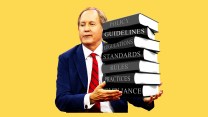
But should Obama gets what he wants, he'll face another major challenge: his own Bureau of Alcohol, Tobacco, Firearms, and Explosives. Over the last three decades, gun activists and lawmakers have purposefully hindered the ATF and carefully molded the agency that enforces gun laws to serve their own interests, stunting the ATF's budget, handicapping its regulatory authority, and keeping it effectively leaderless. The bureau Obama is counting on to lead his gun control push is a disaster…by Republican design.
The problems are obvious. The agency that Obama said "works most closely with state and local law enforcement to keep illegal guns out of the hands of criminals" has the same of number of agents as the Phoenix Police Department. Its budget has barely budged in decades (as the Department of Homeland Security has grown flush with post-9/11 funding). It has fewer investigators than it did in 1973. And its acting (and part-time) director, B. Todd Jones, commutes to work from Minneapolis, where he works full-time as a US attorney. It hasn't had a permanent director for six years. The NRA blocked Obama's earlier appointee, Andrew Traver, in part because Traver had once attended a meeting of police chiefs that focused on gun control. At the unveiling of his gun violence prevention package, Obama announced he would seek to make Jones the permanent (and presumably fulltime) chief of the ATF.
To understand how the ATF became the weakest of law enforcement agencies, you have to go back to President Ronald Reagan's first term.
The 1968 Omnibus Crime Control and Safe Streets Act, the first major piece of gun control legislation since the Capone days, led the Alcohol and Tobacco Tax Division of the Department of the Treasury to sprout a third responsibility: handguns. With the market for moonshine collapsed—due to a global spike in sugar prices—the division's primary investigative responsibility for most of its history withered. The new mandate to regulate arms sales filled the void. It also made the bureau a natural foil for the nascent gun lobby, and the NRA, whose leadership was fast transitioning from a moderate coalition of sportsmen to a band of true believers, went to work to make the agency a pariah.
[Read the full article]