In The Blogs

China's 'Great Shutdown' Is Scientific Gold

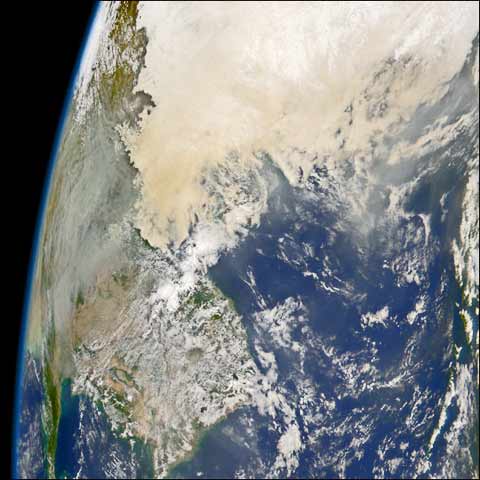
AsianBrownClouda.jpg What happens when you turn off the pollution? Well the Beijing Olympics are giving scientists a once-in-a-lifetime opportunity to observe how the atmosphere responds when a heavily populated region seriously curbs everyday industrial emissions.

Scripps Institution of Oceanography is flying unmanned aerial vehicle to measure smog and its effects on weather during China's 'Great Shutdown.' The flights start at Cheju Island in South Korea, 725 miles southeast of Beijing, and directly in the path of Chinese pollution plumes.

Data from the flights, combined with satellite and ground observations, are tracking dust, soot and other aerosols leaking out of China in atmospheric brown clouds.

Chinese officials have reduced industrial activity by as much as 30 percent and mandated cuts in automobile use by half, to safeguard the health of competing athletes.

Too bad most of Beijing's air quality doesn't have much of anything to do with its own emissions but comes from its own heavily-polluted provinces to the south. Too bad China doesn't make the Great Shutdown permanent. Too bad the whole world doesn't follow. Too bad the athletes' health is more important than everyone else's.

Julia Whitty is Mother Jones' environmental correspondent, lecturer, and 2008 winner of the Kiriyama Prize and the John Burroughs Medal Award.


image
image
Get Mother Jones by Email - Free. Like what you're reading? Get the best of MoJo three times a week.
Comments
no profile pic for comment author

Too bad most of Beijing's air quality doesn't have much of anything to do with its own emissions but comes from its own heavily-polluted provinces to the south. Too bad China doesn't make the Great Shutdown permanent. Too bad the whole world doesn't follow. Too bad the athletes' health is more important than everyone else's.

no profile pic for comment author

I just got an e-mail from my daughter in Beijing. She said the air quality is so bad that she has been coughing, sneezing and barely able to breath since she arrived on Monday. Her comments were "how on earth can athletes be expected to compete in this"? She is an athlete herself with an internal defibulator due to a genetic heart disease, I'll be relieved to have her come home. If this story is true just think what the air is like when the world isn't watching the Olympics.

no profile pic for comment author

Production of cheap products imported into the U.S. market, courtesy WalMart/Target/Kmart - made in China.

Carbon dioxide and pollution - exported to China. Courtesy of Walmart/Target/KMart. Made in China.

no profile pic for comment author

I remember reading that during the Atlanta Olympic games that automobile use in the Atlanta metropolitan region was curtailed. During that time emergency department hospital visits for Asthma dropped to near zero.

no profile pic for comment author

Well done Mother Jones. This is an excellent article, short on facts but the links are great.

Very pleased to see the add for the solar powered phone on your site too.

I'm not a deliberate Greenie but it's hard to ignore the facts. It freaks me out that there is nowhere near as many bugs in my garden as there was when I was a child. Almost no butterflies and the bees are getting rarer and rarer. So I'm glad to see articles like this.

no profile pic for comment author

I'm a "deliberate greeny," and the direction the world is headed in has been freaking me out for years, while I wait in vain for others to start freaking out too -- which is why Tom's post struck me more or less between the eyes.

How is it, that caring about the planet's health (and our own!) is somehow a weird thing that people feel they have to apologize for? I hear people make the mistake-of-scale all the time, when they take the input datum that we have "never been able to do lasting damage to the planet" (which isn't even true in itself), and extract the output datum that "therefore we never WILL be able to do lasting damage."

There have also never been nearly as MANY of us as there are now, duh. There are now so many people wanting a full (read: American) share of the planet's resources, that there is no chance for those resources to recover and renew, before they are again raped. Picture a small island supporting a flock of forty sheep in good grace. Now picture the same island with ten times that number, and you see what's happening to US! (The sheep aren't worried; there's always been enough grass, therefore there always will be enough grass.)

How many times have you heard someone say that the planet will "fix it" without any worry or stress on our part? I live in Alaska, and I've heard this PLENTY.

These folks should reflect that we've left precious little of our environment in any sort of "natural" state; whether it's mowing down the rainforests for plywood and tables, or warming the temperate zones to the point that toxic fungi start winnowing the amphibian populations down, eliminating many species altogether.

The environment gets more fragile and thin every year. Species diversity is an insurance policy for the eco-system. It supplies the flexibility to respond to imbalances. In a species-thin eco-system, each individual failure cascades further through the system, and the end equilibrium is farther from the original state, than if the life-web were rich with inter-related species that could step into each other's roles with a minimum of disturbance.

In a richly-connected system, there are more threads to hold and use the resource-energy that flows through the network; which means that resources are used well and efficiently. One organism's waste is another bread, and the result is a banquet for all. In a thinly-connected system, those resources are more likely to go "to waste" -- meaning that there are no species situated to use them, before they assume a form that's not readily usable.

Downed forests do not hold water, nor use sunlight, which means that plants and animals cannot find and use the resources that that water and sunlight would generate, if there was a rich life-web in place. Water avoids such ruined places, and the sun only heats them up. It takes massive inputs of energy (by humans) to make such places productive, and the benefit gained is far less, and far thinner, than if the existing lifewebs were simply respected, nurtured and incorporated into the scheme of what we also need, to get by.

Etc. etc. Why is this a mystery to people?

And... there are now six billiooo,ooo,ooon of us on the planet, each wanting shelter, furnishings, cars, fridges, televisions, computers, clothes, and cruise vacations.

Oh yeah, and food too. Lots and lots of food. Grown on soils that we're losing to erosion, sending it to the floors of the oceans, along with megatons of the fertilizers that killed the soil, and loosened it to run off with the rains.

The parade of extinctions continues, as well, seemingly invisible to us, because we live our lives out in mere decades, and don't get it that the elimination of hundreds of species per year is a full-blown catastrophy. Future archeologists may have a puzzle to determine if the presently on-going extinctions were caused by human action, or by a massive comet-strike -- they will be so drastic and sudden in the fossil record.

The entire planetary bio-system is much less diverse now than it was even ten years ago. There is less and less capability for correction of imbalances. Oceanic dead-zones are now endemic in some places, causing mass die-offs of already-thinned fish populations. And we don't have much of a clue how to fix such things, except by ending the outfall of wastes and run-off fertilizers.

But do you see us panicking? No. We just turn the channel to some sexy legs and forget all about it. After all, Earth has always fixed our screw-ups,right? It's more important for us to keep driving and burning carbon, than to get all worked up about a non-issue like rampant mass extinctions.

There are six billiooo,ooo,ooon of us now, and (lots!) more on the way. But we're too busy making money and burning through our resources, to make sure our descendents will have food to eat.

no profile pic for comment author

I'm disappointed that China has taken the "short term profit" road to joining the global marketplace instead of learning from our mistakes. China--with the kind of outstanding scientists that have studied here at CalTech and MIT--ought to be looking at ways to leapfrog over heavily polluting industrialization that have earmarked the West (including the former USSR).

Post a comment
Alternately, you may login to or register an account
The content of this field is kept private and will not be shown publicly.
  • Web page addresses and e-mail addresses turn into links automatically.
  • Allowed HTML tags: <a> <ul> <ol> <li> <blockquote> <img>
  • Lines and paragraphs break automatically.

More information about formatting options


Jail.org - Inmate Search
Criminal records, instant public records & people search & current court records. www.jail.org

U.S. Public Records Search
Search County & State Court Records, Criminal records, Vital and Adoption Records www.PublicRecordsInfo.com

Records.com - People Search
Public Records and Background Checks. Instantly Search Criminal Records, Addresses and Court Records www.Records.com

Court Records & County Records
Find Instant Public Records, Criminal Records as Well as County Property Records Search. www.PublicRecordsIndex.com

The HIV Mythology
A former AIDS patient reveals the HIV/AIDS deception

TalkBackTees.com
A treasure trove of liberal wit, wisdom and quotations, from ancient to modern, on colorful, cotton tees.

Support Independent Artists
Amazing art, crafts, apparel, paper-goods and more. A carefully curated selection of sundries since 1999.

FREE CONNECTIONS FOR GREEN SINGLES
Meet progressive singles in the environmental, vegetarian & animal rights community who share your values