Photograph: James Whitlow Delano
WESTBOUND ON THE EASTBOUND BEIJING EXPRESSWAY
Long before Mr. Zhang’s crowning highway maneuver, I’d realized that his flamboyant unpredictability was an asset. I’d hired him as driver and guide for a three-day trip from Beijing to Inner Mongolia on the recommendation of a Chinese environmentalist who’d enumerated all of Mr. Zhang’s virtues except the most important—his suppleness under pressure, which would enable us to overcome the obstacles that are a constant feature of travel in China.
Of course, Mr. Zhang’s chief qualification was that he was an environmentalist, or, more precisely, a fellow environmental-disaster tracker. Now, having toured choked rivers, depleted forests, and grasslands that had ceded to encroaching deserts, we were near the end of our trip, with nothing in front of us but a two-hour jaunt down the broad, brutish Beijing Badaling Expressway to the capital. Ms. Lei, my delicate translator, had announced her wish to get back to Beijing before her four-year-old boy went to bed, and we were running late. Mr. Zhang’s swashbuckling solution was a “shortcut”: Instead of fighting his way along the paved, but circuitous, road to the highway, he sped down a narrow dirt path that held the promise of providing a more direct route. Within minutes he was doubling back on himself, loudly grinding gears as he cut through dust-shrouded cornfields and drought-stricken cherry orchards while peasants leaped out of our way and into the foliage. By the time Mr. Zhang found the expressway, the shortcut had cost us an hour.
I already knew that China’s roads are some of the world’s most dangerous. A quarter of a million people die on them each year—6 times as many as in the United States, even though Americans possess 18 times as many cars—and the entire system is plagued with soul-withering traffic jams prompted by police inspectors who extract “fees” from coal-truck drivers. Lines of trucks often extend behind inspection stations for miles; truckers have waited in them for as long as two weeks.
And now we couldn’t get on the expressway because traffic was at a standstill behind a toll station. An abhorrer of inertia, Mr. Zhang cut across six lanes to the only booth with a short line and cockily paid the toll. For a moment we basked in his nascarish dexterity. Then he slammed on the brakes. In front of us, the road was clogged with coal trucks lined up behind an inspection station far down the road. We’d been funneled into a classic Chinese bottleneck.
Unfazed, Mr. Zhang made a 180-degree turn and headed west on the eastbound expressway. I braced for the inevitable crash. Then, just before we regained the toll station, he swung right and headed for the center divider, past a gigantic, disabled semi stuck perpendicularly to the flow of cars. The half-dozen policemen who stood around the truck gave no sign of noticing us. Through a gap in the divider, Mr. Zhang found an eastbound lane reserved for passenger cars and turned into it; as we sped toward Beijing, we saw that the line of motionless coal trucks extended for miles. Drivers dozed or ate dinner on top of their cargo. On this tottering foundation, the world’s most dynamic economy has been erected. What globalization offers, it also takes away.
THE PEOPLE’S REVOLUTION
In 2005, there were nearly 1,000 pollution-related protests a week in China, and the numbers have only increased since. The protesters run the social gamut, from impoverished villagers to the urban middle class. The government’s response has been similarly varied, ranging from killing and beating protesters to launching investigations into the worst offenders.
Spring 2005: 30,000 villagers overturn buses, beat officials, and burn squad cars after police dismantle barricades set up by elderly protesters on a road to 13 polluting chemical plants.
July 2005: Protesting a pharmaceutical plant, hundreds of residents of the booming factory province Zhejiang riot for three nights. “They are making poisonous chemicals for foreigners that the foreigners don’t dare produce in their own countries,” a demonstrator tells reporters. “It is better to die now, forcing them out, than to die of a slow suicide.”
December 2005: In the fishing village of Dongzhou, police kill up to 30 residents protesting a new coal-fired power plant.
January 2006: During weeklong riots against preferential zoning for chemical and garment factories, 60 Guangdong Province villagers are injured and one—a 13-year-old girl—is killed by police toting automatic weapons and electric batons.
Fall 2006: Villagers from seven Gansu Province towns protest for months against local zinc and iron smelters; half of the 5,000 villagers exhibit high levels of lead in their blood.
June 2007: Up to 20,000 middle-class Chinese congregate outside the city government headquarters in Xiamen to protest a proposed chemical factory. The protesters were alerted by an anonymous cell phone text message (rumored to have been sent by Xiamen University professors and students). The city cracks down on anonymous web posting.
July 2007: Farmers near Mount Emei in Sichuan Province block a highway, demanding $1.1 million in damages from an aluminum company they claim contaminated crops. Ten are injured and five detained when police clear the road.
—Jen Phillips
CHINA EATS THE WORLD
the emergence of China as a dominant economic power is an epochal event, as significant as the United States’ ascendancy after World War II. It is in many ways an astonishment, starting with the ideological about-face that enabled it, the throwing over of Maoist values for plainly capitalist ones starting in the late 1970s. So thorough is the change that the 19-foot-tall portrait of a stolid, potato-faced Mao Zedong that still looms over traffic-choked, commerce-suffused Tiananmen Square looks paradoxical, even startling, in seeming need of an update in which Mao winks—or sobs—in blinking neon. Meanwhile, inside Beijing’s Forbidden City, the heart of old China, buildings with such intoxicating names as Hall of Preserved Harmony and Palace of Heavenly Purity bear signs reading, “Made Possible by the American Express Company.”
The grander astonishment is the most massive and rapid redistribution of the earth’s resources in human history. In a mere two and a half decades, China has awakened from Maoist stagnancy to become the world’s manufacturer. Among the planet’s 193 nations, it is now first in production of coal, steel, cement, and 10 kinds of metal; it produces half the world’s cameras and nearly a third of its TVs, and by 2015 may produce the most cars. It boasts factories that can accommodate 200,000 workers, and towns that make 60 percent of the world’s buttons, half the world’s silk neckties, and half the world’s fireworks, respectively.
China has also become a ravenous consumer. Its appetite for raw materials drives up international commodity prices and shipping rates while its middle class, projected to jump from fewer than 100 million people now to 700 million by 2020, is learning the gratifications of consumerism. China is by a wide margin the leading importer of a cornucopia of commodities, including iron ore, steel, copper, tin, zinc, aluminum, and nickel. It is the world’s biggest consumer of coal, refrigerators, grain, cell phones, fertilizer, and television sets. It not only leads the world in coal consumption, with 2.5 billion tons in 2006, but uses more than the next three highest-ranked nations—the United States, Russia, and India—combined. China uses half the world’s steel and concrete and will probably construct half the world’s new buildings over the next decade. So omnivorous is the Chinese appetite for imports that when the country ran short of scrap metal in early 2004, manhole covers disappeared from cities all over the world—Chicago lost 150 in a month. And the Chinese are not just vast consumers, but conspicuous ones, as evidenced by the presence in Beijing of dealers representing every luxury-car manufacturer in the world. Sales of Porsches, Ferraris, and Maseratis have flourished, even though their owners have no opportunity to test their finely tuned cars’ performance on the city’s clotted roads.
The catch is that China has become not just the world’s manufacturer but also its despoiler, on a scale as monumental as its economic expansion. Chinese ecosystems were already dreadfully compromised before the Communist Party took power in 1949, but Mao managed to accelerate their destruction. With one stroke he launched the “backyard furnace” campaign, in which some 90 million peasants became grassroots steel smelters; to fuel the furnaces, villagers cut down a 10th of China’s trees in a few months. The steel ultimately proved unusable. With another stroke, Mao perpetrated the “Kill the Four Pests” campaign, inducing the mass slaughter of millions of sparrows and a subsequent explosion in the locust population. The destruction of forests led to erosion and the spread of deserts, and the locust resurgence prompted a collapse of the nation’s grain crop. The result was history’s greatest famine, in which 30 to 50 million Chinese died.
Yet the Mao era’s ecological devastation pales next to that of China’s current industrialization. A fourth of the country is now desert. More than three-fourths of its forests have disappeared. Acid rain falls on a third of China’s landmass, tainting soil, water, and food. Excessive use of groundwater has caused land to sink in at least 96 Chinese cities, producing an estimated $12.9 billion in economic losses in Shanghai alone. Each year, uncontrollable underground fires, sometimes triggered by lightning and mining accidents, consume 200 million tons of coal, contributing massively to global warming. A miasma of lead, mercury, sulfur dioxide, and other elements of coal-burning and car exhaust hovers over most Chinese cities; of the world’s 20 most polluted cities, 16 are Chinese.
The government estimates that 400,000 people die prematurely from respiratory illnesses each year, and health care costs for premature death and disability related to air pollution is estimated at up to 4 percent of the country’s gross domestic product. Four-fifths of the length of China’s rivers are too polluted for fish. Half the population—600 or 700 million people—drinks water contaminated with animal and human waste. Into Asia’s longest river, the Yangtze, the nation annually dumps a billion tons of untreated sewage; some scientists fear the river will die within a few years. Drained by cities and factories all over northern China, the Yellow River, whose cataclysmic floods earned it a reputation as the world’s most dangerous natural feature, now flows to its mouth feebly, if at all. China generates a third of the world’s garbage, most of which goes untreated. Meanwhile, roughly 70 percent of the world’s discarded computers and electronic equipment ends up in China, where it is scavenged for usable parts and then abandoned, polluting soil and groundwater with toxic metals.
Though government-run and heavily censored, the English-language China Daily has reported that pollution problems caused 50,000 disputes and protests throughout China in 2005. If unchecked, the devastation will not just put an abrupt end to China’s economic growth, but, in concert with other environmentally heedless nations (in particular, the United States, India, and Brazil), will cause mortal havoc in societies and ecosystems throughout the world.
The process is already under way. During the Mao era, the People’s Liberation Army ritualistically fired shells at the Taiwan-controlled island of Quemoy; now, the mainland spews garbage that floats across the mile-and-a-quarter-wide channel and washes up on Quemoy’s beaches at the rate of 800 metric tons a year. Acid rain caused by China’s sulfur-dioxide emissions severely damages forests and watersheds in Korea and Japan and impairs air quality in the United States. Every major river system flowing out of China is threatened with one sort of cataclysm or another, including pollution (Amur), damming (Mekong, Salween), diverting (Brahmaputra), and melting of the glacial source (Mekong, Salween, Brahmaputra). The surge in untreated waste and agricultural runoff pouring into the Yellow and China Seas has caused frequent fish die-offs and red-tide outbreaks, and overfishing is endangering many ocean species. The growing Chinese taste for furs and exotic foods and pets is devastating neighboring countries’ populations of gazelles, marmots, foxes, wolves, snow leopards, ibexes, turtles, snakes, egrets, and parrots, while its appetite for shark fin soup is causing drastic declines in shark populations throughout the oceans; according to a study published in Science in March 2007, the absence of the oceans’ top predators is causing a resurgence of skates and rays, which are in turn destroying scallop fisheries along America’s Eastern Seaboard. China’s new predilection for sushi is even pricing Japan out of the market for bluefin tuna. Enthusiasm for traditional Chinese medicine, including its alleged aphrodisiacs, is causing huge declines in populations of hundreds of animals hunted for their organs—including tigers, pangolins, musk deer, sea horses, and sea dragons. Seeking oil, timber, gold, copper, cobalt, uranium, and other natural resources, China is building massive roads, bridges, and dams throughout Africa, often disregarding international environmental and social standards. Finally, China overtook the United States as the world’s leading emitter of CO2 in 2006, according to the Netherlands Environmental Assessment Agency.
All this is common knowledge among the scholars and activists who follow Chinese environmental trends. The news, however, has not yet shaken China out of its money-induced euphoria. One indication is that China’s 10 percent growth rate takes no account of the environmental devastation the boom has caused. In June 2006, an official at China’s State Council said environmental damage (everything from crop loss to health care costs) was costing 10 percent of its gross domestic product—in other words, all of the economy’s celebrated growth. Vaclav Smil, a highly respected China scholar at the University of Manitoba, pegs the environmental-damage rate at between 5 and 15 percent, with 7 percent a “solid, defensible figure.” Smil says that shorn of hype, China’s growth rate is also likely 7 percent, “so basically every year environmental damage wipes out the gdp growth.”
LOOKING FOR TROUBLE
for a daredevil, Mr. Zhang looked surprisingly bland. Closely trimmed hair, receding at the temples, crowned his smoothly oval 45-year-old face, and on all four days of our acquaintance he wore the same gray, odorless T-shirt. To sustain his family, Mr. Zhang works freelance as a telecommunications engineer—his current project, he said, was designing a mobile security system for the 2008 Beijing Olympic Games. Freelancing allows him to pursue his real passion: water. He’s tracked Beijing’s numerous waterways and carries in his head a map of them in all their polluted, obstructed, and diverted complexity. Together, they reveal the capital’s fragility. Now he treated me to a sampling of his discoveries: It was the inverse of the typical tourist’s treacly junket, a passage through the region’s environmentally degraded places.
To achieve this, Mr. Zhang eschewed not just highways but, for long stretches, anything paved. He clearly had such adventures in mind when he bought his vehicle, a primordial two-wheel-drive suv made by the Great Wall Motor Company. Having reached Beijing’s Tong Hui canal, Mr. Zhang gleefully bounced us down a dirt path overlooking it. On one side were the makeshift settlements of some of Beijing’s legions of migrant laborers, and on the other, the cement-lined, nearly waterless channel. Mr. Zhang pointed to a slightly viscous liquid issuing from a foot-wide pipe on the opposite bank and declared that this marked the first entrance of raw sewage into the canal; from this point on, he said, all the sewage entering the channel, including the squatters’ own waste, was untreated. Far downstream, the canal’s water merges with the Hai River, one of China’s most polluted waterways.
On the city’s outskirts, we stopped at a gas station, whose attendants told Mr. Zhang that a nearby beer factory had sucked up enough groundwater to lower the local water table by 40 or 50 yards. We took a bridge across a riverbed so dry that the grass in it had turned yellow. After driving alongside the Mi Yun reservoir—Beijing’s last remaining reliable source of water, which has dropped more than 50 feet since 1993—we passed a sign reading, “Looking for someone to drill a well?”
At midday we ascended the Jundu Mountains, the low, jagged range north of Beijing. The twisting road offered frequent glimpses of precarious, crest-top outcroppings of the former world wonder, the Great Wall—obscured by the haze, it looked diminished by China’s new scale. At last we stopped for lunch at a rustic, thick-walled restaurant with cigarette butts on the floor. Mr. Zhang objected to the disposable chopsticks we were offered—whole forests are succumbing to China’s consumption of 45 billion pairs of chopsticks per year—and demanded washable ones. The daintily manicured Ms. Lei was more worried by the restaurant’s indeterminate hygiene, and stuck with the disposables. Reluctantly, so did I.
BEIJING GOES GREEN
In preparation for the Olympic Games, China has spent $3.6 billion and taken some radical, and sometimes loony, steps to clean up the capital.
TRANSIT
Four new subways are being built; fares cut 33% to 27¢. In August, 1.3 million cars were banned for four days. Subway ridership increased by 30%, and pollution was reduced by 20%. A million vehicles will be banned for the entire Olympics. 54,000 taxis and buses have been kicked off the road due to new emissions restrictions. Beijing now has a fleet of compressed-natural-gas buses, and by the Games will be using battery-powered garbage trucks.
GREENWAYS
More than 50 percent of Beijing is now “green areas,” including 20 nature reserves. 33 million trees have been planted along Beijing’s highways and rivers. But a mountain was destroyed to provide the soil.
WEATHER MODIFICATION
135 “rainmakers” at 22 sites around the city have been enlisted to shoot clouds approaching Beijing with silver iodide in a cloud-seeding operation. “If rain clouds are headed toward the Olympic stadium, we will intercept them,” one official said.
FACTORIES
200 factories and steel mills have been relocated outside the city, already the origin of most of Beijing’s particulate matter. Hebei Province is spending $2.8 billion to build six air-quality monitoring stations and install scrubbers in 34 power plants.
INSECT CONTROL
The city aims to increase bird and ladybug populations. Hoping to eliminate 80% of Beijing’s insects, two farmers have volunteered to stake out parks and toilets, videotaping flies to learn their behavior and best eradication methods.
GROUP EFFORT
Bureaucrats told to wear short sleeves to reduce need for AC. Volunteers with the Green Woodpecker Project are trying to persuade Chinese to stop spitting, and videotaping those who persist in order to shame them.
—Jen Phillips
By now I’d realized that Mr. Zhang had only a vague idea of the location of the newly formed Inner Mongolian desert that I’d hired him to take me to. As backup, he stopped at a cluster of houses in Fengning County, Hebei Province, that had been engulfed in an April 2001 sandstorm. Residents told us how the sand penetrated their houses and got into their food, clothes, eyes, and mouths. Many just left: One village’s population, about 200 people in 2001, is now half that.
By the end of our visit, evening had set in, and Mr. Zhang realized he’d locked his keys inside the car. An hour passed while he tried increasingly improbable but inventive stratagems for opening the doors, finally removing the car’s front bumper so he could open the hood and disable the car’s electronic lock system—to no avail. Ms. Lei and I were getting cold and irritable. By the time Mr. Zhang shaped a snag out of a windshield wiper and successfully hooked an inside lock, he looked thoroughly beleaguered. At last back on the road and out of options for spending the night, we came across a karaoke inn near the top of the mountain pass that would take us to Inner Mongolia. We slept in bare, cold rooms as disembodied, dissonant karaoke strains floated up from the floor below.
PULP NONFICTION
no sector better illustrates the vast reach and explosive impacts of China’s manufacturing dominance than logging. At one end are the consumers in the United States, Europe, Japan, and China itself, who are mostly oblivious to the social and environmental destruction left by the Chinese-made furniture, plywood, moldings, and flooring they buy.
At the other end are the wood suppliers, almost all poor countries with weak or corrupt law enforcement and a flourishing trade in illegal lumber. Among China’s leading wood importers, Thailand and the Philippines have already been stripped of their natural forests; Indonesia and Burma are projected to lose theirs within a decade. Papua New Guinea’s will succumb within 16 years, and the vast forests of the Russian Far East will survive no more than two decades. Even so, Forest Trends, a Washington-based nonprofit, estimates that China’s wood imports will probably double over the next decade. Chinese manufacturers are already developing replacement sources in Africa, and South America’s forests are under threat for a different reason: China’s growing consumption of pork and chicken is fed by soybeans grown on newly cleared Amazonian land; by one estimate, 30 percent of the jungle could eventually be transformed into soybean fields.
In the middle is China, the world’s workshop, now both the planet’s leading wood importer and exporter, supplying more than 30 percent of the international furniture trade. Hundreds of sawmills line China’s northeastern border to process softwood logs harvested in Russia, while a port north of Shanghai called Zhangjiagang, described by the British watchdog group Environmental Investigation Agency as “a sleepy backwater” in 2000, grew to become “probably the largest trading centre for tropical logs in the world” by 2005—by then, at least half a billion dollars in wood passed through it annually, according to Chinese customs figures. From the port, many of the logs are transported two hours by road to the town of Nanxun, another former hinterland that the eia calls “the wood flooring centre of the world,” with more than 500 flooring factories.
Until 1998, China fed its wood mills trees from its own forests. That year, the middle reaches of the Yangtze River swelled with the region’s biggest flood in more than 50 years, killing 3,000 people, destroying 5 million homes, and engulfing 52 million acres of land. As winter approached months later, 14 million were still homeless. The land, it turned out, had no defense against erosion left. Lakes and wetlands that once would have absorbed some of the rain had been drained to create farmland, and the forests that once held topsoil in place had been harvested. Torrential rainwater carried the topsoil to the river and then down it, until its bed swelled with new sediment and the floodwater rose above its banks. As a result, China declared a logging ban on what little remained of its old-growth forests. Most environmentalists applauded the ban until they grasped its corollary: Chinese companies began harvesting other countries’ trees on an even grander scale.
Most of the world’s remaining natural forests are formally protected by law and regulation, but enforcement is generally corrupt and ineffectual. Thus, the planet’s deforestation problem is largely one of illicit logging, and China is the world’s leading importer of illegally logged wood. Chinese wood purchases have also helped finance armed conflicts conducted by such international pariahs as Cambodia’s Khmer Rouge, Burma’s military government, and the now-deposed regime of Liberia’s Charles Taylor. “China is the number one buyer of timber from many of the countries most affected by the scourge of illegal logging,” the eia reported in 2005. The largest supplier of timber to China is Russia, where an estimated half of all logging is illegal. In Siberia, pine forests are largely protected unless damaged by fire, so loggers intent on exporting wood to China routinely set the woods ablaze.
In Indonesia, the rate of illegal logging has sometimes reached as high as 80 percent. From there, logging syndicates plied what the eia calls “perhaps the largest and most destructive single trade route of stolen timber in the world,” from the forests of Indonesia’s Papua Province (which comprises most of the eastern half of New Guinea), often through Malaysia, where export documents are forged, to wood factories on China’s southern and central coast. It’s indicative of the injustice perpetrated by illegal logging that when prized tropical hardwood trees called merbau were cut down in Papua in 2004, locals were paid $11 per cubic meter; when the logs reached China, their value increased to $240 per cubic meter; by the time they arrived in the United States or Europe as flooring, they brought $2,288 per cubic meter. Most of the profit falls to high-living timber barons running smuggling syndicates out of Jakarta, Singapore, and Hong Kong. They receive support from Indonesian military and police officials who often invest in smuggling operations themselves or, if not, are bribed to facilitate them.
In addition to its many other devastating effects—species extinction, the spread of disease and poverty—deforestation dramatically speeds up climate change. Not only do cut trees no longer absorb carbon, but they release (either slowly, or, in the case of Siberian fires, rapidly) the carbon they’d sequestered. Thus, deforestation accounts for 18 percent of the world’s greenhouse gas emissions—a rate higher than the global transportation sector’s, pegged at 14 percent. The staggering rate of deforestation in poor, nonindustrial Indonesia places the country third among the world’s emitters, after the United States and China.
While Indonesia and the other supplier countries endure the effects of deforestation, the countries that benefit from it behave as if the problem is not of their making. Thus China has signed both multilateral and bilateral commitments to halt imports of illegal wood but failed to enforce them. And George W. Bush’s “President’s Initiative Against Illegal Logging,” announced to much fanfare in July 2003, doesn’t even propose to ban American imports of illegally cut wood, but rather focuses on helping supplier countries combat illegal harvesting.
An end to American and European purchases of products made from illegally cut wood—still retailed by such companies as Ikea, Home Depot, and Armstrong (see “Timber Line”)—would certainly reduce the destruction of tropical forests, as half the tropical wood that enters China is reexported as finished products. Even so, about 90 percent of all Chinese-manufactured wood products are consumed within China. This is alarming, for per-capita consumption of wood products is still far below that in developed countries, and is likely to grow as the middle class expands. China’s per-capita consumption of paper, for example, is now only an eighth of the United States’; if it reaches the American rate, pulp suppliers will have to double the world’s current annual timber harvest. As Greenpeace argues in a 2006 report titled “Sharing the Blame,” “The world’s forests cannot support either the level of consumption of developed countries, or the aspiration of developing countries to attain a similar level.”
ON THE ROAD AGAIN
mr. zhang said he had a friend who might be able to help us find desertified land, but he wasn’t sure the friend still lived in Inner Mongolia. On that faint hope, we descended the pass and found ourselves in a vast flatness. We drove through urban developments bursting with the excitement of sudden affluence, all flash and tackiness, new and decrepit at the same time. Mr. Zhang found his way with the aid of a dashboard gps system he consulted about once a minute while proclaiming that all such Western devices focus on details at the expense of the whole and are therefore deceptive. Indeed, the primacy of Eastern thought was one of his favorite themes, a point on which he probably spoke for many Chinese: Even as the Chinese transform their economy by embracing Western methods, they never stop believing that their civilization is superior.
At last Mr. Zhang arrived at what looked like an aspiring commercial development, a few yurtish structures atop a partially paved but otherwise featureless expanse. Mr. Zhang quickly determined that his friend had moved away, but the man he asked proved just as valuable. He was a local grassland-management official, a Communist Party member, who happened to know of recently desertified land only a three-hour drive away. What’s more, after futilely trying to give Mr. Zhang directions to the area, he agreed to drive us there himself.
TIMBER LINE
China’s timber exports, about 40 percent of which goes to the United States, exceed $17 billion. But while some furniture and building-supply stores have agreed in theory to buy only wood certified by the Forest Stewardship Council as sustainably and legally harvested, implementation is another story.
Ikea: The chain buys a quarter of its furniture stock from China, which imports wood from Russia. A recent Washington Post investigation found that even though about half the wood from Russia is illegally harvested, Ikea employs only two foresters in China and three in Russia to track the origins of its wood. A company official acknowledged that the expense of guaranteeing its wood’s legality is prohibitive. Ikea has a goal that by 2009, at least 30 percent of its wood will be certified. Currently, only 4 percent of the wood used in its Chinese factories passes that test.
Home Depot: Only 5 percent of its wood products are made from certified timber.
Armstrong Floor Products: Sells endangered Indonesian merbau, and declines to join the certification plan.
—J.L.
Mr. Zhang looked relieved. “I always have good luck!” he exclaimed as he ushered the official behind the Great Wall’s wheel and stationed himself in the passenger seat. The official was decked out in rumpled black pants slung low beneath his belly, a broadly striped, red and brown T-shirt that evoked a beach vacation, and a white baseball cap graced with a Nike swoosh, worn significantly askew. He proceeded to inhale the first of an unending chain of cigarettes—not surprising in a country that produces 2 trillion cigarettes a year for its 360 million smokers.
He spoke with candor, something rare in relations between Chinese authorities and American journalists. All he asked in return was that I not use his name, a request I am honoring by calling him Mr. Li. True to China’s entrepreneurial spirit, Mr. Zhang soon proposed a joint business venture, and Mr. Li looked interested.
Between bouts of business talk, I learned that the region’s environmental decline began during the Cultural Revolution, when too many sheep were raised and too many trees were felled. As capitalism gained momentum in the 1980s, Mr. Li said, peasants needed wood for fences to demarcate their newly privatized fields, and tree cutting accelerated. At the same time, the government dispersed many Han Chinese into the traditionally Mongolian province—to the point that it is now 80 percent Han. The grassland succumbed to the intensified grazing, and storms threw sand across the landscape.
“Every time there’s a dust storm, it feels as if the sky is falling,” Mr. Li said. “It smells like the earth. You have earth in you.” It is decidedly not good earth, either: It causes respiratory and skin diseases among the human inhabitants and their livestock. He displayed his hands, riddled with cuts and cracks.
After a while, Mr. Li parried my questions with some of his own. How many times had I been married? Just once, I said. What did I think of China? Wonderful, I answered diplomatically, and asked him what he thought of the United States. Very, very carefully, he answered, “I know that Americans care about justice.”
As we drove, the grassland gave way to sand dunes, until the terrain looked like the inverse of a golf course: monstrous sand traps the size of fairways, occasionally interrupted by sparse tufts of grass. The road steadily deteriorated and at times disappeared into the dunes, which Mr. Li negotiated by spinning the wheel like a sea captain through towering waves. Inevitably, the car got stuck, and three of us pushed it out. Mr. Li assured us that at our destination the desertification was much worse.
TRADE WINDS
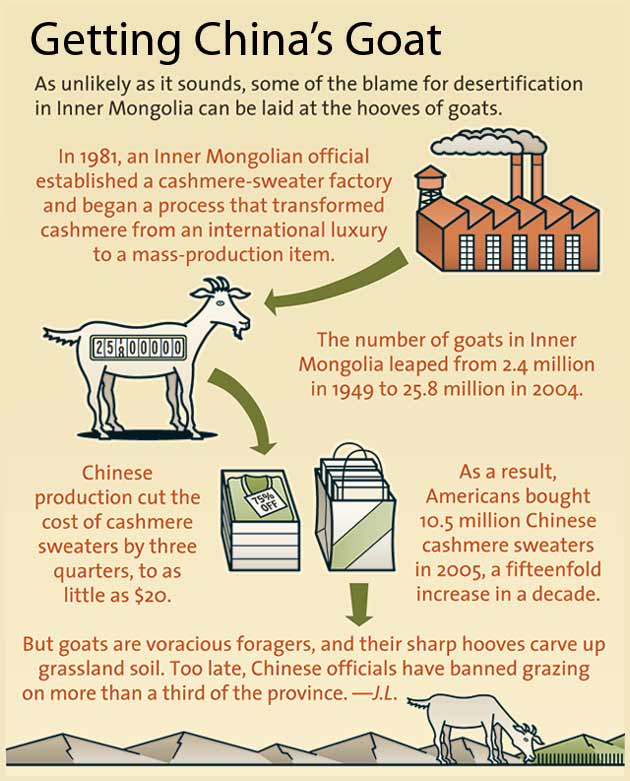
half a century ago, the world was much less dusty. Dust, after all, is nothing more than fine particles of soil, in contrast to larger particles known as sand. Many deserts are basins filled with dust and sand held in place by a protective crust of mosses, lichens, and soil bacteria. But modern civilization has exposed the fragility of these crusts as the human population has pushed impoverished migrants and profiteers onto marginal land. As the deserts deteriorate, they expand: Overgrazing of cattle, sheep, and goats causes grasslands to collapse, baring the underlying dust and sand to the mercy of wind. Sand is too heavy to travel more than a few miles, but dust can fly farther than many birds. If a storm system sucks it upward into the troposphere a few miles above the earth, it reaches a conveyor belt of powerful currents that can carry it across oceans and continents.
China now rivals North Africa as the world’s leading producer of border-crossing dust. It has always been generously endowed with deserts—including the Gobi, Asia’s largest (which China shares with Mongolia), and the forbidding Taklimakan, the world’s largest sand dune desert—which cover more than a fourth of Chinese territory. Until recently, when programs to combat desertification began to make some progress, it lost a Rhode Island-sized parcel of land to desert each year.
Dust storms that now debilitate Beijing appear in records from as long ago as the 1200s, but they occurred less than once a year on average then; today they come at least 20 times a year. At their worst, the storms drape Beijing in a yellowish cloak that blots out the sun, shuts down air and road traffic, clogs machinery, and makes seeing across the street nearly impossible. Each year, they blow a million tons of dust through Beijing and several tens of millions of tons as far as the western Pacific Ocean, 7,000 miles away. Dust particles are so small—at most a seventh of the diameter of a human hair—that human lungs are defenseless against them. Frequent inhalation can cause coughing, painful breathing, bronchitis, asthma, permanently decreased lung function, and premature death.
Dust storms also set off ripples of harm. “When dust blows, what you are seeing are nutrients leaving a system—the ability of the soil to support agricultural crops is leaving,” says Jayne Belnap, a research ecologist at the U.S. Geological Survey. “So you’re setting up a dynamic that causes people to starve or to add more fertilizer to their soil. If they add more fertilizer, then the water becomes eutrophic, and it flows into the ocean and screws that up. It’s just this huge hunk of ‘uh-oh’ on a massive scale. And every time we have an ‘uh-oh’ in a country, it doesn’t matter where, it comes back and hits us.”
That became clear in April 2001, when a satellite photograph showed a vast, perfectly coiled cyclonic spiral of white clouds intertwined with brown dust plumes centered over Inner Mongolia. Joseph Prospero, a leading atmospheric researcher at the University of Miami, called it “the most remarkable dust-storm image that I have ever seen.” Visibility soon dropped close to zero in Beijing and driving was nearly impossible. Satellites tracked the dust as it moved across eastern China, the Yellow Sea, Korea, the Russian coast from Vladivostok to the Kamchatka Peninsula, the Sea of Japan, and Japan itself. In less than a week, it crossed the Pacific Ocean, and produced thick haze as far east as Denver. High concentrations of dust were found as far away as Maine and Georgia and eventually in the Canary Islands off northwest Africa. Dan Jaffe, an atmospheric scientist at the University of Washington-Bothell, calculated that only a 20th of the storm’s dust reached the United States, but that amount, 50,000 metric tons, was two and a half times as much as all U.S. sources typically produce in a day.
For all that, dust storms are merely the most dramatic example of an array of pollutants that Asian winds deliver to other countries. In 2003, Siberian forest fires covered 73,000 square miles, an area larger than North Dakota, and sent up a smoke plume that drove ozone levels above epa limits in Seattle, 5,000 miles away. The fires are assumed to be the work of arsonists intent on supplying Chinese sawmills with logs. A year later, clouds from Asia carried enough industrial pollutants across the Pacific to produce a sudden spike in measurements of mercury, ozone, and carbon monoxide at a monitoring station at Mt. Bachelor, Oregon. Analysis of the pollutants revealed a chemical signature with what Jaffe calls “a very robust China fingerprint.”
Not all Chinese pollution that crosses the Pacific is borne in huge storms. Using high-elevation monitors set up at three California sites, Steven Cliff, an atmospheric scientist at the University of California-Davis, has detected what he calls a “persistent Asian plume”—pollutant-laden air that crosses the Pacific on a nearly continuous basis. To be sure, it’s a fraction of what is emitted within California’s borders, and most of it continues wafting across North America, falling to earth bit by bit. Nevertheless, at Cliff’s mountain sites, particulate matter from Asia accounts for 4 to 6 micrograms per cubic meter of air—already approaching half of California’s annual average pollution limit of 12 micrograms. “The problem is going to be that the ability to emit any sort of pollution from any industry here in California will be reduced because of federal regulations,” Cliff said. “There could be a day when essentially the entire regulatory limit is met” by Asian pollution.
The largest source of that pollution is the billion tons of coal China burns per year, more than virtually all the world’s developed nations combined. The International Energy Agency reported in November 2006 that global coal consumption had increased as much in the previous 3 years as in the 23 before that, and that China was responsible for 90 percent of the increase. It operates more than 2,000 coal-fired power plants and puts a new one into operation every four to seven days. Few possess scrubbers that could limit emissions, and those that do tend not to use them, since scrubbers drive up the plants’ energy and maintenance costs. China’s central government has issued some fairly strict regulations to limit plant emissions, but they are rarely enforced because of corruption and the reluctance of local officials to confront job-generating power companies. Those companies called upon to meet the regulations usually opt for paying an annual $500,000 fee instead. The plants provide 80 percent of China’s energy, at the price of emissions devastating to both China and the rest of the world.
Start with sulfur dioxide, “China’s number one pollution problem,” according to Barbara Finamore, director of the Natural Resources Defense Council’s China program. Sulfur dioxide causes respiratory illness, aggravates asthma and heart disease, and turns soil, lakes, streams, and oceans acidic. It is the key ingredient in the premature deaths of more than 400,000 Chinese each year from air pollution and has led to the outbreak among Chinese in their 30s of chronic lung diseases usually associated with old people. By 2005, China’s sulfur-dioxide emissions were nearly double those of the United States—and they are estimated to have grown by 14 percent since. As a result, acid rain now plagues a third of China, much of Japan and Korea, and even the Pacific Ocean.
Coal has also made China the world’s leading producer of human-caused mercury emissions, accounting for 30 percent of the global total and rising. A 2004 peer-reviewed study found that up to 36 percent of man-made mercury emissions settling on America originated in Asia. Mercury impairs neurological development in fetuses, infants, and children, and is highly toxic.
Another coal-derived pollutant, nitrogen oxide, combines with sunlight to produce ozone, whose inhalation induces coughing, wheezing, chest pain, and airway inflammation. Thanks to coal and cars, China’s nitrogen-oxide emissions have climbed 48 percent in five years. Add the nitrogen oxide from the Siberian arson fires, and the result is a toxic brew powerful enough to raise ozone levels along the U.S. West Coast more or less continuously.
Even so, the most insidious product of China’s coal consumption is carbon dioxide, which, along with CO2 generated by the rest of the world, is destroying China’s ecosystems: Already-arid northern China is drying out, the wet south is seeing more and more deluges and floods, and the Himalayan glaciers that feed China’s major rivers are melting; according to a June 2007 Greenpeace report, 80 percent could disappear by 2035. Such a development would jeopardize hundreds of millions of people who depend on the rivers for subsistence and livelihood.
Nevertheless, China has steadily maintained that the developed countries bear primary responsibility for global warming and must be the first to counter it. The argument has some merit: After all, the United States alone is responsible for a quarter of the man-made greenhouse gases pumped into the earth’s atmosphere over time, while China’s cumulative contribution is still less than a third as much. And even today, China’s per-capita carbon dioxide emissions are less than a fifth of America’s. Yet China’s refusal to curb emissions could single-handedly wipe out reductions made elsewhere, crippling the international effort.
IN THE HANDS OF THE HEAVENS
as we drove on, the evidence of land mismanagement accumulated. On one side of the road, we spotted an area fenced off to prevent grazing, where grass was making a comeback, while on the other, still-grazed side of the road, all we saw was sand. First we passed wooden fences, then a desiccated meadow filled with stumps—the trees probably had become the fence.
People, yurts, and farmhouses were few, and structures tended to disappear within the folds of Inner Mongolia’s rolling landscape. It was jarring to realize just how few people the region’s fragile environment could support and a relief to have escaped intensely populated and polluted Beijing. Breathing Inner Mongolia’s reassuring fresh air and seeing its emphatically blue sky felt like guilty pleasures.
It was late afternoon by the time we reached our destination—a home on the edge of the Hunshandake strip, a recently formed, 8,000-square-mile ribbon of sand. Across the two-lane road in front of the house, a wide swath of fenced land was green, reserved for bovine occupation in the coming winter, while the land behind the house, where the owner’s cattle grazed, consisted of sand: sand punctured by the cattle’s hooves, sand rising into dunes at least 60 feet high—a Sahara in the back yard. Next spring, Mr. Li said, after the cows finish with it, the land across the way will look just as bereft. I clambered up the dune for a view and saw vast fields of sand. “This is not the worst,” Mr. Li said. “The worst is inaccessible.”
The house looked sturdy, even if its thick clay walls were not exactly perpendicular to the floor, and its ceiling was neatly plastered with pages from a magazine. Inside the main room, the prematurely aged, bloodshot-eyed, slightly dazed owner sat in a chair, while his 21-year-old, ruddy-faced daughter leaned insouciantly on his shoulder. Behind them, the pocked white wall displayed a single picture—of Genghis Khan, the 13th-century founder of Mongolia.
I asked how the family was faring in the face of desertification, and the young woman said the situation was getting worse and worse. What grass their cattle ate was covered with sand, which made the cows constipated. “Our livelihood is totally in the hands of the heavens,” she said. “Hopefully, there will be no more wind and much rainfall.”
Now confidently sprawled on a thick pillow, Mr. Li said he was sure things would get better, and lit a cigarette.
After saying goodbye, the four of us drove another three hours to the 800-year-old city of Shangdu, population 20,000, where Mr. Li directed us to a clean hotel. For dinner, we had two kinds of mutton and two kinds of beef. I thanked Mr. Li for accompanying us, and asked him what he would have done that day if we hadn’t come along. He answered that he would have worked in his office.
“On a Saturday?” I asked.
He looked startled. “Today is Saturday?” Assured that it was, he thought for a moment. “Well, it’s a good thing,” he told me, “because if it had been another day, my boss would have been mad at me for missing work.”
THE SINCEREST FORM OF FLATTERY
nothing mentioned so far—not even China’s supplanting the United States as the world’s biggest greenhouse gas polluter—should make Americans feel smug, for what the Chinese are chiefly guilty of is emulating the American economic model. From the 1980s on, Chinese policymakers went on foreign-study missions to figure out how developed countries fostered economic growth. As Doug Ogden, former director of the Energy Foundation’s China Sustainable Energy Program, puts it, “It’s not surprising that the lessons the Chinese drew from their international experiences are often based on sprawl development and private automobile ownership and highly energy-consumptive practices,” since the economies they studied all possess those features.
One of the Chinese officials’ most fateful choices was to promote the automobile industry as a pillar of China’s economy. The decision must have seemed obvious. After all, cars are the foundations of the American, Japanese, and South Korean economies, generating jobs and economic activity. To bolster a domestic industry, Chinese officials imposed quotas and high tariffs on imported vehicles and encouraged consumers to buy cars. The quotas succeeded all too well. China’s car industry is already the world’s third largest, but many of its cities are paralyzed by traffic, the inhabitants are choking on the fumes, and China’s foreign policy increasingly revolves around courting outcast nations such as Sudan to obtain oil at premium prices. From an international perspective, the potential impact on climate change is worst of all. Motor vehicles now account for no more than 3 or 4 percent of China’s greenhouse gas emissions, but the industry is still nascent. According to one projection, the number of cars on Chinese roads will grow from 33 million to 130 million over the next 12 years.
The only thing likely to slow this explosive growth is the increasing scarcity of the resources needed to make and fuel cars. As numerous commentators have pointed out, if China’s income per capita, now less than a 10th of the United States’, ever reached the American level, several Earths would be required to provide resources. “Through all of our engagement with China, the U.S. government has aggressively promoted China’s adoption of an American-style, high-consumption, high-waste economic model,” says Jim Harkness, president of the Institute for Agriculture and Trade Policy and former executive director of the World Wildlife Fund in China. “Combine that with the global trading rules [that downplay environmental and labor standards], the tremendous constraints China faces in terms of its need to generate employment, and the fact that they’ve got all that coal and no oil—and how surprised can we be that we’ve ended up with an environmental nightmare?”
Given the tenfold difference between U.S. and Chinese incomes per capita and the presence of some 800 million impoverished Chinese, even the idea of asking the two nations to sacrifice equally for the global environment is presumptuous, and the Chinese know it. Consider Pan Yue, the outspoken deputy minister of China’s environmental protection agency. Three years ago, Pan declared that the Chinese economic miracle will end soon “because the environment can no longer keep pace.” Yet asked for his view of studies showing that mercury from Chinese power plants is settling in American lakes and rivers, Pan focused his criticism on the United States. “As for China’s impact on surrounding countries, I’m first to admit the problem,” he said. “But let’s talk about this in the context of international fairness. Whose development model are we emulating? Who has been shifting all of its pollution-heavy factories to China? And who bears an even greater international responsibility than China—but has yet to shoulder it—on matters like greenhouse gas emissions?”
The United States passed up the opportunity it had at the beginning of China’s economic transformation to guide it toward sustainability, and the loss is already incalculable. All that is left is the one option that would have served Americans (and the world) best all along, which is to model environmental sanity. Stop buying products made from illegally cut wood. Stop building coal-fired power plants. Instead of subsidizing oil companies, invest government funds in research on sustainable-energy technologies. Build effective mass-transit systems in every city. Cut greenhouse gas emissions. Show China the benefits of responsible behavior.
As it happens, many of the best ideas for moving toward sustainability are already getting a tryout in China: It threatens to surpass the United States even in fostering environmentally beneficial practices. Many have been developed by some of the 2,000 or more environmental groups, domestic and international, that have established outposts in China. The groups have addressed a vast range of environmental issues, from developing energy-efficiency programs for appliances to providing legal assistance for pollution victims to promoting fish circulation by removing some of the thousands of sluice gates blocking flows between lakes and rivers. Yet as smartly conceived as many of these efforts are, virtually all are pilot projects still overwhelmed by the immensity of the problems they take on.
THE TAO OF ZHANG
for the last leg of our Dark Places tour, Mr. Zhang planned to drive back to Beijing, some 200 miles, while traversing the industrial excrescence outside the capital that is both backdrop and counterpoint to the Beijing “miracle.” First we passed through a countryside “greenbelt” where the government has planted trees in U shapes in a dubious attempt to corral Mongolian dust before it reaches Beijing. Then we drove by a dozen or so recently installed windmills, their giant propellers so out of proportion to their hilly surroundings that they looked like catastrophically aberrant insects. By the time we dropped into the lowlands, the sky had turned from slate blue to white to a sinister, sunless gray, and coal announced its presence with mid-20th-century Pittsburghian vigor.
Mr. Zhang said he’d suffered long bouts of depression as he contemplated the coming ecological calamity and wrestled with his growing conviction that millions of people will suffer and die. Feeling guilty for using increasingly scarce water, he said he once even skipped bathing for a month and a half. Apparently unimpressed by this gesture, Ms. Lei asked if his wife approved. “Not completely,” he said, “but she has no choice.”
I could see beyond Mr. Zhang’s stubbornness now, to the earnestness and passion in his tormented embrace of environmentalism. He loves gadgets, yet he deplores consumerism. He believes that China’s tenure as the world’s manufacturer will be short, but blames the West for its predicament.
“China could have said no,” I said.
Not so, he answered—the glittery West has held China in its thrall from the beginning of its encroachment on the country a couple of centuries ago, and now its influence is too pervasive.
But environmental degradation has occurred throughout Chinese history, I said—it’s not just a Western creation. The Taoists who venerated nature were always outmanned by the social-order Confucianists.
Confucius may reign on the surface, Mr. Zhang replied, but Taoism is deeply ingrained in Chinese culture. In fact, only the two greatest civilizations of the world—China’s and India’s—can save humanity now, he said.
We passed mile after mile of bedimmed ground, lots filled with blue-black coal awaiting sorting and shipment, populated by spectral-looking workers with blackened faces and blackened clothes; coal-fired power plants whose smoldering towers suggested witches’ vats; and, in the cities, forests of chimneys poised to combat the looming winter by belching coal smoke high into the curdled atmosphere.
Forty miles from Beijing, we took a detour to inspect a newly formed 200-acre sand dune—the closest dune to the capital, and a powerful warning of encroaching desert. We also drove around the nearby Guanting Dam and up to the lip of its reservoir. The reservoir has been nearly empty since the 1990s, and even before that its water was too polluted to drink. “When this reservoir dries up completely,” Mr. Zhang said, “it will probably become the source of dust that floats over the United States.”
Yet as Beijing loomed, Mr. Zhang’s spirits rose. He talked jauntily on his cell phone while negotiating the expressway’s most dangerous stretch, then once inside the city dueled taxis for every inch of open road, and finally skirted an impasse by driving down a sidewalk. He barely avoided hitting a small car and sang out, “My luck is always good!” We ended up reaching the city center early enough to give Ms. Lei a chance of tucking her boy in. Mr. Zhang’s determination had seen us through the trip.
Our final destination was my hotel, where water flowed without constraint, bed linens were changed daily, and rooms were air-conditioned to a fault. Not least of the hotel’s attractions for its international business clientele, in addition to its swank lobby and 40-meter indoor swimming pool, was its maintenance of the illusion that nothing stands in the way of making money. We stopped under the hotel’s canopied entrance, where I gratefully shook Mr. Zhang’s hand. Surrounded by luxury sedans, his Mongolian-dust-and-coal-soot-encrusted car looked like an intruder, unwelcome but impossible to ignore.