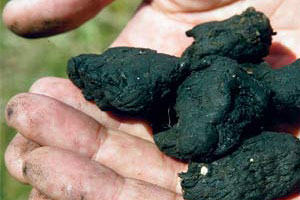
Sludge Happens
Recycling sewage into fertilizer might be making us sick. Why doesn't the EPA give a crap?
IN AUGUST 1987, the National Park Service tore up the White House's South Lawn and tilled in heaps of a new, locally produced fertilizer. The weedy plot's transformation into a carpet of green caught gardeners' attention, and soon there was a waiting list to buy bags of ComPRO, a compost made from nearby wastewater plants' solid effluent, a.k.a. sewage sludge. Four years later, dumping sewage into the ocean was banned, and sludge went national. The Environmental Protection Agency launched a PR push to rebrand it as an all-purpose soil conditioner and fertilizer it innocuously called "biosolids." If sludge was good enough for the first family, the agency reminded us, then surely it was good enough for the rest of America. "The Clintons are walking around on poo," the EPA's sludge chief quipped in 1998. "But it's very clean poo."
Today, more than half the 15 trillion gallons of sewage Americans flush annually is biologically scrubbed, "dewatered," and processed into products with names like BioEdge, Nitrohumus, and Vital Cycle and spread on farmland, lawns, and home vegetable gardens. (The rest is incinerated or landfilled.) Recycling sewage is big business: In 2007 the Carlyle Group paid $772 million for the sludge-residuals company Synagro, whose products are the most popular on the market. Sludge could be the ultimate growth industry; as one trade publication observes dryly, "There will continue to be more wastewater solids to manage with every passing year."
In theory, recycling poop is the perfect solution to the one truly unavoidable byproduct of human civilization. Turning sewage into a potent, inexpensive fertilizer means cleaner rivers and oceans. But as sludge has spread across the country, so have concerns that it may cause as many environmental problems as it solves. In communities where sludge has been used, residents have reported ailments ranging from migraines to pneumonia to mysterious deaths. In a 1994 episode often cited by sludge foes, an 11-year-old Pennsylvania boy died of a staph infection after biking through sludge at an abandoned mine.
Sludge's dirty secret is that it may contain anything that goes down the drain—from Prozac flushed down toilets to motor oil hosed from factory floors. While sludge sold to consumers must be virtually pathogen free, sludge used on farms and industrial sites is permitted to contain low levels of human pathogens. A federal radiation task force recently warned that sludge might be contaminated with radioactive waste; in January, shipments of Canadian sludge with elevated radioactivity levels were turned back at the border. Food companies such as Del Monte and H.J. Heinz won't accept produce grown on sludge-treated land. The Netherlands and Switzerland effectively ban the use of sludge on farmland, and 37 states regulate it more strictly than the EPA.
Despite the growing stink, the EPA has remained bullish on sludge through three presidential administrations. It points out that sludge has never been conclusively linked to any serious illnesses or deaths. Critics say the agency has consistently ignored the risks. "The fight over sludge is not about sewage; it's about hiding industrial waste," says Ed Hallman, an attorney for a former EPA scientist who has accused the agency of covering up the dangers of sludge. "The chemicals absorbed in sludge don't exist anymore as far as the EPA is concerned. They are gone."
COMPLAINTS ABOUT sludge usually begin with the smell. One morning last August, a manure spreader spewed a brown pudding on a field behind Barry Kimbrough's house in Lawrence County, Alabama. "It smelled exactly like what it is—it smelled like shit," recalls Kimbrough, a retiree with a small cattle ranch. "The odor was so bad, some people had to move out of their house for a week or so." Other neighbors complained of breathing problems or pneumonia.
The EPA acknowledges that "biosolids may have their own distinctive odor," but it doesn't regulate their smell. Multiple studies have shown that severe odors can cause health problems, including depression and stress that can lead to chronic hypertension and heart disease. Jimmy Slaughter, a lawyer for Synagro, notes that smelling sludge can elicit "a visceral reaction." Yet, he says, "If we were causing health problems, we would have known a long time ago."
But the stench is just the start. A recent EPA survey of sludge samples from across the US found nearly universal contamination by 10 flame retardants and 12 pharmaceuticals and exceptionally high levels of endocrine disruptors such as triclosan, an ingredient in antibacterial soap that scientists believe is killing amphibians.
The EPA, however, hasn't assessed the safety of many of these chemicals. (The Government Accountability Office recently concluded that the agency's toxics program is "at serious risk of becoming obsolete.") Though it limits the amount of toxic substances that can be dumped into the sewers, with the exception of several heavy metals such as cadmium and lead, the EPA doesn't test for contaminants when they come out the other end of the pipes, where they may be concentrated in sludge. Some scientists are concerned that dangerous levels of contaminants from sludge are passing into crops and groundwater as well as blowing off fields and becoming airborne. Studies have shown that some chemicals in sludge can interact with one another to become more persistent or toxic. Other research has suggested that the toxins in sludge can pass into milk and meat.
In 1979, a Georgia dairyman named Andy McElmurray started applying locally produced sludge fertilizer to his fields. Over the next several years, nearly half his 700 cows died from severe diarrhea. The EPA didn't test his soil, but McElmurray hired his own experts, who concluded that his sludge had contained high levels of thallium. A toxic metal that is the active ingredient in rat poison, thallium rarely turns up in sewage, but it was used as a catalyst by a nearby NutraSweet factory. When McElmurray's experts sampled a local milk brand, they detected thallium at levels more than 11 times above the legal limit for drinking water.
McElmurray sued the federal government for disaster relief, claiming sludge had destroyed his farm. He finally won the case last year. "I believe that if the farmer knew the truth, he would never put sludge on his farmland," he says. "It's all a smoke-and-mirrors game that the EPA has played." His view was echoed by the federal judge who ruled in his favor, finding that "senior EPA officials took extraordinary steps to quash scientific dissent and any questioning of the EPA's biosolids program."
Whistleblowers inside the agency have made similar claims. Last year, Hugh Kaufman, a former EPA investigator, testified in a lawsuit that former administrator Christine Todd Whitman prevented him from looking into the agency's biosolids program. More than a decade earlier, David Lewis, a senior researcher at the EPA's lab in Athens, Georgia, publicly criticized the agency for not doing enough research on sludge. In response, the EPA accused him of unlawfully engaging in a partisan debate. (The Labor Department overturned the complaint.) After Lewis continued to publish alarming studies about sludge in Nature and other journals, the EPA scientist in charge of promoting biosolids gave a sludge-company lawyer a Synagro document that said Lewis had been conducting "uninformed, unsupported, and otherwise unsound science." (Lewis, who retired in 2003 and has since sued the EPA, declined to comment for this article.)
In 2002, the National Academy of Sciences joined the calls for more research. The EPA launched an ongoing round of studies in partnership with the Water Environment Research Foundation, the nonprofit research arm of the sewage industry's main lobbying organization. In 2006, WERF funded Steve Wing, an epidemiology professor at the University of North Carolina, to develop a standardized way to track illnesses reported near sludge sites—something most experts agree is urgently needed. Wing says WERF pressured him "to keep the industry's interest in mind" by micromanaging his work.
WERF "definitely can't be trusted as an honest broker," says John Stauber, coauthor of Toxic Sludge Is Good for You!, which exposed the hyping of sludge. "It's like trusting the nuclear industry to be an honest broker when disposing of nuclear waste." Dan Woltering, WERF's head of research, denies that the group meddled with Wing's research. WERF, he asserts, does "sound, peer-reviewed research" and does not have a policy agenda.
While poop to power is
While poop to power is seductive, let's not forget all those petrochemicals we currently apply to farmland as fertilizers. Sludge has far too much of too many toxins to really be safe for land application, but compost--real, true compost of organic matter from human waste--now that could do something for our farmers. Get us off petrochemicals and continue to cycle organic material appropriately. Industrial waste is what should be separated and used for other purposes, as it usually is what has more of the harmful chemicals. Unfortunately, most states prohibit or make very difficult the process of composting one's waste.
Human waste...?
If humans eat uncontaminated food & water & consume no toxic meds, human poop should be a great fertilizer. But since we are all thoroughly contaminated with Lord knows what, exactly how safe would human fertilizer be? You know, what are we consuming in our water supply? Which of us is using Viagra? Who's on Chemo? etc.
Is human waste any easier to clean up than anything else? I realize chemicals can or should be able to reconstitute into safer forms that can be used.
the institutional
the institutional barriers often imposed by land applying biosolids. There are many challenges including jurisdictional, political, and governmental boundaries when dealing with the hydrogeological and geographical facets of dealing with sludge. In closing I have watched in the Shenandoah Valley hundreds of millions of dollars invested in water quality improvements and very little expended to address the safe management of biosolids.
Best Addressing Biosolid Land Application
This article on sludge as do many others show the questions regarding the impacts of land application of biosolids that was developed by EPA many years ago. Also with increased biological nutrient reduction efforts increased biosolids generations increases the need to best manage this by-product. Land application is the most economical avenue for getting rid of this sludge. Some experts claim that sludge is not good fertilizer and cites whether there is any decent environmental management.
EPA should explore greater pollution prevention controls to best address the land application of biosolids. This is warranted since sludge has been controversial throughout the world.
Promoting best management practices and controls for the land application of biosolids safeguards our environment. Developing greater public dialogue and exploring management responsibilities for safe land application of biosolids can translate into improved health and water quality.
Today over 16,000 sewage treatment facilities serve nearly 190 million Americans (the 72 percent of the U.S. population who are served by sewers not counting those with decentralized septic and wastewater systems). In addition, these facilities serve thousands of industrial and commercial establishments to treat their wastewaters. Roughly eight million dry metric tons of biosolids are produced annually or about 58 pounds per person per year. About 54 percent of the biosolids are land applied as a fertilizer or as a soil conditioner.
Sludge, or biosolids range from 70 percent to greater than 98 percent water. The dry matter in biosolids is mostly inert minerals (i.e., sand and silica) or biological materials comprised of fat, protein, fiber and carbohydrates. Biosolids also have trace amounts of heavy metals and organic chemicals. And, biosolids contain varying levels of pathogenic organisms, vector (e.g., insects and rodents) attractants and odor causing substances. These metals, organic chemicals and pathogens pose a threat to human health unless the biosolids are sufficiently processed and properly placed in the environment.
Part 503 Biosolid Rule allows land application (spreading) of sewage sludge (also known as sludge) needs to be updated. Today there are three main options (each with limitations) to dispose of sludge: landfilling, incineration, and land-spreading. Incineration requires high capital investment, and is limited because of potential air pollution and the production of toxic ash. The science for land applying biosolids is many decades olds when in 1993, the EPA published the 503 Sludge Rule setting standards for the use or disposal of sewage.
EPA’s standards have generated controversy in the scientific and agricultural communities, as well as with the general public. Although the 503 Sludge Rule establishes minimum quality standards for biosolids to be land applied many citizens question the adequacy of these standards. Land applying sludge requires more stringent standards, additional source separation and greater pretreatment of contaminants. Scientists and citizens have expressed concerns about the effects on humans from contaminants concentrated in the sludge during treatment.
Several years ago the EPA Inspector General found: “EPA does not have an effective program for ensuring compliance with the land application requirements of the 503 rules. …While EPA promotes land application, they cannot ensure the public that current land application practices are protective of human health and the environment.”
The National Academies of Sciences in 2002 released a paper called, “Biosolids Applied to Land: Advancing Standards and Practices." They cited their uncertainty about the potential adverse human health effects from exposure to biosolids. Essentially, there is a need to update the scientific basis of the 503 rule so to review the current. exposure and health information on exposed populations. Also the risk-assessment methods need to be updated as does the outdated characterization of sewage sludges.
Finally what is needed are non regulatory tools to assist local citizens and loca officials with technical implications of land application. This would allow users to identify environmental concerns and to give field assistance to the analysis, maintenance and accounting of sludge land applications.
Finally, what I have observed are the inadequate programs to ensure compliance with biosolids regulation and lack of resources devoted to EPA’s biosolids program. We need innovation to overcome the institutional barriers often imposed by land applying biosolids. There are many challenges including jurisdictional, political, and governmental boundaries when dealing with the hydrogeological and geographical facets of dealing with sludge. In closing I have watched in the Shenandoah Valley hundreds of millions of dollars invested in water quality improvements and very little expended to address the safe management of biosolids.
There are many
There are many challenges including jurisdictional, political, and governmental boundaries when dealing with the hydrogeological and geographical facets of dealing with sludge. In closing I have watched in the Shenandoah Valley hundreds of millions of dollars invested in water quality improvements and very little expended to address the safe management of biosolids.
The 'ultra-greenies
The 'ultra-greenies' need to understand that its all about 'baby-steps'. If they were true to their values, they would never read this article as they would be 100% off the grid- unless they grew it, raised it or pulled it from a trash pile, they should never see anything that comes with a 'made in China' sticker.
Same goes
Same goes with all the crap we produce- from solid waste (our wonderful, disposable society, thanks to the China/Walmart mentality that everything should be replaced instead of repaired), to the liquid side.
wonder what is happening in Japan?
Is Japan still spreading what they call "nightsoil" on the rice paddies.
They have been doing this for centuries. Are they still doing it; and are they having thew same problems as here?
Remember seeing three foot diameter cabbage, and four foot long carrots.
And still remember the distinct smell of the countryside.
Sludge Happens
2ND PARAGRAPH
The Carlyle Group (just so the world knows) is the "Bush" connection... the BUSH family is DEEP into the existence of that Financial Organization ....
The EPA is a part of the Government
(so *GO FIGURE* ..................and always follow the money to find the truth)
...................hence the "Dynasty" continues to KILL
First thing is...
Stop allowing industries to dump toxic waste into the sewers.
A pile is a pile is a...
-
tagged as:
- solution
pile ... of unintended consequences.
are Americans really ready to start "paying for playing"? The financial crisis is a great example of ~everyone's lack of accountability, the Wimpy Syndrome- pay Tuesday for a (fat, processed, corporate mfg'd) hamburger (or McMansion) today.
Same goes with all the crap we produce- from solid waste (our wonderful, disposable society, thanks to the China/Walmart mentality that everything should be replaced instead of repaired), to the liquid side.
How many miles will waste be hauled before its applied somewhere? Talk about wasting fossil fuels (if the low concentration 'stuff' gets hauled or pumped)! Thicken/dewater it and we're in the ~20-30% range (what most WTPs are producing now).
Why don't we tell the developers to STOP building on farmland and revitalize the downtowns of America (which has finally been started, thanks to the current generation of young adults).
As for the pharma industry- how dare we infringe free trade/product development? So what if the pill that makes "Bob" bigger and 'better?' doesn't break down... and ends up going through a WTP and back into the environment. Better for the birds and bees!
As for the article- there's no simple solution. Not when you have the likes of ~AQMDs in major cities putting the kabosh on any entity- no matter how green, from entering the marketplace. The 'ultra-greenies' need to understand that its all about 'baby-steps'. If they were true to their values, they would never read this article as they would be 100% off the grid- unless they grew it, raised it or pulled it from a trash pile, they should never see anything that comes with a 'made in China' sticker.
Class A vs Class B Sludge
-
tagged as:
- solution
I find limited scope of this conversation interesting.
Is anyone commenting aware their are two classes of sludge, Class A and Class B.
Based on the aforementioned comments from above, most individuals are referencing class B sludge's. Believe it or not, their are companies using natural technologies to create an exothermic reactions that kills the bugs and renders the material safe an eliminates the orders for application as a fertilizer. In fact, some of the solutions gassify the sludge and use the gas for power generation.
Bottom line is that the poop needs to go somewhere and it will always have pathogens. You should make sure you are supporting legislation and the like that would require every municipality to take all sludge to Class A.
sewer sludge
-
tagged as:
- result
In 1984 the EPA research people were doing a lot of work on sewer sludge.
They saw a simple process that was able to turn it into crude oil.
They were excied-- but said " EPA owned and operated by DOE witch is
owned and operated by DOC" As this would rock the economic boat--
it was Totally rejected. Research was ended.
People could make their own fuels.
Biosolid land application
-
tagged as:
- result
Yesterday , April 30 , 2009 ,the Alabama Senate voted 24-0 to pass Rep. Jody Letson's HB 806 .This is a victory to those of us who have petitioned legislators to consider a bill that would ban the application of biosolid sludge on farmlands near our homes in Lawrence County Alabama . If this bill is signed by Governor Riley , the people will be able to vote on a referendum to ban such application of this sludge which contains PFC's , pharmaceuticals , human and industrial waste , and has been transported by rail to our area from New York State ; as well as waste from Decatur Utilities in the next county . Landowners were offered the sludge as fertilizer , at no cost to them . The foul odor permeating the air for days was not the main consideration , as health considerations and runoff contamination were our primary concern .
Hopefully , the people will prevail in this stinky issue !
Throne of the Ecological Revolution
http://anxietyneurosis.wordpress.com/2009/04/17/throne-of-the-ecological-revolution/
human excrement into hydrogen
-
tagged as:
- solution
Dennis Baker
103-66 duncan ave west
penticton bc canada V2A6Z3
cell 250-462-2771
fax 250-493-3463
dennisbaker2003@hotmail.com
RE : The solution to climate change.
( human excrement + nuclear waste = hydrogen )
The USA discharges Trillions of tons of sewage annually, sufficient quantity to sustain electrical generation requirements of the USA.
Redirecting existing sewage systems to containment facilities would be a considerable infrastructure modification project.
It is the intense radiation that causes the conversion of organic material into hydrogen, therefore what some would consider the most dangerous waste because of its radiation would be the best for this utilization.
I believe the combination of clean water and clean air, will increase the life expectance of humans.
yours sincerely
Dennis Baker
Netta Manning
District Electoral Officer Penticton
Elections BC
80 Calgary Avenue
Penticton BC
Fax 250-487-4476 DEOPEN@elections.bc.ca
Phone 250-487-4469
25/04/2009
Dennis Baker
103-66 duncan avenue east
penticton bc V2A6Z3
Phone and Fax 250-493-3463
This is a formal complaint of Election rigging by the RCMP. Greater/ corroborative/ illegal details are available. The 3 days available after release on bail was insufficient to complete the prerequisites of elections bc to becoming a candidate. The present 9 pm curfew prevents me from attending election events in Vancouver, keeping this covered up.
This is a copy of what entered the Globe and Mail http://www.theglobeandmail.com/servlet/story/RTGAM.20090423.WBcampbellblog20090423160612/WBStory/WBcampbellblog/#commentLatest
You (dennis baker, from penticton, Canada) wrote: Voter turn out is simply a recognition that citizens feel that voting is a waste of time, as the outcomes are predetermined. I have been a Candidate in a Federal election and a municipal election, and a provincial election was in order for me.becoming a candidate€
From: dennis baker (dennisbaker2003@hotmail.com) Sent: April 15, 2009 6:50:49 AM To: electionsbc@elections.bc.ca What ?where? how much?I am thinking about running as a candidate.dennis baker--
The response was to be arrested and charged with possession for the purpose of trafficking. For some alleged drugs in a vehicle that I was a passenger. The owner / driver was not charged. I was released after 5 days, on 500 cash bail.I am offering every media outlet to finance the POLYGRAPH which I willing submit to and then expose this to the public.Dennis Baker
Posted 25/04/09 at 11:32 AM EDT | Alert an Editor | Link to Comment
I do know the Green Party attempted to have me arrested previously when a candidate in a Federal Election, so you might find answers with that organization.
Dennis Baker
منتدى
Stop polluting our
Stop polluting our environment.
I very like your post, nice post. Thanks
We have to realize that we
We have to realize that we lived here in nature, so we have to protect whatever in it instead of polluting with toxic elements.
Regards
Bayi
Thanks for the post!
the institutional barriers often imposed by land applying biosolids. There are many challenges including jurisdictional, political, and governmental boundaries when dealing with the hydrogeological and geographical facets of dealing with sludge. In closing I have watched in the Shenandoah Valley hundreds of millions of dollars invested in water quality improvements and very little expended to address the safe management of biosolids.
human sludge across america
The first lady is dealing with all of americas problems, industries polluting and lieing about the safty of their pollution and dumping anywheres and everywheres, while the american people are trying to clean and recycle to keep america bautiful. I hope the obamas get mad and do something about this epicdemic of pollution thats pledged our country.
These sneakers will be
These sneakers will be hitting stores in June and today louis vuitton we can get a good overview of the line-up and especially get a closer look at the numerous luis vuitton high top sneakers that are part of louis vuitton handbags the collaboration. lvToday's topic has nothing to do Louis Vuitton Sale Of course, they really never let us down.
tiffany jewelry
of tiffany jewelry on ebay are cheaper than tiffany jewellery outlet store, why is that?
You will find the newest tiffany jewelry on sale fashion release on their official website.
I am planning to give my wife a big surprise with tiffany and co as a birthday gift, but I don’t know which one to choose, any ideas?
According to stylists, Paris
According to stylists, Paris Hilton chooses an ideal pair of shoes for her outfits Eugenie Wallet. Like her dress, they're fun and carefree, without being sloppy Louis Vuitton Eugenie. Alongside her popular sportswear and fragrance lines,Neverfull MM handbagParisalso runs a footwear line. "Louis Vuitton Neverfull MM I have always loved shoes and after working on my recently launched sportswear and fragrance lines this seemed like a natural next step", commented the radical shoe princess on her much hyped Paris Hilton Footwear range.
We are providing all kinds
-
tagged as:
- result
We are providing all kinds of louis vuitton handbags, wallets and purses in ourgucci Online Store, all items of which have the most popular styles and are the newest and at discounted prices.
We also provide helpful shopping guide tips for you to choose and compare our bags and other accessories. Get your sale of replica handbags today and you will never be disappointed with it.
Nice post, thanks for
Nice post, thanks for sharing.
Term Paper
Thesis Writing
Arts Papers
Business Papers
ugg sale
I would like to buy uggs,
ugg sale,
ugg boots uk,
ugg boots london,
ugg boots sale,
uggs,
ugg london,
ugg boots sale,
UGG Bailey Button boots,
bailey button ugg boots,
UGG Nightfal boots,
and so on.