In The Blogs

Spending and Taxes in California

Are California's budget woes due to skyrocketing spending?  Michael Hiltzik says this is a myth:

Analyzing the 2008-09 budget bill last year, the legislative analyst determined that since 1998-99, spending in the general fund and state special funds — the latter comes from special levies like gasoline and tobacco taxes — had risen to $128.8 billion from $72.6 billion, or 77%.

During this time frame, which embraced two booms (dot-com and housing) and two busts (ditto), the state's population grew about 30% to about 38 million, and inflation charged ahead by 50%. The budget's growth, the legislative analyst found, exceeded these factors by only an average of 0.2% a year.

There's a lot of truth to this, but I think it goes too far.  For starters, Hiltzik uses a special measure of inflation, not the usual CPI-U, and he doesn't include spending from bond measures.  The chart on the right, using budget data from the Department of Finance, shows per-capita spending including bond measures, adjusted for inflation using the standard CPI figures from the BLS.  There are two things that jump out at you.  First, even using a standard measure of inflation, Hiltzik is right: per capita spending in the decade between 1999 and 2009 has barely budged.  It's up about 6%.
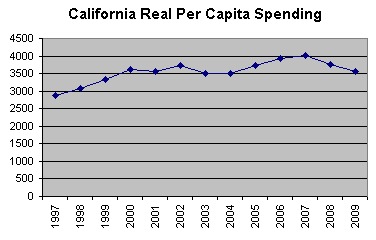
At the same time, if you compare it to 1997 it's up 23%.  California went on a spending spree during the dotcom boom and we never returned to our old levels even after the bust.  What's more, spending in the years between 1999 and 2009 was up even more.  In the decade between 1997 and 2007, per capita spending increased an impressive 39%.  We've tightened our belt considerably in the past couple of years, but that's against the background of some pretty sizeable increases in the intervening years.

California has multiple problems.  Prop 13 reduced our tax base permanently and made it all but impossible to adjust other taxes to make up for it.  Citizens have approved bond measure after bond measure in the seeming belief that because they don't raise taxes, they also don't cost any money.  The governor and the legislature have relied on way too much smoke and mirrors.  But spending has also gone up.  There's just no way to understand the whole picture without acknowledging that.

UPDATE: California's population actually grew about 15% between 1998 and 2008, not 30%.  However, that was just an arithmetic error on Hiltzik's part.  The overall budget growth result that he quoted from the LAO is correct.

(I used population figures from the Census Department in my calculations.  So the per capita spending numbers in the chart should be correct.)
image
image

Get Mother Jones by Email - Free. Like what you're reading? Get the best of MoJo three times a week.
Comments
no profile pic for comment author

State GDP

To get this right, spending needs to be compared to state GDP.

no profile pic for comment author

And/or wage growth (aka per capita GDP)

What PeakVT said, more or less. We have the same problem here in local government, people ranting about how school spending grows faster than inflation. Well duh, wages grow faster than inflation (historically, if not during the Bush years, and union contracts will look to history) so of course spending grows faster than inflation.

One quibble in per-capita-GDP vs median-wage comparison; for decades now, median wages have not grown as fast as average wages. The skew to the extremely rich raises the average, not the median.

no profile pic for comment author

Spending

I'm not sure you should really compare to 2009, essentially that is post cratering panicky and psuedo-random budget cuts.

The basic story I see from this graph is that beginning in 1997, per capita spending went on an almost uninterrupted spree. In 2007, CA state spending was 33% higher per capita, in real dollars than it was in 1997. Any way you look at it, that represents an enormous increase in spending.

In 2008 the bill started coming due and in 2009 it is here with a vengeance.

During that same time, tax rates went up only slightly. Tax receipts were up (though not enough to cover the massive spending increases), because even with Prop 13 limits on housing reassessments, lots of people were buying and selling bubble priced houses.

The bill is coming due.

Also there are two separate issues about Prop 13. The property tax limit on residences is not that big a deal. It is fairly predictable on average, you can budget around it, and people eventually die. It should never have been applied to commercial property, all of the arguments about it don’t really apply to commercial property. The real problem is of course the 2/3 vote to raise taxes. We can do that if we want, but it should be paired to a 2/3 vote to raise benefits. Having a different threshold for benefits and taxes is a systemic invitation to craziness.

no profile pic for comment author

Can anyone explain how it is

Can anyone explain how it is that the largest California state budget category is K-12 education ($40.7B in '09-'10) and yet we spend less than the national median per student, and barely half what NY and NJ spend, and are still vastly over budget?

no profile pic for comment author

Kevin, You should redo your

Kevin,

You should redo your calculation adjusting health care spending seperately.

An large amount of California's spending is on health care. The inflation rate for Health care is significantly higher than the CPI-U. If you correctly account for that, the inflation adjusted increase would appear much lower.

MarkH

Cal health care system

What does the current Cal health system look like?
What does it offer us for a national plan?
How have costs gone since it's implementation?

no profile pic for comment author

For me the odd thing is (and

For me the odd thing is (and I will accept Kevin's contention as true) that as a faculty employee of the state university system (CSU not UC), these were not particularly good years. Minimal wage increases [the average annual increase of the the 12 years from 1997 would likely be under 2% a year], many retirees not replaced, cutting the number of courses offered increasing class sizes, etc --- to whom was the spending spree flowing? Well, we did increase the number of adminstrators at my campus and provided minions to them all ---- but as for what we offered students, there was no spending spree and in fact, student fees continued to rise. I know people think all state employees (and maybe especially faculty at universities) have cushy lives, but outside of the prison guards and some other law enforcement groups, I'm not sure who these priveleged state employees are. There is a problem with local city and county pension systems, but that's because elected officials found promising gold plated pensions easier than actually negotiating salary increases. People who knock unions have to remember that contracts are *negotiated*, workers generally don't impose terms on management -- if anything, it's the reverse that's more often the case.

no profile pic for comment author

Healthy Families, which the

Healthy Families, which the governor proposes cutting, was started in 1998 and dramatically expanded by Gray Davis.

The 3% at 50 pension for the CHP -- which has since spread through law enforcement and fire ranks, and raised the bar for all other pensions -- was enacted in 1999.

The Vehicle License Fee ("car tax") cut made in the late '90s appears on the state books as a spending increase, because the state pays that money to county governments.

That might not bring you to $25 billion, but they're three large programs enacted in the dot-com boom that still haven't gone away.

no profile pic for comment author

Healthy Families, which the

To this list, you might want to add growth in cost of the California Prison system where current year expenditures likely will exceed $9.5 billion up from about $4.2 billion in 1999-2000.

Also, just a note, Healthy Families is California's implementation of the federal S-CHIP program that serves low income children and some of their parents. This program operates with a 2:1 federal match. It did experience expenditure growth because of some expansions (as noted) and because of state population growth; as well as from overall health care cost increases.

no profile pic for comment author

It doesn't matter what the

It doesn't matter what the spending level is. Problems arise when you don't have enough money or income to pay for your spending.

no profile pic for comment author

Longer time series please!

What would be really interesting would be to look back several decades (to pre-Prop 13?) to help put the last decade + into better context. Was the dotcom spending increase a binge in spending, unprecedented? or was it an opportunity to return to halfway decent services that California used to be famous for? My sense it that California has been pretty badly broken fiscally for a very long time, so this time series just doesn't go back far enough.

no profile pic for comment author

Abby, You're correct -- sort

Abby,

You're correct -- sort of. The severe recession in the early '90s took a severe toll on public services, and back in the day you'd hear about "pent-up" demand.

But I never noticed the pent-up demand for the highest-paid prison guards in the nation -- or the most generous law-enforcement pensions.

no profile pic for comment author

I was actually thinking of pre-90s cuts

Your point about the growth of prisons is well taken. Rather than cut all welfare, as the governor proposed today, they should release all non-violent offenders. Just to see how people respond...

But my point about decline in spending was really about the big cuts in things like education that happened in the 1980s? 70s? My california history is fuzzy, which is part of why I'd like Kevin to draw us a graph...

Kevin Drum

Good comments. I agree that

Good comments. I agree that % of state GDP is the best way to look at things, but those are hard numbers to get hold of. Basically, all I wanted to do here was provide a rough look at the past dozen years to provide some idea of what the bigger picture looks like. Spending increases really have been a part of the story.

The question of what inflation number to use is genuinely difficult. As Hiltzik points out, there's an inflation measure designed for state expenditures, which have a different makeup than the broad economy. My problem with this is twofold. First, it's awfully easy to play games with this. Second, at some point the broader economy really does matter. State spending can't keep going up faster than the rest of the economy forever.

All of this would be moot if we had reliable GSP numbers. I've never found ones that seem authoritative, though. If anyone has a suggestion on this score, let me know.

no profile pic for comment author

BEA and FRED2

GSP data here. Tax and spending data here via custom query. An ugly graph using the data here (Open Office charts leave a few things to be desired, as does Picasa). 11 more graphs starting at #91 in the album.

Since it's hard to tell, the graphs indicate that through 2006 California's taxing and spending wasn't outside the norm but above average. Debt was about average. It was below average in federal transfers received.

The state GSP in 2007 was $1.87 trillion, which leads to a guestimate that the current deficit amounts to about 1.2% of GSP. The deficit is a large percentage of the budget, but not a particularly large percentage of California's economy.

no profile pic for comment author

Studies of state spending

Studies of state spending and taxes often use personal income (available at bea.doc.gov) instead of GSP.

no profile pic for comment author

Tax Cuts booked as expenses

As trotsky pointed out, one of the anomalies of the California budget is that the VLF (car tax) cut that Schwarzenegger enacted is booked as an expenditure. This is 4 billion a year that was added into the expense category, because Arnold gave away local money, then backfilled it with state money. To pay for this rather substantial tax cut, the Governator borrowed 15 billion, the cost of which adds another 2 billion a year to principle and interest costs. This 6 billion is the spike you see in 2005 and 2006. Pull this back out at around $166 per capita, and you'll see that the growth in spending has been very flat on a per capita basis when adjusted for inflation. And I have to say that CPI is a number that has been pretty suspect since the Clinton years.

It's really crazy to count a tax cut as a spending increase, then use as the wingnut talking point for the explosive growth in spending. The only category where we've seen explosive growth in spending has been in the state prison system, based on right wing toughoncrime sentencing and parole policies.

Let's not forget too that California used to have an estate tax that was fully deductible against federal estate taxes, and would be generating about 1.2 billion a year now. That would pay to keep the state parks open and still have room to keep 17,000 teachers from being laid off.

no profile pic for comment author

Odd math?

I cannot figure out the math in the article. If population grows by 30%, and inflation was 50%, then spending would have to grow by a factor of 1.3*1.5=1.95, or 95%, to stay the same per person after adjustment for inflation. That is a lot more than the 77% in the budget. Sloppy math, or what am I missing?

But I agree with most of what Kevin says. Spending is part of the problem, though certainly not the only one.

no profile pic for comment author

In 2007, CA state spending

In 2007, CA state spending was 33% higher per capita, in real dollars than it was in 1997. Any way you look at it, that represents an enormous increase in spending.

Not if real gross state product per capita is up by a third (or more).

no profile pic for comment author

All of this would be moot if

All of this would be moot if we had reliable GSP numbers. I've never found ones that seem authoritative, though.

http://en.wikipedia.org/wiki/List_of_U.S._states_by_GDP_(nominal)

http://www.bea.gov/regional/index.htm#gsp

They're only updated through 2007, though. Not sure when the 2008 numbers come out.

no profile pic for comment author

During this time frame,

During this time frame, which embraced two booms (dot-com and housing) and two busts (ditto), the state's population grew about 30% to about 38 million,

Prepared by California Department of Health Services, EPIC Branch, EPICenter web site

California Population, 1999

Year
1999
Total 33,418,380

Now if I can remember how to do some 6th grade math

38,000,000 - 33,400,000 = 4,600,000

4,600,000 / 33,400,000 * 100% = 13.7% change

I guess 13.7% is almost 30% if you are a liberal who never was really good at math and are trying to make an absurd claim. Kevin this story is inane. You should be ashamed that you even put it up without checking his math.

no profile pic for comment author

Inflation

Not sure why you would think the CPI would be the better measure of inflation to use. The CPI is heavily influenced by housing costs (in the form of owner-equivalent rent) which is not an issue for State and Local governments. At the same time, it probably understates medical care inflation as experienced by governments since the CPI includes only consumers out of pocket medical spending. At least the implicit price deflator for state & local governments is based on what governments actually spend money on. The goal is to adjust for inflation, you deal with the issue of the broader economy by comparing spending to personal income or GSP.

As for an authoritative source for state gross state product, how about the Bureau of Economic Analysis in the US Department of Commerce? If their US GDP data is authoritative, I would think their state GSP data would be too, no?

no profile pic for comment author

Inflation is underestimated as a matter of policy

Even the highest figures are too low.

no profile pic for comment author

Putting the blame on Prop 13

Putting the blame on Prop 13 is also wrong. If you do the math, property tax revenue in the 25 years after Prop 13 grew by over 100% after inflation. Population grew in that time period by only about 50%. So per capita property tax revenue has been increasing in real dollars.

Post a comment
Alternately, you may login to or register an account
The content of this field is kept private and will not be shown publicly.
  • Web page addresses and e-mail addresses turn into links automatically.
  • Allowed HTML tags: <a> <ul> <ol> <li> <blockquote> <img>
  • Lines and paragraphs break automatically.

More information about formatting options


Jail.org - Inmate Search
Criminal records, instant public records & people search & current court records. www.jail.org

U.S. Public Records Search
Search County & State Court Records, Criminal records, Vital and Adoption Records www.PublicRecordsInfo.com

Records.com - People Search
Public Records and Background Checks. Instantly Search Criminal Records, Addresses and Court Records www.Records.com

Court Records & County Records
Find Instant Public Records, Criminal Records as Well as County Property Records Search. www.PublicRecordsIndex.com

Mother Jones Podcast
Get in on the conversation! We talk about culture, politics, the environment, the economy and more. Listen now!

TalkBackTees.com
A treasure trove of liberal wit, wisdom and quotations, from ancient to modern, on colorful, cotton tees.

Support Independent Artists
Amazing art, crafts, apparel, paper-goods and more. A carefully curated selection of sundries since 1999.

FREE CONNECTIONS FOR GREEN SINGLES
Meet progressive singles in the environmental, vegetarian & animal rights community who share your values