
- ‹ previous
- 780 of 2798
- next ›
From the Annals of Bad Editors
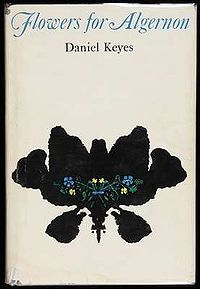
I'm not quite sure why I looked this up — I think I was verifying the spelling of Daniel Keyes' name — but this afternoon I checked out the Wikipedia entry for "Flowers for Algernon" and learned this:
In 1958, Keyes was approached by Galaxy Science Fiction magazine to write a story, at which point the different elements of Flowers for Algernon fell into place. On submitting the finished story to Galaxy, however, the editor suggested changing the ending so that Charlie retained his intelligence, married Alice, and lived happily ever after. Keyes refused to make the change and sold the story to The Magazine of Fantasy and Science Fiction instead.
Keyes worked on the expanded novel between 1962 and 1965 and first tried to sell it to Doubleday, but they also wanted to change the ending. Again, Keyes refused and gave Doubleday back their advance. Five different publishers rejected the story over the course of a year until it was taken on and published by Harcourt in 1966.
Seriously? Did these guys also tell Shakespeare that Romeo and Juliet was kind of a bummer and he really ought to have Juliet wake up just as Romeo was about to take the poison — followed by a backslapping reconciliation between the Montague and Capulet clans and a joyous wedding between the star-bless'd lovers?
Jeebus. What the hell kind of story is it if you give it a happy ending? What was up with these guys?













Did I just read a blog post
Did I just read a blog post citing Wikipedia? Somebody pinch me.
Daniel Keyes should be sued
Daniel Keyes should be sued for giving so many children so much distress. He is a monster and most likely a molester.
Is this weird comment day
Is this weird comment day and nobody told me? Something in the water? Or what?
Your fault
I believe this is because you haven't written about peak oil in so long that readers are suffering withdrawal.
Also: this happened to me, with my second novel. Except in my case, the happier ending that the editors demanded was much better.
I find this post strangely
I find this post strangely comforting -- that this kind of crap isn't new. Steven Soderbergh just dropped out of the Moneyball movie because Columbia Pictures' producers wanted to Disneyify the script. But apparently this isn't a sign of-the-times, just the same old story.
It's pretty simple. The
It's pretty simple. The depressing stuff has only a remote chance of reaching required reading lists for secondary schools, and by the time it does the editor is probably going to be retired.
The happy stuff will get sold in airports and will likely make a small flash for a few months. It certainly sells better in the short term. Same's true for movies.
Part of the problem of editors/producers messing with writing is that the author has generally set the characters up for a particular ending. You might as well rewrite the whole thing if you rewrite the ending. At least in movies you often you see a goofy tragic character turn into an unexpected prince and you know you're looking at a rewrite.
I always thought flowers for algernon was a bit contrived and played on some fairly bizarre concepts about intelligence and our insecurities about it. The writing may have been great . . .
Somehow, I don't think the
Somehow, I don't think the editor of Galaxy had classroom use in mind when he wanted to change the ending. Ditto for the book publishers in the early 60's.
There's a more common dynamic at work here, and I've heard it described (by writers): "the editor pissed in it, and decided it improved the flavor"
I'm sure that editors have plenty of sarcastic things to say about writers, too.
They didn't and that was my
They didn't and that was my point. Their goal is a more marketable story not necessarily the best or most powerful story. Not saying they get there. Most of them just lack imagination to defy the formulas.
Whoa, that's insane! The
Whoa, that's insane! The ending is what makes "Flowers for Algernon" so powerful that you never forget it. The pathos of Charlie's awareness of losing his intelligence...just remembering chokes me up. (The movie sucked though.)
'...you never forget it.'
I read that book in eighth grade, and I've forgotten the ending. Just being a jerk and saying that it's possible.
The movie
Yeah, the movie wasn't very good. But at least they kept the ending.
Prevalent in movies and TV
I see something like this in the preview for the movie The International. Knowing a little about BCI it seems this would make a great detective story taking time to tease out why the bank came into existence and how it works. Although some of this may be touched on it takes on a breathless, breakneck pace with lots of chasing and running around.
You see something similar even in educational, scientific programs on Nova, the history channel and discovery channel. Instead of letting the data speak for itself there is a lot of excessive camera zooming and rotating. It makes me dizzy watching this. Especially on an HD display why not present a static display of a scene or a chart and let your mind travel around instead of having the camera rushing about?
Unfortunately the trend is towards more camera motion and shorter cuts. Instead of letting the story or the data determine the pace of the presentation someone has determined that they will use heavy handed methods of reaching out and grabbing your attention to prevent you from wandering off to some other source of entertainment.
You've obviously not heard
You've obviously not heard of Bowdler--the man who rewrote Shakespeare in the early 19th century to conform to the tastes of the time. Or Nahum Tate, the veritable Poet Laureate of England himself, who rewrote King Lear with a happy ending. Where did I find all this? Wikipedia!
Does that mean the
Does that mean the Republicans shouldn't rewrite history whenever it's convenient for them? They can't change the ending so that Ronnie is a hero? And BushII, and Sarah Palin?
I don't think their listening.
As a short story...
I dunno, as a magazine short story, "gets smart and gets the girl" might have worked better as a quick, simple plot. In novel form, slowly watching him lose his intelligence is very important, but if he had to wrap that up in a paragraph or two I can certainly see the advantages of just leaving the happy ending.
In novel form, slowly
Actually, it works just great; I've never read the novel, just the story (it was in some Hugo Winners anthology I got from the SF Book Club), and it was very effective.
An old story with movies...
See "Our Town," the movie, or "The Vanishing," American version, as just two examples -- and in both these cases, it was the authors themselves who decimated their own work.
Scary stuff
I can't think of a single more Orwellian fact than this:
There is an American version of Terry Gilliams classic "brazil" that has a happy ending.
Other commenters have
Other commenters have already pointed out that the original version of Flowers was the novella.
As for the editor of Galaxy asking for those changes, I don't believe it. Galaxy at the time was still edited by Horace Gold, and he was much too good an editor to ask for something like that.
That Darn Mouse
I forget the particulars, but some time in the early 60s the story was read for the Pacifica Radio stations by some professional actor. I was on the board the night it was played over Los Angeles KPFK. At its conclusion some people called in and they were CRYING.
Burgess's Clockwork Orange,
Burgess's Clockwork Orange, in the original, had a happy ending! The protagonist grew out of his sociopathy.
Burgess's American editors argued (if memory serves) that Burgess was unable to face up to the dark implications of his tale, and they lopped off the last chapter. That's the version that Kubrick adapted for his movie.
The editors were absolutely correct. Burgess's ending undercut the whole story, and the deletion of that chapter was absolutely essential. Burgess remained pissed off about it, though, and later published the full version in the U.S., along with a bitter complaint about his editors.