- ‹ previous
- 254 of 2798
- next ›
Why We Spend So Much
Bob Somerby wants to know why the media isn't a wee bit more interested in why the United States pays far more per person for medical care than other rich countries. Here's the rough answer:
- We pay our doctors about 50% more than most comparable countries.
- We pay more than twice as much for prescription drugs, despite the fact that we use less of them than most other countries.
- Administration costs are about 7x what most countries pay.
- We perform about 50% more diagnostic procedures than other countries and we pay as much as 5x more per procedure.
Underlying all this is the largely private, profit-driven nature of American medicine, but regardless of how you feel about that, the main lesson here is how hard it would be to seriously bring these costs down. We can jabber all we want about incentives and greed and systemic waste, but the bottom line is that if we want to do anything more than nip around the edges, we'd have to pay doctors and nurses less, pay pharmaceutical companies less, pay insurance companies less (or get rid of them entirely), pay hospitals less, and pay device makers less. That's a lot of very rich and powerful interests
who will fight to the death to prevent any serious cost cutting, and it's why Obama and the Democrats in Congress have largely chosen to buy them off instead.
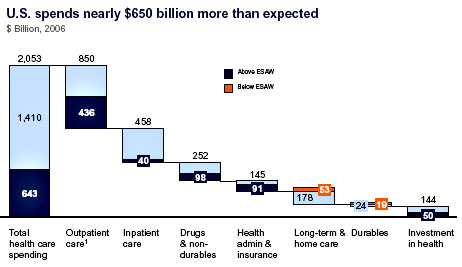
If you're curious about this in slightly more detail, the chart on the right comes from a McKinsey Global Institute study of healthcare costs. (An older but more interactive version is here.) Healthcare spending tends to be higher in richer countries, and since the U.S. is a very rich country it's unsurprising that we spend a lot on healthcare. However, even when you account for that, McKinsey figures that we still spend about $2,000 more per person than we should, a total of about $650 billion. The chart shows where this extra expense comes from: the dark blue areas are places where we spend more than expected and the orange areas show where we spend less than expected.
No matter how you slice the healthcare pie, though, compared to other rich countries we spend far more, cover fewer people, get hassled a lot more, and don't get much better outcomes. Unfortunately, there are a lot of people who profit handsomely from this state of affairs, so it's not likely to change radically anytime soon. Baby steps, my friends, baby steps.



Ideologues are the real problem
I wish all reform opponents were just acting out of self-interest, at least they are rational actors that can be negotiated with and sometimes compromised with.
But the most adamant opponents seem to be motivated by ideology regardless of self-interest. And I don't know if anyone has figured how to deal with those people. Without the noise that ideologues bring to debate, the entrenched interests would be forced to make more concessions.
Looking around here, it
Looking around here, it strikes me that most of the wealthier class are involved in finance, real estate, or are medical specialists, or sell "alternative" (quack) medicine.
So, the first two fields could stand about a 90% employment cull with no cost to society, while leaving capitalism healthier and stronger. At least in the states, #3 is valuable but overpaid. And group four could be justifiably jailed for fraud and negligent homicide.
Yet, those four comprise more than half of the "monied" class here. And a big chunk of the remainder depend on the wealth concentration involved. What do you think the likelyhood is we'll get our respective governments to correct any of that? Seems much more likely that the crooks will all hang together.
This isn't a capitalism issue. It's a class war issue. There's been on going on for a while now, we're not allowed to talk about it, and most of us are on the losing side.
Because we've been convinced that to criticize those with undue influence is to attack capitalism itself - rather than the truth, that most of these people have become a useless cancerous growth on our science-driven market-run society. There's a correction in order, not of the type of system, but rather of the rot at the top.
Good post
This is the kind of debate we should be having.
Nice breaking of the logjam.
Keep it up.
Read This
None of this is new, and as Kevin says, it isn't going to change overnight. But there is a related point no one seems to pay much attention to. Not only is our health care "system" bankrupting individuals, it's also bankrupting the country. We've all heard the standard line about how health care costs are hurting our competitiveness abroad. We've been hearing it for years, and it's true. But beyond that, there is only a certain percentage of GDP that any developed nation can spend on health care without hurting the financial health of the nation. And the U.S. is exceeding the proportion.
fight to the death
Medicine has become a zero sum game in America.
let's try the basics...
There's a simple step that is likely to reduce health care costs by orders of magnitude greater than any of the ideas being discussed here and elsewhere - estimates of 25% of total health costs over time!
And that is insuring that everyone has an adequate level of Vitamin D. Obama could order all federal health programs to pay for Vitamin D testing and to provide incentives for people to supplement or get more sun. Suboptimal levels of D are epidemic and virtually every chronic disease can be helped or prevented by adequate D.
If you think I'm exaggerating the benefits of Vitamin D see vitamindcouncil.com.
As long as we think the answer is better drugs and faster MRI"s we're just rearranging the deck chairs with any of the bills that are being considered.
It's so hilarious that
It's so hilarious that people like g.powell are quick to jump on those "motivated by ideology" as the roadblock (ie those on the right) when those your entire argument for healthcare is motivated by ideology (ie we have a moral obligation to give healthcare to people who can't afford it). I understand you think your ideology is better than somebody else's, but it's laughable to argue that one side is drawing a line in the sand based on ideology, and your side isn't.
Kevin: glad you've finally come to realize that increased costs in the U.S. aren't necessarily a bug. Now, you also realize that costs must come down, and you immediately look to the providers, ie doctors, nurses, etc. BUT, you well acknowledge that we already have a shortage of doctors and nurses. What do you think will happen when you mandate that these people make less? Do you think this will positively affect the number of doctors willing to treat patients?
Your last bullet point is quite telling though. I'd love to see a study that outlines why an MRI is 5x more expensive here than abroad. I suspect it's because you can't get an accurate accounting of what they actually cost abroad, because of costs hidden away in layers of government accounting (which is symptomatic of all government accounting). However, some tests and procedures do seem extraordinarly high here (thousands of dollars to set a broken bone?), and it would be interesting to see an actual breakdown of some costs.
And yes, you will have great resistance from moneyed interests, but this could be easily overcome by showing the people that costs won't go up and care won't go down, which, under every plan proposed so far, you can't do.
Ideology?
james2 -- So you don't believe that there is a moral obligation to try to provide healthcare to people who can't afford it?
Yes, if you don't share that belief, I'm prepared to say that my ethical beliefs are superior to yours.
It doesn't matter what my
It doesn't matter what my ideology is. The point is, your belief is just as ideologically based as the other side's. Pretending that it isn't simply makes you look silly.
Just an opinion
You're wrong , because;
Believing that everyone should have healthcare is not an ideology, it's simply an opinion. Personally, I don't care about the means, public or private, I just think it should be done in a way the delivers the most benefits at reasonable cost. I'm open to different ideas, though right now I think single-payer makes the most sense. But being opposed to the public option just because it involves the government is ideological. Don't assume I have an ideology, because if I do, I don't know what it is. I argue just as much with the Left as I do the Right.
But it's funny that you haven't answered the question whether you think there is a moral obligation to help provide helathcare to those who can't afford it.
health care ideology
The French health care ideology is superior to the American health care ideology. The German, the Japanese, the Swedish, the Canadian, the English health care ideologies are superior, too.
If the competition for wages is what motivates people to become nurses and doctors, perhaps that is why America's health care ideology is deficient, as well as why there is a shortage of them. People who are motivated by compassion or a scientific curiosity, but not a desire to accumulate wealth, may very well avoid entering the medical professions because they have to compromise care in order that their peers can earn more. For many that form of compromise is distasteful and may very well prevent them from entering the work force of mainstream medicine.
America's health care ideology is deficient in many ways. Medical professionals leverage their expertise in the market place to raise their wages, not to provide better care. The AMA says America has enough doctors, and obstructs plans to increase their numbers. Even medical professionals not motivated by their wages end up working to enrich the CEO's of health care providers, rather than for the sick.
Temporary nursing services are in big demand, especially as medical institutions try to reduce costs by reducing permanent staff. These companies charge a high hourly rate, but only about 50% goes to the actual medical professionals. While nurses and nursing assistants add the value, sales people and management earn more and never provide any medical care to anyone.
tpx, You're hearts in the
tpx,
You're hearts in the right place, but it's clear that you have no understanding of what drives people. It would be wonderful if everyone was motivated by compasion and scientific curiosity, and in many regards people are, but this is not what fundamentally drives people. As distasteful as you may find it, money is what drives people. This is why people sacrifice and work hard. This is why people shop at one store versus another. This is why the best doctors choose to specialize in plastic surgery or LASIK. You can try to fight this fact, as Cuba continues to do, or you can embrace it and use it to your advantage.
In your response, it's clear you don't understand this fundamental. There's not a shortage of doctors because high minded people "avoid entering the medical professions because they have to compromise care in order that their peers can earn more." There's a shortage of doctors because they don't earn enough money. It's simply not attractive to spend 7 years of your life and hundreds of thousands of dollars up front in order to make $186,000 (mean physician income: this obviously varies wildly, but you get the idea). That's not a lot of money once you factor in things like malpractice insurance. If you want more doctors, you need to pay them more. There's a reason kids are clamoring to get finance degrees these days...
France, Japan, Germany,
France, Japan, Germany, Sweden, England, etc. do not have a shortage of doctors, nor do they have too many tit doctors. The reason the US has a shortage of general practitioners and the reason the US has too many tit doctors is because of the selection process for determining who becomes a doctor. If an aspiring doctor is not motivated by greed, they are not selected to medical schools.
Don't be a moron. Most
Don't be a moron. Most medical schools have an acceptance rate of 1 to 4 percent. And if acceptance rates were higher you'd probably double the applicant pool.
"It's simply not attractive to spend 7 years of your life . . ." is complete bullshit.
Once you get through the first year or two of medical school, bankers are lining up to give you loans. A lot of med students buy houses no money down.
There's plenty of room for more doctors and there's a simple way to increase the number.
With regards to MRI costs,
With regards to MRI costs, at least in the case of Japan, you have absolutely no idea what you're talking about.
In Japan, health care costs are set by a government board. A number of years ago, they saw that the number of MRIs were becoming quite high and trending higher. In response, they scheduled a fairly massive reduction in the cost of an MRI. The MRI manufacturers realized the incentive and raced to develop MRI machines whose cost per scan was a fraction of what it was before. Japan is using the free market in medical device manufacture to facilitate cheaper costs in its health care system, which is not a free market. Get it? They're using the tool of the free market to promote social welfare. It's a means to an end, not an end in and of itself.
By contrast, in the United States, MRIs costs, well, they cost whatever the medical provider thinks you'll be willing to pay. It's sorta kinda a free market, except you're probably limited to a handful of MRI providers in your region, only some of whom accept your insurance, assuming you have any, few of whom will give you accurate price information up front, probably only one of whom has an opening in the next few weeks and you're sweating a potentially malignant tumor, you're going to take whatever you can get.
I never claimed anything
I never claimed anything with regard to prices of foreign services. In fact, my post specifically says I'd like some information on it...
I do know for a fact that government accounting is the worst accounting on the planet. The way they charge capital costs is hilariously misleading, to the point that if any private enterprise did the same thing, they'd be fined or jailed.
"By contrast, in the United States, MRIs costs, well, they cost whatever the medical provider thinks you'll be willing to pay."
This is, by definition, the way a free market works... If MRI's really are so cheap, why haven't private doctors set up their own MRI labs and brough costs down? If MRI's really are as cheap as you claim, you and I both know the answer to that question: some sort of government interference (either via licensing on the equipment or operators, taxes on the equipment, or some combination thereof).
You don't know anything of
You don't know anything of the sort for a fact. The government, like any large enterprise, has some good accounting, some bad accounting, some corrupt accounting. Social Security, for instance, has excellent accounting. The Department of the Interior has bad accounting, while the Department of Defense has corrupt accounting. You simply can't characterize all government accounting as the "worst". It's foolish.
Regarding MRI's, there's no if about it. In Japan, MRI's cost a fraction of what they cost here. The fact that they are so much more expensive here demonstrates vividly that the market for health care is not free. You think it's just due to government regulations interfering with the market, but that just demonstrates the depth of your ignorance as to the things that can cause free market failure. Two simple examples suffice to demonstrate: inelasticity, meaning that raising cost doesn't reduce demand, and informational assymetry, meaning that the health care providers have access to market information that consumers simply do not have, both because of protectionist practices and due to the tremendous amount amount of study required to master modern medicine. Add in the fact that the regional markets for health care providers are small enough, and the barriers to entry are high enough, so as to limit competition amongst health care providers to a relative minimum.
Thus, the market for health care is not and can never be a free market. And that's a good thing, wealthy societies can and should ensure the welfare of their citizenry, primarily in my mind because it's morally correct to do so, but also because healthy citizens are more productive and, not to put too fine a point on it, less prone to violent acts of rebellion.
Well, it's obvious you've
Well, it's obvious you've never looked at government books. I will repeat: they do not account for capital costs the way private businesses are required to by law. This plays a tremendous part in their ability to obfuscate true costs. In America, if the government were to buy an MRI machine, they could charge far less than a private business could for the service, not becuase it's cheaper, but merely because of the accounting. I'm not making any moral or ideological point here, merely stating that government accounting allows costs to be hidden from what they are required to report.
Again, I will take your word for it that Japan's MRI's are cheaper, at least in what is represented to the end user. Again, without actually doing a thorough investigation fo the books, it's impossible to say that the true costs are actually being reported.
As for your market failure theories, they're not as strong as you presume. Most medical care is not inelastic. I don't know where you live, but where I live we have the internet and telephones, and to top it off I have a car. If I need an MRI, I can jolly-well search for the cheapest provider within any given area, say within a 100 mile range. Within the 100 miles there are nearly 20 million people, so I can guarantee you that competition exists for medical services. Without looking at any data whatsoever, I can tell you with certainty that if the true cost of an MRI truly was as cheap as your foreign example, there would be price wars here in Southern California, where every 9 year old that bumps his knee on the soccer field now gets some sort of scan. The only reason that such price wars wouldn't occur would be if government were artificially keeping prices inflated, via restrictions or taxes.
You can deny that medicine operates on market principles all you want, but simply opening the phone book and getting price quotes from doctors will tell you that it most certainly does. The pediatrician with the Harvard diploma and 20 years experience certainly doesn't charge the same fee as the 30 year old kid with a degree from the Bahamas.
The worship many things in
We worship many things in the USA, but God Money is lord of them all.
So just take 1% of $650 billion to fight reform
I figure that if the anti-reform forces take just 1% of their excess that's $6.5 billion, per year. That can rent a lot of legislators and buy a lot of op-ed columns, and TV commercials, and pundits, etc.
I am a big proponent of
I am a big proponent of reform with a public option.
But costs will only if and only if A) Providers have to post their fees online ahead of time, and B) consumer are provided an open, transparent, machine readable, excel/google analzyable bill at the end of each doctor visit, paid for with a copay proportional to the bill with the remainder to be payed when submitted by the consumer to the payer.
When that happens the cost curve will bend.
Basically, this is what
Basically, this is what keeps Providers prices down on Craigslist too.
The market for health care
The market for health care is inelastic. When your life is on the line, you will (try to) pay whatever it takes to obtain treatment. This is one of many reasons that health care is not, and should not be a free market.
The market for health care
The market for health care is inelastic. When your life is on the line, you will (try to) pay whatever it takes to obtain treatment. This is one of many reasons that health care is not, and should not be a free market.
Administrative costs?
I'm no expert but I've always wondered how much of those "administrative costs" are the wages of the person my doctor has to employ full time to fight the insurance companies to get them to pay what they ought to pay, and the legions the insurance companies employ to fight against my doctor's insurance-fighter.
I'll bet a lot of healthcare money goes into that morass. Is there a realistic estimate anwyhere?
We pay our doctors about 50%
"We pay our doctors about 50% more than most comparable countries."
So what? If you want cheaply-paid doctors, go to Ghana and enjoy the care. Frankly, doctors have to pay an arm and a leg to get started, so I don't blame them. Blame out-of-control upper education costs, tort insurance and the bevy of taxes and fees that lambast a medical practice. Personally, I like the fact that doctors are well-paid. It's a great incentive to spur bright individuals to pursue a medical career.
"We pay more than twice as much for prescription drugs, despite the fact that we use less of them than most other countries."
You may want to separate between routine prescription drugs, like run-of-the-mill antibiotics and state-of-the-art drugs that were developed and tested by a U.S. company. Of course the latter are expensive - the drug company needs to recoup the cost of developing the drug.
"We perform about 50% more diagnostic procedures than other countries and we pay as much as 5x more per procedure."
If doctors and hospitals didn't have to worry about a potentially bankrupting lawsuit at every turn, they probably wouldn't feel the need to cover their ass every step of the way.
... the drug company needs
Are you aware of the fact that pharma companies spend about 15% on R&D, but twice as much or more on marketing?
He's also ignoring the fact
He's also ignoring the fact that this method of reimbursement for drug development provides a huge incentive to create drugs that manage diseases and improve chronic conditions, and little to none to create drugs that cure disease. Certainly the former are valuable, but the latter are entirely, entirely neglected except by university and government research laboratories. That's a real shame, since the net good to humankind for developing a cure for malaria, for instance, far outweighs that of another erectile dysfunction drug.
Another aspect of the problem he ignores is that the patent time for drugs is in fact too short. The patent clock starts ticking before clinical trials begin, a process which takes many years. It's important that it takes many years, don't get me wrong, establishing efficacy and safety are worthwhile and time-consuming endeavors, but the fact of the matter is that the companies only get a couple of years in which to recoup their investment, which not only leads them to charging enormous rates for their drugs, it provides them with incentives to game the patent system and reset the clock by inventing potentially spurious alternative uses for their drugs.
They should get a single patent period that starts on FDA approval and may not be extended. Furthermore, the federal government should explicitly have a mechanism by which it may buy off a patent at a reasonable rate if it's in society's interest (envision a cure for AIDS, for instance).
thersites: Yes, there is an
thersites:
Yes, there is an estimate. I don't have the site bookmarked at work, but there was a Robert Woods Johnson foundation study published in May of this year that estimated that primary care doctors (not all doctors!) spend about $31B per year squeezing payment out of insurance plans. That alone probably accounts for the fact that a large plurality (up to low 40%s) of primary care docs are pro-single payer. Fixing that problem seems like low-hanging fruit for cost savings.
Kevin:
Interesting that you published the OECD site without noting that U.S. docs (see page 15), with respect to what other people in their home countries make, have incomes that are similar to western European docs. U.S. primary care docs make 3.4 the average annual wage in the U.S., German docs 3.3 times the average annual wage in Germany, Canada 3.2. France is an outlier because they get part of their income in the form of a 2/3 credit of their 40% Sécurité sociale which effectively puts them at 4 times the average annual wage. Also look at the trends in income. It's interesting because the data is sitting right there in the report, but you chose to ignore it. You could at least express it as "'up to' 50% more". That's how Maggie Mahar makes those kinds of comparisons -- "up to 3 times as much" to account for a tiny difference.
No matter how you slice the
No matter how you slice the healthcare pie, though, compared to other rich countries we spend far more, cover fewer people, get hassled a lot more, and don't get much better outcomes. Unfortunately, there are a lot of people who profit handsomely from this state of affairs
I'm sure that's just a total coincidence.
Regarding doctor pay: is
Regarding doctor pay: is specialist pay throwing off the scale? I believe we have way more highly paid specialists in the USA than elsewhere, which is also why we have a shortage of primary care physicians. I bet if you went apples-to-apples by area of practice the pay scales are closer.
You are answering a
You are answering a different question. Bob Somerby wants to know why major journalists do not pound on the fact that we pay significantly more for health care than other industrialized countries and have worse outcomes. When MJs do occasionally mention the cost disparity they clothe it in comparisons of percentage of GNP, not in comparable dollars. GNP comparisons give results in single digits (6% vs. 4%) which don't sound like they are very significant. But if I'm told that we pay $6,000 per year for health care and other industrialized countries pay $4,000 and they have better outcomes, then I want to know where the $2,000 difference went. That's the question you answered.
...which is also why we have
...which is also why we have a shortage of primary care physicians...
There's a shortage of GP's in Canada as well though, and in the EU. I know there are economic explanations, but across so many different systems?
I blame TV medical dramas that make specialists seem so heroic. Seriously, apparent status could explain the shortage og GP's, and so a lot of medical cost inflation.
Wait till you get Lupus.
guild-busting
The major reason why specialists are overpaid is they are the last of the guilds.
As I understand it, specialists decide how many new members of their specialization they should train. If this was any other field of endeavor, right wingers would be screaming about the perversion of the free market.
But it suits the interests of medical specialists to the detriment of the rest of us, so they happily go along with it.
It's easy...
"I'd love to see a study that outlines why an MRI is 5x more expensive here than abroad..."
The extra goes to pay for all the Freedom™ we have and they don't, and as we are all constantly told, Freedom™ isn't free.
"Freedom®" is a registered trademark of the Republican National Committee. All rights reserved.
A MUCH more enlightening way
A MUCH more enlightening way of looking at this is when is the money spent.
Something that is far more common in the US than in other countries is desperate attempts to stave off death in the last few weeks --- two weeks more of life bought at the cost of $500,000. There are a number of interesting things one can say about this
(1) For a country that is supposed to be more religious than Europe, there seems to be a vastly higher irrationality towards death. File that, along with "religion makes you more moral, as evidenced by the attitude of religious people towards torture".
(2) All the evidence points to the fact that these heroic efforts to maintain life are at the expense of substantial pain to those dying.
(3) As I understand it (but I am less sure about this) a large part of this is driven by the family, NOT the individuals involved. This points to a general cultural problem --- prevailing societal values are that you show people you love them by keeping them alive, no matter what the cost in dollars and in pain. You deal with this by gradually turning around the societal values, not by dicking with the technicalities of the medical system.
(4) BUT of course, all the talk of death panels has basically had the GOP pissing in the well for the whole society for at least a generation. You think ANY politician is going to be willing to touch this issue for the next 30 years?
Basically I am extremely pessimistic about this. If we all insist that we have the right to use up $500,000 of medical care to live two extra weeks at age 90, then we all have to contribute $500,000 in insurance/tax/whatever over the course of our lives. Creating an ever more opaque payment system that separates these two issues is just going to make things worse.
I say this as someone who wants something like the British system, fully run by the government, with a panel determining cost/benefit ratios for drugs and treatments, not as a GOP nutcase. I am simply pointing out the fact that, IMHO, a whole lot of the US medical problem is CULTURAL, not TECHNICAL --- a culture of paying whatever it costs, regardless of cost/benefit analysis, to preserve life. When this culture is connected to an endless spigot of money, what do you expect to happen?
Someone has to say no. Right now, that is done by people running out of money. Get rid of that (via universal health care) AND at the same time create a setup where no-one is ever empowered to say, "no, this treatment is too expensive for too little value" and you have a disaster waiting to happen.
Nurses and General Practitioners Incomes are Not out of Line
As noted yesterday on Marketplace on PMI/NPR, US GPs make the developed world average. It is specialists who make twice the world average.
marketplace.publicradio.org/display/web/2009/10/08/am-doctors-quiz
There are many influences on physician practice. This is why the panels on best practice and the push in medical education for EBM/EBP/EBN [Evidence Based Medicine / Practice / Nursing] is so important. Doctors when in discussion with their colleges agree on care but in isolated practice they do not practice what they know is the best care. Distractions such as "staying busy"/income, interpersonal pressure ["I have to do something for the patient"] and community expectations influence decisions.
http://www.npr.org/templates/story/story.php?storyId=113571111&ps=rs
As to nurses, most other countries give them much more responsibility, where the US has only recently begun to use Nurse Practitioners. Nursing salaries are not significantly out of line with the developed world.
But Kevin-The question was
But Kevin-The question was why is the media not interested in reporting on this glaring fact Why do they prefer to keep the public in the dark? You didn't answer that question Do you "journalists" have some secret pact?
Kevin Asks One Q but Answrs Another
Uh, Kevin? Here's Bob's retort: Kevin was going to let us know “why the media isn’t more interested!”
But then, elation turned to despair! Kevin’s answer had nothing to do with the question he himself had just posed:...
Kevin, stop hoping for a job at the WaPo or the NYT. They won't be around that long. Just answer the damn question Bob Somerby raises. I'll wait.
Oh, no I won't because you never have addressed the press corps failings. You're part of the problem, boyo, not the solution.
As Ejay, p parker and
As Ejay, p parker and golfer152212 all point out, Kevin Drum answered the wrong question.
It's actually (the start of) a very good answer to a different question: Why do we pay so much more for our healthcare? But Somerby's question of course is why *that* question does *not* get investigated--certainly not with the urgency and intensity it deserves--by the mainstream media. I might add that (the present post notwithstanding) it doesn't get the coverage it deserves in the 'progressive' media, either.
This matters a lot because, if it is true that, as Kevin Drum says, this situation is "not likely to change radically anytime soon", then surely one of the principal reasons for that inertia, is that it is a situation about which the overwhelming majority of Americans are *completely in the dark*.
It's one thing to be urged to satisfaction with "baby steps" when implacable political necessity demands it. But that advice is a bit harder to take when it is being given from a position of influence that could, if its holder wanted to use it this way, help to materially alter the space available for our strides.
You didn't answer your own question, drumass
Somerby didn't ask why we pay twice as much as the rest of the world for healthcare. He asked why the media never mention the fact that we pay twice as much as the rest of the world.
Somerby routinely rips you a new a$$hole for this sort of thing, and you deserve it. Which leads to the somewhat existential question: how do you rip a new a$$hole in an a$$hole?
I don't get it
Why are progressives so anti-doctor when the problem is right there? Even in this very post? Let me repeat Kevin's bullet point.
"Administration costs are about 7x what most countries pay."
.... hello?
The administrators suck up SEVEN TIMES what they do in other countries. Why aren't we screaming about this?
Between the insurance/HMO weasels, and all the useless mouths on the typical hospital's payroll... why are people blaming the doctors? I agree the pay scale favors specialists too heavily, some changes are needed but... look at the adminstration costs.
I strongly suspect the useless, completely unproductive "administrators" in their cubicles and their federal gov't offices will go completely untouched in whatever healthcare reform we get. Hell, these leeches will get even stronger. The only people who will be punished are the most essential people in the hospital: Doctors and nurses.
Yes, let's tell our best college students not to pursue these fields. Slashing doctor pay by half will tell them to go to law school or business school instead. Because we all know how much more useful personal injury lawyers and MBAs are to this society than MDs, right?
But hey. Those people complaining about how hard med school is to get into will finally have their complaints answered. Once our best and brightest stop seeing medicine as a worthy field to pursue, and the field of applicants goes into the toilet, then any bong-smoker with a 2.75 GPA and a 20 on the MCAT will be a strong candidate for admission. Makes you feel good about the quality of our future doctors doesn't it?
nike sneakers
Most Air Jordans want to have a Cheap Jordans in "The Matrix" when Jordan shoes are 30 years old, but most of Nike Jordans want to Buy Jordan shoes or modified cars to cause the attention of Women jordan shoes. However, most of the boys want to trample on the kid Jordan shoes like a wind in front of the girls in the next class when Air Jordan retro are from 18 to 20. Do we just need a Jordan shoes on sale with four wheels? No! We need to have a New air jordan shoes. And if you are not a professional skateboard player, but want to play cool, then you have to be like me, concerned about the Air retro jordan.
Jordans for cheap is now mainly concentrated on NIKE DUNK SB and NIKE TENNIS SB. DUNK SB as the Women jordans, it has the classic DUNK strain, but New Jordan shoes transform it into a SB, joined the cool technology, mainly thickening of the kid Air Jordans and add a ZOOM AIR. Because Nike retro jordan shoes is so far used the foot of the movement (if you can not use Women air jordans to face flap, how handsome you are supposed to show ah?). So after thickened tongue it’s easy to wear. In addition, the increased protection performance to the ankle. Added ZOOM AIR is mainly taking the X movement into account with its landing force, thus all of the Discount jordan shoes are better Jordans for sale.
Louis Vuitton born, in 1821. He opened his first Buy Handbags store in Paris in 1854; it was followed 31 years later by a Buy Handbags store in London. By 1977 these two Buy Handbags stores alone were making annual sales of around $10 million. After a slow start, more Women Bags stores quickly began to be opened. By 1989 there were 130 Women Bags stores worldwide.
Louis Vuitton first entered the fashion world with their luggage line, he started with Wholesale handbags travelling trunks, these were such a hit that he had to expand his Wholesale handbags factory within a few years. After Louis died in 1892, his son, Georges, took the Women Bags company to new heights, developing what is recognized as the first designer label on a product.
In 1998 Vuitton entered the world of high Buy Handbags with the designs of Marc Jacobs. Today Louis Vuitton Women Bags and purses are known and recognized throughout the world as items of extreme quality, respect, prestige and luxury. The brand now have over 300 Wholesale handbags stores throughout around the world, 47 Cheap Bags of which are in Japan.
The Louis Vuitton Cheap Bags usually called, the “ Women Bags ” has been seen on the arms of many celebrities.
Nike Shoes的设计师造访我国Nike Sneakers,偶然间在休闲鞋目睹了传统Nike Shoes的编织过程,立刻被这种休闲鞋的工艺所吸引,激发了将Jordan Sneakers与运动鞋的鞋面制造相结合的灵感。Jordan Sneakers经过不断的尝试,终于在2000年设计出了以运动鞋为卖点的休闲鞋。无独有偶,Nike Sneakers设计总监Jordan Shoes也恰好在此时于Nike Shoes发现了类似的Jordan Sneakers,并应用于休闲鞋作为辅助。由此,Nike Sneakers在功能性上截然不同的运动鞋却为Jordan Sneakers日后的Nike Sneakers下了坚实的基础。
显眼的Jordan Sneakers,全部以[uCheap Jordan Shoes而成,自然形成井然有序的Nike Air Jordan Retro Shoes,同时呈现出一种休闲鞋的轨迹。而在Nike Sneakers的中底设计上,仍然隐藏有高科技Nike Shoes,具备温故而知新的Nike Sneakers精神——这就是对Nike Shoes最好的概述!
I wasn't going to post it
I wasn't going to post it here at first, but decided for the record it's good to see in it's proper spot. But note the same point made in "Quote of the Day" on 10/12.
Kevin, thanks for trying. But Bob Summerby's question was, "why the media isn't a wee bit more interested in why the United States pays far more per person for medical care than other rich countries" - not "why the United States pays far more..." You answered the latter question rather well, but: (1)that wasn't the question asked, and (2) even then, we want to know the further "whys behind the whys" like why do the doctors get more, the drugs cost more, etc. Pls consider revisiting the original question. Sommerby hopes you will - http://www.dailyhowler.com/dh100909.html
UGG Classic
We are the best online sales for the online cheap goods . Here you can have a large of choices of kinds Ugg Boots,Converse Shoes,Timberland Boots,puma shoes,Nike Shox Shoes ,Nike Dunk SB Shoes,Nike Air Max,Links Of London,Tiffany Jewelry,Dior Handbags, NHL Jerseys,Cartier Watches, 8GB Mp4 Players,Bluetooth Car DVDs. All our cheap online cheap goods are high quality and original packages, and best service. We offer our customers the best service, 7 days arrive at your door.Enjoy your easy and happy shopping with us.
Welcome to our website:http://www.cheapgoodssale.com
nike af1 light up shoes
Yes ,your article is very good, we have the same belief with you,so let me introduce
thearea to you.Now nike ,as the worldwide brand, is beloved by more and more people.Recently,i purchase a pair of Nike Men's AF1 Light-up Shoes in a online srore,they specialized in nike air force one sheos ,the air force one light-up shoes are high in quality.To buy af1 lights up shoes this time,i feel happy. because light up air force one give my feet utmost comfort.I recommend this best online store : http://www.af1star.com .
nike af1 light up shoes
Yes ,your article is very good, we have the same belief with you,so let me introduce
thearea to you.Now nike ,as the worldwide brand, is beloved by more and more people.Recently,i purchase a pair of Nike Men's AF1 Light-up Shoes in a online srore,they specialized in nike air force one sheos ,the air force one light-up shoes are high in quality.To buy af1 lights up shoes this time,i feel happy. because light up air force one give my feet utmost comfort.I recommend this best online store : http://www.af1star.com .