More Patents Does Not Equal More Innovation

Get your news from a source that’s not owned and controlled by oligarchs. Sign up for the free Mother Jones Daily.


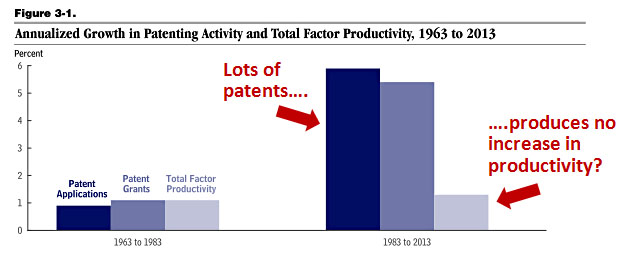
Via James Pethokoukis, here’s a chart from a new CBO report on federal policies and innovation. Needless to say, you can’t read too much into it. It shows the growth since 1963 of total factor productivity (roughly speaking, the share of productivity growth due to technology improvements), and there are lots of possible reasons that TFP hasn’t changed much over the past five decades. At a minimum, though, the fact that patent activity has skyrocketed since 1983 with no associated growth in TFP suggests, as the CBO report says dryly, “that the large increase in patenting activity since 1983 may have made little contribution to innovation.”
The CBO report identifies several possible innovation-killing aspects of the US patent system, among them a “proliferation of low-quality patents”; increased patent litigation; and the growth of patent trolls who impose a substantial burden on startup firms. The report also challenges the value of software patents:

The contribution of patents to innovation in software or business methods is often questioned because the costs of developing such new products and processes may be modest. One possible change to patent law that could reduce the cost and frequency of litigation would be to limit patent protections for inventions that were relatively inexpensive to develop. For example, patents on software and business methods could expire sooner than is the case today (which, with renewals, is after 20 years), reducing the incentive to obtain those patents. Another change that could address patent quality, the processing burden on the USPTO, and the cost and frequency of litigation would be to limit the ability to obtain a patent on certain inventions.

Personally, I’d be in favor of limiting software and business method patents to a term of zero years. But if that’s not feasible, even a reduction to, say, five years or so, would be helpful. In the software industry, that’s an eternity.

DECEMBER IS MAKE OR BREAK

A full one-third of our annual fundraising comes in this month alone. That’s risky, because a strong December means our newsroom is on the beat and reporting at full strength—but a weak one means budget cuts and hard choices ahead.

The December 31 deadline is closing in fast. To reach our $400,000 goal, we need readers who’ve never given before to join the ranks of MoJo donors. And we need our steadfast supporters to give again—any amount today.

Managing an independent, nonprofit newsroom is staggeringly hard. There’s no cushion in our budget—no backup revenue, no corporate safety net. We can’t afford to fall short, and we can’t rely on corporations or deep-pocketed interests to fund the fierce, investigative journalism Mother Jones exists to do.

That’s why we need you right now. Please chip in to help close the gap.

DECEMBER IS MAKE OR BREAK

A full one-third of our annual fundraising comes in this month alone. That’s risky, because a strong December means our newsroom is on the beat and reporting at full strength—but a weak one means budget cuts and hard choices ahead.

The December 31 deadline is closing in fast. To reach our $400,000 goal, we need readers who’ve never given before to join the ranks of MoJo donors. And we need our steadfast supporters to give again—any amount today.

Managing an independent, nonprofit newsroom is staggeringly hard. There’s no cushion in our budget—no backup revenue, no corporate safety net. We can’t afford to fall short, and we can’t rely on corporations or deep-pocketed interests to fund the fierce, investigative journalism Mother Jones exists to do.

That’s why we need you right now. Please chip in to help close the gap.

We Recommend

Latest

Sign up for our free newsletter

Subscribe to the Mother Jones Daily to have our top stories delivered directly to your inbox.

Get our award-winning magazine

Save big on a full year of investigations, ideas, and insights.

Subscribe

Support our journalism

Help Mother Jones' reporters dig deep with a tax-deductible donation.

Donate