Can You Guess Who Gets the Most Abuse in Comments?

Get your news from a source that’s not owned and controlled by oligarchs. Sign up for the free Mother Jones Daily.


The Guardian decided to analyze their corpus of 70 million comments to see who gets the most abuse. The results won’t surprise you:

Although the majority of our regular opinion writers are white men, we found that those who experienced the highest levels of abuse and dismissive trolling were not. The 10 regular writers who got the most abuse were eight women (four white and four non-white) and two black men…And the 10 regular writers who got the least abuse? All men.

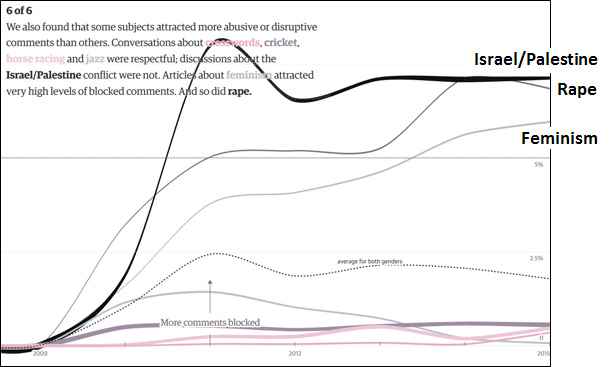
Of course, certain subjects invited more abuse than others:
And abuse that starts in one place can spread astonishingly quickly via social media:

Avalanches happen easily online. Anonymity disinhibits people, making some of them more likely to be abusive. Mobs can form quickly: once one abusive comment is posted, others will often pile in, competing to see who can be the most cruel. This abuse can move across platforms at great speed—from Twitter, to Facebook, to blogposts—and it can be viewed on multiple devices—the desktop at work, the mobile phone at home. To the person targeted, it can feel like the perpetrator is everywhere: at home, in the office, on the bus, in the street…This must surely have a chilling effect, silencing people who might otherwise contribute to public debates—particularly women, LGBT people and people from racial or religious minorities, who see others like themselves being racially and sexually abused.

Is that the kind of culture we want to live in?

Is that the web we want?

The article also includes a short quiz: Which comments would you ban? I disagreed with two out of eight of their real-life examples.

DECEMBER IS MAKE OR BREAK

A full one-third of our annual fundraising comes in this month alone. That’s risky, because a strong December means our newsroom is on the beat and reporting at full strength—but a weak one means budget cuts and hard choices ahead.

With only days left until December 31, we've raised about half of our $400,000 goal—but we need a huge surge in reader support to close the remaining gap. Whether you've given before or this is your first time, your contribution right now matters.

Managing an independent, nonprofit newsroom is staggeringly hard. There’s no cushion in our budget—no backup revenue, no corporate safety net. We can’t afford to fall short, and we can’t rely on corporations or deep-pocketed interests to fund the fierce, investigative journalism Mother Jones exists to do. That’s why we need you right now. Please chip in to help close the gap.

DECEMBER IS MAKE OR BREAK

A full one-third of our annual fundraising comes in this month alone. That’s risky, because a strong December means our newsroom is on the beat and reporting at full strength—but a weak one means budget cuts and hard choices ahead.

With only days left until December 31, we've raised about half of our $400,000 goal—but we need a huge surge in reader support to close the remaining gap. Whether you've given before or this is your first time, your contribution right now matters.

Managing an independent, nonprofit newsroom is staggeringly hard. There’s no cushion in our budget—no backup revenue, no corporate safety net. We can’t afford to fall short, and we can’t rely on corporations or deep-pocketed interests to fund the fierce, investigative journalism Mother Jones exists to do. That’s why we need you right now. Please chip in to help close the gap.

We Recommend

Latest

Sign up for our free newsletter

Subscribe to the Mother Jones Daily to have our top stories delivered directly to your inbox.

Get our award-winning magazine

Save big on a full year of investigations, ideas, and insights.

Subscribe

Support our journalism

Help Mother Jones' reporters dig deep with a tax-deductible donation.

Donate