Let’s say that ten years ago you bought $1,000 in shares of DrumCo stock. Naturally it’s a well-managed company and today those shares are worth $1,300. You sell them for a $300 profit, and pay a nice, low 20 percent capital gains tax of $60.
But then you start to think. What about inflation? That $1,000 in 2008 is the equivalent of $1,150 today. Your real profit is only $150, and $60 represents a capital gains tax of 40 percent. What a rip off! Part of your “profit” is really just keeping up with inflation. Why do you have to pay any taxes on that?
This is an ancient question, and I’m not here to answer it. You can make a good case for various ways of handling capital gains taxes. However, there’s one question I can answer: what does the law say you have to pay? The answer is that the law doesn’t care about inflation. The base price of the stock is whatever you paid for it in dollars at the time, and the selling price is whatever you sold it for later. The difference is your profit, full stop. Congress has had dozens of chances to change this, but it gets complicated once you dive into it. So they’ve always left it alone and made up for the implicit inflation penalty it by making the capital gains rate pretty low.
The Trump administration is considering bypassing Congress to grant a $100 billion tax cut mainly to the wealthy, a legally tenuous maneuver that would cut capital gains taxation and fulfill a long-held ambition of many investors and conservatives. Steven Mnuchin, the Treasury secretary, said in an interview on the sidelines of the Group of 20 summit meeting in Argentina this month that his department was studying whether it could use its regulatory powers to allow Americans to account for inflation in determining capital gains tax liabilities. The Treasury Department could change the definition of “cost” for calculating capital gains, allowing taxpayers to adjust the initial value of an asset, such as a home or a share of stock, for inflation when it sells.
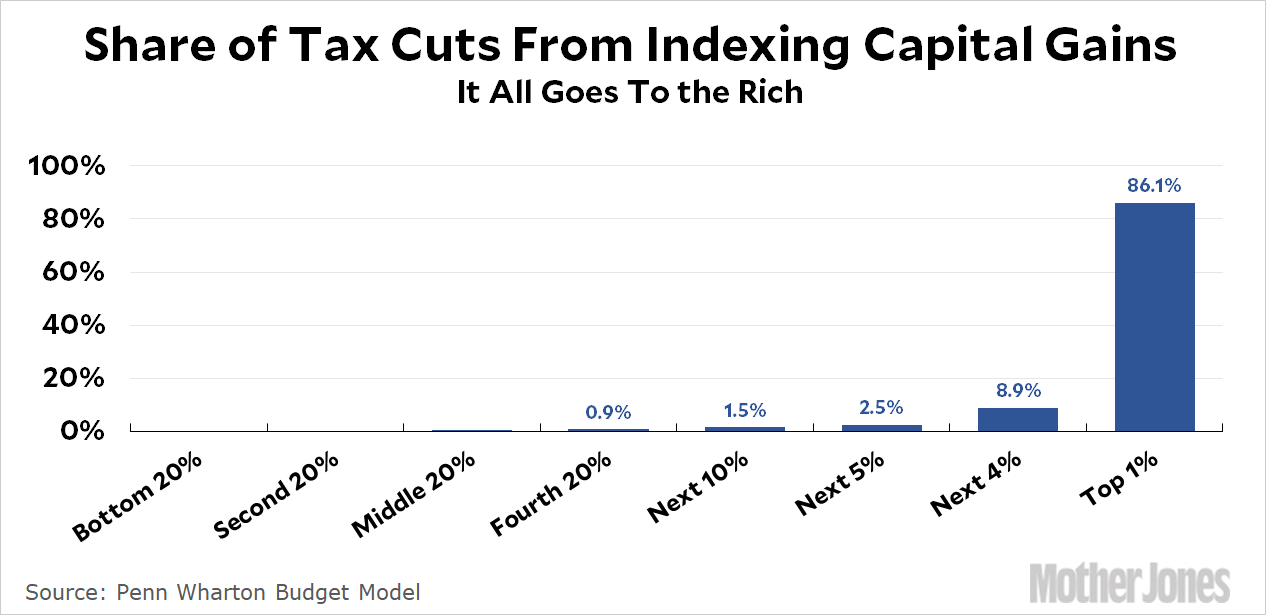
So who gets all this extra money? The upper middle class? The affluent? The prosperous? The well-off? No, no, and no. Almost all of it would go to the straight-up super rich:
Independent analyses suggest that more than 97 percent of the benefits of indexing capital gains for inflation would go to the top 10 percent of income earners in America. Nearly two-thirds of the benefits would go to the super wealthy — the top 0.1 percent of American income earners.
….According to the budget model used by the University of Pennsylvania’s Wharton School of Business, indexing capital gains to inflation would reduce government revenues by $102 billion over a decade, with 86 percent of the benefits going to the top 1 percent.
The good news is that Trump and his wealthy real-estate pals almost certainly can’t do this. The law is simply too clear on this point. Still, at least it shows that their hearts are in the right place, doesn’t it?
And if they do somehow get away with it, there’s still a silver lining. Now that they’ve gotten religion on inflation, it means that in the interests of fairness they’ll surely be in favor of indexing things like the minimum wage to inflation too. Right? I mean, what possible reason could there be for indexing the wages of the rich to inflation but not the wages of the poor?
Can you pitch in a few bucks to help fund Mother Jones' investigative journalism? We're a nonprofit (so it's tax-deductible), and reader support makes up about two-thirds of our budget.
We noticed you have an ad blocker on. Can you pitch in a few bucks to help fund Mother Jones' investigative journalism?
Help us finish strong.
We’re not shy about asking you to help pay for the journalism you rely on—especially now. We have until December 31 to raise $400,000 to keep our nonprofit newsroom running at full strength into 2026. We’re off to a good start, but to make our goal we need contributions from readers who have never given before—and from steadfast donors who can give again. Every gift matters. Will you help us close the gap?
Help us finish strong.
We’re not shy about asking you to help pay for the journalism you rely on—especially now. We have until December 31 to raise $400,000 to keep our nonprofit newsroom running at full strength into 2026. We’re off to a good start, but to make our goal we need contributions from readers who have never given before—and from steadfast donors who can give again. Every gift matters. Will you help us close the gap?