The MoJo Interview: Joss Whedon
Meet the geek god behind Dollhouse, Buffy, and Dr. Horrible's Sing-Along Blog.
For more of this interview, listen to Sheerly Avni's extended conversation with Joss Whedon, or download the podcast from iTunes.
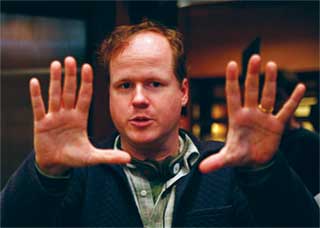
Since creating the cult TV series Buffy the Vampire Slayer in 1997, director, writer, and Toy Story scribe Joss Whedon has emerged as a shining star in the geek firmament. He's also become one of pop culture's most surprising feminists. Though they inhabit the male-centric world of sci-fi, his female protagonists, from Buffy to the women of the short-lived space-cowboy series Firefly, are funny, smart, and able to punch, kick, and banter their way out of trouble. When he came up with the idea for Dollhouse, a new series in which the heroine is rented out to fantasy-seeking clients and has her mind erased after each assignment, he asked for a thumbs-up from the women's advocacy group Equality Now after pitching the networks. The widely anticipated new show, featuring Buffy's Eliza Dushku, is set to premier on Fox in January. Mother Jones met with the 44-year-old Whedon in his small office on the Fox lot, where he discussed the importance of obsession in art and the ironies of preaching feminism on Rupert Murdoch's flagship channel. To listen to an extended interview with Whedon, click here.
Mother Jones: How has writing for television been different from writing for film?
Joss Whedon: I respect television in a way that some people who came out of film might not. Some people might take this as stereotyping, but I describe television as feminine and movies as masculine, in the sense that television wants to examine a problem from all sides and talk about it for a long time, and movies just want to hit the climax and then maybe have a smoke. I respect the rules of TV, the rules of keeping things commercial and interesting and pop-y and fun.
MJ: Some examples of those rules?
JW: My cast was not hideous to look upon. I made every act break at an exciting time that would make you want to come back after you examined these products that we used to examine before TiVo. And I tried to make money for the people that I work with, like Hyman Roth.
MJ: Tell us a little bit about your concept of "womb envy."
JW: Everybody makes fun of Uncle Joss when he brings up womb envy! But I still believe in it. It's a very simple theory and I gave it a silly name, but basically it just seemed to be a fundamental thing that women have something men don't, the obvious being an ability to bear children, and the resilience to hang in as parents. I don't understand why or how anyone ever pulled off the whole idea of "women are inferior." Men not only don't get what's important about what women are capable of, but in fact they fear it, and envy it, and want to throw stones at it, because it's the thing they can't have.
MJ: When you wrote Buffy, were you actively thinking, "I'm going to make an empowered feminist icon," or were you just intuitively telling the story you wanted to tell? Or are they the same?
JW: It's both, and they're not the same. Because "intuitively" means, "This is what turns me on, this is what I need to see, this is my obsession." I've seen a lot of movies [written] by guys who set out to [create a feminist icon] and didn't feel it. Look at A League of Their Own. All of the good lines are Tom Hanks'. Those guys are really fabulous writers, but it's not enough to say, "This should be done." You have to need to do it. The way Guillermo del Toro [Pan's Labyrinth] needs to make movies about insects—that man cares more about insects than anyone I know. He clearly is obsessed. And obsession is beautiful. It's what makes art.
MJ: As a father, what do you think about the fact that Pixar doesn't have a [top-billed] female protagonist yet?
JW: I wrote Toy Story [for Pixar]. And I remember at the time having a crisis in myself because I couldn't figure out Bo Peep. There's no reason why there couldn't be [female Pixar leads]. There is that moment in The Incredibles, when the mom has a pep talk with Violet and Violet stands up like a hero and you can see her other eye for the first time. [My wife] said, "Oh look, they wrote a scene for you."
MJ: What kind of fallout have you gotten for Buffy having an affair with a woman in the Buffy comic?
JW: I have gotten no fallout of any kind. The fact of the matter is that [women kissing] is kind of old news. It's even old news in pop culture. We tried not to turn it into a giant event and spend months going "Wait for the Buffy kiss—so she can figure out how heterosexual she is!"
MJ: You create interesting heroes, as well as interesting villains. In Angel, you have the good guy fighting against an evil law firm, Wolfram and Hart. In Firefly, you have Captain Malcolm Reynolds, a defeated rebel soldier, battling the victorious planetary Alliance.
JW: Evil doesn't come in saying, [breathes heavily, Darth Vader-style], "It's your faaather." Generally speaking, it's a lot more nebulous. In fact, it usually isn't evil so much as it is a lot of people overthinking things until they find themselves caught in an untenable situation.
MJ: In the second-to-last season of Angel, the hero actually takes a job with Wolfram and Hart, and eventually he just loses it and brings down the house.
JW: Well, you know, I'm sure I'm going to bring down News Corp with Dollhouse. Hmmm—maybe you shouldn't quote that. I'm not a huge fan of Mr. Murdoch's politics, God knows, or his methods. But I've been at Fox on and off for practically the whole of my career. Am I the biggest hypocrite in the world for taking their money? Am I doing any good? Or am I working for Wolfram and Hart? I feel at the end of the day, I'm doing some good. They're letting me tell my stories. We'll see if the stories on Dollhouse actually come out the way I plan them to.
It's like I'm reading an article from about 5 years ago. This is a man who works for Fox, hardly a bastion for equality, or for quality television for that matter. There is nothing strongly feminist about this man or his work: he still portrays women as having to be beautiful,over-sexualized, and equal to men simply because they know how to fight like men. Nothing in this interview is even remotely surprising or challenging. I was compelled by the title, but now don't want to read the article. What the hell?
While this is not the most thorough interview of Joss Whedon I've ever read. I take issue with M's assertion that Whedon is neither a feminist in fact nor in his portrayal of us. While it is true that his female characters are often physical(they do fight well)this is an important and empowering part of femininity long neglected. I teach women self-defense and it is often extremely difficult to get women to react aggressively either verbally or physically.Further, Whedon's females are as smart as they are agile and their physicality can often be seen as metaphor. His admiration of POWERFUL women is apparent.
Hey. Angel had very strong women. Cordy. Fred, who survived 5 years in a hell dimension. Gwen Raiden. In fact, Angel was a MUCH BETTER show than Buffy was.
I also disagree with M's arguments.
It's TV - who ISN'T beautiful on TV? The good thing is that each of Whedon's female characters are a combination of things, more than their "obligatory beauty" - intelligent, fierce, and yes, sexual.
Willow, Tara, Zoe, Kaylee, Fred - each strong in her own way, and not hypersexualized. Even Buffy wasn't a hypersexed character. But yes, some of them (Inara, eg.) were sexual beings, but they OWNED their sexuality, rather than having to depend on another to define their sexuality.
As for "knowing how to fight like men"...being able to stand up for one's self does NOT equal fighting like men. Being a physically strong woman does NOT...OK, you get the picture. None of them are the typical damsel in distress, the "just lie back and enjoy it" kind of women. They DO fight back. They take a stand. How is that as a detriment to their character? That's not "fighting like a man", that's power.
"The geek god behind Dollhouse, Buffy, and Firefly talks about "womb envy" and why feminists are hot."
Feminists are "hot" because saying "feminists are hot" sucessfully trivializes what feminism is about.
"Dollhouse, a new series in which the heroine is rented out to fantasy-seeking clients and has her mind erased after each assignment"
Gag.
It looks like "feminists" have their minds erased after each feminist movement.
"Dollhouse, a new series in which the heroine is rented out to fantasy-seeking clients and has her mind erased after each assignment"
Oh, you mean like this?:
M, if you think the only reason the women in Joss' show are considered powerfull is that they fight, clearly you havent watched many episodes.
And the femenists are hot thing doesn't trivialise femenism. first of all it was a quick thing to let people know at a glance the gist of the artice, second of all i just read the article and joss doesnt say it. Finally, alot of people will be reading this just as dollhouse fans, not as femenists, so that was a quick way of speaking in their terms.
I would also like to point out that the attitude of insulting people who ARE ON OUR SIDE for not being femenist enough is one of the biggest barriers holding femenism back. Lots of women i know have turned away from the femenist movement because of that very image.
Clearly Joss isn't feminist enough. Just like Barack isn't black enough.
I swear we would live in a freaking social paradise two weeks after we stopped attacking each other if we would just stop being so damn self-righteous.
Feminism and Hotness
Hotness is inextricably linked to feminism, especially American and French feminism. Sexual independence and pleasure lie at the center of modern feminism, whether we're talking about Kate Chopin or more modern advocates. One could argue that Marjory Kempe and Theresa of Avila also place sexuality at the center of their own Christ-centered feminism.
That said, I agree there's much more to feminism than sex. Arguments claiming that feminism is always sexual or is oriented towards sex deserve to be challenged. North American feminism, like other feminisms, is evolving and appears, at least, to be rather more inclusive than earlier proscriptive forms. If feminism is partially about power and choice, then I'd say we're seeing more of both. That's a good thing.
Somehow I don't feel very
Somehow I don't feel very reassured about anyone's degree of feminism when it is argued by a person who can't even spell the word. For crying out loud, men insinuate themselves into every damn thing--do they have to be in our word too?
(I know... men can be feminists too. I am mostly joking. Mostly.)
You know something, though? Women are the decorative class, and women are the sex class. I'm so tired of this fun-feminism, sex-pos-feminism crap where we have to be willing to treat our looks and sexuality as objects to buy and sell in order to be liberated. Um, I don't have to look good for anyone, and I sure don't have to have sex with anyone, even if they're paying me. And it would be nice if someone would actually be original and put out a TV show or a movie that is not about a living Barbie doll who puts out when she feels like it. Here's a newsflash for you. Women don't have to be ready for sex all the time. The fact that Whedon feels it necessary to continually explore the concept of women who put out for money is worrisome to me. If prostitution is the world's oldest profession, it has already been thoroughly explored as a social institution. NEXT. Try something else.
You know, and I don't want to hear this "of course they're beautiful, it's TV" nonsense--Roseanne was a big hit when she had her sitcom, and while it could be argued that she is beautiful, she is not conventionally so. We could have explored further the genre she opened up. Unfortunately the decision to do so or not to do so is more in the hands of the networks than the audience. Let's not talk about the way TV is done as if it's what the public always wants. How many times now have we heard stories about some promising TV series or other that got nixed in its first season? I can think of one really good example that ties back in to the subject of this article, can't you?
I want women to become more real in TV and movies. That's all. Men have had that already. It's our turn.
Where's the podcast?!?
Am I the only person who follows the podcast link to 3 apparently irrelevant podcast results, with nothing having to do with Whedon, only an interview with Twitter's founder?
This interview was posted days ago, but the podcast is still nowhere to be found.
What gives?
(I know it's available as streaming audio, but the podcast would be a lot more convenient.)
womb envy
i'm confused. does joss whedon actually believe that he came up with the concept of womb envy? it sure sounds like it here. yet the phrase was coined by a female neo-freudian psychoanalyst in the 1930's. i have historically believed whedon to be a feminist and hope that the development of dollhouse will reveal that to still be true, but i wish he was more hip to the history of feminism so as not to inadvertantly take credit for something that's not his.
ahj
It's like I'm reading an article from about 5 years ago. This is a man who works for Fox, hardly a bastion for equality, or for quality television for that matter. There is nothing strongly feminist about this man or his work: he still portrays women as having to be beautiful,over-sexualized, and equal to men simply because they know how to fight like men. Nothing in this interview is even remotely surprising or challenging. I was compelled by the title, but now don't want to read the article. What the hell?