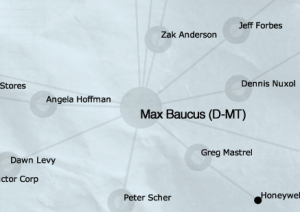
Having cleared the Environment and Public Works committee, the cap-and-trade bill is now being considered by Sen. Max Baucus’ finance panel, which has jurisdiction over how carbon permits will be allocated. But at a hearing on Thursday, committee member Sen. Maria Cantwell (D-Wash.) signaled that she thinks cap and trade contains too many opportunities for manipulation of carbon markets, and instead wants to offer her alternative—a proposal for a “cap-and-dividend” scheme.
Cap-and-dividend works by only limiting emissions by “upstream” industries—that is, the first sellers of fossil fuels, like oil refineries and coal mines. All pollution permits under the cap would be auctioned, and most of the revenues would be returned to energy consumers. As with cap-and-trade, the limit on emissions becomes stricter over time.
Now Cantwell may have a chance to offer elements of her bill for consideration. “When the right time is there we’ll certainly be putting ideas on the table,” she told reporters. The dividend idea, Cantwell said, “would be something that the committee want to discuss and have a lot of input on.”
Cantwell has a far better acronym than the Kerry-Boxer bill—hers is called the “Carbon Limits and Energy for America’s Renewal– or CLEAR, for short. In part because her proposal only covers first sellers, her bill is more concise than the cap-and-trade proposals, coming in at just 32 pages. By comparison, the chairman’s mark of the Kerry-Boxer bill is 925 pages, and Waxman-Markey totaled 1,427 pages in the end. Granted, legislation is by nature complex and brevity does not necessarily make good policy. But at a time when complicated, inscrutable market structures have wreaked havoc on our financial system and distrust about climate legislation doling handouts to big business runs rampant, the appeal of something simple and direct is clear.
Cantwell’s bill requires all carbon trading to be done on exchanges, and would allow only polluters to participate in trading. (Cap and trade allows speculators to participate in its carbon market.) And where her measure requires 100 percent of pollution permits to be auctioned, Kerry-Boxer and Waxman-Markey both distribute roughly 85 percent of those permits free of charge. Seventy-five percent of the revenues from the sale of the permits would then be refunded to consumers, in the form of a “carbon refund payment,” to offset the increase in energy prices. The other 25 percent would go to a dedicated trust fund for job training programs, clean energy research and development, and climate mitigation and adaptation programs.
Baucus declined to offer a time line for his committee work on Tuesday. “No date set,” he told reporters. “It really depends on a lot of factors: other committee’s actions on health care, Copenhagen … There will be other hearings though. We’re taking this very seriously.” Sen. John Kerry (D-Mass), who along with Lindsey Graham (R-S.C.) and Joe Lieberman (I-Conn.). is spearheading a separate track of negotiations in the Senate, now says it’s unlikely that this effort will produce a full bill before early next year.