Image: Antonin Kratochvil
To get to Gaviotas from Bogotá, it takes 16 hours driving over the rutted, dust-choked roads of a dangerous no man’s land. If it’s raining, the trip will take several days navigating jeep-swallowing mud. Guerrillas and paramilitary roadblocks can further delay travel. Eventually, a green mass looms on the horizon, and aluminum sunflowers begin to dot the empty savanna. The latter turn out to be delicate windmills; the former is a 25,000-acre forest, rising improbably from an infertile tropical plain.
Amid the trees is a cluster of low white buildings and colorful houses with dramatic, swooping roofs, all bearing solar collectors. Begun in 1971 as a scientific experiment, Gaviotas is now a self-sufficient town of 200, supported by clean, renewable industries that have made the once improbable goal of zero emissions a reality.
The first Gaviotans were a handful of Bogotá engineers and soil chemists, persuaded by a Colombian visionary named Paolo Lugari to try to make an unlivable place livable. Lugari reasoned that someday expanding populations would have to inhabit hitherto inhospitable places. And because barren, sparsely settled savannas constitute much of the tropics, a research station in Colombia’s eastern plains could have global implications.
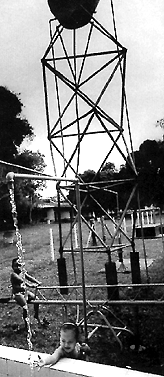
The scientists weren’t seeking an alternative lifestyle so much as applying common sense to use what little materials lay at hand. The first problem was finding pure water in this land of muddy, malarial streams. The hand pumps the Gaviotans invented to reach deep aquifers proved so easy to use they hooked them to children’s seesaws. Next they developed solar “kettles” to sterilize drinking water, windmills to convert mild tropical breezes into energy, solar water heaters that work in the rain, and soil-free hydroponic systems to raise edible and medicinal crops. These innovations have spread to other parts of Latin America; nearly 700 villages in Colombia alone now use the pumps developed in Gaviotas.
After years of experimentation, Gaviotas scientists discovered that Caribbean pines from Honduras could flourish in the area’s thin, highly acidic soil, and the bark resin could be harvested without cutting down the spreading forest. Tapped like maple syrup, the natural resin is used in paints, cosmetics, perfumes, and medicines in lieu of petroleum-based substances. When distilled in Gaviotas’ pollution-free factory, its byproduct is marketable turpentine.
Besides providing a sustainable living, the pines have also created what biologists call an unimaginable miracle: In their sheltered understory, a tropical forest not seen for millennia in these savannas has regenerated, restoring the habitat of already proliferating deer, hawks, and anteaters. The 250 native plant species thus far identified inspired Gaviotans to convert their pharmacy into an herbal apothecary and begin an ethnobotanical research lab with local Guahibo Indians. Many Guahibos and rural peasants now live in Gaviotas, riding to work on Gaviotas-designed savanna bicycles, the official mode of transportation. The newest projects include a purified water bottling plant and a musical instrument factory, using wood culled from the pine forest.
In the midst of Colombia’s ongoing civil upheaval, drug wars, and environmental stresses, Gaviotas has evolved into a community of peace and sanity. A place without police or politicians, it proves that even the leanest environments provide rich tools and resources if people choose to live sensibly. “If we can do it here,” says Paolo Lugari, “it can happen anywhere.”
Alan Weisman is the author of Gaviotas: A Village to Reinvent the World, published by Chelsea Green Publishing this spring. Additional research by Jen Wieczorek.