How Old Should Kids Be Before They’re Allowed to Play in the Front Yard on Their Own?

Get your news from a source that’s not owned and controlled by oligarchs. Sign up for the free Mother Jones Daily.


Pew Research routinely comes out with long, detailed surveys of interesting things, and I usually thumb through them looking for intriguing tidbits. Today it’s “Parenting in America,” and you’ll be unsurprised to learn that middle-class parents generally have a more positive view of things than poor parents. I may have more to say about this later, but in the meantime here’s a tidbit that answers a question I’ve pondered more than once: how old should kids be before they’re allowed to do stuff on their own?
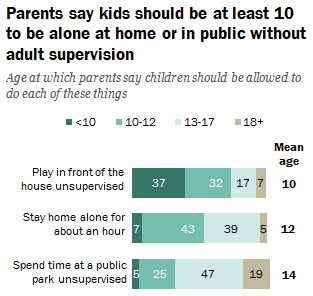
I don’t know how this has changed over time, but these figures sure seem strange. I played on my own in front of my house when I was five,1 but today’s parents think you need to be 10—and a substantial fraction think you need to be over 12 to play in front of the house unsupervised.

Ditto for the others. I suppose 12 isn’t unreasonable for staying home alone, but again, a substantial fraction think you need to be 14 or 15 or even 18.

As for public parks, holy cow. The average age for allowing kids to play in a park without adult supervision is 14, and there’s a substantial fraction who think you literally have to be an adult yourself before you should be allowed to go to a park on your own.

Unsurprisingly, Pew says that the answers are correlated with income, which is correlated with the kind of neighborhood you live in. If you live in a safe neighborhood, the average age for playing in front of the house is 9. If you live in a poor neighborhood, it’s 11. This makes sense.

Still, the overall numbers sure strike me as high. Of course, I’ve led a sheltered existence, so maybe I just don’t get it. But the world is a safer place than it was 30 years ago. Do kids really need to be ten just to play in the front yard these days?

1I called my mother to confirm this. She did.
DECEMBER IS MAKE OR BREAK

A full one-third of our annual fundraising comes in this month alone. That’s risky, because a strong December means our newsroom is on the beat and reporting at full strength—but a weak one means budget cuts and hard choices ahead.

The December 31 deadline is closing in fast. To reach our $400,000 goal, we need readers who’ve never given before to join the ranks of MoJo donors. And we need our steadfast supporters to give again—any amount today.

Managing an independent, nonprofit newsroom is staggeringly hard. There’s no cushion in our budget—no backup revenue, no corporate safety net. We can’t afford to fall short, and we can’t rely on corporations or deep-pocketed interests to fund the fierce, investigative journalism Mother Jones exists to do.

That’s why we need you right now. Please chip in to help close the gap.

DECEMBER IS MAKE OR BREAK

A full one-third of our annual fundraising comes in this month alone. That’s risky, because a strong December means our newsroom is on the beat and reporting at full strength—but a weak one means budget cuts and hard choices ahead.

The December 31 deadline is closing in fast. To reach our $400,000 goal, we need readers who’ve never given before to join the ranks of MoJo donors. And we need our steadfast supporters to give again—any amount today.

Managing an independent, nonprofit newsroom is staggeringly hard. There’s no cushion in our budget—no backup revenue, no corporate safety net. We can’t afford to fall short, and we can’t rely on corporations or deep-pocketed interests to fund the fierce, investigative journalism Mother Jones exists to do.

That’s why we need you right now. Please chip in to help close the gap.

We Recommend

Latest

Sign up for our free newsletter

Subscribe to the Mother Jones Daily to have our top stories delivered directly to your inbox.

Get our award-winning magazine

Save big on a full year of investigations, ideas, and insights.

Subscribe

Support our journalism

Help Mother Jones' reporters dig deep with a tax-deductible donation.

Donate