Wait! I Have a Better Dual Y-Axis Chart.

I blew it! In my post earlier this morning about charts with dual y-axes I picked some miscellaneous data as an illustration. Then I saw a tweet about an article written in October that lays out the relationship between trust in government and murder rates:

The murder rate since World War II has tracked almost perfectly, as criminologist Gary LaFree has observed, with the proportion of Americans who say they “trust the government in Washington to do what is right” most of the time and who believe that most public officials are honest.

How about that. But is it true? Here’s a lovely chart with dual y-axes to provide a quick visual check. Note that I’m plotting murder vs. mistrust in government, since that’s supposed to be the actual driving factor:
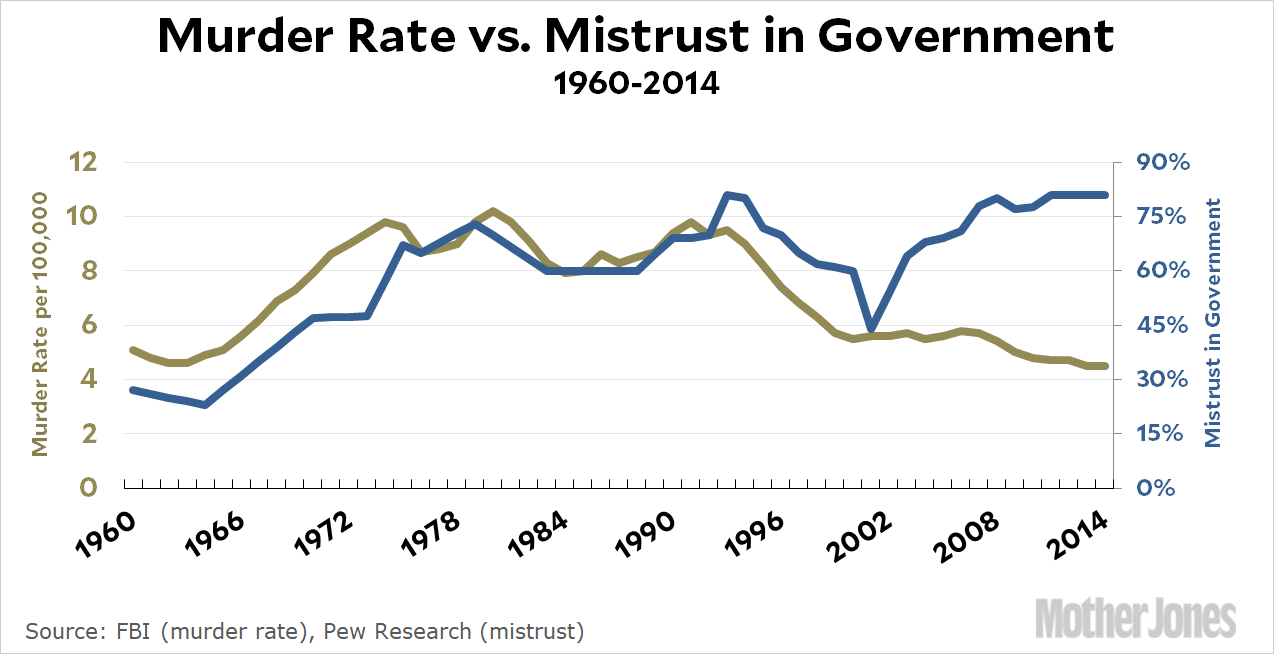
It actually fits pretty well until the late-90s, when mistrust started rising again but the murder rate kept going down. (The 9/11 attacks caused a spike downward and improved the fit, but that obviously shouldn’t be taken seriously. The divergence really began around 1998 or so.)

I have no comment on this, since I haven’t read LaFree’s book and really couldn’t judge it anyway. If anything, I might guess that an increase in murder rates is a factor in driving up mistrust in government, but who knows? As with the lead-crime hypothesis, you need a lot more than a single national correlation to make a case for causality.

However, it does show the usefulness of dual y-axes in a real world test. If you put these charts side-by-side, it would be hard to see if they match up. If you charted them on a single axis, the murder rate would look like a flat line down around zero. But with a dual axis you can pretty easily get a quick-and-dirty sense of whether there’s anything there. And if you then do the serious analysis to convince yourself that the correlation is real, the chart is a great visual illustration of your thesis.

BEFORE YOU CLICK AWAY!

December is make or break for us. A full one-third of our annual fundraising comes in this month alone. A strong December means our newsroom is on the beat and reporting at full strength. A weak one means budget cuts and hard choices ahead.

The December 31 deadline is closing in fast. To reach our $400,000 goal, we need readers who’ve never given before to join the ranks of MoJo donors. And we need our steadfast supporters to give again today—any amount.

Managing an independent, nonprofit newsroom is staggeringly hard. There’s no cushion in our budget—no backup revenue, no corporate safety net. We can’t afford to fall short, and we can’t rely on corporations or deep-pocketed interests to fund the fierce, investigative journalism Mother Jones exists to do.

That’s why we need you right now. Please chip in to help close the gap.

BEFORE YOU CLICK AWAY!

December is make or break for us. A full one-third of our annual fundraising comes in this month alone. A strong December means our newsroom is on the beat and reporting at full strength. A weak one means budget cuts and hard choices ahead.

The December 31 deadline is closing in fast. To reach our $400,000 goal, we need readers who’ve never given before to join the ranks of MoJo donors. And we need our steadfast supporters to give again today—any amount.

Managing an independent, nonprofit newsroom is staggeringly hard. There’s no cushion in our budget—no backup revenue, no corporate safety net. We can’t afford to fall short, and we can’t rely on corporations or deep-pocketed interests to fund the fierce, investigative journalism Mother Jones exists to do.

That’s why we need you right now. Please chip in to help close the gap.

We Recommend

Latest

Sign up for our free newsletter

Subscribe to the Mother Jones Daily to have our top stories delivered directly to your inbox.

Get our award-winning magazine

Save big on a full year of investigations, ideas, and insights.

Subscribe

Support our journalism

Help Mother Jones' reporters dig deep with a tax-deductible donation.

Donate