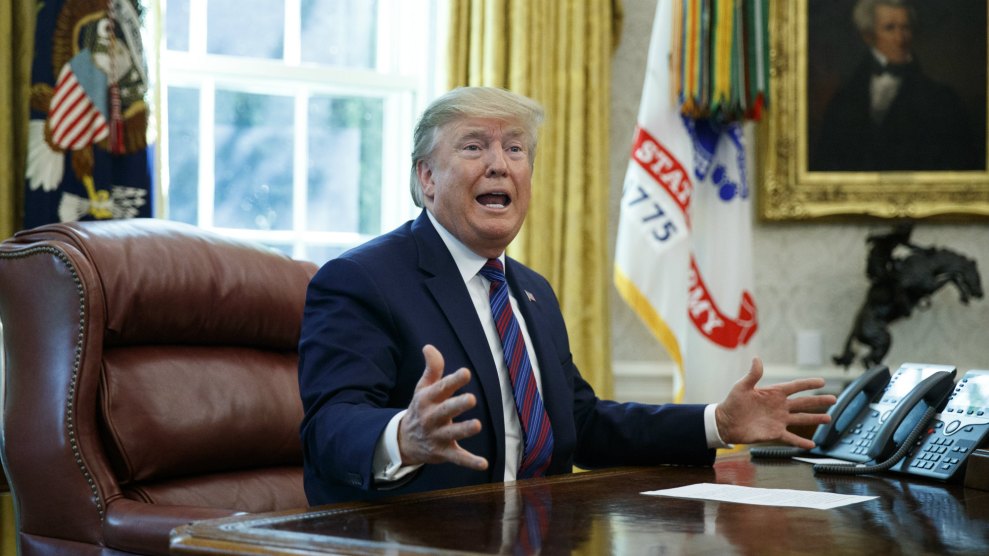
A lot of badly run companies are trying to blame tariffs. In other words, if they’re running badly and they’re having a bad quarter or if they’re just unlucky in some way, they’re trying to blame the tariffs. It’s not the tariffs. It’s called bad management.
Can you imagine how Fox News would play this if Oba—
The 2017 Republican tax bill was designed as a gift to corporations and the rich. However, it also contained a nod to the poor: a tax incentive to spur development in low-income “opportunity zones.” If this seems out of character for the modern GOP, don’t worry. The New York Times explains that there was, naturally, a gigantic loophole:
Some opportunity zones that were classified as low income based on census data from several years ago have since gentrified. Others that remain poor over all have large numbers of wealthy households. And nearly 200 of the 8,800 federally designated opportunity zones are adjacent to poor areas but are not themselves considered low income.
Under the law, up to 5 percent of the zones did not need to be poor. The idea was to enable governors to draw opportunity zones in ways that would include projects or businesses just outside poor census tracts, potentially creating jobs for low-income people. In addition, states could designate whole sections of cities or rural areas that would be targeted for investment, including some higher-income census tracts.
The result is predictable:
Billions of untaxed investment profits are beginning to pour into high-end apartment buildings and hotels, storage facilities that employ only a handful of workers, and student housing in bustling college towns, among other projects. Many of the projects that will enjoy special tax status were underway long before the opportunity-zone provision was enacted. Financial institutions are boasting about the tax savings that await those who invest in real estate in affluent neighborhoods.
….Even supporters of the initiative agree that the bulk of the opportunity-zone money is going to places that do not need the help, while many poorer communities are so far empty-handed.
But don’t worry:
“The early wave, that’s not what you judge,” said John Lettieri, president of the Economic Innovation Group, an organization that lobbied for the establishment of opportunity zones.
Would you like to hear about three weird ways that cancer has changed my health? Of course you would. These are all very peculiar changes that are seemingly unrelated to the multiple myeloma itself, though who knows? Maybe they resulted from it in some strange way; maybe they’re due to the chemo drugs; or maybe they’re just things that happened coincidentally. I have no idea. Here they are:
Breathing: All my life I’ve been a mouth breather because my nose is chronically too stuffed up to breathe through. I even had my deviated septum corrected a couple of decades ago (it didn’t help). But when I was in the hospital five years ago my nose cleared up. I figured maybe the hospital air was super filtered or something, but after I got home my nose stayed cleared up and it remains clear to this day.
Peeing: My bladder has gotten tougher. Or my prostate has gotten bigger. Or something. But I can slurp down a big ol’ Diet Coke with my popcorn at the movies and not have to get up halfway through. I sleep through the night almost all the time. For some reason, I’ve regressed to about my 40-year-old self. I just don’t have to pee as often as I used to.
Sweating: I am much more tolerant of cold weather and much less tolerant of hot weather. If I lived in Duluth this would be an unalloyed benefit. Unfortunately, I live in Southern California. This is a big change for me: I used to be a typical SoCal boy, playing tennis in 90-degree heat and barely sweating a drop. These days, all it takes is a walk around the block in 80-degree heat for me to start sweating like a pig. It’s very strange.
This is all very mysterious. But after five years I have to figure that these are permanent changes. I wonder what caused them?
U.S. households ramped up their spending in July, providing reassurance that the economy’s decadelong expansion continued to roll despite slowing factory activity and global growth. Personal-consumption expenditures, a measure of household spending, increased a seasonally adjusted 0.6% in July from June, a pickup from the previous two months, the Commerce Department said Friday, continuing a solid performance by the economy’s main driving force.
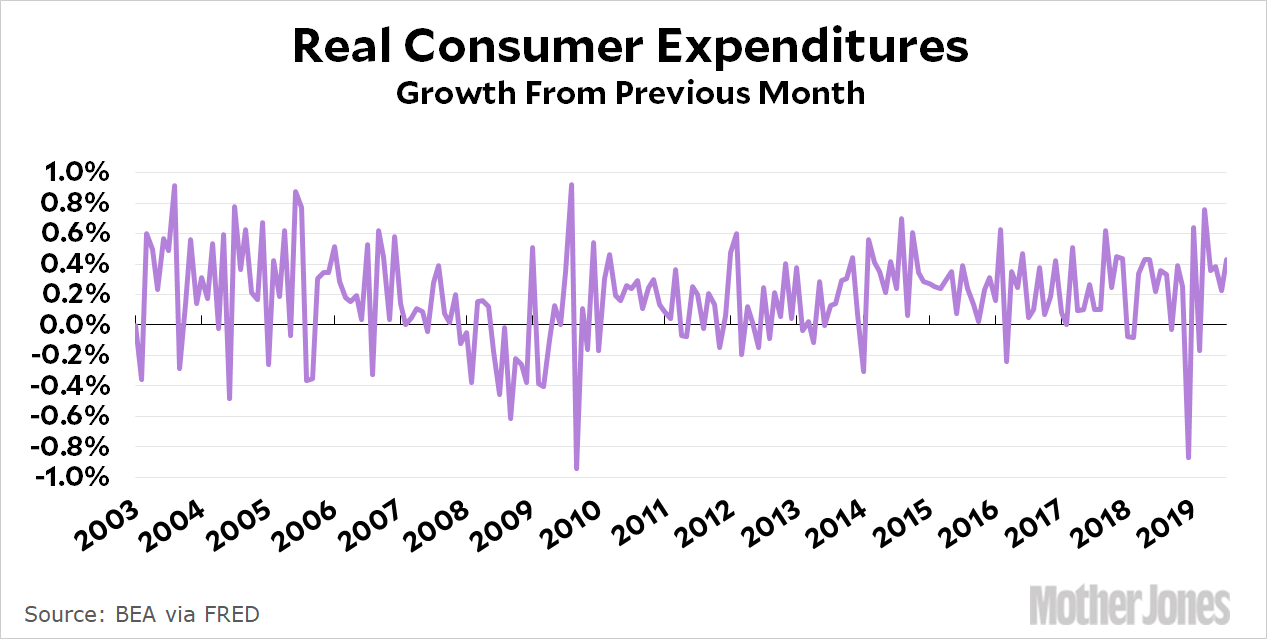
First of all, this isn’t adjusted for inflation, even though real numbers are released at the same time as nominal numbers. Second, take a look at monthly growth in consumer spending over the past couple of decades:
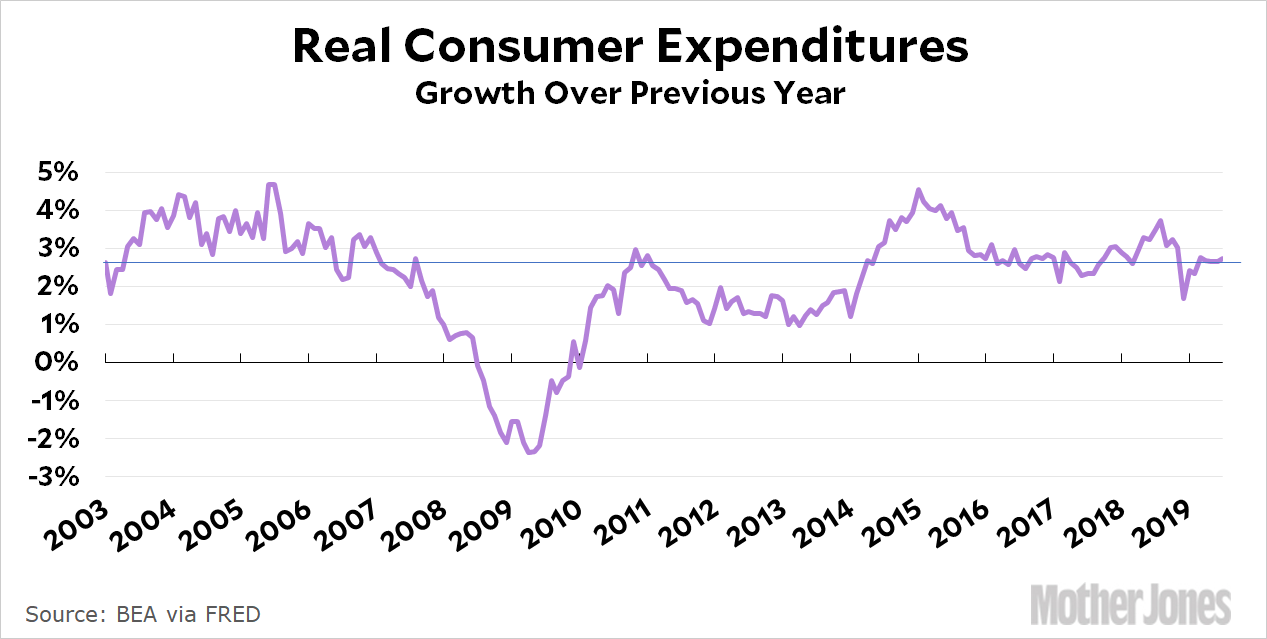
It’s all noise. There’s no way to pull any useful information out of this. If, instead, you compare year-over-year growth—which makes more sense in the first place—you get this:
There’s still some noise, but there’s also a clear signal: consumer spending grew in July at about the rate as June and May and April and March. It’s actually a little below the average of the past couple of years.
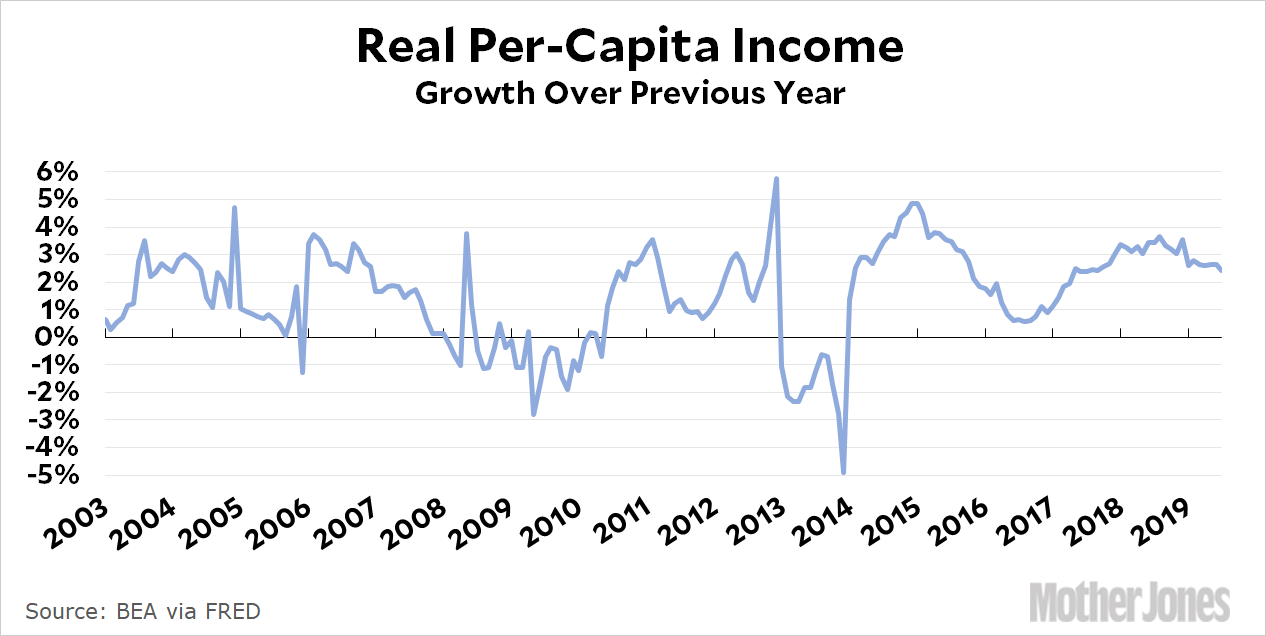
I should note that this works in both directions. If you look at personal income, it didn’t increase at all between June and July. It was completely flat. Bad news! But if you look at year-over-year growth, things look a little different:
Income growth has been showing some decleration over the past year, but it’s still pretty positive.
I know this stuff seems kind of tedious, but it matters if you really want to know the state of the economy. The Journal summary of July is that consumer spending was strong but income growth was weak. In reality, they were both fairly average.
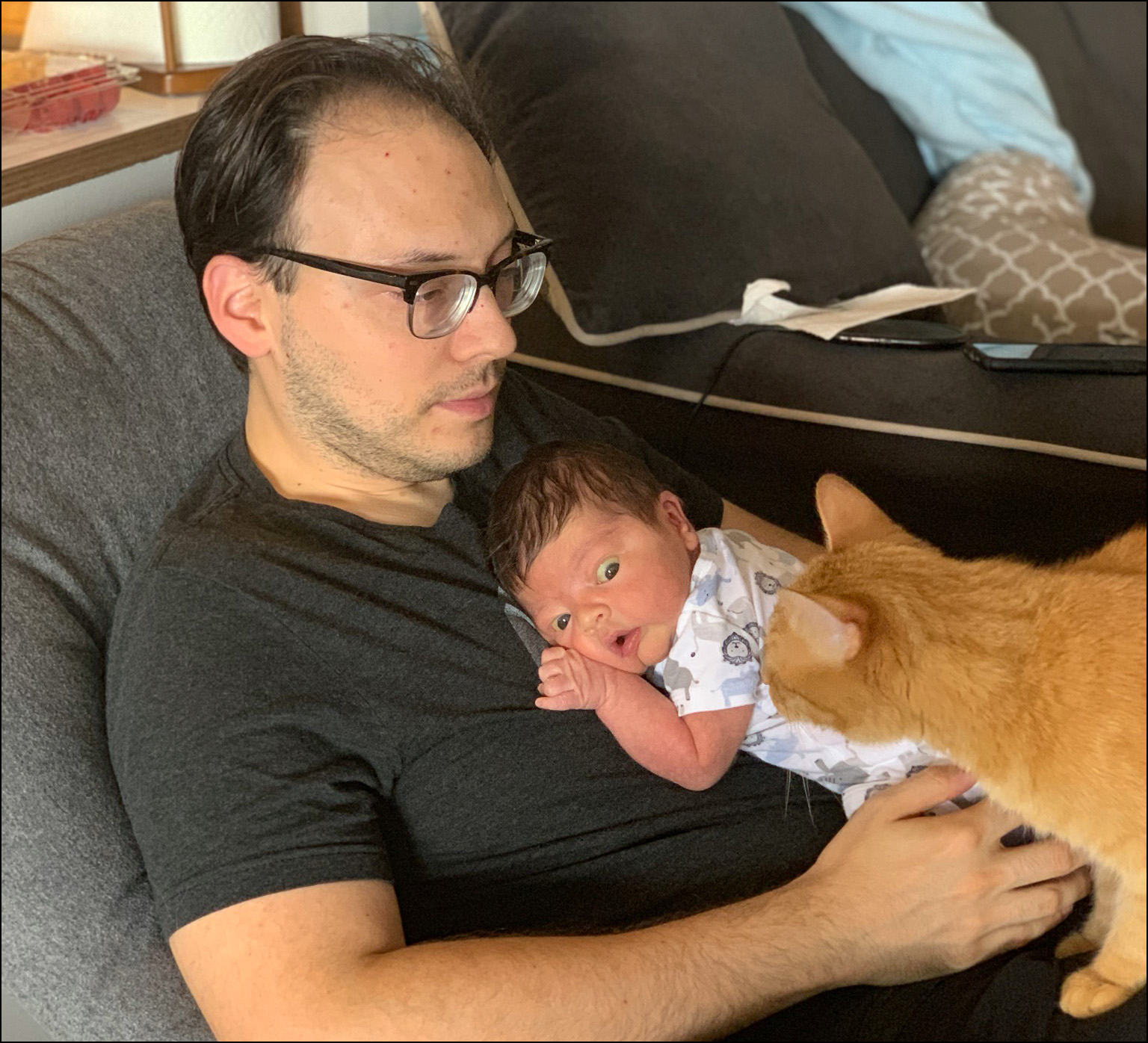
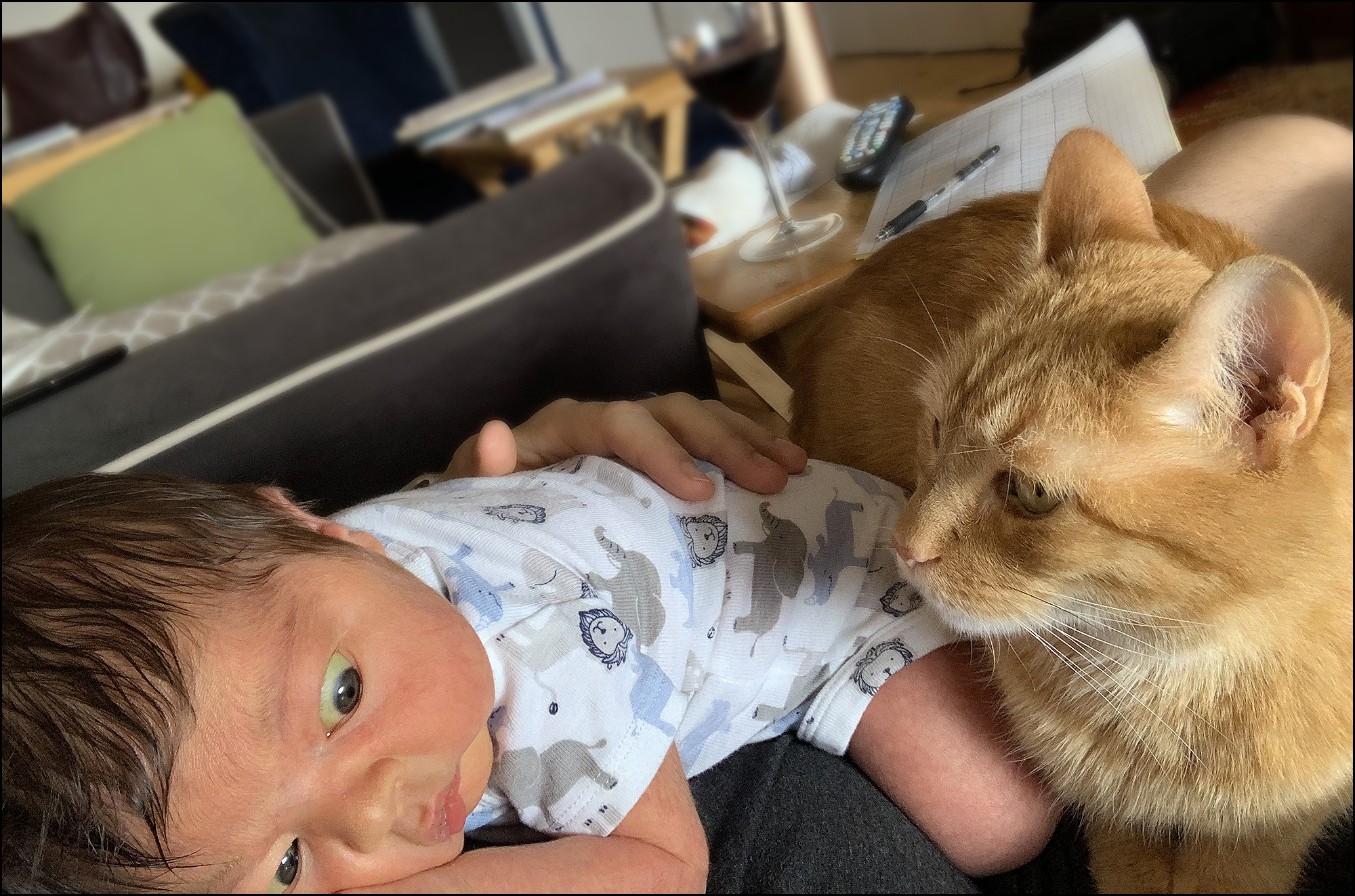
Two of our favorite people in the world had their first baby a week ago. Everyone is back home now and thriving, and that means it’s time for young Dylan to make the acquaintance of Tony the cat, who you may remember from last year. All my plans for this week’s catblogging went out the window as soon as I saw the pictures of this momentous occasion. Mom is the one snapping photos for the historical record; Dad is being careful to stay still and not alarm anyone; Tony is cautiously checking out the tiny human; and Dylan is obviously a little . . . unsure . . . of what to make of this gigantic orange furball that weighs as much as he does.
As you can see, Tony settled down a few minutes later, apparently approving of the new addition, who will surely grow up to be an excellent servant someday. Dylan appears to be settling in too, but still keeping a watchful eye out. That’s probably wise.
NOTE: No cats or babies were harmed in the making of this post.
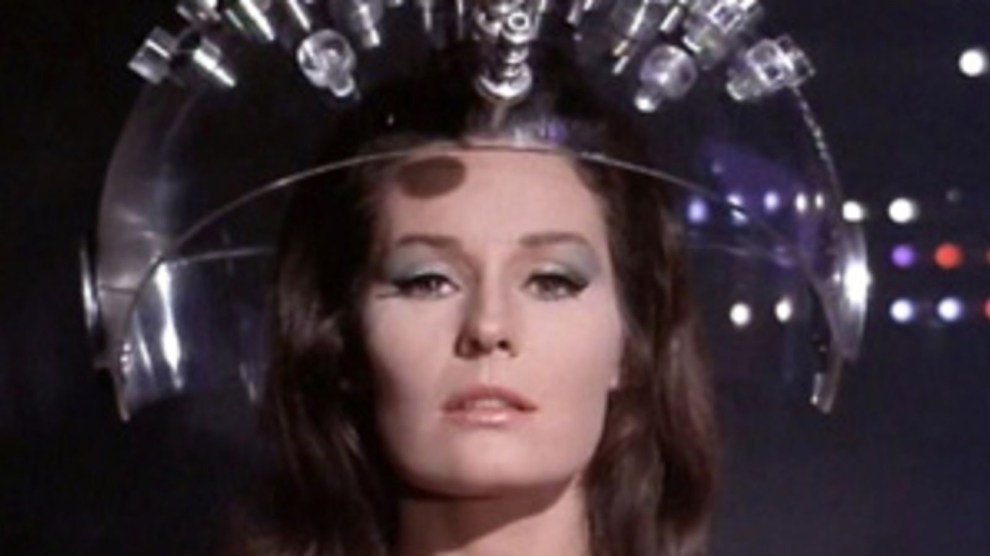
Let’s do some science fiction today. Recently both Mark Zuckerberg and Elon Musk’s have announced that they’re building tech to read your mind. It doesn’t work so great yet, and it’s mainly aimed at controlling prosthetics or allowing you to answer your iPhone with a flick of your mind. But it’s getting better, and in the near future it’s a good bet that technology will be able to read minds in at least a crude way.
Over at Vox, Sigal Samuel talks to neuroethicist Marcello Ienca about what this means. Ienca proposes four cognitive human rights we should all have, including this one:
2. The right to mental privacy
You should have the right to seclude your brain data or to publicly share it.
Ienca emphasized that neurotechnology has huge implications for law enforcement and government surveillance. “If brain-reading devices have the ability to read the content of thoughts,” he said, “in the years to come governments will be interested in using this tech for interrogations and investigations.” The right to remain silent and the principle against self-incrimination — enshrined in the US Constitution — could become meaningless in a world where the authorities are empowered to eavesdrop on your mental state without your consent.
The Fifth Amendment guarantees a right against self-incrimination. But why? Notably, it is not designed to make it easier for the guilty to avoid punishment. There are two main arguments in favor of it. First, authorities should have to make a criminal case against you on their own, rather than forcing you to help them out. Second, forced confessions have a long and gruesome history of being misused. No more Star Chamber proceedings for us. A third, perhaps narrower, argument is that juries should judge cases on the facts, not on listening to the defendent on the stand and deciding whether she “sounds” guilty or cagey.
But do any of these really apply to a technological solution? For the purposes of this conversation, let’s assume the tech is accurate and noninvasive.¹ It could easily be adapted to address all of these issues. First, authorities could be required to pass some kind of “probable cause” bar before they’re allowed to interrogate anyone. We can set that bar wherever we like, and we can insist that interrogation be strictly limited (no fishing expeditions) and done in front of a judge. Second, if a case goes to trial, the interrogation would be done in open court. There would never be any incentive to beat a confession out of someone since the truth would eventually come out anyway. And the defendent’s demeanor would never come into play. All that matters is what the brain scan tells us about the facts in the defendent’s memory.
Given this, why would anyone not want to use tech like this? It would vastly improve the accuracy of the criminal justice system. It would be racially blind. It would save billions of dollars. It would deter crime since the odds of being caught would become pretty high.
I’m sure there are drawbacks here and there. Would it work on the mentally ill? How about people who have genuinely convinced themselves they’ve done nothing wrong (or vice versa)? But these strike me as fairly minor issues in the face of a system that could reform and improve the criminal justice system by orders of magnitude in a stroke. What’s not to like?
¹Needless to say, maybe it wouldn’t be. Or maybe it could be gamed. Or maybe the same tech could be used to implant false memories into criminals’ heads. Who knows? But for now let’s stick to the basic question of whether it’s a good idea even if it works.
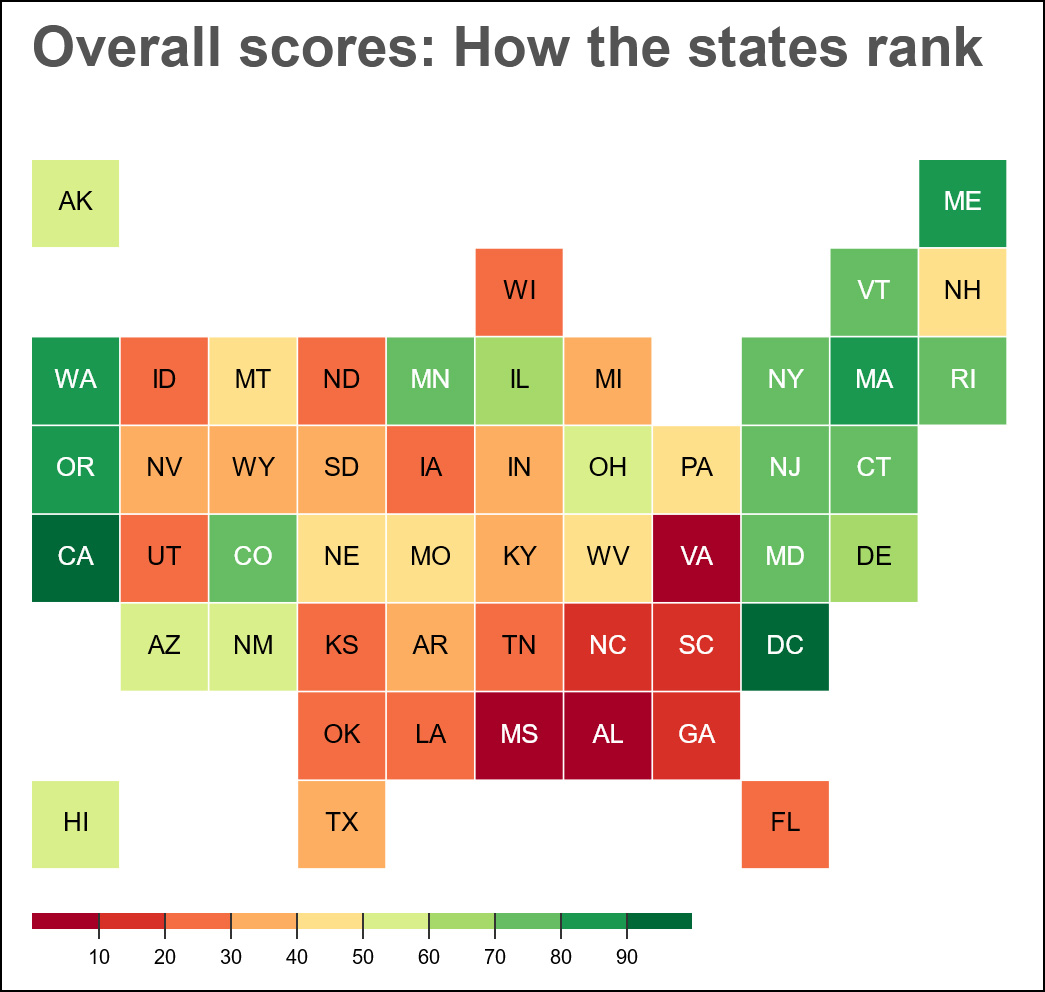
Chief Executive magazine says that California ranks dead last as the worst place to do business in the United States. I’m a little suspicious of any list that ranks California #34 in “living environment,” since that’s precisely the reason so many people put up with our high taxes and regulations, but I suppose they have their reasons. In any case, there’s a flip side to this. Guess which state Oxfam ranks as the best state for workers?
I imagine this is sort of a zero-sum game. If a state is good for CEOs, it’s probably not so great for workers, and vice versa.
But wait! As it happens, despite our terrible taxes and endless rules and high minimum wage and environmental tomfoolery, it turns out that the average income of the top 1 percent in California is over $500,000. That’s the highest outside the mid-Atlantic and the 6th highest in the country. So for all their bitching, and for all the worker protections we have in place, California seems to be a pretty good place for CEOs after all. Maybe there’s a lesson to be learned from—
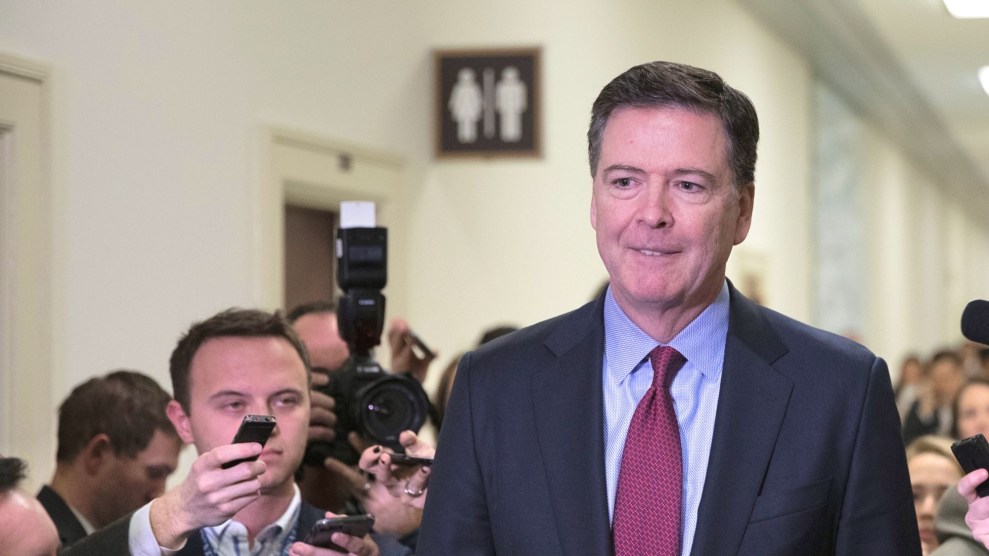
Former FBI Director James Comey arrives at the Longworth House Office Building on Capitol Hill in Washington, DC, on December 7, 2018.Alex Edelman/Zuma
Yesterday the Justice Department’s Inspector General released a scathing report about James Comey’s leak of a report to the New York Times. I spent most of the day trying to figure out why the IG was so beside himself, but I failed. Let’s go through the case.
The facts are simple and undisputed. Back when he was FBI Director, Comey kept summaries of his conversations with President Trump. After Trump fired him, he gave one of the summaries to a friend, with instructions to share the substance, but not the summary itself, with Michael Schmidt of the Times. Comey also gave copies of the other summaries to his lawyers, but did not share them with the press.
So that’s that: basically Comey leaked to the press the fact that Trump had tried to influence the investigation of Michael Flynn. If Comey had just picked up the phone and called Michael Schmidt, he would have done nothing wrong. However, because he had a friend do it based on the contents of a summary Comey wrote while still in office—a summary which contained no classified information—he violated government policy.
There are a few other details to the case, including whether Comey should have retained possession of his summaries at all when he left office, and the fact that some of the summaries had a few very minuscule passages that were retroactively labeled confidential. But the leak is the key issue.
All of this has been common knowledge for two years. Comey acknowledged what he had done almost immediately. When the FBI asked for the summaries back, he gave them back. When they retroactively classified a couple of phrases, he notified the appropriate authorities immediately. So why did this take two years and 62 pages to clear up? That’s hard to figure out.
Now, by definition, leaking is against government policy, so presumably Comey did indeed violate government policy. But surely this is more whistleblowing than leaking? It was a very small, very focused leak that exposed clear wrongdoing on the president’s part. No classified information was put at risk and no investigations were compromised. Only one thing happened: the country found out that the president of the United States had lobbied the FBI Director to go easy on a friend of his.
That sure sounds like a pretty good reason for a leak. And while I don’t expect the Inspector General to condone leaking, this case certainly doesn’t seem to justify the time, money, or vitriol that the IG brought to it. It’s a bit of a mystery.
Ben Wittes has more here if you want to dive deeper into the details.
Take a close look at your receipt the next time you buy some tunes at Amoeba Music in Hollywood. You’ll see a 35-cent charge tacked on for “wages & benefits.” That’s not a state or local tax. It’s the company simply reaching a little deeper into your pocket to cover its costs of doing business.
Chris Carmena, Amoeba’s general manager, told me the 35-cent charge helps defray expenses related to minimum-wage requirements, paid sick leave and workers’ healthcare. “It obviously doesn’t cover all of our costs,” he said, “but it helps.”
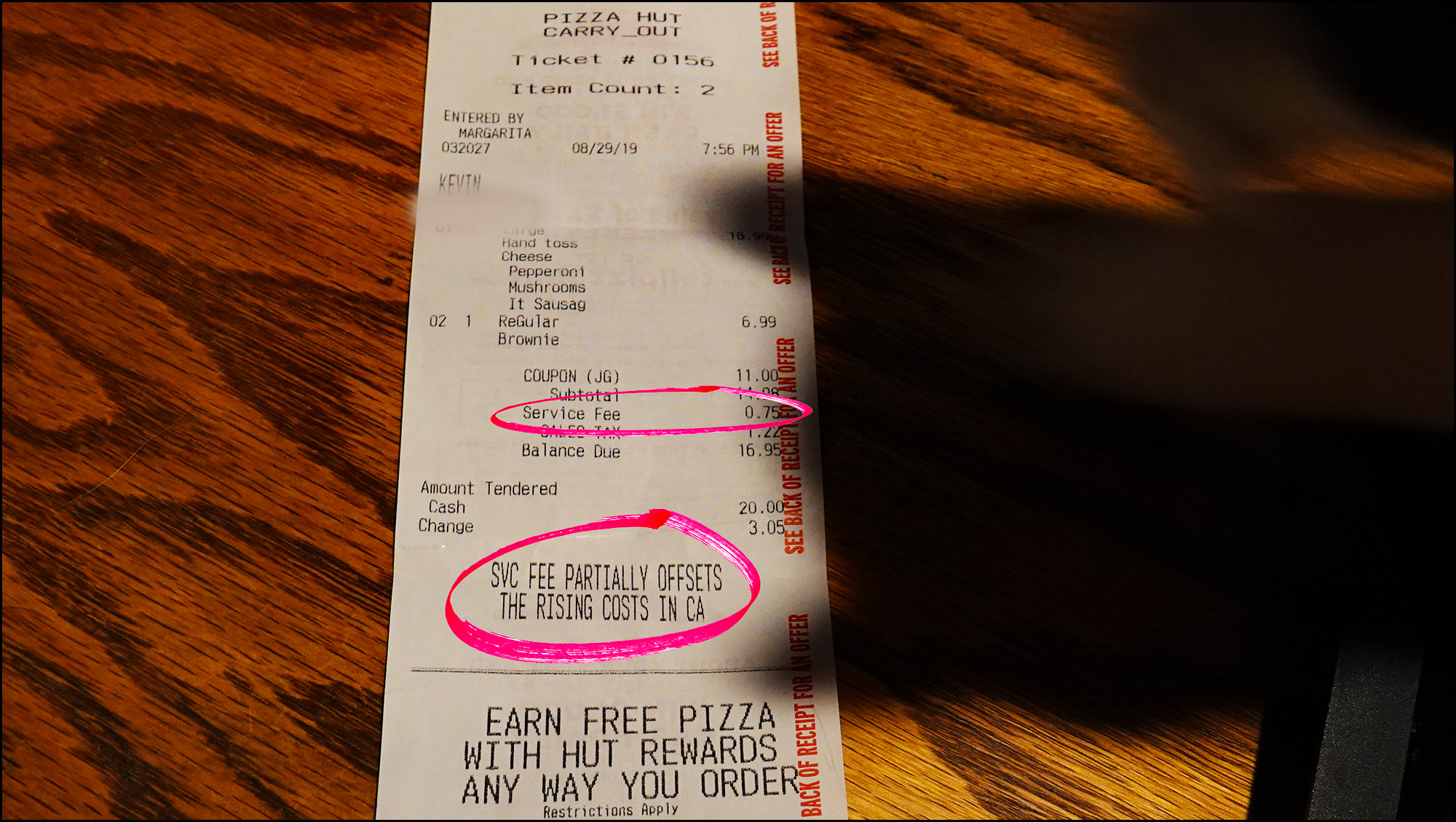
Funny he should mention that. Last night we got a large 3-topping pizza from Pizza Hut for only $7.99. What a deal! Except that it included a 75-cent fee to defray “the rising costs in California.”
Cat shadow, as usual, is shown for scale.
Kevin Drum
Well, I have no doubt that costs are rising in California, though no particular new reason comes to mind at the moment. And at the very, very least, Pizza Hut should give us some warning of this fee on their website.
Aside from random griping, though, my real reason for posting this is to find out if the Hut is doing this elsewhere. I’m sure that some of you are willing to admit to buying pizzas from Pizza Hut (ours was, ahem, just an experiment). Has anyone from other states seen a similar fee?
In 2015, the state mandated that employers give their workers three days a year of paid leave….Then in March 2016, on the Saturday before Easter, Gov. Jerry Brown cut a backroom deal with labor union leaders and state lawmakers to ratchet up the minimum wage in California to $15 an hour by 2023 for smaller employers, and by 2022 for larger ones.
….“Due to a myriad of legislative and court decisions, some restaurants in California have elected to add a surcharge to their receipts to defray increased costs incurred over the last several years,” begins an article on the association’s website titled, “Understanding and Guidance on Surcharges.” The tone is matter-of-fact. “The increased costs of operating a restaurant can be attributed to minimum wage increases, health care, paid sick leave, restrictive scheduling, cost of food and supplies and increased pay equity between traditionally tipped employees and heart of the house employees.”
The article offers advice on how to calculate taxes correctly and how to avoid getting sued by a city attorney, such as the one in San Diego who filed a slew of cases in 2017 charging some surcharging restaurants with false advertising and consumer fraud. Last November, a San Diego Superior Court judge ruled in one of these cases that “the surcharge is not unlawful as a matter of law.” Similar rulings followed in similar cases.
….Stephen Zolezzi, CEO of the Food and Beverage Association of San Diego, said in 2018 that surcharges allow the restaurant industry to send a message. “Yes, it’s a political statement,” he said. “We’re trying to show people the consequences of legislation that adds to the cost of doing business.”
I’m still curious if this is becoming common in any other states. Or is it just California?
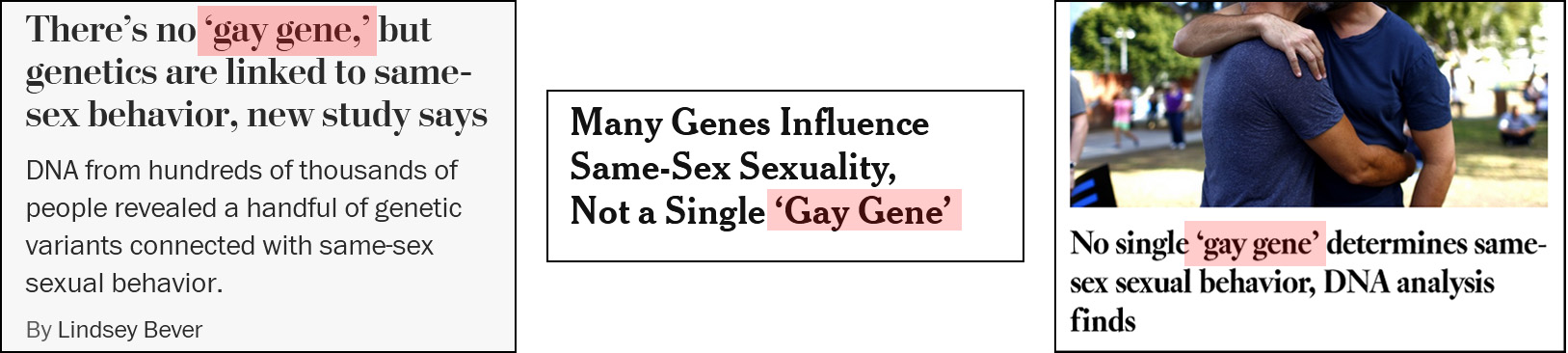
The nation’s press is trying to atone today for the sins of its past:
A few years ago a research team conducted a small study that located a few epigenetic markers that seemed to be associated with being gay. Not a single working geneticist—and I say this advisedly—not a single one suggested this was the discovery of a “gay gene.” Even the study’s own team didn’t say that. In fact, mostly the study was criticized for being too underpowered to really say much of anything at all.
But it got played as a gay gene anyway. Today, however, the results of a new, very high-powered study were published, and they showed what everyone knew all along: there are a whole bunch of genetic variations that each have a tiny effect but, taken together, probably account for a propensity toward same-sex attraction. The study suggests that genetic variation might account for about a third of that propensity, with environmental and social factors accounting for the other two-thirds.
How did we know this all along? Because this is the case for literally every complex personality trait, something we’ve been aware of for years. Whether it’s IQ or artistic ability or extroversion or anything else, the contribution of the genome—whether it’s 10 percent or 90 percent—depends on the combined effects of hundred or thousands of tiny genetic variations. Not only isn’t there a gay gene, there isn’t an anything gene.
One concern is that evidence that genes influence same-sex behavior could cause anti-gay activists to call for gene editing or embryo selection, even if that would be technically impossible. Another fear is that evidence that genes play only a partial role could embolden people who insist being gay is a choice and who advocate tactics like conversion therapy. “I deeply disagree about publishing this,” said Steven Reilly, a geneticist and postdoctoral researcher who is on the steering committee of the institute’s L.G.B.T.Q. affinity group, Out@Broad. “It seems like something that could easily be misconstrued,” he said, adding, “In a world without any discrimination, understanding human behavior is a noble goal, but we don’t live in that world.”
We should all be sympathetic to Reilly’s concerns, but repressing the truth is never a good way to deal with bigotry. It won’t change the minds of the bigots but it might very well damage our ability to deal with them. It also damages our ability to conduct further research. One way or another these results are going to end up in the public sphere, and we’re better off if it’s done by careful researchers who earn the public’s trust by being open and honest about their results.
And we respect that! But maybe you’re of a mind to support our work directly instead? We have until December 31 to raise the last $400,000 we need to keep our nonprofit newsroom running at full strength into 2026. Will you make a gift today?
We noticed you have an ad blocker on. Can you pitch in a few bucks to help fund Mother Jones' investigative journalism?
Billionaires own the media,
but they don’t own us.
At Mother Jones we know these aren’t conventional times, and they require unconventional coverage. That’s what deliver every day: fierce, independent journalism you can’t find elsewhere. Perhaps never in the history of our country has that been more necessary than now. But we can’t do it without reader support—your support. Please chip in today.
Billionaires own the media,
but they don’t own us.
At Mother Jones we know these aren’t conventional times, and they require unconventional coverage. That’s what deliver every day: fierce, independent journalism you can’t find elsewhere. Perhaps never in the history of our country has that been more necessary than now. But we can’t do it without reader support—your support. Please chip in today.