• Did Status Anxiety Power Trump to Victory? Let’s Look.

    The New York Times reports today on a new paper that looks at whether people voted for Trump out of a sense of economic anxiety:

    A study published on Monday in the Proceedings of the National Academy of Sciences questions that explanation, the latest to suggest that Trump voters weren’t driven by anger over the past, but rather fear of what may come. White, Christian and male voters, the study suggests, turned to Mr. Trump because they felt their status was at risk.

    That’s certainly plausible. Let’s go to the study itself to see what it says:

    Although the panel does not include repeated measures asking directly about racial status threat—and such measures might be susceptible to social desirability bias in any case—it included a short form of the social dominance orientation (SDO) scale, tapping individual differences in support for hierarchy over equality. Psychologists most often use it as an indicator of a stable personal trait indicating animus toward outgroups, but those high in SDO also are known to oppose trade and foreign direct investment out of a desire to dominate other countries.

    The study compares a panel of voters who took an identical internet survey in 2012 and 2016, and it directly includes a set of questions measuring attitudes toward social dominance. But for some reason it doesn’t take the obvious next step of simply correlating increases in SDO with increases in support for Trump. That’s odd, isn’t it? Instead it looks at three other questions. Long story short, here are the results:
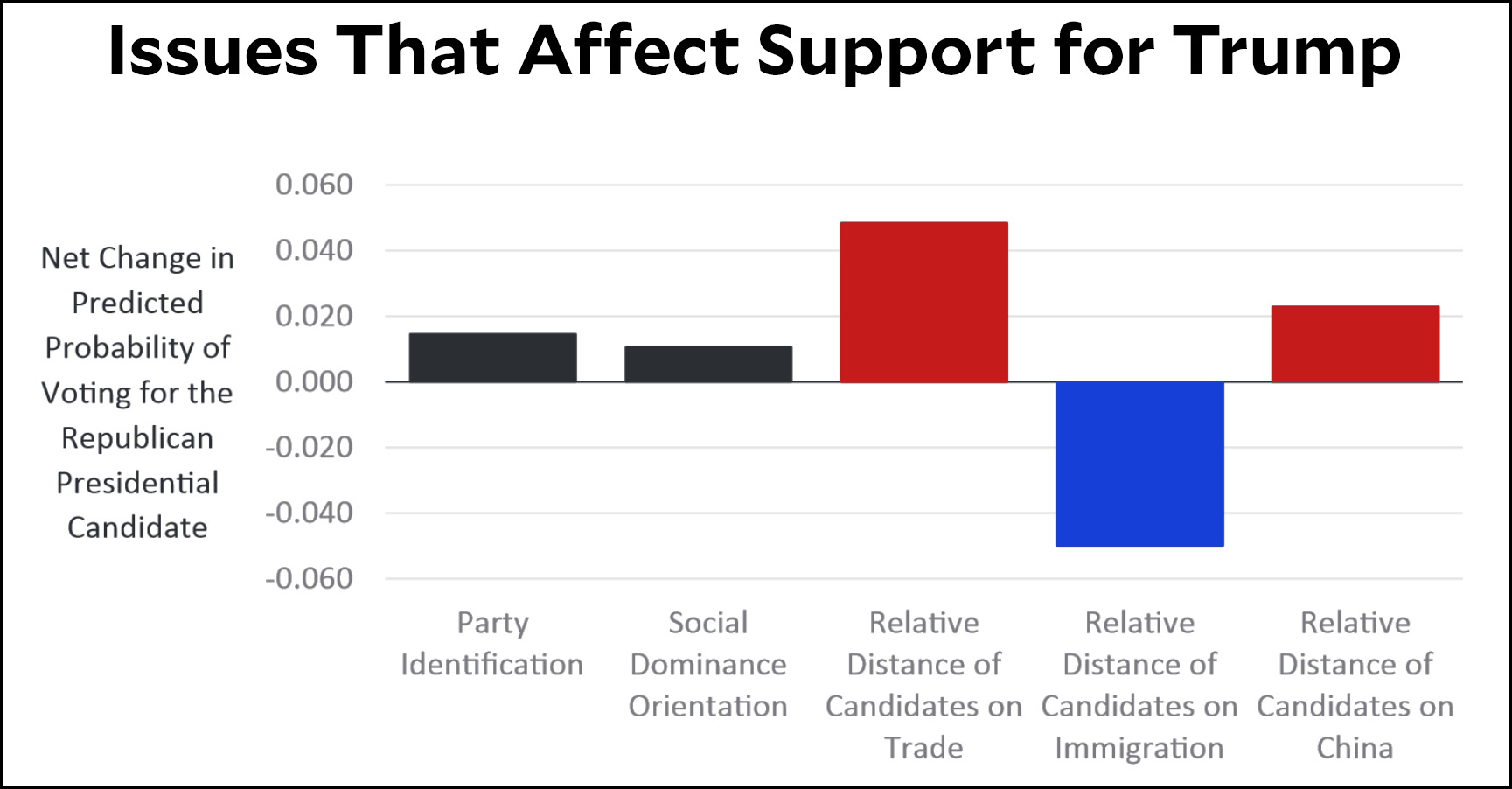
    I think you can see the problem: changes in SDO had only a tiny and barely significant effect on the vote for Trump, which suggests that it wasn’t all that important. So how do we save this study? It’s easy. Step 1: Examine other issues. Trump gained about 5 percentage points of support due to his views on trade. He lost about 5 percentage points due to his views on immigration. And he gained about 2 points for his China bashing.

    Step 2: Make a post-hoc claim that these issues are what really matters:

    Notably, all three of these issues capture potential racial and global status threat. For example, immigration captures the perceived threat of allowing those who are racially different into one’s country. Trade opposition captures Americans’fear of takeover by more dominant economic powers as well as racial opposition based on resentment of “others,” including  foreigners and businesses in countries that are racially different. Prejudicial attitudes toward domestic minorities predict trade attitudes more strongly than the vulnerability of a person’s occupation or industry of employment. Finally, China can be considered an outgroup threat both racially and with respect to threatening American global dominance.

    The real takeaway from this study is that Trump’s tough talk on trade was pretty popular. But that’s not very interesting, so it gets made into something else. This is how the game is played, kids.

  • Pruitt About to Take Next Step in Banning Science at the EPA

    Serrano, Shutterstock/ ZUMA Press

    This is why Scott Pruitt is able to get away with acting like he’s the Sun King:

    Environmental Protection Agency Administrator Scott Pruitt is expected to propose a rule Tuesday that would establish new standards for what science could be used in writing agency regulations, according to individuals briefed on the plan. It is a sweeping change long sought by conservatives.

    The rule, which Pruitt has described in interviews with select media over the past month, would only allow EPA to consider studies for which the underlying data are made available publicly. Advocates describe this approach as an advance for transparency, but critics say it would effectively block the agency from relying on long-standing, landmark studies linking air pollution and pesticide exposure to harmful health effects.

    ….Andrew Rosenberg, director of the Union of Concerned Scientists’ Center for Science and Democracy, said in an email that Pruitt’s move would expand on his earlier decision to change the standards for who can serve on EPA’s advisory committees….“First, they came after the agency’s independent science advisers, and now, they’re going after the science itself,” Rosenberg said. “What is transparent is the unabashed takeover of EPA leadership by individuals who have demonstrated disinterest in helping communities combat pollution by using the best available science.”

    As long as he keeps doing stuff like this, conservatives will let him get away with anything. I imagine Pruitt’s next step is to ban the use of science entirely because it so obviously has anti-industry bias. And after all, doesn’t EPA stand for Emitter Protection Agency?

  • Raw Data: Density and Traffic

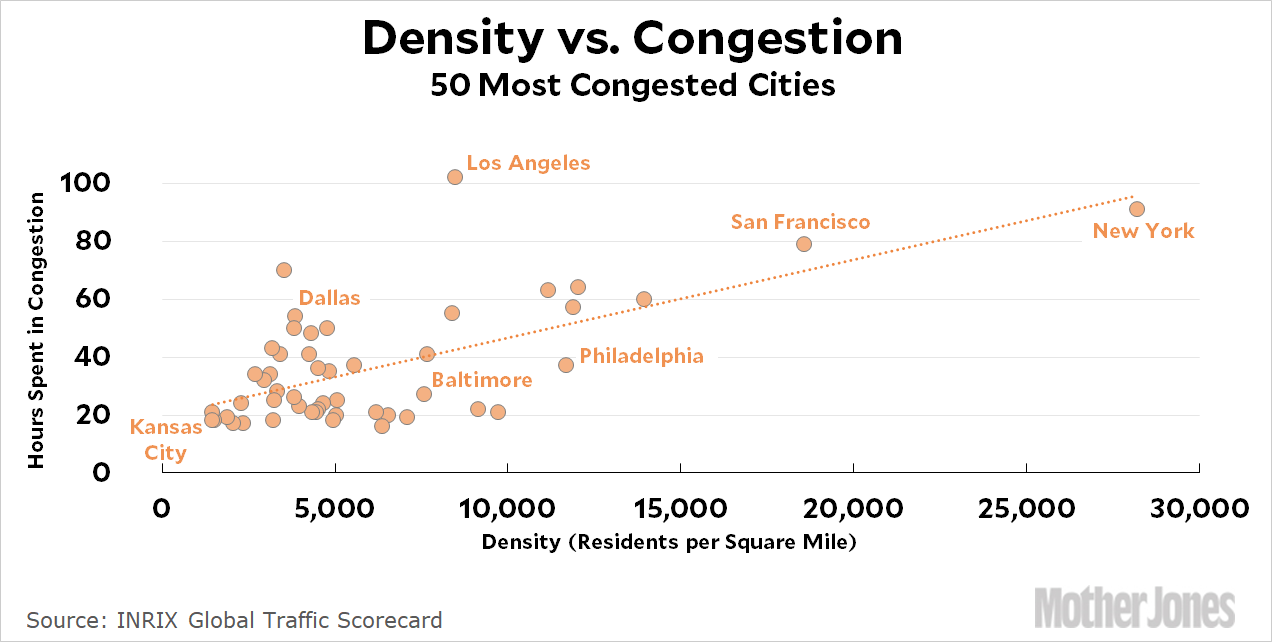
    Does higher density in big cities increase traffic congestion? Or does it actually reduce congestion by moving more people closer to where the jobs are, thus cutting down on commutes? This is not an easily answered question, but here are a few markers. First, here’s a simple chart showing that time spent in congestion increases as density increases:

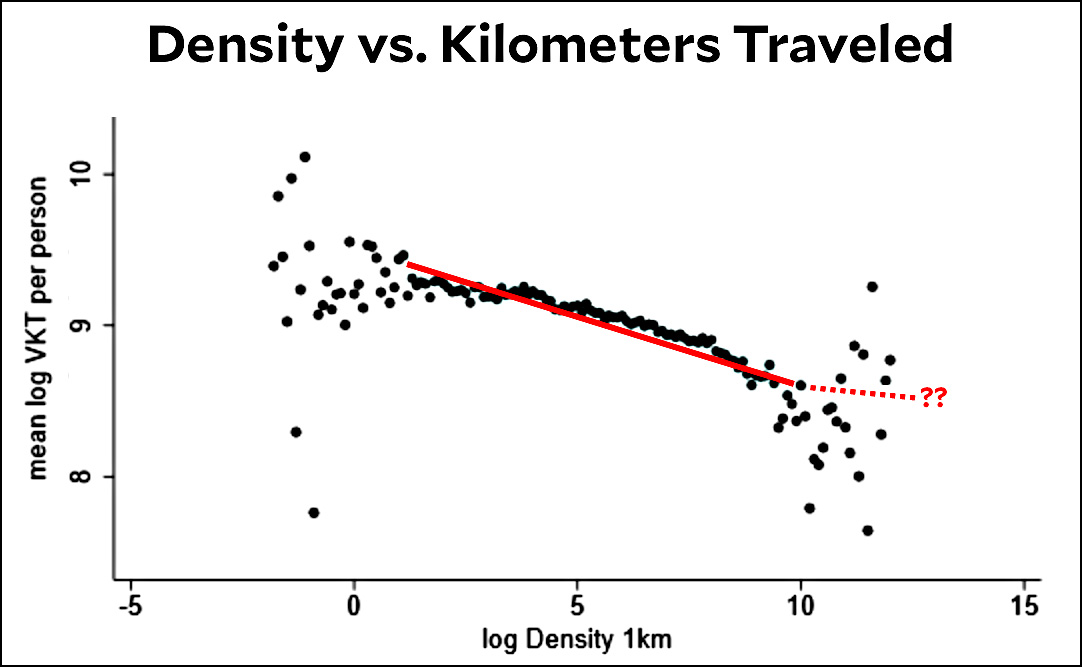
    However, there are other ways of looking at this and more sophisticated ways of doing the analysis. Gilles Duranton, an expert in urban design at Wharton, teamed up with Matthew Turner to perform a detailed analysis of total vehicle use based on an enormous dataset from the National Household Travel Survey. Here’s what they found:

    In mid-size cities, total traffic decreases with higher density. In the biggest cities, however, the correlation breaks down and it’s hard to say what happens. Higher density probably still reduces traffic, but the size of the effect is smaller and seemingly random.

    Unfortunately, even in mid-size cities the effect is quite small. The authors estimate that a doubling of urban density leads to only a 10 percent decrease in total miles traveled:

    Urban density appears to have a small causal effect on driving….Our estimates of the relationship of driving to urban form allow us to assess the cost effectiveness of densification as a policy response to excessive driving. These estimates suggest that urban form is not cost effective compared to explicit pricing programs.

    In particular, even concentrating the population residing in 83% of the area the continental US into an area of about 1500 square kilometers would result in only about a 5% decrease in aggregate driving, and this policy appears to describe the upper envelope of what densification policies can accomplish. On the other hand, existing estimates of the gasoline price elasticity of driving suggest that a similar decrease in driving would be accomplished with a gas tax that is no larger than gasoline price fluctuations observed over the past five to ten years. Congestion pricing programs appear to have even larger effects.

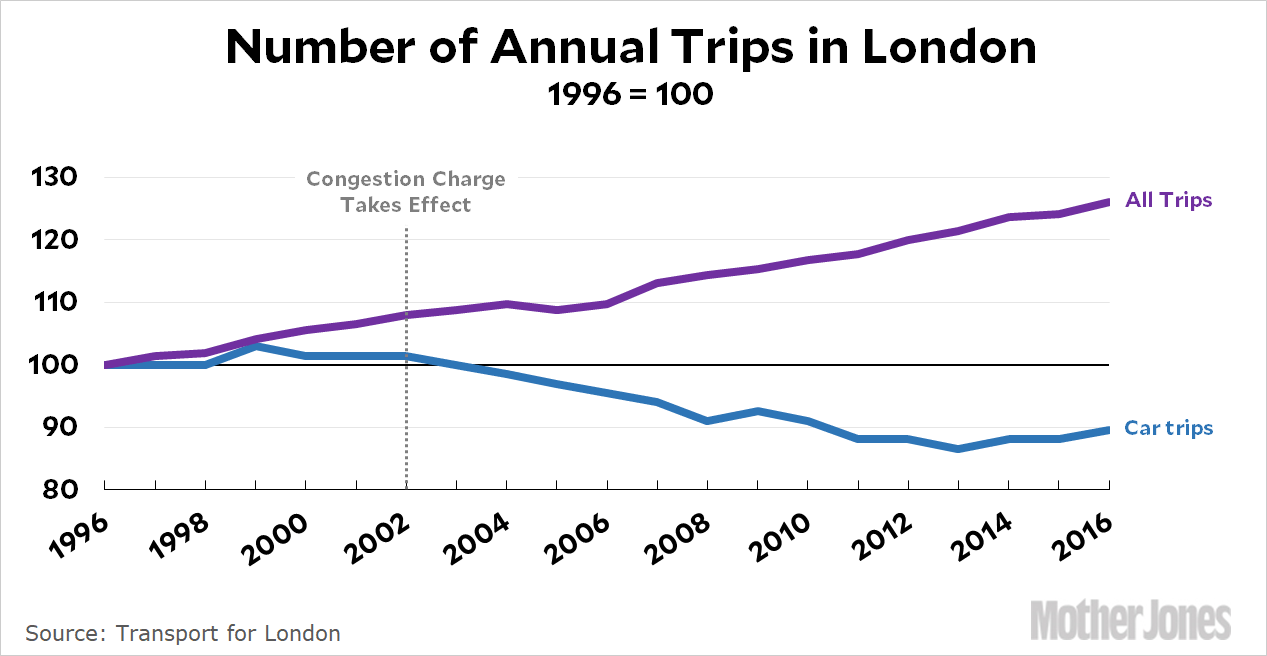
    So higher density is a mixed bag: it appears to produce somewhat more congestion but slightly fewer total miles traveled. If you really want to reduce traffic, the authors suggest that a gasoline tax or, even better, a congestion charge provide far more bang for the buck. For example, here are the number of trips taken in Central London before and after they introduced a congestion charge:

    As it turns out, traffic in London is about as pokey today as it was in 1996. However, the congestion charge has still been a success: although taxi and delivery trips have increased, the number of car trips into London from the suburbs has fallen by about a quarter. If that hadn’t happened, congestion would be far worse than it was in 1996.

    One of the most persistent objections to denser urban development comes from residents who object to making congested streets even more congested. The evidence suggests that this is a legitimate concern, and to overcome it urban planners need to offer concrete solutions. Better mass transit is obviously one possibility, but it doesn’t necessarily reduce traffic at the location where someone is proposing to build a new apartment block. However, a congestion charge would reduce traffic everywhere, and at least stands a chance of mollifying residents who are tired of too many cars (and probably hate all the out-of-town commuters tying up their streets anyway).

    So far the idea of a congestion charge hasn’t caught on in America. New York almost got one recently, but the legislature killed it a few weeks ago. But if it ever does catch on, there’s likely a bargain to be made: a congestion charge—with proceeds earmarked for mass transit—paired with statutory and zoning changes that make it easier to get approval for dense residential blocks. Why not do both?

  • Need a Job? Just Call Bernie.

    Bernie Sanders is finally putting the socialist back in Democratic Socialist:

    Sen. Bernie Sanders (I-Vt.) will announce a plan for the federal government to guarantee a job paying $15 an hour and health-care benefits to every American worker “who wants or needs one,” embracing the kind of large-scale government works project that Democrats have shied away from in recent decades.

    Sanders’s jobs guarantee would fund hundreds of projects throughout the United States aimed at addressing priorities such as infrastructure, care giving, the environment, education and other goals. Under the job guarantee, every American would be entitled to a job under one of these projects or receive job training to be able to do so, according to an early draft of the proposal. A representative from Sanders’s office said they had not yet done a cost estimate for the plan or decided how it would be funded, saying they were still crafting the proposal.

    Let’s do a little back-of-the-envelope arithmetic here. There are about 113 million full-time wage earners in America right now and roughly a quarter of them make less than $15 per hour. Add in health care benefits and you’re up to a third of the labor force making less than they would under Bernie’s plan. That’s about 37 million people. Now toss in some part-time workers and some self-employed workers and we’re up to something on the order of 50 million.

    That’s 50 million people who would be better off with a government-guaranteed job than with the job they have now. In other words, it’s insane, and I really hope I don’t have to explain why.

    But—

    Since this is just a proposal, let’s also suppose that Bernie is proposing universal health care and a minimum wage of $15, which we know he supports. In that case, everyone with a job would be just as well off keeping it. However, there would still be millions who don’t have a job and want one, and more millions who might not like their jobs and would prefer a government job that’s a little cushier. How many is that? Maybe 5 million? 10 million? And probably more like 15-20 million during a recession.

    That’s still pretty damn close to insane. It’s about 3-10 percent of the labor force effectively nationalized forever by the federal government, which makes it roughly comparable to the emergency labor force employed for a few years by the WPA during the depths of the Depression. This is why even our lefty comrades in social democratic Europe don’t guarantee jobs for everyone. It would cost a fortune; it would massively disrupt the private labor market; it would almost certainly tank productivity; and it’s unlikely in the extreme that the millions of workers in this program could ever be made fully competent at their jobs.

    But in the era of Donald Trump, where everything is “so easy” when you’re holding a rally on the campaign trail, I suppose it will sell well. Everything pitched at a third-grade level seems to these days.

    Sigh. Go ahead and take your shots, Bernie Bros.

    UPDATE: If this argument isn’t doing it for you, click here for a more analytic post about a federal jobs guarantee.

  • The Border Patrol Wants Us to Think Its Job Is More Dangerous Than Ever. It’s Not.

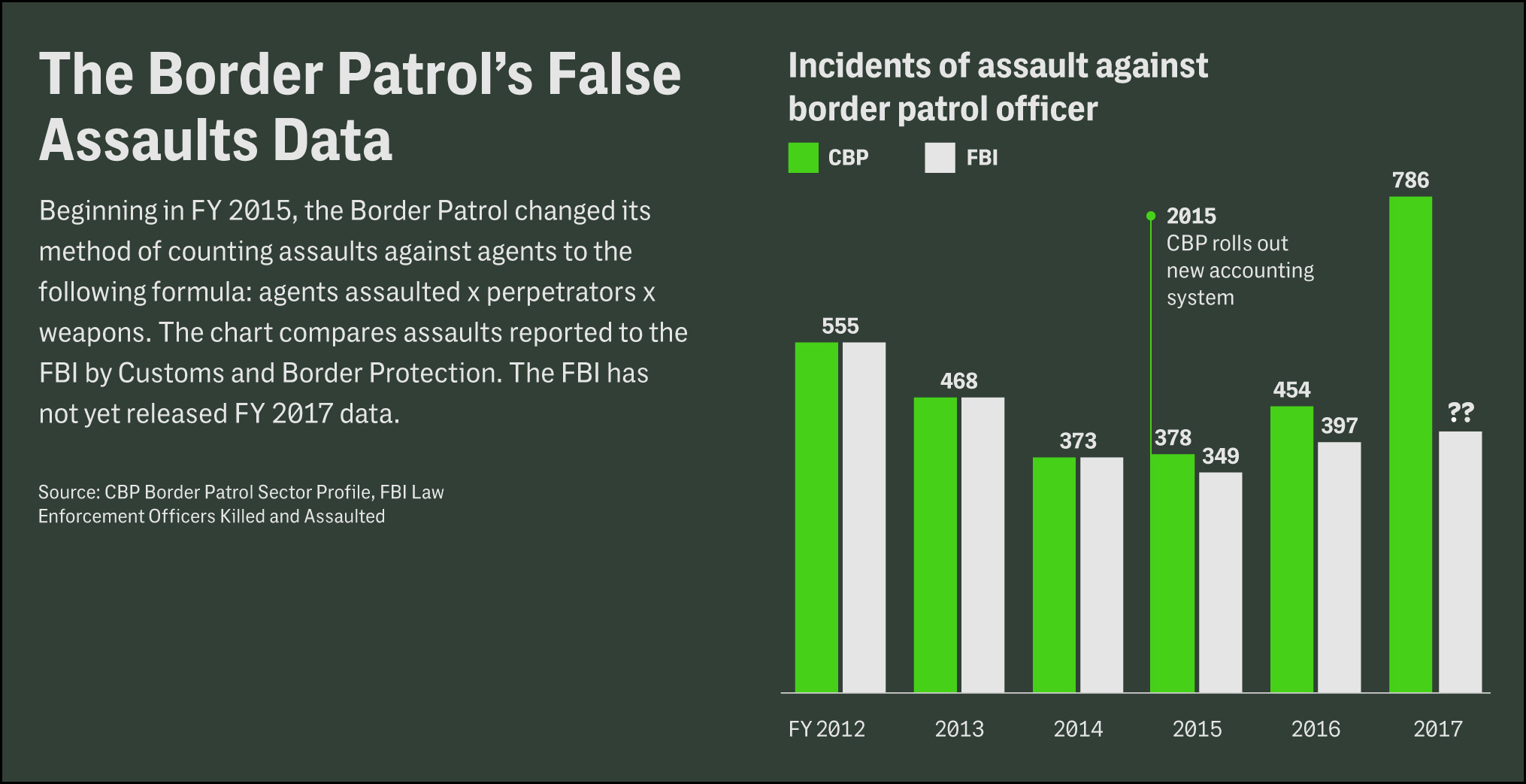
    Protecting our borders from illegal immigration is a tough job. According to the Border Patrol, assaults on officers jumped from 454 to 786 last year, an increase of 332 assaults. Over at the Intercept, Debbie Nathan decided to check into this:

    Almost the entire increase — 271 purported assaults — was said to have occurred in one sector, the Rio Grande Valley…on a single day….Christiana Coleman, a CBP public affairs spokesperson…explained in an email that “an incident in the Rio Grande Valley Sector on February 14, 2017, involved seven U.S. Border Patrol Agents assaulted by six subjects utilizing three different types of projectiles (rocks, bottles, and tree branches), totaling 126 assaults.”

    That’s some fancy countin’, pardner! No one else counts assaults that way, but in 2015 the Border Patrol decided to pioneer this innovative new method. Unsurprisingly, the number of reported assaults skyrocketed:

    As you can see, using the normal measure of assaults as reported by the FBI—one victim = one assault—nothing much has changed: the number of assaults has gone from 373 to 349 to 397 to … oh, probably around 400 or so in 2017. I guess we’ll have to wait and see. But regardless of what the Border Patrol wants everyone to think, the danger of assault simply hasn’t changed much. The only thing that’s changed is the rate of misleading statistics.

  • Lunchtime Photo

    Let’s start out the week with something pretty. I have several photos of Half Dome to get through eventually, and they’re all gorgeous because Half Dome can hardly help but be anything else. This is Half Dome barely before sunset, with Ahwiyah Point to its left. It was taken from Mirror Lake.

    February 14, 2018 — Yosemite National Park, California
  • Here’s Why the Waffle House Shooting Wasn’t Worse

    Metro Nashville Police Department via ZUMA

    James Shaw Jr. is the “I’m not a hero” who heroically wrestled a gunman to the ground during Sunday’s Waffle House shooting. Here’s how it happened:

    During a sudden break in the firing, Mr. Shaw sprinted through the door as fast as he could, slamming into the gunman and knocking him to the ground. He grabbed the rifle and tossed it over the restaurant counter….Mr. Shaw said Sunday that he eventually learned that the pause in the gunman’s firing came when he was trying to reload the rifle. It was a brief enough break, Mr. Shaw said, for him to make a move.

    If Travis Reinking had purchased a high-capacity magazine for his AR-15, more people would have died. If he’d been limited to a smaller magazine, fewer people would have died. That’s simple enough, isn’t it?

  • Kim Jong Un Will Never Give Up His Nukes

    Yonhap News/Newscom via ZUMA

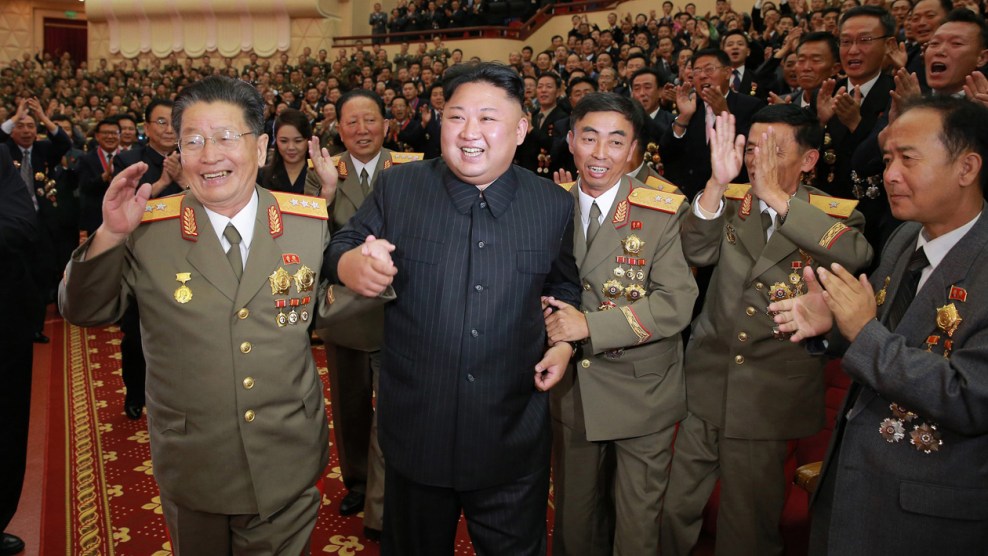
    Here’s my simpleminded take on North Korea:

    1. Kim Jong Un wanted nuclear weapons for several reasons, but the main one was to make sure North Korea didn’t end up like Afghanistan, Iraq, and Libya.
    2. Now that he’s got them, he feels like he can start to make deals without worrying about being on the business end of American regime change.
    3. This means that he might well be willing to enter into substantive talks. But he will never give up his nukes.
    4. Also: he will never give up his nukes.
    5. And: he will never give up his nukes.

    Did I mention that he will never give up his nukes? I did? Well, he won’t.

    That’s my guess, anyway. The question is whether (1) the US and South Korea accept that and move forward or (2) continue their sanctions war until (2a) they finally get tired of it or (2b) North Korea becomes a wasteland of famine and revolt. At the moment, my money is on 2a.

  • Working on the Railroad Is Pretty Lucrative in North Platte, Nebraska

    Ed Lallo/ZUMAPRESS

    Check this out. Railroads are having a hard time finding workers thanks to a tight labor market, so they’re trying out a bold new strategy:

    Railroad workers are being offered signing bonuses of up to $25,000 to join BNSF Railway and Union Pacific Corp. as the freight railroads struggle to fill jobs in a historically tight labor market.

    ….Freight volumes are rising on strong economic growth and industrial expansion, and a shortage of available truck capacity is pushing more shipments onto rails. At the same time, the unemployment rate has fallen to 4.1% in the U.S., and as low as 2.8% in some markets where railroads are hiring.

    In response, the companies are dangling incentives that analysts and union leaders say are the highest they can recall. Union Pacific is offering $10,000 to $20,000 “hiring incentives” to train crews in cities like Denver, Kansas City, Mo., and North Platte, Neb., where its largest rail yard is located. Those jobs average $40,000 in pay over the first year and $60,000 the next, according to job listings.

    I wonder how that’s working out? In any case, if you like hard manual labor and don’t mind living in North Platte, that’s the place to be.