• CBO: Reauthorizing CHIP Will Save $6 Billion

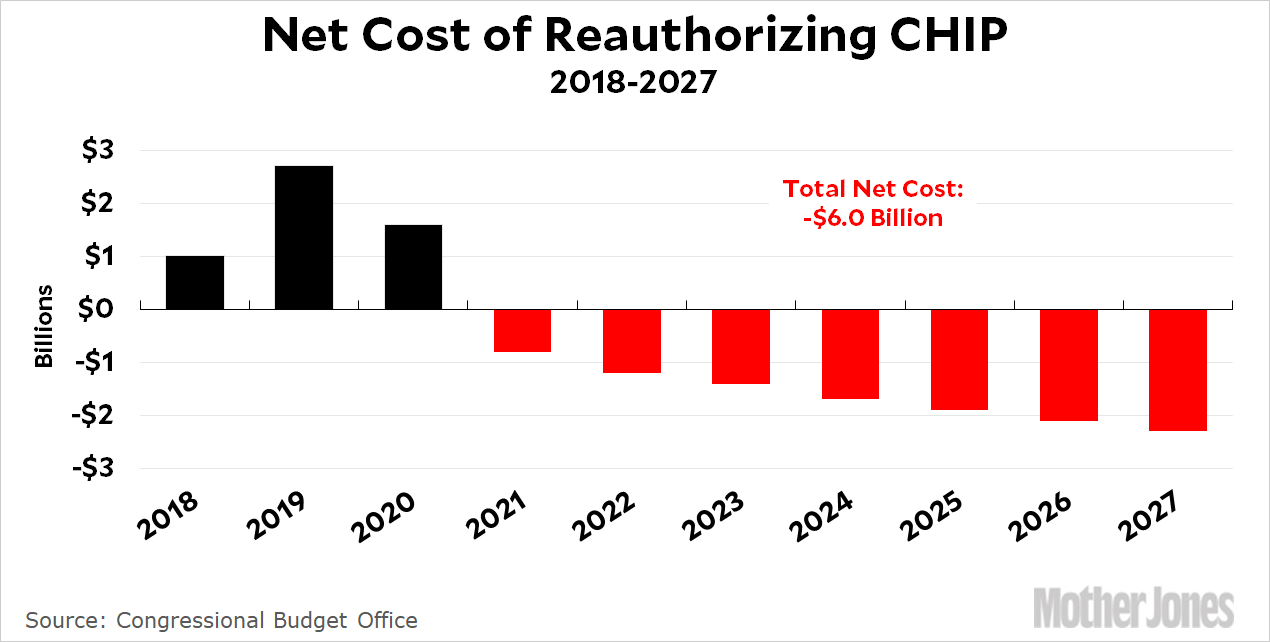
    You may recall the news from a few days ago that extending the Children’s Health Insurance Program would cost only $0.8 billion, which should make it very easy to pass. As it happens, that estimate only included seven years of funding, for reasons I couldn’t quite figure out. (It’s a five-year funding bill.) But no matter. CBO has now estimated its cost assuming that it’s reauthorized for a full ten years. Here it is:

    The reason the cost goes down over time is that it’s based on the savings from kids leaving Obamacare in favor of CHIP. The more expensive Obamacare is, the bigger the relative savings from getting kids into CHIP. And since the Republican tax bill makes Obamacare more and more expensive over time, it makes CHIP more and more cost-effective over time. This is stupid, but that’s what Republicans did.

    In the end, then, reauthorizing CHIP saves us $6 billion over ten years. Can we pass it now?

  • WaPo: Deal on Dreamers Might Be Near

    Erik Mcgregor/Pacific Press via ZUMA

    The Washington Post reports that a bipartisan deal on immigration could be near:

    A bipartisan group of senators, led by Richard J. Durbin (D-Ill.), Lindsey O. Graham (R-S.C.) and Jeff Flake (R-Ariz.), said earlier Thursday that they were nearing a deal resembling the framework Trump laid out for Democrats and Republicans: legal protections for dreamers; changes in security along the U.S.-Mexico border, restrictions on family migration policy, which some conservatives deride as “chain migration,” and changes to a diversity lottery system that grants visas to 55,000 people from countries with low immigration each year.

    ….Sen. Thom Tillis (R-N.C.), who once actively participated in the bipartisan group’s talks, said he doubted whether they could strike a deal that passes the closely divided Senate and the GOP-dominated House. “That group has members that for 16 years have tried to get a congressional outcome and it’s not just about 60 votes. It’s 50 percent plus one in the House,” Tillis said.

    Tillis is right, of course. Various immigration proposals have passed the Senate over the years, only to crater when they get to the House. But there’s something different this time: Donald Trump. If he decides to put his stamp of approval on this, that would probably force Paul Ryan to bring it to the floor of the House. And once there, it might pass with both Democratic and Republican votes.

    We’ll see. Trump promised that whatever Congress sent him, he’d support it. If that’s true—and if the rest of the White House staff can keep Stephen Miller gagged long enough—something might actually have a chance of getting passed.

  • Raw Data: The Black-White Unemployment Gap

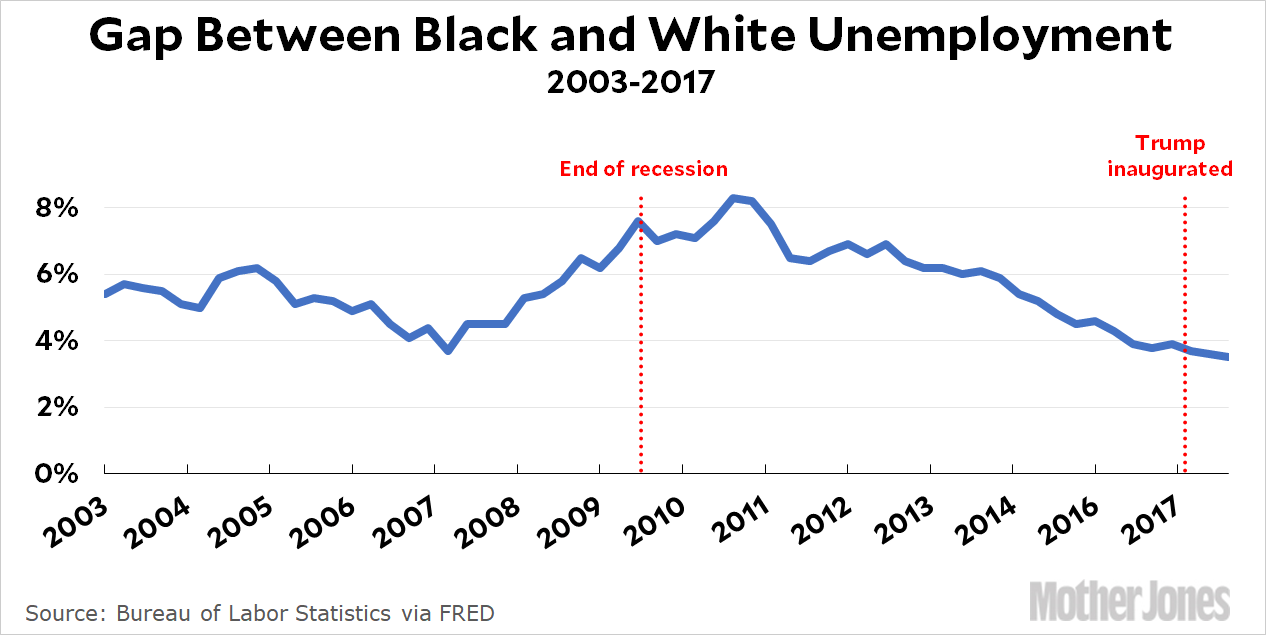
    Just in case you’re interested in the reality-vs-fantasy quotient of Donald Trump’s latest claim that he’s been great for black unemployment—and I admit there’s no reason you should be—here’s the gap between the black and white unemployment rates:

    It’s been falling ever since the end of the Great Recession, and nothing much changed when Trump became president. It’s fallen a little bit more since his inauguration, but that’s all.

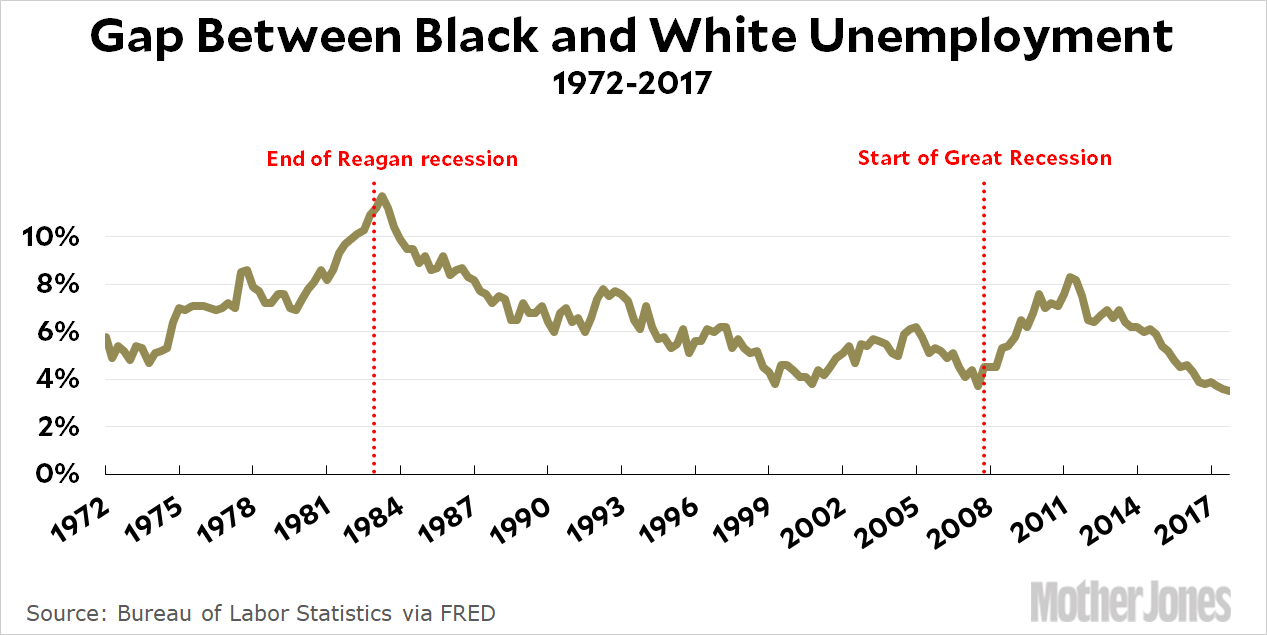
    On the bright side, this really is the lowest the gap has been since BLS started keeping records by race in 1972. In fact, the long-term trend is kind of interesting:

    Ever since the end of the Reagan recession, the black-white unemployment gap has been on a pretty steady downward path that’s interrupted like clockwork by every recession. When times are bad, blacks are laid off at higher rates than whites, and only after the economy has started expanding do blacks make up their losses. The good news is that during economic expansions, the gap has been in the 4-5 percent range for the past two decades. The bad news is that the gap has been in the 4-5 percent range for the past two decades.

  • Fox & Friends Needs to Stop Confusing the President

    Fresh off his surprising public announcement that he favored the Democrats’ approach to immigration reform—a position that was quickly “clarified” by other Republicans in the room—President Trump tweeted this after getting confused by a Fox & Friends segment:

    This was a little peculiar since Trump supports the extension of FISA. Josh Marshall:

    “Two hours later at 9:14 AM, apparently after someone explained to him that he was attacking his own bill, the President tweeted this. “With that being said, I have personally directed the fix to the unmasking process since taking office and today’s vote is about foreign surveillance of foreign bad guys on foreign land. We need it! Get smart!” There is of course a rather intense debate about whether these powers should exist at all. But President Trump is misstating what the law actually does. More importantly, he just made policy, or temporarily changed his policy without his staff knowing, based on something he watched on Fox and Friends.

    Trump’s initial tweet sent Congress into a temporary tizzy, but I think everyone is drawing the wrong conclusions from this. Sure, it’s yet more evidence that Trump is a moron, but more importantly it shows that Fox & Friends is not taking its constitutional role seriously.

    These guys know that Trump is watching, and they know that Trump is easily confused. We all understand that he’s declined over the past couple of years, and America’s well-being depends on Fox & Friends switching to a simpler format and being more careful to explain to Trump what he does and doesn’t support. We all have patriotic duties in these difficult times, and Fox & Friends needs to make sure it doesn’t confuse the commander-in-chief early in the morning before his staff is ready to take over that job.

  • Yet Another Company Announces One-Time $1,000 Bonuses

    Walmart is the latest employer to hand out one-time bonuses to all its workers:

    Wal-Mart Stores Inc. said it would raise starting pay to $11 per hour for all its U.S. employees and hand out one-time bonuses as competition for low-wage workers intensifies and new tax legislation will add billions to the retailer’s profits….The company said the salary change would add $300 million to its annual expenses and it expects to take a $400 million charge in the current quarter for the one-time bonus. The amount of the bonus will vary based on length of service, reaching up to $1,000 for an individual with 20 years of service.

    As usual, this is supposedly due to the transformational magic of the tax cut bill. Fine. But what’s the deal with the $1,000 bonus? Every company that announces something includes a $1,000 bonus. Is this just a bizarre coincidence? Some kind of herd effect? Or did the idea originate somewhere? It can hardly be a coincidence that so many companies are suddenly handing out exactly $1,000 to all their employees.

    UPDATE: Walmart is also closing 63 Sam’s Club stores and laying off hundreds of workers. Oddly, there is no mention of whether this is also due to the tax bill.

  • Here’s Yet Another Reason to Believe in Skyrocketing Income Inequality

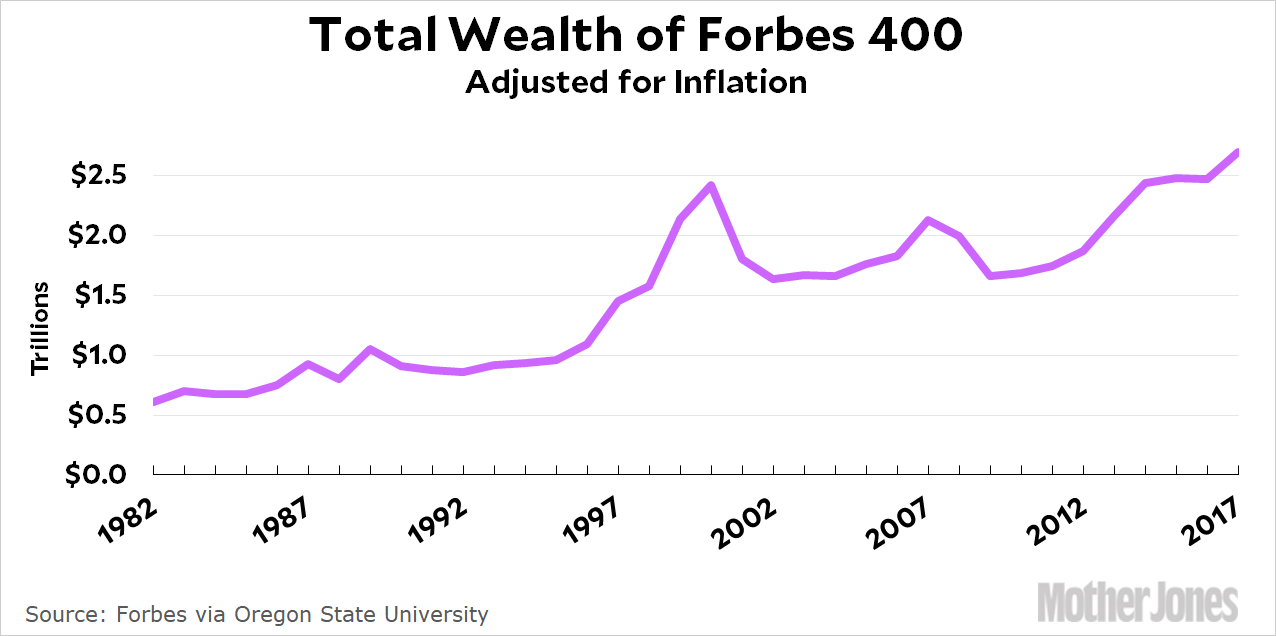
    Continuing on our theme of the day, here’s the total net worth of the Forbes 400 list of the world’s richest people:

    This might actually understate things since it’s a global list, not just an American one. But even at that, the wealth of the world’s richest people has gone up nearly 5x in the past 35 years.

    My point in putting up all these charts today isn’t to prove that income inequality has gone up any particular amount. It’s just to show that there are lots of data points which simply aren’t consistent with the notion that income inequality has hardly gone up at all. You can look at the sluggish incomes of the middle class; the rising wealth of the top 1 percent; the skyrocketing wealth of the top 0.01 percent; or any number of other things, and they all point in the direction of income inequality that’s doubled or tripled or more over the past four decades. Given all this, it’s simply not plausible to argue that there’s nothing going on.

  • Ohio’s Voter Removal Law Is… Probably Not Illegal

    Ohio removes people from the voting rolls if they have failed to vote in the past two years and then fail to respond to a notice and fail to vote during the next four years after that. But federal law says that you can’t remove someone from the rolls for failure to vote. So is Ohio breaking the law, since failure to vote is what precipitates this process? Or are they OK because there’s more here than just failure to vote?

    That depends on what the law actually says. I was curious, so I took a look at the text of the 1993 motor voter law. Here’s the relevant section:

    Any State program or activity to protect the integrity of the electoral process by ensuring the maintenance of an accurate and current voter registration roll for elections for Federal office…shall not result in the removal of the name of any person from the official list of voters registered to vote in an election for Federal office by reason of the person’s failure to vote, except that nothing in this paragraph may be construed to prohibit a State from using the procedures described in subsections (c) and (d) of this section to remove an individual from the official list of eligible voters if the individual – (A) has not either notified the applicable registrar (in person or in writing) or responded during the period described in subparagraph (B) to the notice sent by the applicable registrar; and then (B) has not voted or appeared to vote in 2 or more consecutive general elections for Federal office.

    Section (c) is about purging voter rolls based on change-of-address information from the Post Office. Here is section (d):

    A State shall not remove the name of a registrant from the official list of eligible voters in elections for Federal office on the ground that the registrant has changed residence unless the registrant…has failed to respond to a notice…and has not voted or appeared to vote…in an election during the period beginning on the date of the notice and ending on the day after the date of the second general election for Federal office that occurs after the date of the notice.

    The Ohio program follows this to the letter: they send a notice, and then purge you from the voting rolls if you fail to vote over the next four years—which is two federal elections. The only remaining question, then, is the same one we started with: Does the precipitating event have to be evidence of a change of residence, or can it be failure to vote?

    Section (c) of the law is all about using change-of-address information as a reason to start the removal process, and the fact that there’s a separate Section (d) implies that there can be other reasons too. The question, then, is whether failure to vote for two years can be one of them. As near as I can tell, the motor voter law is silent about that.

    I have to confess that Ohio’s procedure doesn’t sound entirely unreasonable to me. No one questions that there’s a legitimate state interest in keeping voter rolls up-to-date, and there are a limited number of ways to do that. I’m not sure what the technical legal standard is here, but my personal view is that this seems like an arguably sensible approach that’s probably within the purview of a state to enact. I suspect the Supreme Court will see it the same way.

  • Yet Another Reason to Believe That Income Inequality Has Skyrocketed Recently

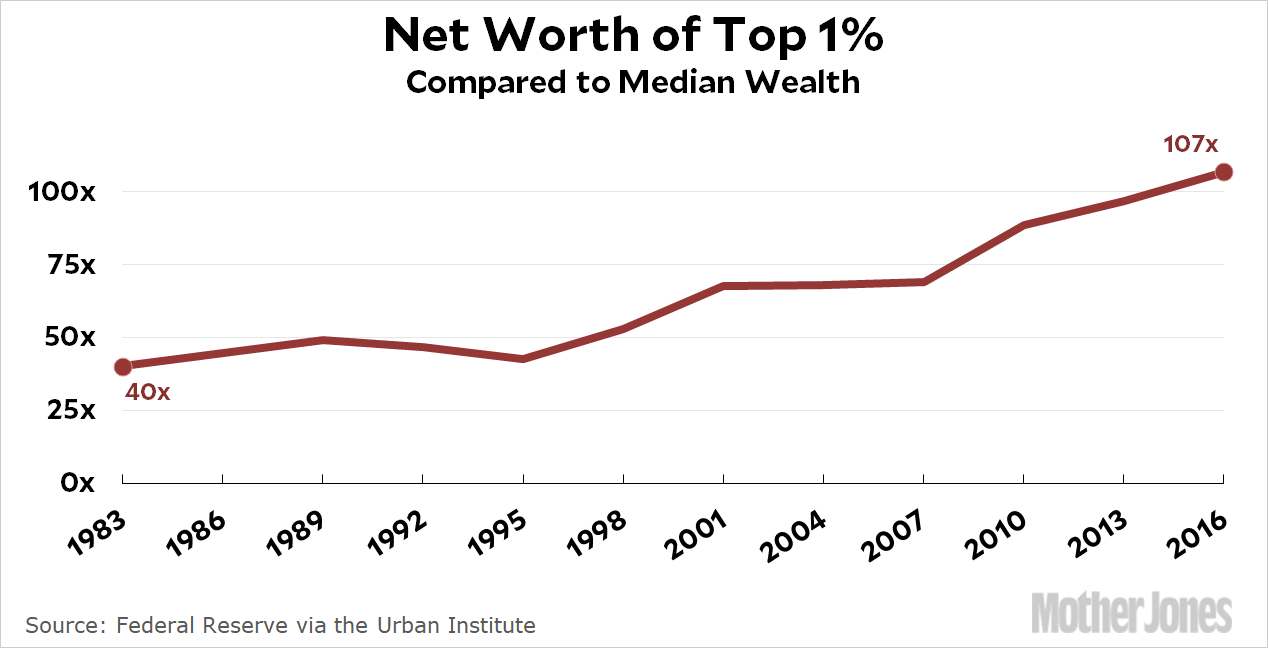
    Here’s another reason I think the rise of income inequality is real. If income inequality had stayed about the same over the past few decades, then you’d expect wealth inequality to stay roughly the same too. But that’s not what’s happened:

    Measurement of wealth has its own problems, but it doesn’t suffer from possible tax changes that might mask its actual value. And since this is presented as a multiple of median wealth, issues of the proper inflation rate don’t come into play. Nor does non-cash income.

    In just three decades, the wealth of the top 1 percent has nearly tripled compared to the median. This is consistent with a considerable increase in income compared to the median. It is not consistent with the idea that the income of the top 1 percent hasn’t changed, but only seems like it has. One way or another, all this extra wealth came from real income.

  • The Latest Windows Keyboard Is a Piece of Crap

    Behold the inexplicably useless new Windows on-screen keyboard.

    I’m about to post some serious stuff—honest—but first I have to get something off my chest. I have never been as pissed off about an operating system “upgrade” as I am over the new on-screen keyboard in Microsoft’s latest Windows update.

    The old OSK was fine. It took up about a third of the screen (vertically), included both letters and numbers, and the keys were plenty big even for me.

    The new OSK takes up nearly half the screen, and it can’t be moved offscreen temporarily. If you try, it bounces back so the whole keyboard is visible. This means there’s very little screen space available when the keyboard is active, and there are times when you can barely see stuff in the middle of the screen no matter where you put the OSK. What’s even worse, the new OSK doesn’t allow you to highlight text. You can’t hold down the Shift key and use the arrows for highlighting. Since double tapping text is a very hit-or-miss affair on a Windows tablet, this means there’s literally no way to highlight text anymore.

    I know how petty this sounds, but why? Why ruin a perfectly good keyboard? And even if Microsoft needed a new one to satisfy complaints of some kind, why not keep the old one around too? It’s still there in the code, after all. I know this since it pops up during boot when I need to enter my password. But there’s no way to access it during normal use.

    This single, seemingly trivial change has made it all but impossible to blog on the tablet. I can still do it, but it’s hardly worth the effort, and it inflates my blood pressure every time I try. It’s really infuriating.

  • Lunchtime Photo

    Dana Point Harbor. A woman and her dog.