• Income Inequality Really Has Increased a Lot Since 1973

    How much has income inequality increased over the past few decades? This is a matter of some contention, and the answer can depend on things like what inflation rate you use; whether you correct for household size; whether you measure consumption or income; and estimates of non-cash income like health benefits. My preference has always been to look at income shares so the inflation rate doesn’t matter; personal income so household size doesn’t matter; income rather than consumption; and to include as much non-cash income as possible.

    However, there’s always been another major critique of income numbers that has to do with technical changes made to tax laws in 1986. Dylan Matthews points to a recent paper on this subject:

    What looks on paper like a big increase in inequality in the 1980s and onward, Auten and Splinter argue, is really just money being shuffled around in response to Ronald Reagan-era changes to tax law. In 1980, the top individual income tax rate was 69.13 percent; by 1989, it had fallen by more than half, to 28 percent.

    In the 1960s and 1970s, companies usually reinvested their profits rather than giving raises to executives….Reinvesting the money ultimately benefited shareholders in the company by increasing the company’s value, and benefiting shareholders means benefiting rich people….After the tax cuts, companies started directing more money to raises. Rather than exploding actual inequality, Auten and Splinter write, the Reagan tax changes mostly shifted money that used to go to rich people through stocks so that it instead went to rich people in the form of salary.

    This is a very technical argument that’s above my pay grade—though I’ll note that the wonks at the CBO don’t think it changes the overall numbers much. However, my own objection to it is fairly simple, and it might be wrong. But here it is anyway for public critique.

    The famous income series from Piketty and Saez is the basis for most of these arguments. These are the figures that Auten and Splinter think are overstated. But their critique applies solely to rich people. Workers in, say, the bottom 90 percent never got much income from capital gains and therefore weren’t plausibly affected by the Reagan-era tax changes. If we look solely at this share of the population, here’s what it looks like:¹
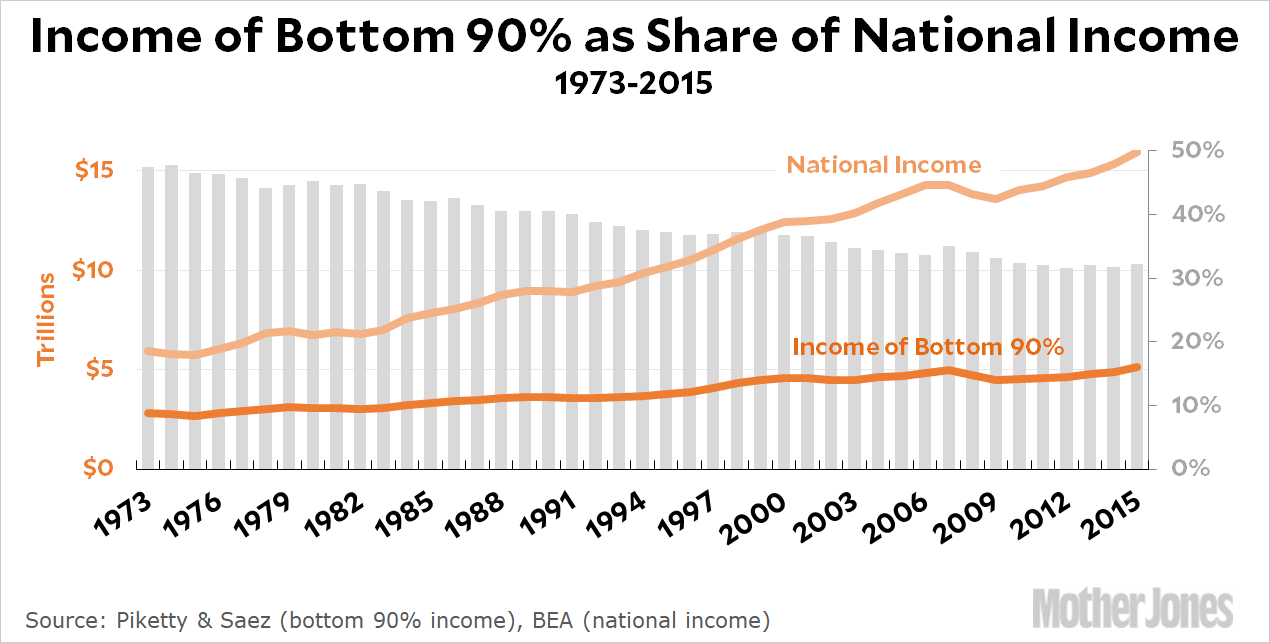
    Since 1973, the income share of the bottom 90 percent has declined from 47 percent to 32 percent. Obviously this means that the income share of the top 10 percent has increased from 53 percent to 68 percent. This is pretty consistent with an even bigger increase for the top 1 percent.

    Don’t take the precise numbers in the chart too seriously—they’re probably a little low across the board—but I think they’re roughly in the right ballpark and show the correct trend. Basically, the idea here is that the income share of the non-rich is easier to measure since it’s mostly wage income and isn’t affected by tax law changes or capital gains measurements. Whatever’s left must be the income of the rich, one way or another. If you do this, the 90-10 measure of income inequality has increased from 113 percent to 213 percent since 1973. That’s a lot.

    ¹Since this is a tricky derivation, here are the details for data nerds. Income of the bottom 90 percent comes from Piketty & Saez here. Table_Incomegrowth has the income figures and Table A0 has the historical series of total tax units (roughly the same as number of households). I multiplied average income by 90 percent of total tax units to get total income for the bottom 90 percent. National income is here. Piketty & Saez use CPI-U-RS to create real income figures, so that’s what I used to deflate the national income numbers. (I spliced in chained PCE for 1973-77.) The share of total income for the bottom 90 percent is their real total income divided by real national income. The spreadsheet is here.

  • White House Caught Doctoring Transcript For Second Time

    Yesterday’s televised session on immigration is being spun as evidence that President Trump isn’t senile. You might think Trump’s supporters would be touting something a little more upbeat than “not senile,” but that’s hard to do when Trump demonstrated virtually no understanding of a subject that has literally been his signature issue for the past two years. Pretty much the best you can say about Trump’s performance is that he didn’t fall asleep or start telling stories about his old days on The Apprentice.

    Matt Yglesias has the right take on this. As he (and everyone else) has noted, Trump was obviously confused even about DACA, the topic that Congress has to decide right away:

    The key exchange of the afternoon came when Sen. Dianne Feinstein (D-CA) asked the president if he might like to completely abandon his administration’s stated position on the issue under discussion and, instead, adopt the Democratic position. At this point, you would expect a Republican Party politician to restate the Republican Party’s position on the issue….Trump, instead, just said he agreed with Feinstein!

    The Washington Post picks up the story:

    So pliant was Trump that when Sen. Dianne Feinstein (D-Calif.), one of the most liberal members of the chamber, asked if he would support “a clean DACA bill” that protects the dreamers with no other conditions, the president sounded amenable. “Yeah, I would like to do it,” Trump said.

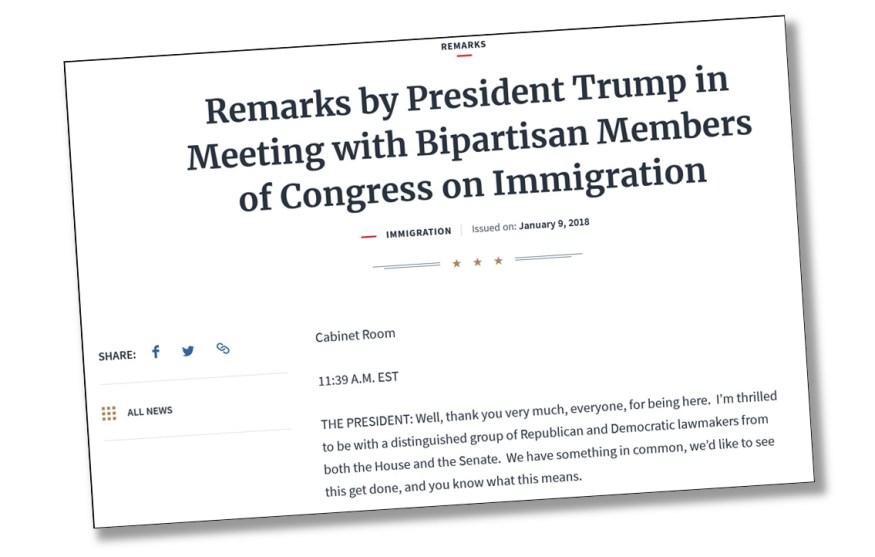
    Trump’s apparent concession so alarmed House Majority Leader Kevin McCarthy (R-Calif.) that he interjected himself, although he was careful only to gently contradict the president….McCarthy apparently was not the only one concerned by Trump’s seeming agreement with Feinstein. When the White House released its official transcript Tuesday afternoon, the president’s line — “Yeah, I would like to do it” — was missing.

    A White House official said that any omission from the transcript was unintentional and that the context of the conversation was clear.

    “Unintentional.” Sure it was. Just like it was last July.

    This episode shows not just that the White House is dishonest, but that it’s stupid. Doctoring a transcript to remove the one line that everyone gasped at in real time is idiotic. Apparently one of the new tasks of the press in the Trump era is going to be scouring White House transcripts for errors. Unintentional though they may be, surely we’re all interested in keeping these historical records accurate. Right?

  • South Korea Lays Down Marker in Suck-Up Olympics

    Yonhap News/Newscom via ZUMA

    Oh please:

    South Korean President Moon Jae-in credited U.S. President Donald Trump on Wednesday for helping to spark the first inter-Korean talks in more than two years, and warned that Pyongyang would face stronger sanctions if provocations continued….“I think President Trump deserves big credit for bringing about the inter-Korean talks, I want to show my gratitude,” Moon told reporters at his New Year’s news conference. “It could be a resulting work of the U.S.-led sanctions and pressure.”

    The sucking-up Olympics is getting out of hand, and I fear this is only the beginning. As more people come to realize that Trump really is as childlike as his reputation, we’re likely to see a lot more of this.

  • Trump to Blue States: Drop Dead

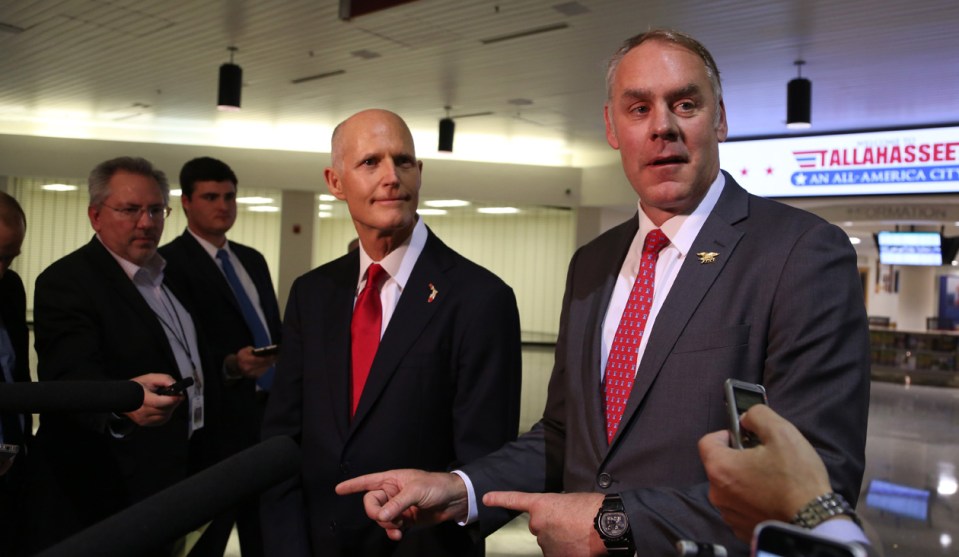
    The guy with a smile on his face is Florida governor Rick Scott. And why not? The other guy is Interior Secretary Ryan Zinke, who has just agreed to exempt Florida from new rules opening up offshore oil drilling everywhere else.Scott Keeler/Tampa Bay Times via ZUMA

    It just never ends:

    “Local voice matters.” But only as long as that voice is a Republican governor in an important swing state. West coast states with Democratic governors who didn’t vote for Donald Trump can pound sand. Ditto for Virginia, which opposes drilling off its coast. Ditto for northeastern states, all of which oppose drilling off their coasts. You guys didn’t vote for Trump, so tough luck.

    To state the obvious, the problem here isn’t so much that California is likely to see lots of new offshore oil rigs in its future. Lease auctions for public lands in the West haven’t attracted much bidding, and I suspect the same will be true for offshore leases. Rather, the problem is that the Trump administration is being run like the mafia, with friendly states getting explicitly favorable treatment and enemy states—this is how Trump seems to think of them—being gleefully punished. This attitude has already spread to Republicans in Congress, who crafted their tax bill with petty punishments of blue states as a top priority.

    This is not—repeat not—something that Democrats have ever made a habit of. The stimulus bill treated every state fairly. Obamacare treated every state fairly. Even in judicial appointments, a favorite playground for partisan politics, every state was treated fairly. But now Republicans are doing their best to bring back the kind of frankly punitive spoils-system politics that we all thought had been long abandoned. We’re sure learning a lot these days about what “conservative” means in the 21st century.

  • Yet Another North Carolina Voting Law Has Been Struck Down

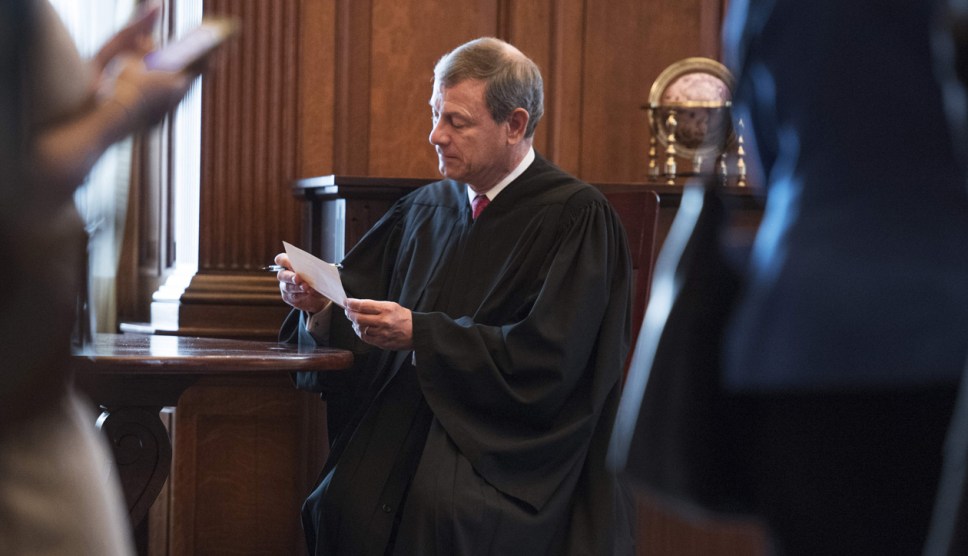
    No, this is not a picture of John Roberts rereading his opinion in Shelby vs. Holder. But maybe he should.Tom Williams/Congressional Quarterly/Newscom via ZUMA

    Here’s some good news: a federal court in North Carolina has overturned the state’s recent gerrymandering of its congressional districts. According to Nicholas Stephanopoulos, this is a first. Courts have overturned state legislative maps before. And they’ve overturned congressional maps because they were racial gerrymanders. But this is the first time a federal court has ever overturned a congressional map because it was a partisan gerrymander. Rick Hasen has more:

    The majority opinion by Judge Wynn is an unqualified victory for the plaintiffs, finding multiple grounds (including equal protection, the First Amendment, and the Elections Clause) for ruling that North Carolina’s plan is unconstitutional.

    The result is not a big surprise given what North Carolina did here. After its earlier redistricting was declared a racial gerrymander, it came up with a new plan using only political data that it described as a partisan gerrymander on its own terms. It did this as a defense against a future racial gerrymandering claim. As the court explained at page 16, NC “Representative Lewis said that he “propose[d] that [the Committee] draw the maps to give a partisan advantage to 10 Republicans and 3 Democrats because [he] d[id] not believe it[ would be] possible to draw a map with 11 Republicans and 2 Democrats.” If there’s any case that could be a partisan gerrymander, it’s this one.

    The Supreme Court is already considering two partisan gerrymandering cases, one from Wisconsin and one from Maryland. No doubt NC will appeal this case to the Supreme Court, which is likely to hold it in light of the decision in those cases (it would be too late, absent extraordinary briefing, to set the case for argument this term). It likely will be sent back to this court to reconsider in light of what the Court does.

    In the unanimous opinion, Judge James Wynn writes that legislators never argued that their plan was designed to do anything other than favor Republicans:

    Legislative Defendants also do not argue—and have never argued—that the 2016 Plan’s intentional disfavoring of supporters of non-Republican candidates advances any democratic, constitutional, or public interest. Nor could they. Neither the Supreme Court nor any lower court has recognized any such interest furthered by partisan gerrymandering—“the drawing of legislative district lines to subordinate adherents of one political party and entrench a rival party in power.” And, as further detailed below, partisan gerrymandering runs contrary to numerous fundamental democratic principles and individual rights enshrined in the Constitution.

    Rather than seeking to advance any democratic or constitutional interest, the state legislator responsible for drawing the 2016 Plan said he drew the map to advantage Republican candidates because he “think[s] electing Republicans is better than electing Democrats.” But that is not a choice the Constitution allows legislative mapdrawers to make. Rather, “the core principle of [our] republican government [is] that the voters should choose their representatives, not the other way around.”

    Not only does this ruling come after a previous map was tossed out for racial gerrymandering, but it comes only 18 months after a court struck down North Carolina’s new voting laws too. The court gave the North Carolina legislature two weeks to produce a new map.

    I wonder what Chief Justice John Roberts thinks of all this? He was the deciding vote to gut the Voting Rights Act on the grounds that it wasn’t really needed anymore because we live in a more enlightened age.¹ The next day² Republican leaders in North Carolina announced their intention to enact new election laws. Over the next couple of years, North Carolina tried to enact a racial gerrymander of its legislative districts that was struck down; passed a voting law that was overturned because it was designed to “target African Americans with almost surgical precision”; passed a racial gerrymander of its congressional districts that was struck down; and then produced yet another gerrymandered map that tried to hide the original’s intent by favoring Republicans instead of whites.

    If North Carolina had still needed preclearance from the Justice Department for this stuff, it never would have seen the light of day. But as soon as preclearance was gone, racial targeting was instantly back on the menu. The same thing has happened in other states too. The big difference is that North Carolina’s Republicans are unusually stupid and never even bothered to hide what they were doing. Republicans in most other states at least made a pretense that race had nothing to do with their voting law changes.

    Roberts’ decision was basically an empirical one: he wrote that requiring preclearance wasn’t unconstitutional per se, but it did need to be based on evidence that racial discrimination still existed. Given what’s happened since, I wonder if he’s had second thoughts? After all, we don’t really have to rely on arguments over demographics and social science anymore. We just have to look at what’s actually happening now that Southern states are freed of most constraints. It’s not pretty.

    ¹I want to note that this isn’t really snark. It’s a pretty fair summary of what Roberts wrote in Shelby County v. Holder.

    ²Seriously. It was literally the day after the Supreme Court handed down its opinion. See p. 10 of the court decision overturning North Carolina’s election law.

  • Lunchtime Photo

    Today is my entry in the Abstract Digital school of art. The original photo is here. My technique was to load it into Photoshop and then start dicking around with anything that came to hand. Probably a filter or two. Color replacement here and there. Changes to hue and saturation. After a bunch of trial and error, I got one I liked. Think of it as Jackson Pollock by way of Tiffany. You may or may not like it, but it was kind of fun making it.

  • Are We Headed For Another Oil Shock?

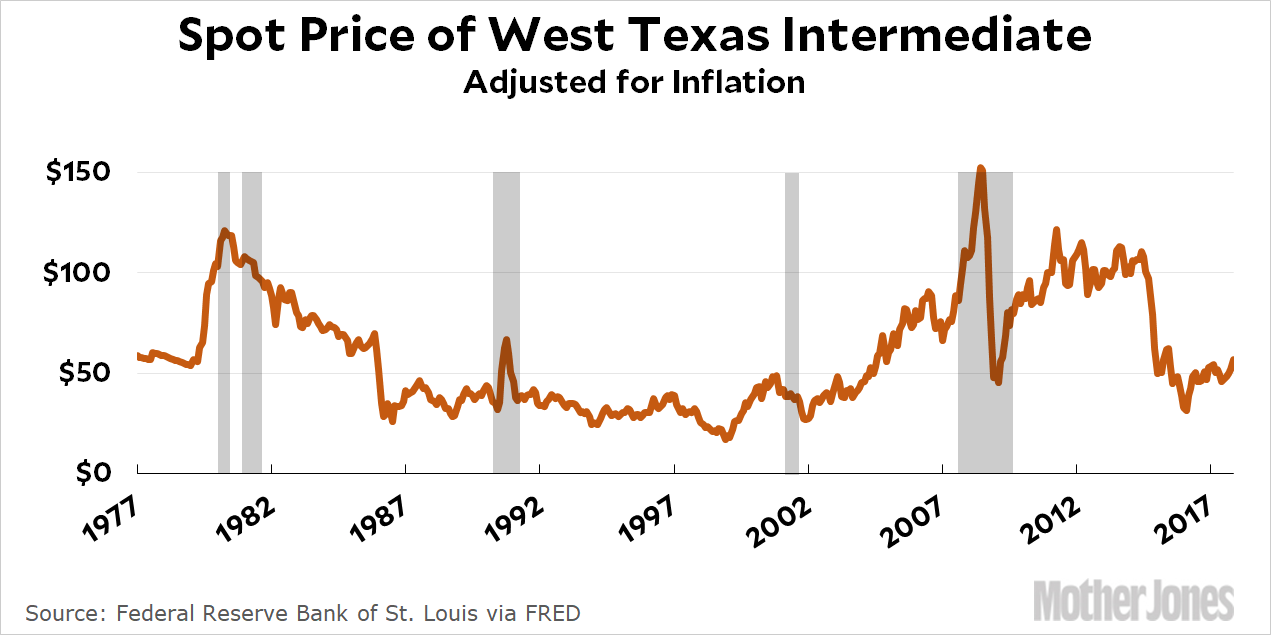
    One of my regular readers emailed today to note that the price of oil has been creeping up over the past six months:

    Admittedly, oil prices are volatile, but it’s possible to see a pattern in longer-term views. The worldwide supply glut from fracking in the 2014-2016 window (which decreased prices) has been taken up by increasing demand. Now we are at supply-limited pricing again, with fracking included. So if there’s any shock to supply, unless the Saudis open up the spigots (if they can), the price will spike up. I don’t sense wide awareness of this.

    That got me curious. Here’s what long-term oil prices look like over the past 40 years:

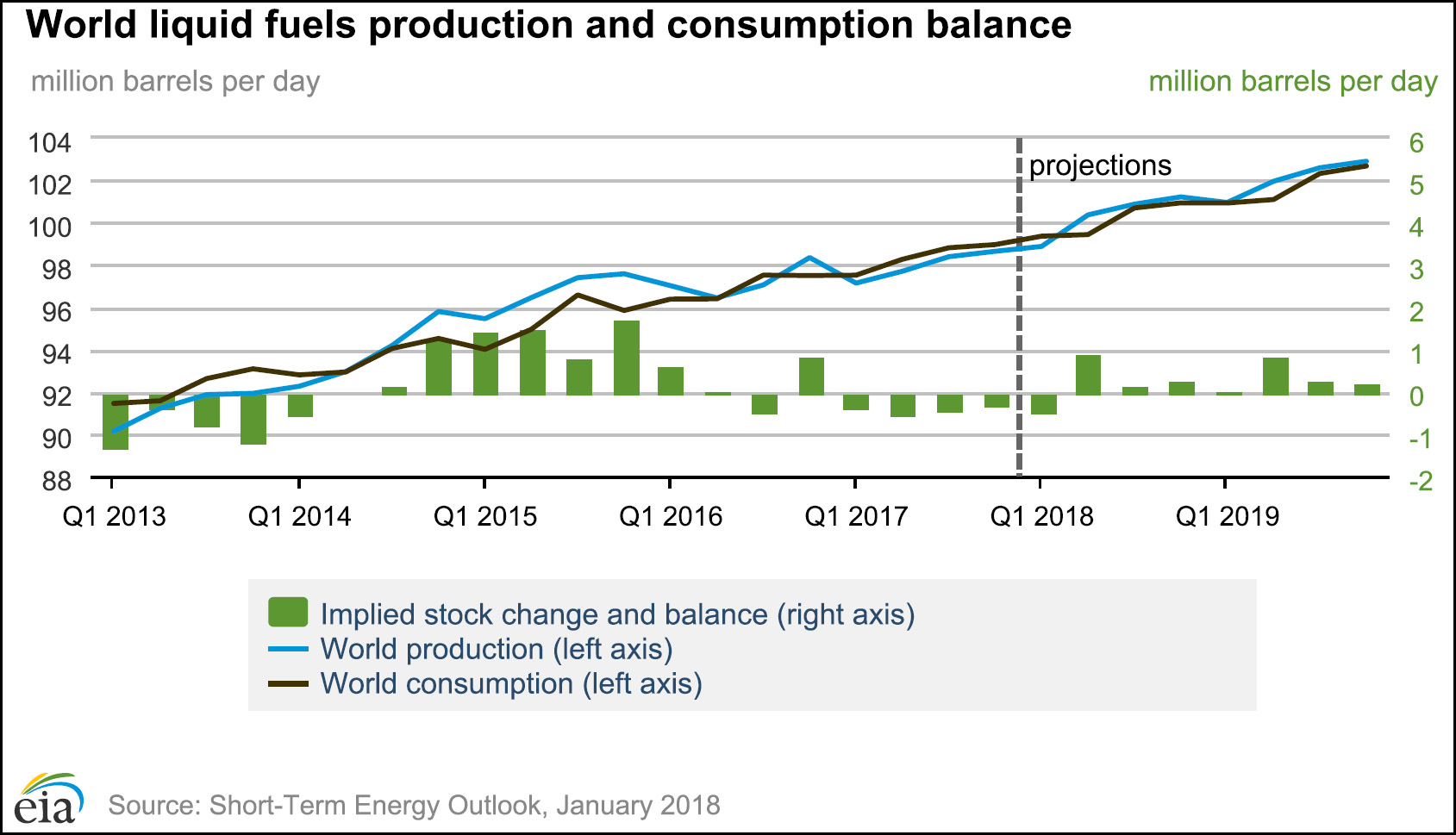
    There’s nothing that looks especially concerning in these numbers, but the basic oil-recession cycle is fairly simple: (a) economic expansion leads to higher demand for oil, (b) demand eventually bumps up against supply constraints, (c) oil prices spike, (d) leading to a recession. However, the Energy Information Administration seems to think supply will continue to keep up with demand over the next couple of years:

    For the time being, it doesn’t look like oil will be a constraint on growth in the near future. But ask me again next month and I might change my mind.

  • Trump: I’ll Sign Any Immigration Bill Congress Sends Me

    When I wrote earlier this morning that an immigration deal was possible, I didn’t realize that President Trump was about to host a White House meeting on the very subject. What’s more, reporters were allowed in the room for the first hour, so we all got a view into where things stand. Here are some excerpts from CNN’s real-time coverage.

    “I think my positions are going to be what the people in this room come up with,” Trump said….Trump added if the group presents him with a plan he does not like he would support it anyway. “If they come to me with things I’m not in love with, I’m gonna do it. Because I respect them,” he said.

    ….Rep. Bob Goodlatte says he will introduce a bill that “addresses the DACA concerns” tomorrow….adding that legislatures hoped to “do it in a bipartisan fashion and put our best foot forward.” “It will address DACA in a permanent way, not a temporary short-term thing. We are going to address the border enforcement and security and the wall,” he said.

    ….Sen. Lindsey Graham, foreshadowing how he believes some conservatives will react to the DACA discussions unfolding on television, said he could “hear the drumbeat” on Fox News and that “right-wing radio and TV talk show hosts are going to beat the crap out of us.”

    ….President Trump told lawmakers he would provide political cover for them if they moved forward on comprehensive immigration reform….“I’ll take the heat. I don’t care. I don’t care. I’ll take all the heat you want to give me, and I’ll take the heat off both the Democrats and the Republicans.”

    ….Here’s how Trump hopes to see things move: “We’ll do DACA and we can certainly start comprehensive immigration reform the following afternoon. We will take an hour off and start. I do believe that. Once we get DACA done and it’s done properly with security and everything else, if it’s done properly, we have taken a big chunk of comprehensive out of the negotiations. I don’t think it’s going to be that complicated.

    Trump has a childlike belief that nothing is very complicated, but in this case he could be right. The Senate passed a comprehensive bill a few years ago, and it could serve as the outline for a new one. Getting the votes to pass it will be hard, but the policy part really isn’t all that complicated.

  • Trump Campaign Had a Mole Who Talked to the FBI, Alleges Fusion GPS Founder

    Bryce Vickmark via ZUMA

    Sen. Dianne Feinstein has released the testimony of Glenn Simpson, the founder of Fusion GPS, who testified to Congress last year about the origins of the infamous Trump-Russia “dossier.” He says the FBI took it seriously when Christopher Steele, the author of the dossier, talked to them:

    The ex-British spy who authored a dossier of allegations against then-presidential candidate Donald Trump was told the FBI had someone inside the Trump campaign providing agents with information, according to a newly-released transcript of a congressional interview.

    ….“My understanding was that they believed Chris at this point — that they believed Chris might be credible because they had other intelligence that indicated the same thing and one of those pieces of intelligence was a human source from inside the Trump organization,” Simpson said. Using the parlance of spies and law enforcement officials, Simpson said the FBI had a “walk-in’’ whistleblower from someone in Trump’s organization.

    Who’s the mole? Let the guessing games begin!

    UPDATE: Wait! Maybe there was no mole after all:

    UPDATE: Plus this:

  • GOP Goal For 2018: Keep Government From Collapsing

    20th Century Fox

    Republicans have given up on doing anything important in 2018:

    Instead, Republican lawmakers are likely to embrace a slimmed-down agenda focused on the basics, including funding the government, raising the government debt limit and striking a deal on immigration, according to GOP lawmakers and aides.

    ….At risk of losing one or both chambers in November, Republicans say they want to avoid controversy over policies that stand little chance of passing the Senate, where most bills need 60 votes to clear procedural hurdles. Voters are especially wary of plans to overhaul safety-net programs, which polls show remain highly popular. Republicans say they are confident the surging economy will help their electoral prospects.

    Well, that’s the problem, isn’t it? Republicans almost literally have no policy positions these days that are popular. Repealing Obamacare polled poorly. Their tax bill is widely detested. No one wants to touch Social Security or Medicare even in a symbolic vote.

    The only popular proposal on President Trump’s plate is his trillion-dollar infrastructure project, but Republicans in Congress aren’t interested. So that leaves two things: (a) immigration and (b) avoiding disaster. The weird thing is that a comprehensive immigration deal is actually possible. The Senate could pass one pretty easily, and if Trump then bragged that it was the greatest, toughest, most America-Firstest immigration plan ever, his base would support it and the House would probably pass it. You know, sort of a Nixon-goes-to-China thing. And it would give Republicans another big win going into the 2018 midterms.

    Would Democrats buy in? Beats me. But it probably doesn’t matter since there’s no one in the Republican Party these days likely to lead the charge. Marco Rubio won’t do it again. Mitch McConnell has little interest. Trump is clueless and can’t lead anything. So I guess keeping the government open and paying its bills is all we’re going to get this year. Given the most likely alternatives, I can live with that.