Trump’s nominee to lead Indian Health Service, facing claims he misrepresented his resumé, says his employment records were destroyed in a tornado. https://t.co/3fOzIqvwTa
Let’s make one thing clear: there was, in fact, a tornado. And it did destroy a bunch of records at St. John’s Regional Medical Center in Joplin, Missouri, where Robert Weaver says he worked. And Weaver did work there. That much isn’t in doubt—though it’s not clear why a tornado that hit the hospital in Joplin also destroyed Weaver’s personal copies of his employment records. Just bad luck, I guess.
However, that’s the good news. The rest, via the Wall Street Journal, is…not so good:
President Donald Trump’s nominee to lead the troubled Indian Health Service appears to have misrepresented his work experience at a Missouri hospital to a Senate committee, according to former employees at the hospital….“I don’t recall that name whatsoever,” said Augusto Noronha….“I’ve never heard that name before,” said Wayne Noethe….Rhonda Foust, who worked in finance at the Joplin hospital from 1981 to 2010, said she doesn’t recall crossing paths with Mr. Weaver….Jane Obert, a longtime manager who served as compliance officer among other jobs from 1992 to 2008, said that his name didn’t ring a bell to her….Diane Sadler, an accounting manager at the hospital from 1993 until 2010, said she worked “side by side with accounts receivable” and never met Mr. Weaver.
Wait a second. Didn’t I say that Weaver really did work at this hospital? Yes I did:
Another former executive, Bob Henderson, who was director of patient financial services, said he recalled a subordinate named Rob Weaver who registered E.R. patients, gathered insurance information and collected copays, and who eventually supervised a few other patient-registration workers….He said he didn’t recall Mr. Weaver ever overseeing accounts receivable or working in budgeting or physician recruitment, or regularly participating in the leadership meetings while working under his chain of command.
According to other hospital officials, Weaver’s position was an entry-level job. But by the time this got typed up as a resume, Weaver’s experience included “various hospital administration positions, including managing all accounts receivable, budgets, patient access and physician recruitment.” This is like one of those parody career advice books, where registering ER intake becomes “patient access” and collecting copays becomes “managing accounts receivable.”
And yet, believe it or not, this still isn’t the best part of the story. Several of Weaver’s defenders said that he had “worked with” the Indian Health Service for two decades:
Asked by the Journal what constituted his IHS experience, the spokeswoman said he had needed the system as a patient, especially when he was a child, and pointed to his career in health care.
I dunno. Maybe Weaver’s experience in later life makes him eminently qualified to run a $6 billion federal agency. That’s certainly what the Trump administration thinks. An HHS spokeswoman told the Journal that “any suggestion Mr. Weaver is unqualified to run IHS is a pure act of character assassination.”
The Deepwater Horizon drilling rig in 2010 after an explosion that killed 11 and eventually released more than 200 million gallons of crude oil off the shore of Louisiana.John Mosier/ZUMApress
When I say that I’m relatively sanguine about the future of America, I’m talking in very broad terms. What I mean is that although Republicans are going to do lots of things that I think are damaging, I don’t think they’ll be able to drive a stake through the heart of American democracy.
In a narrower sense, however, I also think the damage they can do is more limited than they’d like (or that liberals are afraid of). Here’s an example. On Wednesday the Interior Department announced that it would open up nearly the entire outer continental shelf for oil and gas drilling. That’s bad. But actually getting oil platforms up and running takes more than just an announcement. Here on the West Coast, for example, the governors of California, Oregon, and Washington have all announced that they will do “whatever it takes” to stop it from happening:
There are myriad obstacles opponents can throw in front of the proposal, not to mention questions about whether the oil industry has much of an interest in California’s offshore reserves at a time when domestic oil production is at its highest level in decades.
….In California, the state coastal commission also has the authority to review activities in federal waters to ensure they are consistent with the state’s coastal management plans….While the U.S. Secretary of Commerce could override a commission finding that new oil drilling violated the state’s management plan, federal courts have tended to side with states in such contests.
And California has another weapon: State Lands Commission jurisdiction over tidelands and waters that extend roughly three miles offshore. That gives the commission the ability to stop the construction of pipelines that are the most economical way of transporting oil and gas from offshore rigs to land. “In some ways that is an even more formidable tool that the state of California and like-minded local governments can utilize to deny approval of things like oil terminals and pipelines crossing state sovereign tidelands,” said Richard Frank, director of the California Environmental Law & Policy Center at UC Davis.
Needless to say, the mere fact that building drilling platforms would touch off a legal war is something that will cause oil companies to think hard before they spend money on leases.
There’s no question that it’s genuinely bizarre to have a presidency that seems to be literally driven by a desire for revenge on Barack Obama because he made fun of Donald Trump at a dinner a few years ago. In one sense that makes Trump more dangerous than a normal president, but the very fact of Trump’s derangement has also spawned a far more energized opposition movement than a normal presidency might have. That’s why Trump doesn’t have his wall. Or his immigration restrictions. Or the repeal of Obamacare. Or the end of financial regulations. On one side, he has a Democratic Party implacably opposed to everything he does, and on the other he has a rejuvenated liberal movement determined to tie him up in court forever. This doesn’t mean Trump will do no damage. He’ll do plenty. But in the end, I suspect it will be less than we fear. There’s a real limit to how far even an unhinged political party and a monomaniacal president can buck public opinion.
In the year since Donald Trump moved into the White House, one of the key questions was how long the institutions of American democracy would hold up if he tried to create an authoritarian state centered around himself. For a long time things seemed to be largely OK: the institutions of state were mostly able to resist Trump’s incursions into their necessary roles and perform their duties more or less as intended.
….But all of that started to change this week….Republican Senators who began last year by pretending to want investigations into Russia’s interference in the election are now actively scuttling those investigations. Two Republican Senators, Charles Grassley of Iowa and Lindsey Graham, have now made a criminal referral to the FBI against [Christopher] Steele, the longtime intelligence officer who provided information designed to expose Russia’s crimes and accomplices….Meanwhile, reports surfaced the FBI wilted some months ago after ongoing public pressure from Donald Trump to prosecute his political opponents for nonexistent crimes by reopening investigations into the Clinton Foundation and the Uranium One nothingburger.
….On the real collusion front, the integrity of the FBI’s investigation in Trump and his associates is being hampered by Intelligence Committee Chairman Devin Nunes’ blatant attempts to acquire sensitive documents held close by the FBI, and to subpoena FBI officials whose public testimony would harm the investigation itself.
As I mentioned the other day, I’m in non-panic mode right now. Still, there’s no question that things are getting worse. Republicans are in panic mode over the possibility that Robert Mueller is about to start plowing relentlessly through the White House like a bulldozer leveling an old shack. By the time he’s through, they’re understandably afraid there might not be much left standing.
At the risk of being too Pollyannaish, it’s almost good news that Republicans are acting this way. It means they realize their party is in existential trouble.
This is one of the paradoxes at the heart of my relative calm about the future of America. On a nationwide level, I consider the election of Donald Trump to be a fluke: he was running against a party that had been in power for eight years; he got a last-minute tailwind out of the blue from James Comey; and then his 2 million+ loss in the popular vote turned into a quirky, razor-thin Electoral College win.
But at the level of the Republican Party, there was nothing flukish about it. Trump led the primary race from the start. He serially demolished a field that would normally have been considered pretty strong. And he did it despite the almost unanimous opposition of party regulars. Trump very plainly tapped into something very real in the Republican rank-and-file psyche.
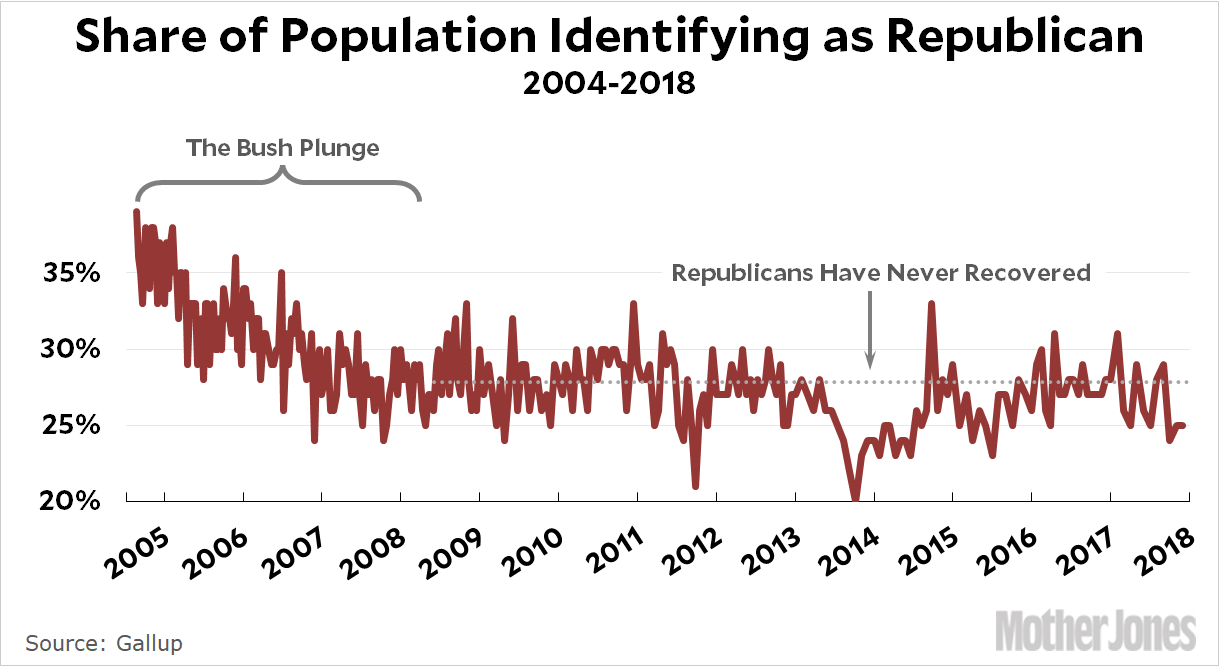
My take on this is pretty simple. For years it’s been obvious that Republicans are the party of whites and Democrats are the party of nonwhites. This worked fine for a while, but starting in the 90s it became an increasingly weighty albatross and Republicans became increasingly desperate to increase both white turnout and their share of the white vote. Fox News helped with this. Karl Rove’s focus on the “missing evangelicals” helped. Gerrymandering helped. Pack and crack helped. Photo ID laws helped. But these were just pellets in a war dominated by a disastrous decline in party ID in the Bush years that the party never recovered from.
For a while this worked, though Republicans have won the popular vote for the presidency only once in the past quarter century. By 2012, however, they had run out of new tricks to gain more white votes and suppress more nonwhite votes—and the nonwhite share of the population was still continuing its implacable rise. Party leaders understood perfectly well that this meant they needed better outreach to people of color, but this was something they could never pull off. Their only other option was to become even more explicitly unambiguous in their appeal to the white vote, and that never seemed like a plausible strategy: you might gain some working-class whites out of the deal, but you’d lose at least as many centrist whites who’d be disgusted by the all-but-open appeal to racism.
Unfortunately, it turned out that this is what the Republican base wanted, which is why Trump won the nomination easily. Party leaders had no choice but to get aboard, but in the end Trump did lose more white votes than he gained. Compared to 2012, Trump gained among high school grads but lost votes among college grads. When the returns were in, not only did the white share of the overall vote continue its long decline, but Trump got a smaller share of that white vote than Romney.¹ Party leaders had been right: an outright appeal to white racial grievance did more harm than good.
So here’s the situation:
The Republican Party is screwed. Both their base and the conservative media-industrial complex are all-in on racial grievance-mongering, but it’s clear that this is a losing strategy nationwide that’s only going to get worse. The demographic argument for the GOP’s demise has been a Chicken Little prediction for years, but it’s pretty clear that the sky really is falling now.
By a fluke, they won anyway in 2016.
At the moment, it looks like they’re about to get squashed like bugs in the 2018 midterms.
There’s really only one possible reaction to all this: panic. And that’s what we’re getting. Just as working-class whites are in a panic over their loss of status, Republicans are in a panic over their loss of numbers. Now, with their doom finally staring them in the face, Republicans are doing anything they can to put it off—and that’s unmasked some pretty despicable behavior.
Once again, though, Republicans are stuck. If they act decently, they’ll lose their base. But the farther they go down the road of outrage and coverups, the more centrist votes they’ll lose. Virginia and Alabama are just the start. The Resistance is just the start. #BlackLivesMatter is just the start. What we’re seeing now is not the birth spasms of a new, authoritarian America. It’s more like the final bout of Cheyne-Stokes breathing before the death of the Republican Party.
¹In 2012, whites made up 72 percent of the voting population and Romney won 59 percent of them. In 2016, whites made up 71 percent of the voting population and Trump won 57 percent of them. Among the population as a whole, Trump gained 3 points among high school grads but lost 7 points among college grads.
Remember the weatherbeaten house from Thursday? It was a fake. Did I fool you? Huh? Did I?
The house itself was fine, but the sky behind it was dull. So I gave it a facelift. That was fun, so I created a whole bunch of other facelifts too. Choose your favorite!
(My favorite is #5. It’s similar to #1, the one I posted Thursday, which Marian chose. I think the softer, brighter sunrise fits a little better.)
Bill Clark/Congressional Quarterly/Newscom via ZUMA
If you want a good example of how budget scoring from a baseline can produce bizarre results, look no further than the proposed funding extension for the Children’s Health Insurance Program. Back in October, CBO estimated that the net cost of the extension would be $8.2 billion over ten years. That broke down like this:
Cost of CHIP: $49 billion
Medicaid savings: $15.1 billion
Obamacare savings: $19.2 billion
Revenue increases: $6.7 billion
But now we have a new estimate, and the net cost is only $0.8 billion. Huzzah! But this is not because CHIP will cost any less. Here’s the breakdown:
Cost of CHIP: $48.4 billion
Medicaid savings: $14.8 billion
Obamacare savings: $26.4 billion
Revenue increases: $6.6 billion
Everything is about the same except that funding CHIP now increases the savings from Obamacare by a lot more. But why? Why is it that over the course of only three months, funding CHIP will suddenly save Obamacare $7 billion more than it used to?
Well, it’s all about the elimination of the individual mandate. First of all, the CBO boffins figure that this will cause Obamacare premiums to go up. This in turn means that the savings from enrolling a child in CHIP instead of the more expensive Obamacare is higher.
Second, they also figure that more parents will decide to forego insurance thanks to the higher premiums. Now pay close attention. If CHIP goes away, some parents will decide to buy into Obamacare anyway because they want their kids to be insured. That costs the government money since it subsidizes Obamacare. With the higher premiums, it will cost the government even more. Thus, extending CHIP, and preventing parents from enrolling in Obamacare, will save more money.
Did you get all that? If you didn’t, don’t worry. The bottom line is that by making Obamacare worse and more expensive, the savings from moving people off Obamacare and into CHIP gets bigger. Pretty awesome, isn’t it?
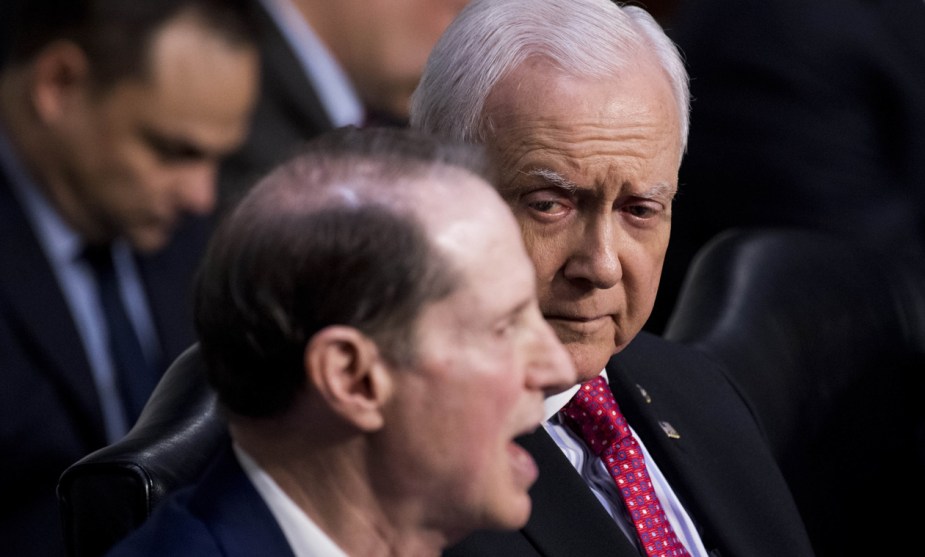
The net result of this is that extending CHIP funding will cost essentially nothing. That’s sure going to make it easier to pass. Did Orrin Hatch know this all along? Is that why he kept saying he wasn’t worried about getting CHIP reauthorized? I kinda doubt it, but you never know. If he did understand all this, he’s one smart cookie, isn’t he?
It’s a new year, so let’s not start things off by playing favorites. Here are both Hopper and Hilbert in one of their favorite places: on top of the fence surveying their domain. I’m not sure I remember what was going on here. Maybe a squirrel? Or a hummingbird?
Paul Manafort is suing Robert Mueller for going beyond his remit by prosecuting him for fraud rather than collusion with Russia.
Donald Trump has threatened to sue a publisher over a book he doesn’t like.
Chuck Grassley and Lindsey Graham are trying to get the FBI to investigate Christopher Steele, the guy who put together the Trump “dossier.”
The FBI has reopened its absurd investigation of the Clinton Foundation.
After James Comey testified before Congress in March, Attorney General Jeff Sessions tasked a staffer with generating “one negative article a day in the news media.”
The American legal system is really getting a workout these days, now that we have a president who sees courts and the Justice Department primarily as tools to take revenge on his enemies. I hope it’s up to the task.
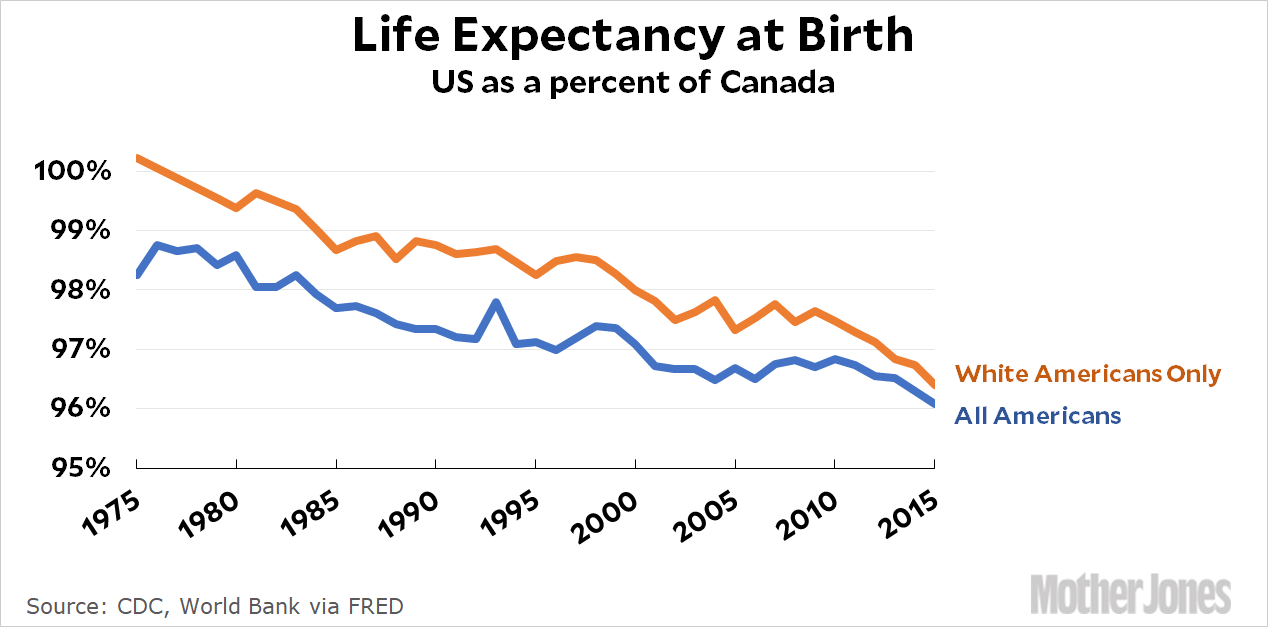
Life expectancy in the US has been a little lower than in Canada for a long time—probably due to the racial composition of the US population—but over the last four decades it’s dropped steadily and dramatically. Among whites, who used to live a little longer than Canadians, the drop has been even bigger. Today, the average American lives only 96 percent as long as the average Canadian. Draw your own conclusions.
It’s nice to see a conservative being honest about something that’s normally a conservative hobbyhorse. In this case, it’s AEI visiting scholar Bruce Meyer talking about fraud in the EITC program:
James Pethokoukis: So, what about that fraud issue many conservatives gripe about? Is it an overpayment or mispayment issue? What is happening there with that?
Bruce Meyer: I think that that’s overstated. You sometimes will hear numbers like 30% — I probably shouldn’t repeat these numbers — that a substantial share of the dollars are paid in error. But many of these calculations don’t go back and say, “Well, the money went to grandma instead of her daughter who we think should get the credit.” Those statistics often will count the money that goes to grandma but then not net out the money that should have gone to the daughter, so it would’ve been paid out anyways; it just went to the wrong person.
….It’s a scandal that the instructions for the Earned Income Tax Credit — I haven’t looked at the most recent tax guide — but it used to look something like 18 very dense pages out of the entire 200 pages of tax guide, so it’s just way too complicated. It’s not surprising that there are lot of errors under that circumstance.
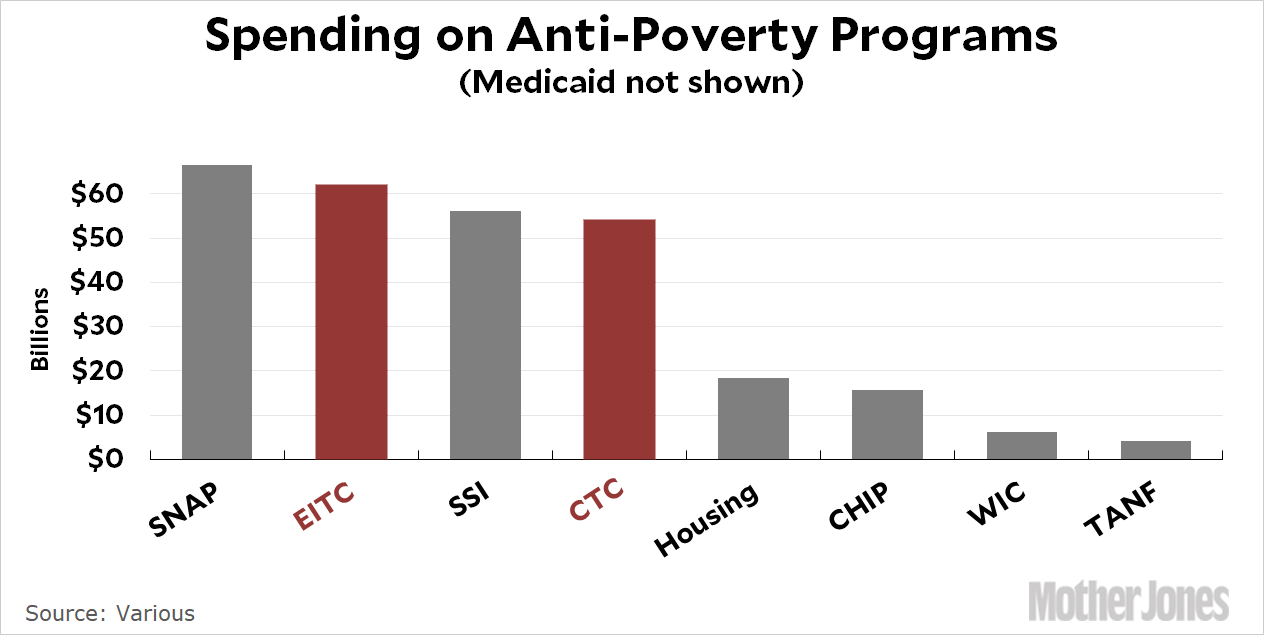
The EITC is a program that provides tax refunds to people who work. Liberals like it because it helps poor people. Conservatives like it because it only rewards people with jobs. Economists like it because it doesn’t act as a disincentive for work. Aside from Medicaid,¹ it’s one of the biggest and broadest anti-poverty programs we have:
The problem with the EITC is that for the past couple of decades conservatives have been pushing a story about the program being riddled with fraud. In the 90s, Bill Clinton managed to pass an EITC expansion, but only on condition that he agree to an extra $100 million solely to audit EITC applicants—at a time when Newt Gingrich was busily cutting funds for the IRS audit unit that mostly checks up on high-income taxpayers.
But most EITC “fraud” is just unintentional errors. As Meyer points out, the rules surrounding the EITC are complex, and the biggest part of the complexity revolves around children. Generally speaking, EITC is only available to families with kids, and the rules about residency and custody and so forth are many pages long—not to mention the added complexity related to income calculations and benefit levels. It’s no wonder that mistakes are frequent.
But here’s an odd thing: if there are lots of mistakes in claiming the EITC, there are also lots of mistakes in claiming the Child Tax Credit. Many of the rules are similar, and similarly complex. And yet conservatives almost never complain much about that. Why? Most likely because the EITC is limited to poor people while the CTC doesn’t start phasing out until family income is above $100,000. To Republicans, the EITC is a welfare program targeted largely at blacks and Hispanics while the CTC is a family program that helps lots of middle-income folks. That makes all the difference.
¹Medicaid spending clocks in at around $550 billion counting both state and federal contributions. It’s nearly ten times bigger than the #2 anti-poverty program.
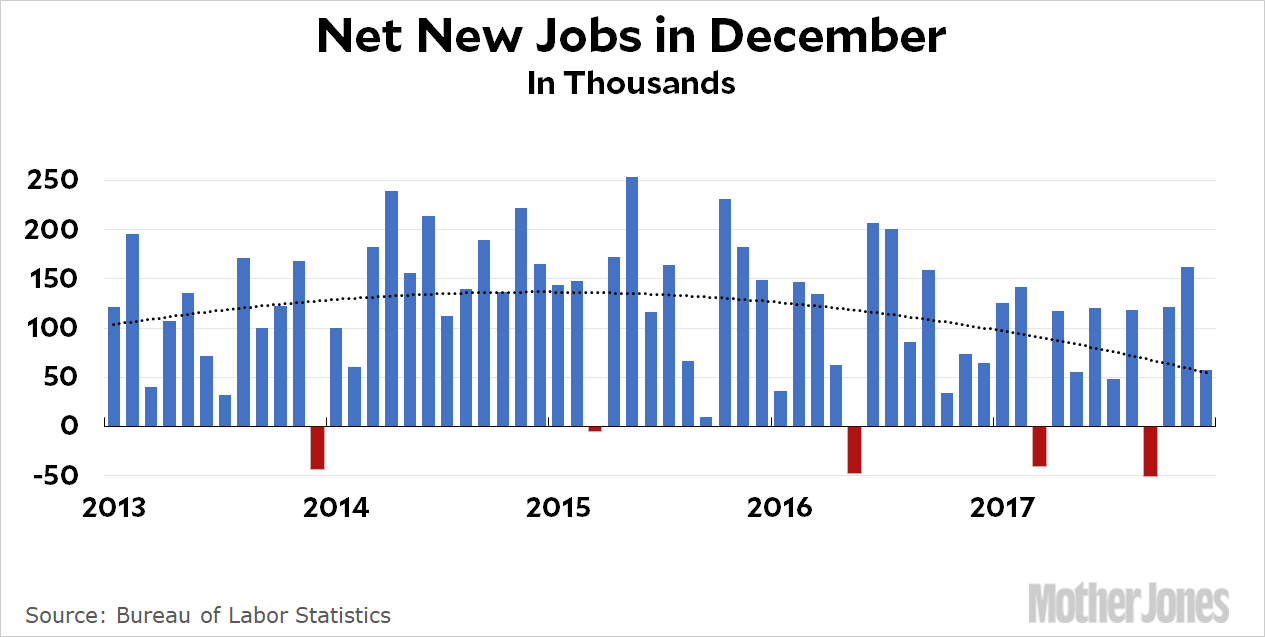
The American economy gained 148,000 jobs last month. We need 90,000 new jobs just to keep up with population growth, which means that net job growth clocked in at 58,000 jobs. That’s pretty weak. The employment-population ratio stayed flat yet again, and the headline unemployment rate stayed steady at 4.1 percent.
I added a trend line this month because the general trajectory of the jobs report is pretty clear these days: after peaking at the start of 2015, job growth has been on a slow but steady downward trend. At the current rate, net job growth will be close to zero by the end of the year. Alternatively, of course, it’s possible that the trendline will change. Maybe the tax cut will produce a temporary sugar high. Or maybe a recession will start and job growth will crater.
On the bright side, wages of production and nonsupervisory workers were up 3.9 percent. That’s a net gain of about 1.7 percent after accounting for inflation. It would be good news indeed if we could keep this up for a while.
And we respect that! But maybe you’re of a mind to support our work directly instead? We have until December 31 to raise the last $400,000 we need to keep our nonprofit newsroom running at full strength into 2026. Will you make a gift today?
We noticed you have an ad blocker on. Can you pitch in a few bucks to help fund Mother Jones' investigative journalism?
Billionaires own the media,
but they don’t own us.
At Mother Jones we know these aren’t conventional times, and they require unconventional coverage. That’s what deliver every day: fierce, independent journalism you can’t find elsewhere. Perhaps never in the history of our country has that been more necessary than now. But we can’t do it without reader support—your support. Please chip in today.
Billionaires own the media,
but they don’t own us.
At Mother Jones we know these aren’t conventional times, and they require unconventional coverage. That’s what deliver every day: fierce, independent journalism you can’t find elsewhere. Perhaps never in the history of our country has that been more necessary than now. But we can’t do it without reader support—your support. Please chip in today.