I took this in the late afternoon on R568 in County Kerry. Even in real life it looked pretty bleak and eerie, but naturally I amped that up a bit in this picture. OK, I amped it up a lot. But the effect is kind of cool. You expect that maybe Mordred or Voldemort are lurking just outside the frame. Or maybe Vladimir and Estragon.
Tillerson said the department’s budget in recent years had ballooned to some $55 billion and was filled with spending inefficiencies. He also said the State Department would need less money as global conflicts wind down. Although it’s not the first time Tillerson has made such a claim, critics note that he’s given no specifics about which conflicts he sees petering out. They warn that new conflicts could easily emerge from North Korea to Iran.
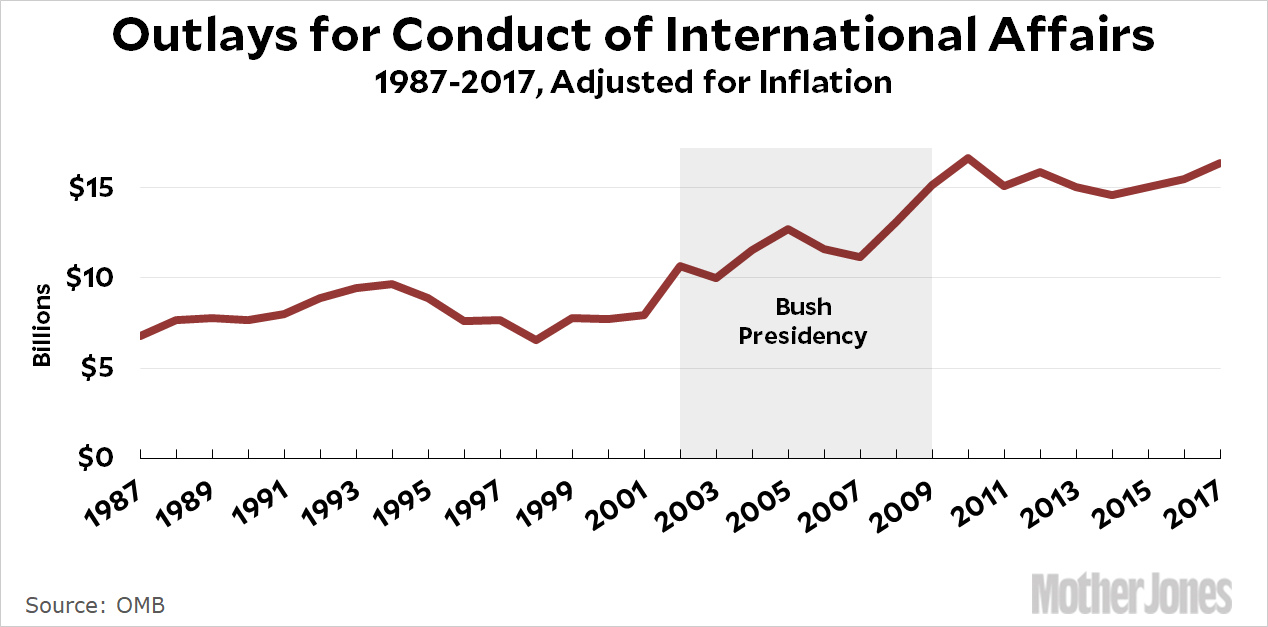
As for the budget ballooning to $55 billion, the bulk of that is humanitarian and military assistance, which is a whole different subject. For the State Department’s core duties, their budget looks like this:
Does Tillerson have a point? State Department outlays did increase substantially after 9/11, roughly doubling from $8 billion in the final Clinton budget to $15 billion in the final Bush budget. Was that too much? Should it be cut back now that our wars in the Middle East are kinda sorta winding down? Maybe. I’d sure like to hear someone actually make the case, though, rather than just tossing out a phony number and pretending that it’s justification enough.
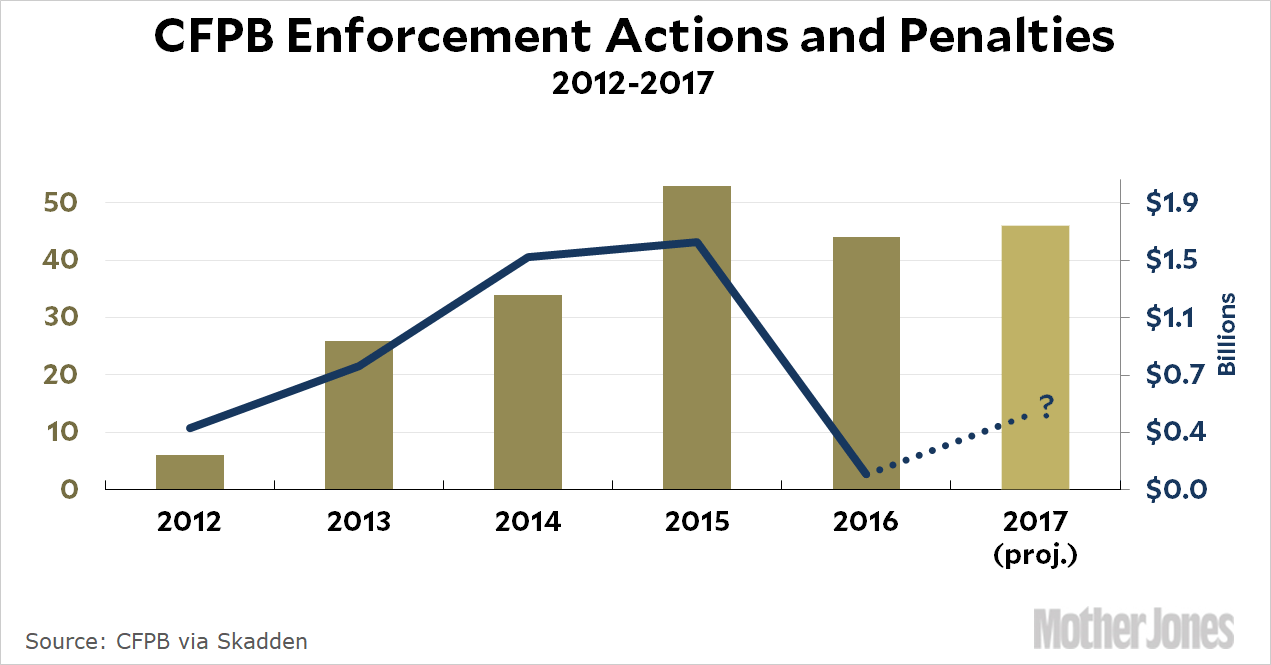
The acronym CFPB stands for Consumer Finance Protection Bureau. But protection of who? And from whom? The answer is: protection of consumers from big banks. And that’s why big banks hate it:
And that, of course, is why the Republican Party and its leader, the great populist Donald Trump, hate it too. Sometimes the simple answers are really all you need.
He reports today that this led to a flood of Twitter spam calling him an idiot, a shill, etc. etc. The usual. But what he didn’t expect was that a lot of it came from the alt-right/neo-Nazi crowd. If you think about it, though, this isn’t so mysterious after all: the alt-right folks are obsessed with “fiat money” and hyperinflation and so forth, so it’s unsurprising that they’re into Bitcoin as a hedge against government-controlled money. It’s the same reason they’re into gold. Like gold, there’s a hard limit to the amount of Bitcoin in circulation, and it’s practically an article of faith among these folks that a highly constrained money supply is the only real guarantee of value.
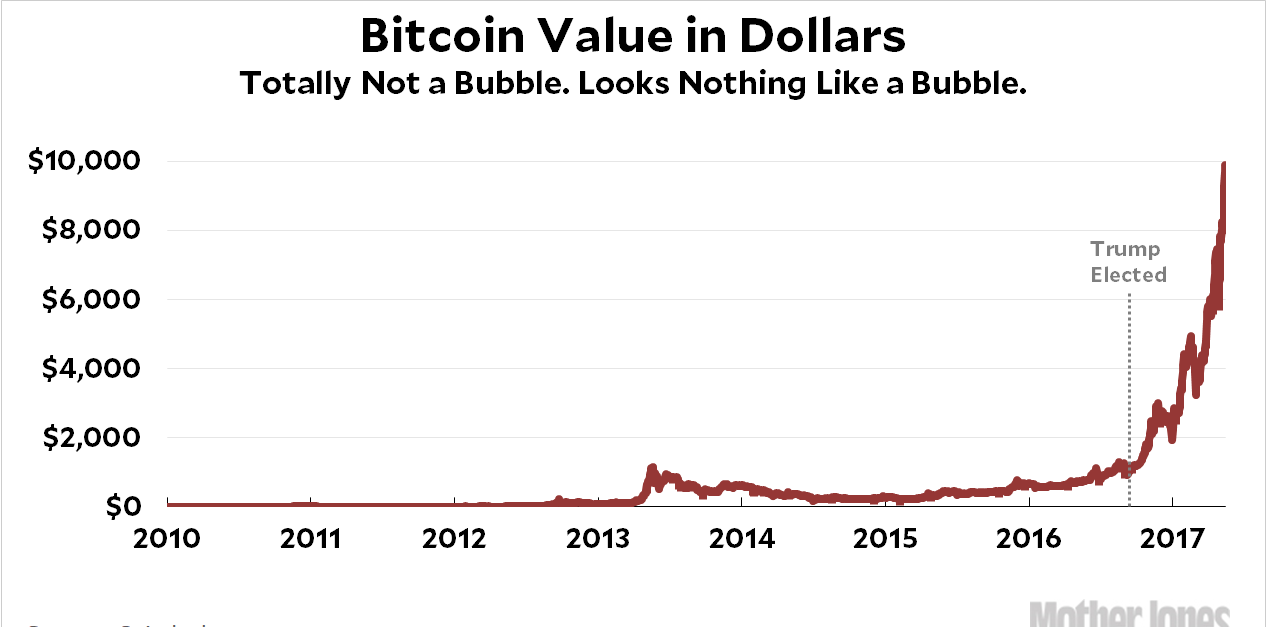
If, as I think, BTC doesn’t deliver, then the bubble will eventually burst. I called it a long time ago: and although BTC continues to follow an overall upward trend (there have been, ahem, fluctuations that would have ben recognized as a full-on collapse in any conventional currency) we’re going to run out of new BTC to mine sooner or later. At that point, the incentive for mining (a process essential for reconciling the public ledgers) will disappear and the currency will … will what? The people most heavily invested in it will do their best to patch it up and keep it going, because what BTC most resembles (to my eye, and that of Jamie Dimon, CEO of JP Morgan Chase) is a distributed Ponzi scheme. But when a Ponzi scheme blows out, it’s the people at the bottom who lose.
The longer BTC persists, the worse the eventual blowout—and the more angry people there are going to be. Angry people who are currently being recruited and radicalized by neo-Nazis.
This is a fairly exotic concern, and perhaps not in my Top 100 list. Bitcoin is still mostly a Chinese thing, I think, and I doubt that there are more than a few hundred neo-Nazi types who are invested in it. Still, this is at least a more intriguing thing to worry about than whatever Donald Trump rage-tweeted about last night.
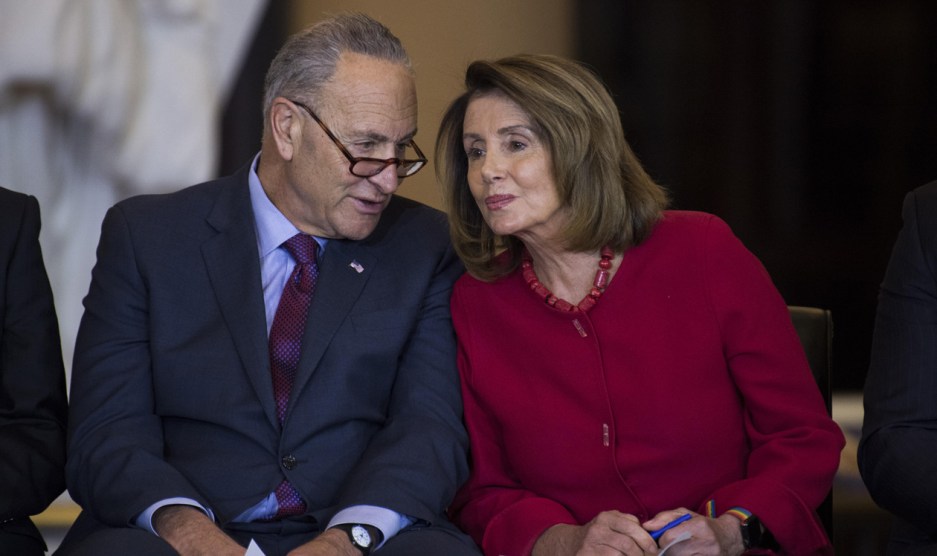
Tom Williams/Congressional Quarterly/Newscom via ZUMA
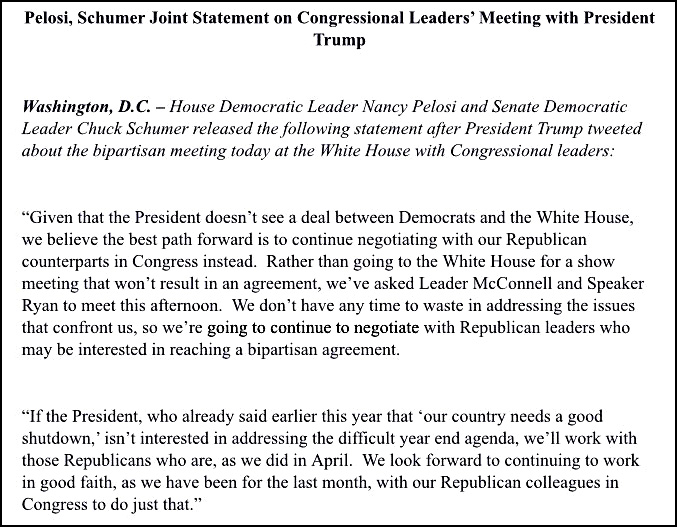
My my. Democrats are showing some spine. Donald Trump tweeted this earlier today:
Meeting with “Chuck and Nancy” today about keeping government open and working. Problem is they want illegal immigrants flooding into our Country unchecked, are weak on Crime and want to substantially RAISE Taxes. I don’t see a deal!
Shazam! I guess Trump isn’t the only one who can pre-emptively pull out of a meeting. Now he can either (a) back down, (b) accept that he’s irrelevant, or (c) launch more insulting tweets. I’m guessing C.
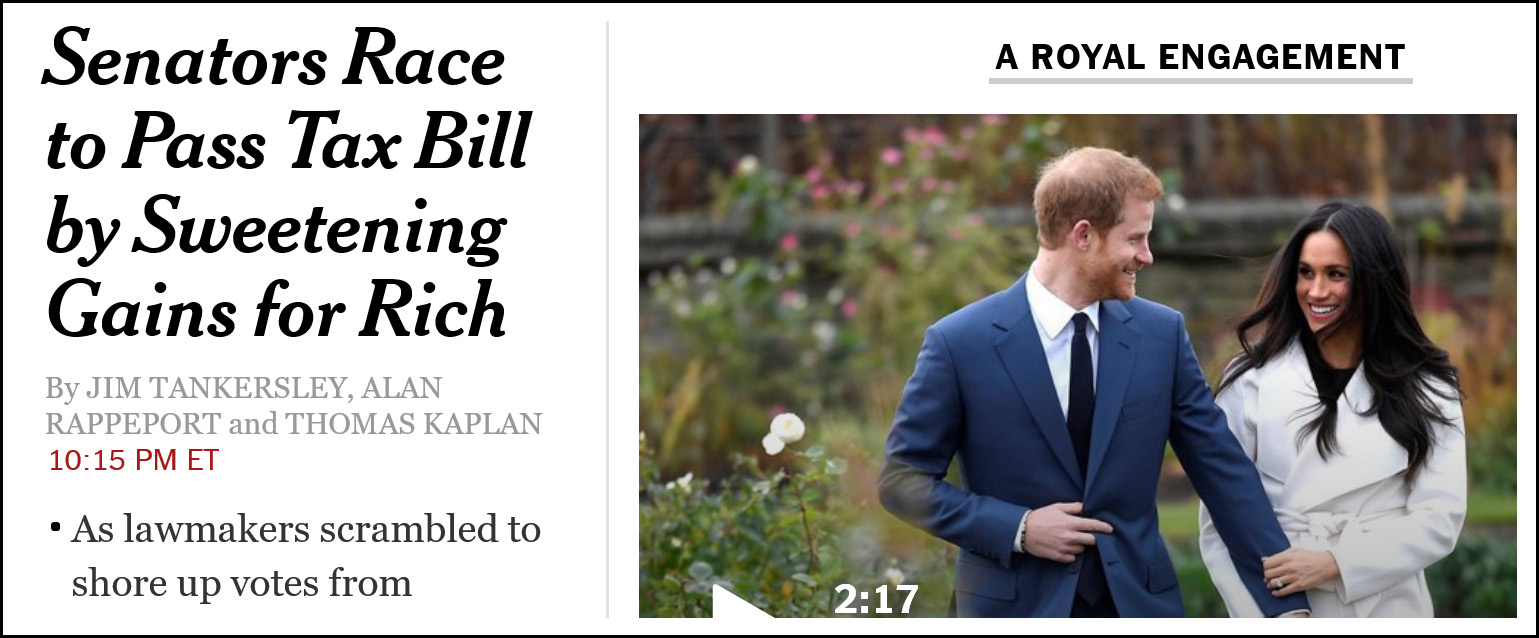
Of course that’s what they’re doing. How else would you round up votes from a bunch of Republicans?
I’ve sort of given up on the latest batch of estimates about the effect of the tax bill. They all say the same thing: It gives big cuts to the rich; big cuts to corporations; big cuts to hedge fund zillionaires; and a few crumbs for the middle class that disappear over time. And none of this has the slightest effect. Republicans just don’t care. It doesn’t matter that the economy is strong and doesn’t need a tax cut. It doesn’t matter that CBO hasn’t had time to produce an official estimate of the bill. It doesn’t matter that American corporations are already among the lowest-taxed in the world. It doesn’t matter that the bill will have virtually no effect on growth. It doesn’t matter that the rich have done so well over the past few decades that they hardly need another windfall.
Republicans are just going to do it, and that’s all there is to it. So why not turn off your brain and go read about Prince Harry instead? He’s also rich, but at least he doesn’t spend his time whining about how meager his allowance is.
Scientists at the Massachusetts Institute of Technology and Harvard University have developed a variety of origami-inspired artificial muscles that can lift up to a thousand times their own weight — and yet be dexterous enough to grip and raise a delicate flower. The devices, described in the Proceedings of the National Academy of Sciences, offer a new way to give soft robots super-strength, which could be used everywhere from inside our bodies to outer space.
This 10 cm-long linear actuator was fabricated within 10 min, with materials costing less than $1. This actuator weighs 2.6 g, and it can lift a 3 kg object within 0.2 s using a -80 kPa vacuum.
Sure enough, that’s a thousand times its weight. But it’s still only about six pounds. Robots with grippers made of FOAM (fluid-driven origami-inspired artificial muscles) won’t be destroying human civilization any time soon.
Joking aside, this really is intriguing. Robotics engineering seems to be advancing about as fast as artificial intelligence—and of course, the two are synergistic. Muscles are controlled by intelligence, and they get better with both exercise, which improves their raw capability, and practice, which improves their response to intelligent control. The same will be true of artificial muscles. Engineering will improve their raw capability and better AI will provide more precise control. In 20 or 30 years our grandchildren will be appalled at the idea that we ever let clumsy, unreliable human beings perform surgery on us. What kind of madman would submit to that?
Over at National Review they’ve reprinted a long review essay of Gene Dattel’s “fearless, eye-opening” new book, Reckoning with Race: America’s Failure. I tried to read the whole thing, but I’ll confess that after several thousand words telling me that northerners have long been racists too, I sort of gave up. Surely this isn’t news to anyone? “I have never seen, even in Mississippi and Alabama, mobs as hateful as I’ve seen here in Chicago,” Martin Luther King Jr. said in 1966, and evidence for brutal and widespread northern racism both before and after that is plentiful. It’s hardly a secret.
(That said, it’s still true that legal slavery was worse than even circumscribed freedom, and statutory Jim Crow was worse than cultural bigotry. It matters that we hold two thoughts in our minds at once: racism wasn’t confined to the South, but it was still quite a bit worse than it was in the North.)
Anyway, the point of these thousands of words turns out to be simple: Dattel is apparently making the case that the rise in “black pathologies” starting in the 1960s is the fault of blacks themselves and the pernicious effects of 60s counterculture, not white racism and oppression. After all, as reviewer Myron Magnet says:
America fought a war to end [slavery], had a civil-rights movement to try to erase its malign remnants, and spent decades on affirmative action and other nostrums to expunge even the faintest remaining traces. Whatever white Americans could do to atone for and repair the damage they caused, they have done, as much as imperfect humans in an imperfect world can do.
We’ve done absolutely everything we could do. Everything! Later in the review, Magnet summarizes The Dream and the Nightmare, which he wrote in the 90s:
In that book, I argued that the counterculture’s remaking of mainstream white American culture in the 1960s — the sexual revolution; the fling with drugs…the belief that in racist America, the criminal was really the victim of society…[etc.] — all these attitudes that devalued traditional mainstream values trickled down from young people and their teachers in the universities, to the media, to the mainstream Protestant churches, to the ed schools, to the high schools, and finally to American culture at large. And when these attitudes made their way to the ghetto, they destigmatized and validated the already-existing disproportionate illegitimacy, drug use, crime, school dropout, non-work, and welfare dependency there, and caused the rate of all these pathologies to skyrocket startlingly in the 1960s and beyond.
….Aghast at the minority-crime explosion that rocked not just the ghettoes but much of urban America, voters began electing officials, especially in New York, who believed that the real victim of a crime was the victim, not the criminal — who ought to be arrested and jailed — and crime fell accordingly.
In other words, blacks today have no cause to blame their troubles on anyone but themselves. Unless they want to blame it on lefty counterculture. This is pretty putrid stuff, and I don’t feel like taking it on right now. Instead, I’m going to change the subject so suddenly you might get whiplash.
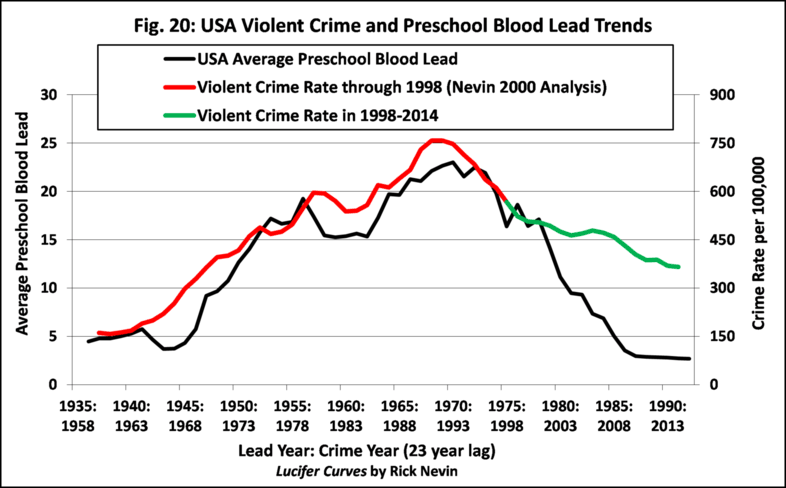
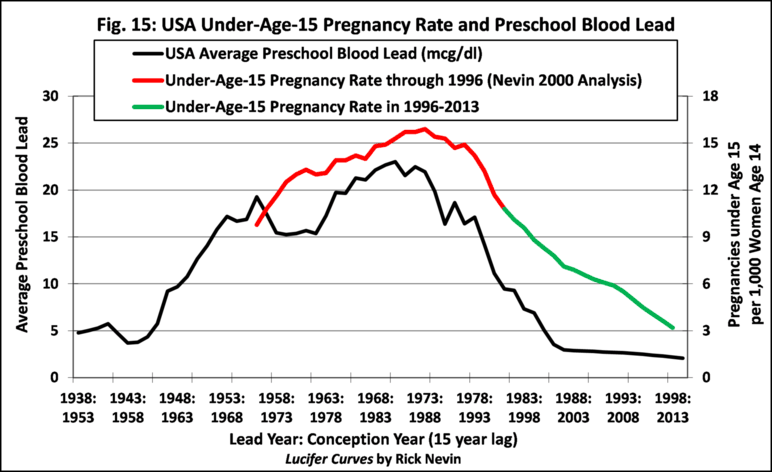
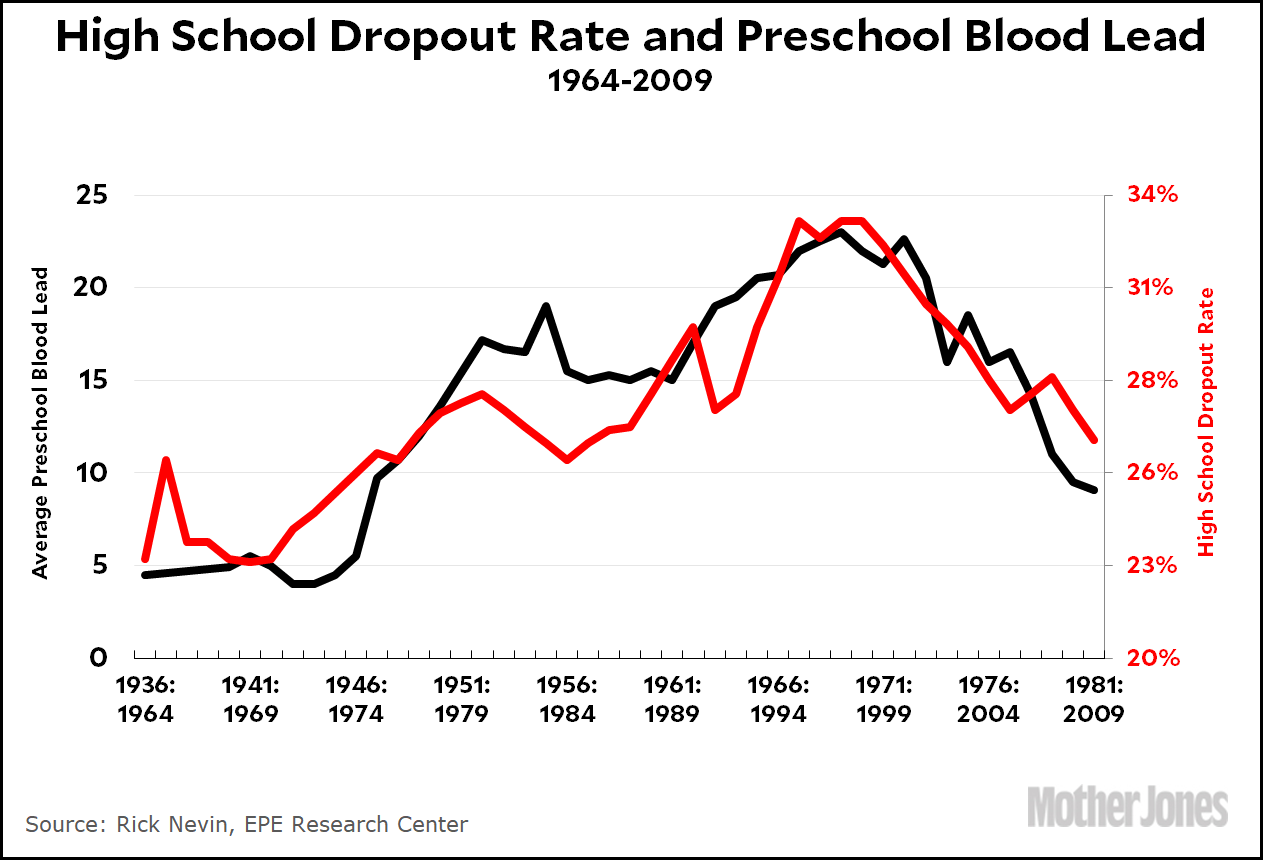
Here we go: it’s hardened beliefs like this that make it so hard for many people to accept the lead-crime hypothesis that I’ve written about frequently and at length. A lot of teen pathologies did start to skyrocket in the 60s, but the primary cause was almost certainly lead poisoning. Certainly lead was the proximate cause of increases in crime, teen pregnancy, and school dropout rates. And these effects were more pronounced among blacks than whites, because blacks lived disproportionately in areas with high levels of lead. The opposite is true too: the decline in these pathologies starting in the 90s was due to the phaseout of lead in gasoline.
In theory, none of this should be too hard to accept. The evidence is strong, and given what we know about the effects of lead on brain development, it makes perfect sense. In practice, though, if lead poisoning was the primary cause of the increase in various pathologies in the 60s and beyond, then the counterculture wasn’t. And if the phaseout of leaded gasoline was responsible for the subsequent decline, then the EPA gets the credit, not tough-on-crime policies. And that can’t be tolerated.
On the left, the problems are similar. Liberals tend to dislike “essentialist” explanations of things like crime rates because that opens the door to noxious arguments that blacks are biologically more crime prone than whites. As it happens, lead poisoning isn’t truly an essentialist explanation, but for many it’s too close for comfort. And anyway, liberals have their own explanations for the crime wave of the 60s: poverty, racism, easy availability of guns, and so forth.
This is why something that ought to be viewed dispassionately as a straightforward scientific hypothesis has such a hard time gaining traction: if it’s true, then everyone’s pet theories about the 60s have to be seriously reevaluated. And no one wants to do that: on the left, most people want to stick with racism and poverty, and on the right they want to stick with moral decay and black culture. It’s more fun that way, you see.
Boats lined up outside Ross Castle in Killarney, waiting for next summer and the expected horde of tourists wanting tours of Lough Leane. We just took the tour boat instead.
“Net neutrality” is a simple thing: it mandates that ISPs (internet service providers, usually your cable or mobile phone company) provide the same level of service to all comers—from mighty Disney to modest Breitbart to tiny little startups. Without it, internet providers can sign exclusive deals with big companies so that their sites are nice and fast, while the also-rans are sluggish and unreliable.
But would internet providers do this? One of the arguments against net neutrality is that it addresses a problem that might happen in the future, not a problem that actually exists. This argument doesn’t do much for me, since I think the probablility that internet providers will sign lucrative deals like this is pretty close to 100 percent. Hell, some internet providers have already come pretty close. Netflix pays Comcast for fast service on its lines. In the past, T-Mobile has “zero rated” certain sites so they don’t count against your data limit. These should be viewed as opening salvos, not full-blown non-neutrality, but they’re certainly a sign that monopoly internet providers know they have a very valuable commodity that they can auction off to the highest bidders if they’re allowed to.
But what concrete evidence do we have about the future of a non-neutral internet? How about overseas, where net neutrality isn’t universal? I was thinking I should look into that, but Rep. Ro Khanna beat me to it:
In Portugal, with no net neutrality, internet providers are starting to split the net into packages. pic.twitter.com/TlLYGezmv6
Although both countries are part of the European Union, which has an explicit commitment to network neutrality, they’re allowed under provisions giving national regulators some flexibility. These regulators can open loopholes permitting “zero rating,” through which ISPs can exclude certain services from data caps….The potential for abuse is obvious: The system gives ISPs the ability to set terms for any service’s inclusion in one of these special tiers.
…. In early January the FCC staff, in one of its last published reports before President Trump appointed Pai chairman of the FCC, concluded that zero-rating deals offered to broadband customers by AT&T and Verizon violate net neutrality principles. The deals “present significant risks to consumers and competition…because of network operators’ potentially unreasonable discrimination in favor of their own affiliates,” the staff reported.
….The arrangements that offended the FCC staff were AT&T’s “sponsored data” and Verizon’s “FreeBee Data 360.” AT&T, according to the FCC staff, gives content providers the ability—for a fee—to offer programming to its subscribers without its counting toward the subscribers’ monthly data usage limits. The problem is that AT&T offers this service to programmers at terms worse than those it gives DirecTV, which it owns….Verizon pulled the same stunt to favor its own go90 video service, the FCC staff found.
This is just the start. At the moment, ISPs like Comcast and Verizon are being careful because they don’t want to do anything to jeopardize the elimination of net neutrality. But once they’re convinced it’s gone for good, they’ll start experimenting to see how far they can push things.
Can I prove this? Of course not. But it’s obvious that in a non-neutral market, ISP’s can make a huge amount of additional money by charging content providers for fast service. So why wouldn’t they do it? It’s not as if their customers can switch to someone else, after all.
And we respect that! But maybe you’re of a mind to support our work directly instead? We have until December 31 to raise the last $400,000 we need to keep our nonprofit newsroom running at full strength into 2026. Will you make a gift today?
We noticed you have an ad blocker on. Can you pitch in a few bucks to help fund Mother Jones' investigative journalism?
Billionaires own the media,
but they don’t own us.
At Mother Jones we know these aren’t conventional times, and they require unconventional coverage. That’s what deliver every day: fierce, independent journalism you can’t find elsewhere. Perhaps never in the history of our country has that been more necessary than now. But we can’t do it without reader support—your support. Please chip in today.
Billionaires own the media,
but they don’t own us.
At Mother Jones we know these aren’t conventional times, and they require unconventional coverage. That’s what deliver every day: fierce, independent journalism you can’t find elsewhere. Perhaps never in the history of our country has that been more necessary than now. But we can’t do it without reader support—your support. Please chip in today.