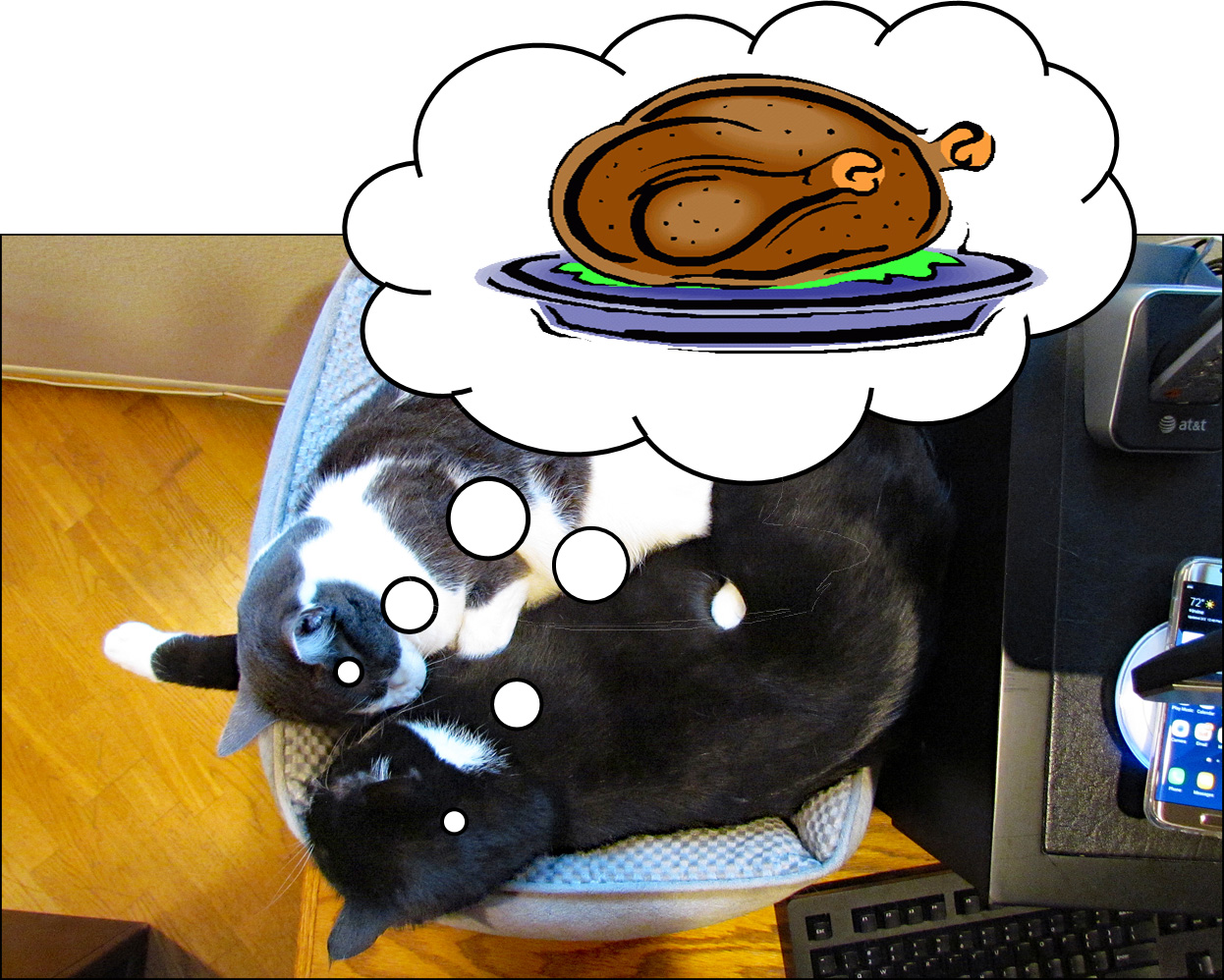
Their duel was set for high noon—Excel spreadsheets at twenty paces—but there’s no word yet on how that turned out.
As a reminder, here’s the basic dispute:
The 1998 Vacancies Reform Act gives the president the power to fill vacant positions in the executive branch. It is the “exclusive” means for filling positions “unless” another statute expressly names a successor.
The 2010 Dodd-Frank Act expressly says that the deputy director of the CFPB “shall” become director in case of a vacancy.
The White House position is that Dodd-Frank doesn’t remove the president’s VRA power. It merely means that VRA is no longer the “exclusive” means of filling the vacancy. The president still has the option of using it.
The lawyers will sort this out, but here’s the part that was tickling my brain last night. It’s one thing to disagree about what statutory language means, but surely it has to mean something. Right? But if the White House interpretation is correct, then the language in Dodd-Frank is literally meaningless. VRA still controls, and the president had the power to name the deputy as the new director all along if he wanted to. So why bother even including it?
This is the question I haven’t seen addressed. If VRA is the controlling statute regardless, then why did Congress even bother including language about a CFPB successor in Dodd-Frank? It might make sense if this applied only to temporary absences (due to illness, for example), but that’s not the case. Everyone agrees that the Dodd-Frank language applies equally to both temporary absences and resignations.
My untutored view is that the Dodd-Frank language means exactly what it says: if the director resigns, then the deputy director takes over, full stop. And it was included as a means of maintaining CFPB independence from the White House, something that Congress clearly intended. This is the only interpretation that seems to make consistent sense.
But I suppose a judge will decide I’m wrong soon enough.
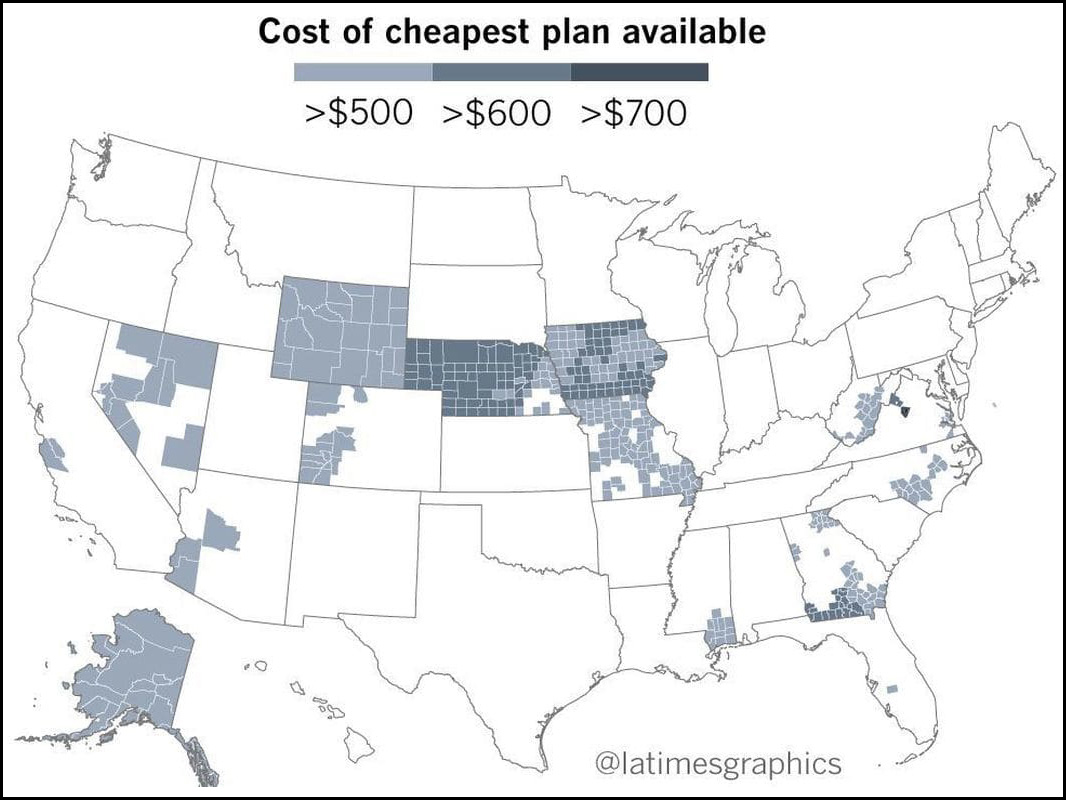
The Republican plan to kill off Obamacare’s individual mandate would affect the entire country, but its biggest effect would likely be in sparsely-populated rural areas. According to an LA Times analysis, insurers there would either pull out entirely or else raise rates drastically because the pool of customers is so small:
That could leave consumers in these regions — including most or all of Alaska, Iowa, Missouri, Nebraska, Nevada and Wyoming, as well as parts of many other states — with either no options for coverage or health plans that are prohibitively expensive. There are 454 counties nationwide with only one health insurer on the marketplace in 2018 and where the cheapest plan available to a 40-year-old consumer costs at least $500 a month. Markets in these places risk collapsing if Congress scraps the individual insurance mandate.
….Eighty-six percent of these 454 at-risk counties have fewer than 50,000 residents, census data show. Healthcare costs are often higher in rural areas, as there are fewer medical providers and populations tend to be older and sicker. These counties also overwhelmingly supported Donald Trump last year, with 9 out of 10 backing the Republican presidential ticket, according to election data.
It’s yet another way that Donald Trump is screwing the very people who put him in office. Most of these folks don’t seem to realize it, though. They’ll either blame Democrats or else shrug and figure that at least Trump hates the same people they do.
You think the kids these days are out of control? Pfft. Just wait until that hummingbird gets a taste of my mighty leap and razor sharp teeth. *That's* out of control.
I am sick again, with a reprise of the exact same stomach bug I had earlier this week. I’m pissed. What’s going on here?
Anyway, I feel too lousy to do any actual thinking, but this Noah Smith tweetstorm represents my view of the kids these days so perfectly that I have to pass it along. I probably would have added a caveat that I think there is a genuine lack of respect for free speech rights on campuses these days, but that’s about it. However, I don’t really have any idea how serious this problem is, so let’s just leave it alone for now and let Noah have the stage while I go back to bed.
7/More importantly, we have evidence that professors are a politically MODERATING influence, and that when students are radicalized, they radicalize each other: https://t.co/gKKaoznufD
9/And notice that all the scare stories you read about in the media, including Evergreen State and Reed College, are stories about STUDENT activists attacking their moderate-lefty professors.
Not about extremist professors leading the charge.
11/When I was a college kid, students protested for higher wages for janitors. They protested the WTO. They protested the shooting of Amadou Diallo. They protested the Iraq War.
15/Now, I respect @JonHaidt‘s campaign for more ideological diversity in the social sciences. Get some conservative viewpoints in there, go ahead! Intellectual monoculture is boring. Have some real debates!
16/And sure, I do turn up my nose at the sociologists (and the increasingly small # of economists) who think political activism and scientific inquiry go well together. They don’t. Objectivity is important.
19/And meanwhile, let’s not fall victim to the Availability Heuristic.
Outrage over lefty campus protests is an intentional distraction from the real, important bad things being done (and being attempted) by the Trump Administration.
20/Right-wing media outlets like the Daily Caller, Breitbart, etc. are trying to find something that’s viscerally scary to conservatives, and shove in their face in order to distract them from the damage that Trump is doing to the country.
21/Just like antifa provided a bogeyman that let right-wing media do the “both sides” defense when murderous Nazis rampaged in the streets of Virginia, campus protests provides a bogeyman that lets right-wing media distract from and excuse Trumpism.
Watch in awe as the fearsome Jaws surges from the underbrush and overwhelms a defenseless plant. Nearby, a furry killer whale joins playfully in the carnage.
Here are a few more quick hits. I promise to keep this shorter than yesterday.
The lead stories in both the Washington Post and the New York Times are about Jared Kushner losing influence in the White House. Maybe this is true, maybe it isn’t. But it sure looks like someone close to Donald Trump is eager to push this narrative. I wonder who?
Yesterday I wrote about the fact that we now have two directors of the CFPB following the resignation of Richard Cordray. Today the Office of Legal Counsel released its memo explaining why Trump has the authority to fill the vacancy even though, by statute, the deputy director automatically moves up in the “absence or unavailability” of the director. I figured the whole thing would turn on the meaning of that phrase, but no. As it turns out, OLC agrees that “absence or unavailability” also encompasses the resignation of the director.
So what is their justification? As near as I can tell, they make a lengthy argument that the statutory language doesn’t overrule the Vacancies Reform Act, which allows the president to fill vacant positions, it sits alongside the VRA. In other words, it merely gives the president a second choice. He can either appoint someone or he can allow the deputy to become acting director.
The OLC’s reasoning seems sort of half-assed to me, but I’m no lawyer. Stranger things have been upheld by courts. The more interesting question is why Trump is bothering with this in the first place. Why not just nominate a new director? The Republican Senate would surely vote quickly to confirm and that would be the end of it. It might delay things two or three months, but that’s hardly a big deal.
So far, the leading theory seems to be that Trump wants a court battle in order to set a precedent that he can do this. He has a habit of installing his people in jobs before they’re approved by the Senate, and it’s not at all clear that this is legal. But if he can get a court to agree with OLC’s legal argument, he’d have a free hand to install his nominees all over the government without being delayed by pesky Senate confirmation hearings. So much winning!
After the first 27 minutes of today’s Alabama-Minnesota basketball game, Minnesota led 57-50. In the next three minutes, the entire Alabama bench was ejected; an Alabama player fouled out; and another one was injured. At that point, Minnesota led 67-54. Alabama then played the last ten minutes with only three players and outscored Minnesota 30-22. That wasn’t quite enough to win the game, which means there will probably be no ESPN 30-for-30 story about this, but it certainly suggests a novel strategy for playing better basketball.
Gardiner Harris presents the latest smdh story about Rex Tillerson’s apparently deliberate program to destroy the State Department. No explanation for Tillerson’s behavior truly makes sense. It’s just inexplicable. There’s been a mass exodus of top diplomats; Tillerson basically hides in his office all day; and people who decline to quit when he asks them to are assigned scutwork:
Even more departures are expected as a result of an intense campaign that Mr. Tillerson has ordered to reduce the department’s longtime backlog of Freedom of Information Act requests. CNN reported that the task had resulted from Mr. Trump’s desire to accelerate the release of Mrs. Clinton’s remaining emails. Every bureau in the department has been asked to contribute to the effort. That has left midlevel employees and diplomats — including some just returning from high-level or difficult overseas assignments — to spend months performing mind-numbing clerical functions beside unpaid interns.
All because Trump continues to be convinced that somewhere there must be a smoking-gun email that will put Hillary Clinton behind bars.
He sees the calls for Mr. Moore to step aside as a version of the response to the now-famous “Access Hollywood” tape, in which he boasted about grabbing women’s genitalia, and the flood of groping accusations against him that followed soon after. He suggested to a senator earlier this year that it was not authentic, and repeated that claim to an adviser more recently.
This is the kind of thing that makes you think maybe all those lies Trump tells aren’t actually lies. Maybe he’s really so divorced from reality that he convinces himself they’re true. What else could explain him saying something like this in the face of crystal clear documentary evidence to the contrary?
My Twitter feed is full of outrage over this profile of Tony Hovater, a neo-Nazi who lives in Huber Heights, Ohio. Hovater, according to the story, is a welder by trade; owns four cats; just got married; and is “polite and low key”—or, as author Richard Fausset puts it, “He is the Nazi sympathizer next door.”
The outrage is over the story’s seeming normalization of white nationalists and neo-Nazis, but I think that’s probably overblown. Fausset’s goal was perfectly reasonable: to dig into Hovater’s past and explain how a guy who was basically normal ten years ago suddenly took a U-turn that transformed him into a racist zealot. The real problem, as Fausset basically admits here, is that the story fails on its own terms. Hovater himself doesn’t really seem to know how it happened, and Fausset comes away from hours of interviews without any compelling insights either.
This is yet another case of a story that should have been spiked. No one wants to do that after putting a lot of work into something, but sometimes days or weeks of reporting just doesn’t pan out. This was one of those cases.
More generally, this was the latest entry in a popular recent category of journalism that could be described as the “well-dressed racist” genre. The motivation for these pieces is obvious, and their goals are pretty obvious as well: to let people know that hardcore racists don’t all advertise themselves these days with white hoods or swastika tatoos. In other words, don’t be fooled by a nice suit or a mild manner. They’re still just as dangerous as the Klansmen of old.
There’s a high risk to writing these pieces, because they really need to be done well. Screw it up, as Fausset did, and you do more harm than good. And I’m not at all sure it’s worth it anyway. There were plenty of vicious but well-dressed racists in the old days too, and frankly, I’m not sure it’s news to anyone that some of today’s racists are also well dressed and college educated. Maybe it’s time to put this whole genre to bed. Even the good examples probably don’t really accomplish much.
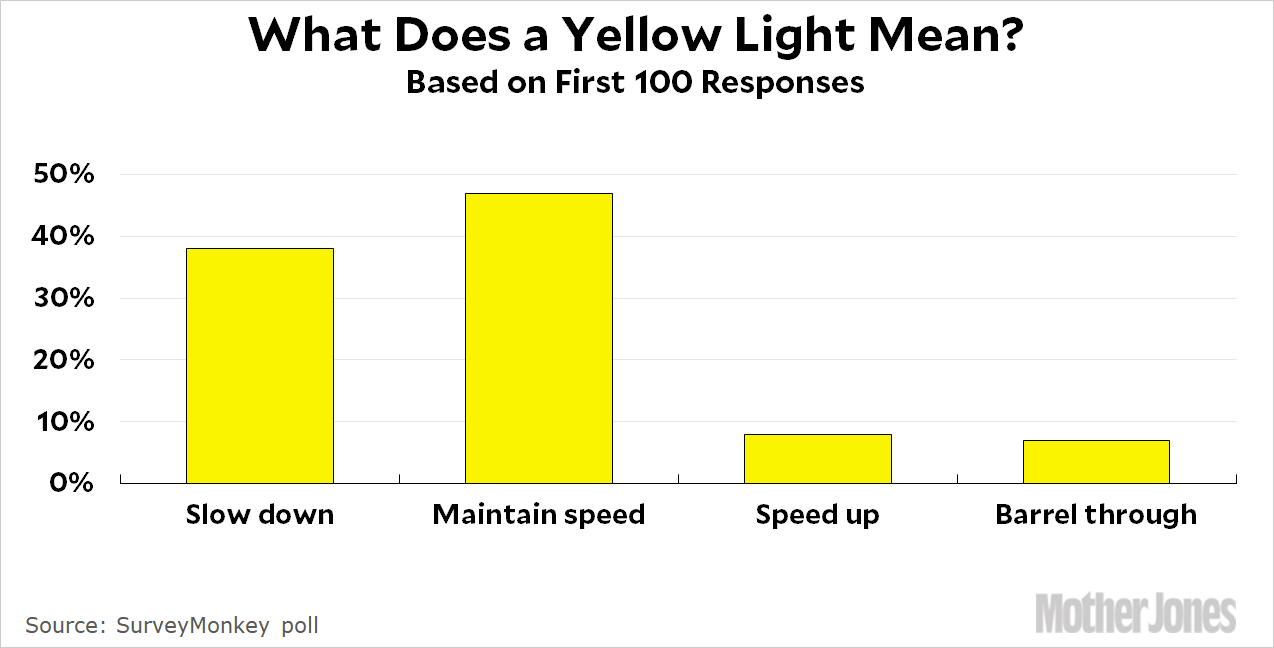
I blew it. Sorry. It turns out that SurveyMonkey allows only 100 reponses to their free surveys. The cheapest option that would allow me to retrieve all the responses costs $408, and as much as I cherish my readers, that’s a little steep for a crummy little web survey joke. However, here are the results from the first 100 responses:
You guys are really law abiding! That makes me kind of sad, actually. Atrios may be wrong about driverless cars, but he wins this round about yellow lights. And next time I guess I’ll use Google Forms if I do any further scientific polling.
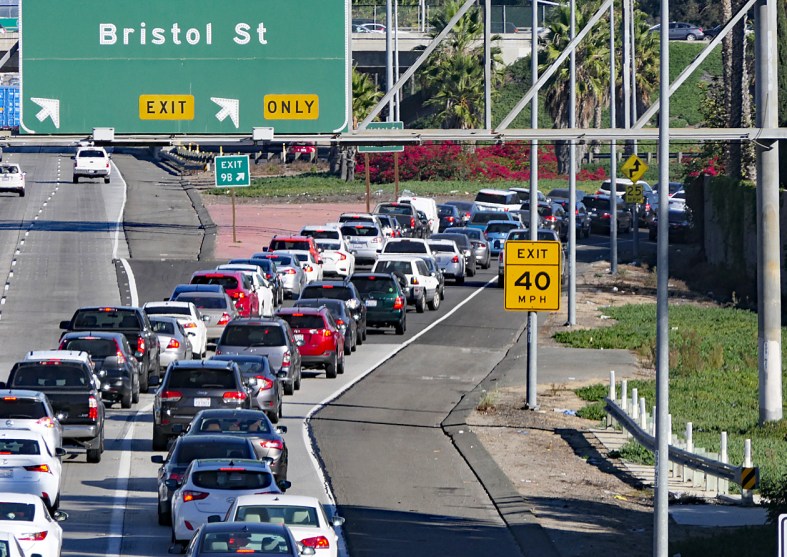
The I405 Bristol Street offramp to South Coast Plaza, 2:01 PM on Friday, November 24, 2017. When these folks finally get off the freeway, they still have half a mile to go before they'll get to the mall.
I’ve got a bunch of stuff clogging up my browser tabs and RSS reader, and I don’t think I’ll get around to doing full-blown posts about any of them. So here’s a quick dump of interesting stuff that caught my eye over the past couple of days:
The New York Times reports that Mike Flynn’s lawyers are no longer cooperating with Donald Trump’s lawyers. The Times suggests that this means Flynn has been flipped and may be providing dirt on Trump. As one person “close to the administration” told the Washington Post, it’s a “classic Gambino-style roll-up”—not a phrase one normally associates with a president of the United States. Stay tuned.
A few days agoDavid Dayen wrote a piece explaining that Donald Trump can’t unilaterally name a successor when Richard Cordray steps down as director of the CFPB. It turns out that the deputy director automatically takes over. This was interesting, but a bit moot, since Cordray has never appointed a deputy. But today, a few hours before his resignation took effect, he finally did:
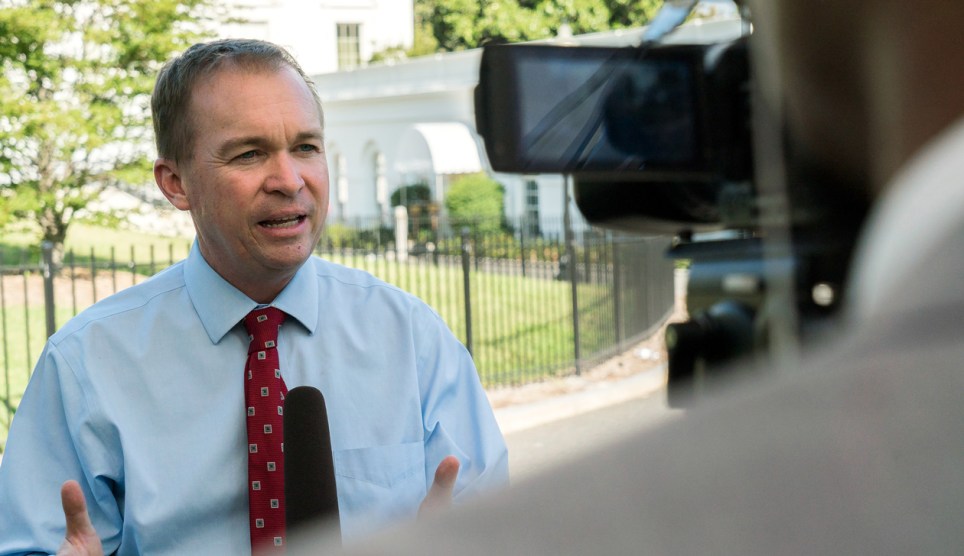
Cordray on Friday appointed the agency’s chief of staff, Leandra English, as the CFPB’s deputy director, establishing her as his successor when he steps down at the end of the day. The move appears designed to thwart any move by President Donald Trump to name another temporary official to head the controversial agency. Trump has been reported to be considering White House Budget Director Mick Mulvaney for the role.
Dayen thinks this signals an “epic fight” over the position. What happens if Trump appoints someone new, claiming that the Federal Vacancies Reform Act gives him the authority to do so, but English stays on, insisting that she’s the only legitimate director because language in the Dodd-Frank bill overrides FVRA? Pass the popcorn!
I suspect this is a fight Trump won’t pick, but I guess you never know.
UPDATE: That was quick. It looks like Trump decided to pick this fight after all. As of midnight Friday, there are two dueling directors of the CFPB. I imagine this will go to court quickly, possibly directly to the DC Circuit Court as the court of original jurisdiction.
Via Alex Ward, here’s the most likely reason that there’s suddenly been a lull in North Korean missile tests, and it has nothing to do with Donald Trump’s blathering:
Until 2012, North Korea never tested missiles during autumn and winter. That changed when Kim Jong-un took over, but not by a lot. They still conduct very few tests in the fourth quarter. The reason comes down to simple bad weather:
Missile launches require good weather. Even NASA delays rocket launches sometimes because of storms. That poses a problem for North Korea, which suffers from brutally cold and blustery winter weather…..At the same time, North Korea’s harvest season takes place during the last three months of the year….Come winter time, Pyongyang prioritizes food transportation over missile launches.
The bad news is that missile tests are likely to pick up next year, and very likely to pick up in February, when South Korea is hosting the Winter Olympics.
Just to remind everyone, there are three separate rules that the Republican tax bill has to conform to:
The Republican budget resolution, which limits the bill to additional deficits of $1.5 trillion over its first ten years (2018-2027).
The Byrd Rule, which limits additional deficits to zero after the first ten years (2028 and beyond).
PAYGO, or pay-as-you go, which, when combined with the Budget Control Act, mandates that any new deficits need to be offset with equal spending cuts.
#1 appears to be pretty well in hand. #2 is still a problem as far as I know, though we haven’t yet seen the latest JCT estimates. And #3 is basically an ICBM headed straight for the Capitol dome: we can all see it coming, but for some reason hardly anyone is talking about it. I don’t quite understand this.
By the way, all of this could have been avoided if Republicans were willing to work with Democrats. The fact that this sounds so ridiculous is a sign of the times, but the fact is that there’s plenty of corporate tax reform that Democrats would go along with—but only if it’s deficit-neutral, which is the one thing Republicans are dead set against. Their goal is, and always has been, budget-busting tax cuts, not economy-growing tax reform.
From the deputy Washington editor of the New York Times:
People who use 2027 distribution tables to say tax plans hurt the middle class are being disingenuous. Tax writers had middle class tax cuts expire precisely because they know Congress will extend them. The damage is to the debt.
Oh come on. If Republicans were really that confident, they’d have the entire bill expire in 2027. That would sure make passage a whole lot easier. But they aren’t all that confident, so they had to make a decision: which part would they prefer to jettison if worst comes to worst? And the answer was the middle-class tax cuts.
It appears that thousands—or maybe millions—of comments submitted to the FCC in favor of repealing net neutrality were fake. New York State Attorney General Eric Schneiderman has been trying to investigate, but apparently the FCC has refused to cooperate. This is very strange. It’s unlikely that these comments had any actual impact on the Republican FCC commissioners, who were all dedicated to repealing net neutrality from the get-go, so why would they be so uninterested in finding out how this happened and who was behind it?
John Eligon went to Vallejo, California, recently to take a look at one of the most diverse cities in America. “About 30 miles north of Oakland,” he writes, “it is the rare place in the United States where black, white, Asian and Hispanic people not only coexist in nearly equal numbers, but actually connect.”
I found that most people in Vallejo interacted quite comfortably across racial lines and were accepting of one another, more so than in much of the rest of the United States. Several black people told me, for instance, that they did not feel profiled anywhere they went in town, something I certainly do not hear in most other parts of the country to which I travel.
Despite this, the entire “behind the scenes” piece is devoted to Fred Hatfield, an explicitly racist white guy Eligon met in a diner. Hatfield was “very much an exception in Vallejo,” Eligon says, but he was apparently worth a thousand-word spotlight anyway. Why?
Eligon explains that his piece is really about himself: “Mr. Hatfield’s disparaging remarks about minorities and his quickness to stereotype me underscored a truth about covering race in America as a black man: The story is never far from home.” I’d buy that if his article really was about his experience covering race in America—which would probably be pretty interesting. But it’s not. It’s basically a thousand words about Hatfield.
I struggle a bit to understand why Hatfield was worth this attention. After all, it’s hardly news that if you look around you’ll find some people willing to be overtly racist to your face. Nor, as Eligon acknowledges, is Hatfield even remotely typical of Vallejo. In the end, then, this piece is just the latest in the tired genre of liberal anthropology: stories about “regular places” that inevitably feature “regular people” saying terrible things. This is understandable if (a) these people are representative and (b) there’s a good reason to profile the place itself, but often it seems to be little more than an excuse to highlight non-college graduates outside of big cities being appalling.
Maybe I’m missing the point, but surely this genre is old in the tooth? Reporters should describe the world as it is, warts and all, and that means showing us raw racism and stupidity when that’s how the world is. But it doesn’t mean going out of our way to highlight this stuff just because it confirms our liberal pieties.
That’s thanks to a design concept called “shared space,” where urban planners drastically lessen the presence of traffic lights, signs, and barriers, encouraging all forms of transportation to share the road….The heightened risk forces commuters to remain on high alert as they pass through an intersection, in theory leading to safer travel….After installing shared spaces, Ipswich’s accident rates with injuries fell from 23 over three years to just one per year. Pedestrian injuries at London’s Kensington High Street fell by nearly 60 percent.
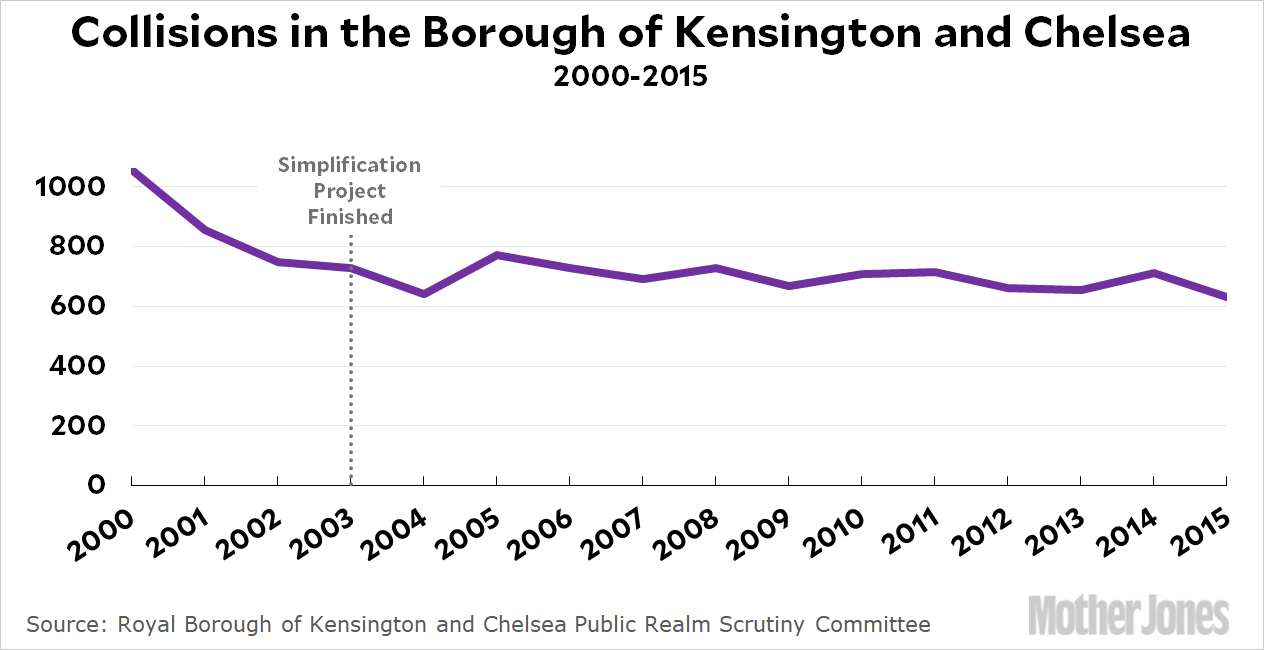
I just spent three weeks living near Kensington High Street, and I didn’t notice any lack of signs or crosswalks. What did I miss? Not much, apparently: it appears that some modest changes were made there starting in 2000, but not so much that it’s surprising I didn’t notice them. Still, it was apparently enough to produce impressive results: for the past decade reporters have been dutifully passing along the news that collisions involving pedestrians, bicycles, and motorcycles dropped by 48 percent in the three years after the project was completed in 2003.
But there’s a gotcha. First, it turns out that these same collisions dropped by 37 percent everywhere in the borough. Second, it mostly happened before the KHS simplification was carried out:
Color me confused. The entire borough got safer, obviously for reasons unrelated to road simplication. And it mostly happened between 2000 and 2002, before the traffic simplification was even finished. If Kensington High Street followed the same trend, it mostly benefited from the global changes and has probably seen only modest improvement from the simplification. Unfortunately, there don’t seem to be any studies of KHS more recently than 2005, so who knows?
In any case, the borough itself says that “although the scheme is often cited as an example of ‘simplification’ (since some barriers and other street furniture were removed) it should properly be considered as a holistic re-design of the area that produced (on average) a simplified space although many features were added as part of the scheme.” And it doesn’t appear to have had a big effect. So it might be best to stop using this as one of the half dozen examples that shows up in every article about traffic simplification.
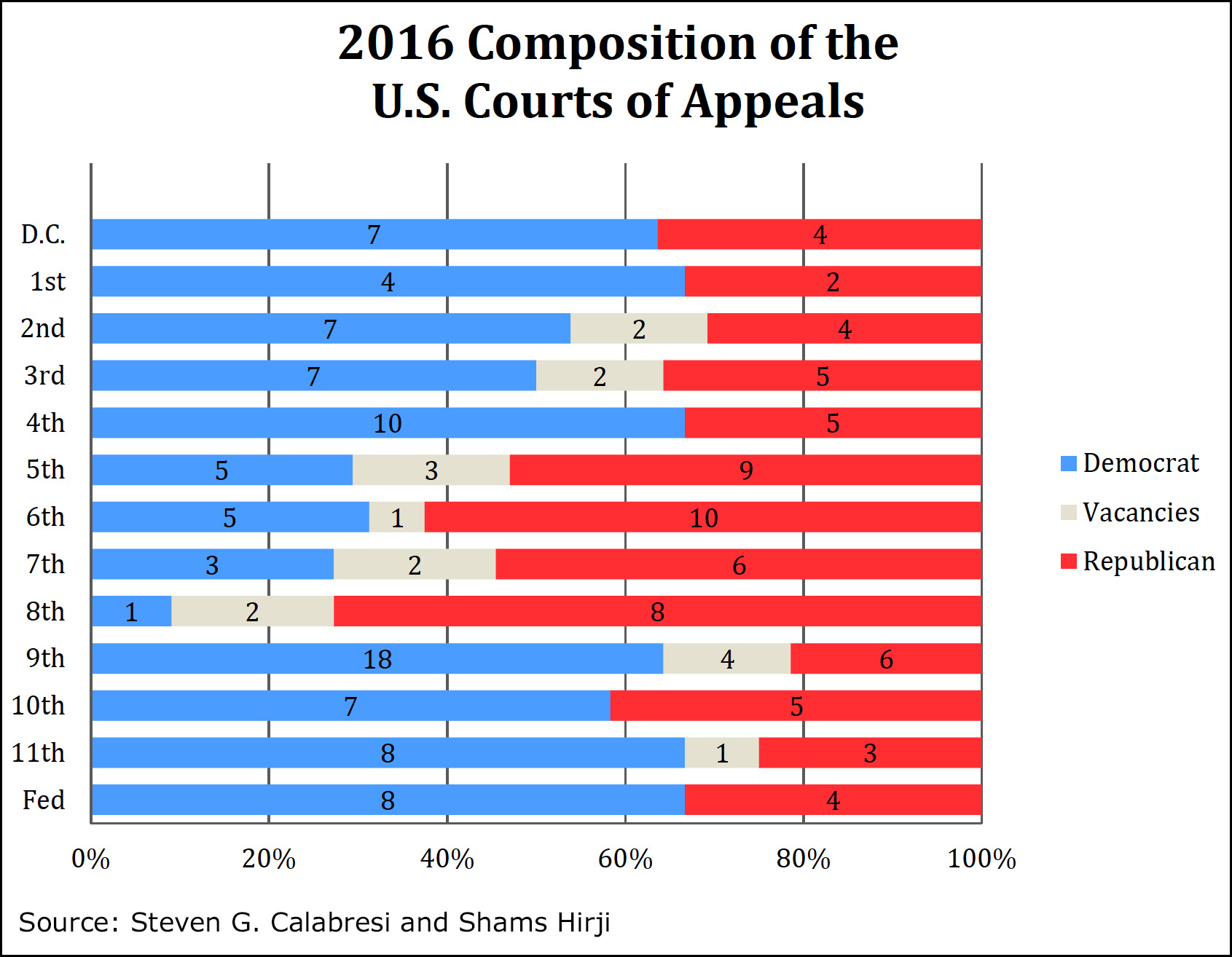
The latest hotness in conservative circles is a proposal to create a whole bunch of new judgeships. Back in 2013, when Democrats merely wanted to fill three empty seats on the DC Court of Appeals, conservatives argued that, properly measured, caseloads were down and we really ought to just eliminate the empty seats entirely rather than let President Obama fill them. But now that a Republican is president, guess what? The court system is groaning under the weight of increased caseloads. We need new judges, and we need them now—with “now” defined as prior to November 2018 when Republicans might lose their Senate majority.
However, the primary author of this proposal, Stephen Calabresi, is pretty frank that although increased caseloads should be the public rationale, it’s really about getting more conservative judges appointed. And don’t call it court packing!
In fact, it is a court-unpacking plan. It counteracts Democratic court-packing under President Carter and a Democratic Congress in 1978…and it counteracts the partisan effects on the judiciary of Senator Chuck Schumer’s shameful filibustering of lower-court federal judges under the younger President Bush and his abolition of the filibuster of lower-court federal judges under President Obama.
….Republicans will have controlled the presidency for 32 of the 52 years between 1969 and 2021. By all rights, Republicans ought to have a three-fifths majority on all the federal courts of appeals. Instead, there is a Democratic majority on almost all of those courts….This is a national scandal of epic proportions, which Congress should and could address by increasing the size of the federal courts of appeals and district courts by 33 percent.
Really? It’s a “national scandal” that Republicans don’t have the same percentage of judges as they’ve had of presidential years between 1969 and 2021? How about if we rerun this from, say, 1993 to 2016? Let’s see. That gives Democrats 67 percent of the years but, shockingly, only 56 percent of the seats on federal courts of appeals. My goodness.
This is a dumb game. If you pick the years right, you can get any percentage of Republican or Democratic years you want. (Though, at the very least, you should probably stop at the present instead of using a range that, comically, goes out to 2021.) And the composition of the courts is always weighted more heavily toward the most recent president’s party.
But why stop there? Democrats won 49 percent of all votes for the Senate in 2016 but won only 35 percent of the open seats. They won 49 percent of the two-party House vote but occupy only 44 percent of the seats. And Hillary Clinton won 51 percent of the two-party presidential vote but Donald Trump is currently occupying the White House. Is this an epic national scandal too?
And by the way, Calabresi also wants to summarily dump all 250 administrative law judges currently on the books and turn them into trial judges with lifetime tenure too. Pronto.
I’d call this a sad joke if it weren’t for the fact that sillier things than this have turned into real-life movements thanks to Fox News and talk radio. Luckily, Calabresi seems not to know anything about reconciliation rules, so he suggests that this should all happen as part of the Republican tax bill. I believe the Senate parliamentarian would have something to say about that. Still, as dumb as this is, it’s worth keeping an eye on. After all, I thought Randy Barnett’s invented-from-whole-cloth argument against the individual mandate was silly too, and that came within a hair’s breadth of overturning all of Obamacare.
What kind of roundup would this be if I didn’t end it with Donald Trump’s latest bit of self-parodic narcissism?
Time Magazine called to say that I was PROBABLY going to be named “Man (Person) of the Year,” like last year, but I would have to agree to an interview and a major photo shoot. I said probably is no good and took a pass. Thanks anyway!
I feel for him. Cat Fancy called a few weeks ago to say that Hilbert and Hopper were probably going to be named Cats of the Year, but they’d have to be groomed and videoed and photographed and—long story short, I took a pass.¹ It would have interrupted nap time, after all, and they might have lost out to Serwer’s brood anyway. Who needs the grief?
¹This joke stolen from Atrios. Used without permission.
Hilbert had his beauty shot in the leaves a couple of weeks ago, so Hopper gets her chance today. It’s not quite as good as Hilbert’s, but blame the photographer for that, not the cat.
REVISE AND EXTEND: Actually, the picture of Hilbert is more dramatic than this one, but it’s not better. Hopper has a lovely, feline expression in this shot, doesn’t she?
Donald Trump returned to a favourite subject on Thursday, telling a US coast guard audience the air force was ordering a new plane that was “almost like an invisible fighter”….Trump first startled reporters with talk of an invisible plane in October, when he discussed the F-35 at a military briefing in hurricane-hit Puerto Rico….“That’s an expensive plane you can’t see. As you heard, we cut the price very substantially. Something that other administrations would never have done — that I can tell you.”
….Trump also told coast guard members of his pride in having increased military spending. “We’re ordering tremendous amounts of new equipment — we’re at $700bn for the military. And, you know, they were cutting back for years. They just kept cutting, cutting, cutting the military. And you got lean, to put it nicely. It was depleted, was the word. And now it’s changing.”
In case you’re interested, here’s the order history of the F-35 so far:
As you can see, Trump had no impact on either the price of the F-35 or the order book. The unit price declined steadily for years under both Bush and Obama, and the order quantities have been going up.
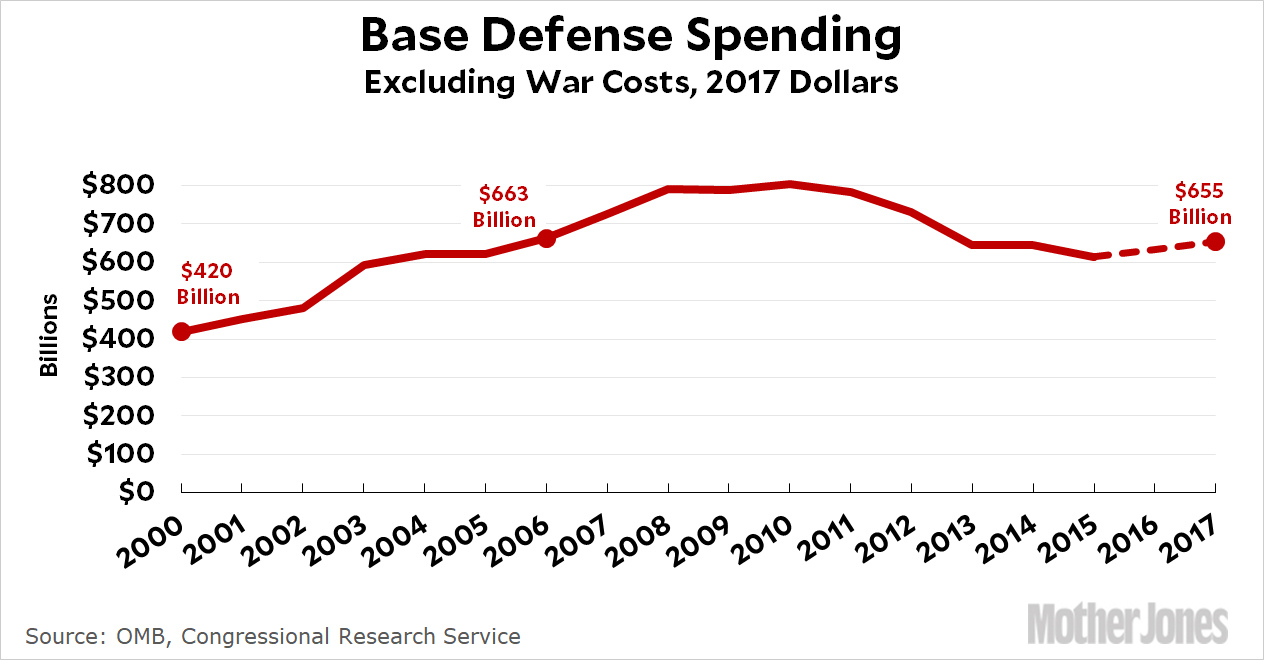
As for defense spending, it’s naturally decreased since the drawdowns in Iraq and Afghanistan. What we’re more interested in is base defense spending excluding war costs. Here it is:
I dunno. Unless you consider the 2008-10 spike to be the new normal forever, base defense spending is about the same as it was midway through the Bush administration and about 50 percent higher than it was before 9/11. I’m not sure I’d call that “depleted,” but I guess your mileage may vary.
According to the retail industry, “Black Friday” is the day when retail profits for the year go from red to black. Are you skeptical that this is really the origin of the term? You should be. After all, the term Black ___day, in other contexts, has always signified something terrible, like a stock market crash or the start of the Blitz. Is it reasonable to think that retailers deliberately chose this phrase to memorialize their biggest day of the year?
Not really. But to get the real story, we’ll have to trace its origins back in time. Here’s a 1985 article from the Philadelphia Inquirer:
[Irwin] Greenberg, a 30-year veteran of the retail trade, says it is a Philadelphia expression. “It surely can’t be a merchant’s expression,” he said. A spot check of retailers from across the country suggests that Greenberg might be on to something.
“I’ve never heard it before,” laughed Carol Sanger, a spokeswoman for Federated Department Stores in Cincinnati…”I have no idea what it means,” said Bill Dombrowski, director of media relations for Carter Hawley Hale Stores Inc. in Los Angeles…From the National Retail Merchants Association, the industry’s trade association in New York, came this terse statement: “Black Friday is not an accepted term in the retail industry…”
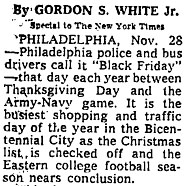
Hmm. So as recently as 1985 it wasn’t in common use nationwide. It was only in common use in Philadelphia. But why? If we go back to 1975, the New York Times informs us that it has something to do with the Army-Navy game. The gist of the story is that crowds used to pour into Philadelphia on the Friday after Thanksgiving to shop, they’d stay over to watch the game on Saturday, and then go home. It was the huge crowds that gave the day its bleak name.
But how old is the expression? When did it start? If we go back yet another decade we can find a Philly reference as early as 1966. An advertisement that year in the American Philatelist from a stamp shop in Philadelphia starts out: “‘Black Friday’ is the name which the Philadelphia Police Department has given to the Friday following Thanksgiving Day. It is not a term of endearment to them. ‘Black Friday’ officially opens the Christmas shopping season in center city, and it usually brings massive traffic jams and over-crowded sidewalks as the downtown stores are mobbed from opening to closing.”
But it goes back further than that. A couple of years ago I got an email from a Philadelphia reader who recalled the warnings she got from the older women at Wanamaker’s department store when she worked there in 1971:
They warned me to be prepared for the hoards of obnoxious brats and their demanding parents that would alight from the banks of elevators onto the eighth floor toy department, all racing to see the latest toys on their way to visit Santa. The feeling of impending doom sticks with me to this day. The experienced old ladies that had worked there for years called it “Black Friday.”
“For years.” But how many years? Ben Zimmer collects some evidence that the term was already in common use by 1961 (common enough that Philly merchants were trying to change the term to “Big Friday”), and passes along an interview with Joseph Barrett, who recounted his role in popularizing the expression when he worked as a reporter in Philadelphia:
In 1959, the old Evening Bulletin assigned me to police administration, working out of City Hall. Nathan Kleger was the police reporter who covered Center City for the Bulletin. In the early 1960s, Kleger and I put together a front-page story for Thanksgiving and we appropriated the police term “Black Friday” to describe the terrible traffic conditions. Center City merchants complained loudly to Police Commissioner Albert N. Brown that drawing attention to traffic deterred customers from coming downtown. I was worried that maybe Kleger and I had made a mistake in using such a term, so I went to Chief Inspector Albert Trimmer to get him to verify it.
So all the evidence points in one direction. The term originated in Philadelphia, probably sometime in the 50s, and wasn’t in common use in the rest of the country until decades later. And it did indeed refer to something unpleasant: the gigantic Army-Navy-post-Thanksgiving day crowds and traffic jams, which both retail workers and police officers dreaded. The retail industry originally loathed the term, and the whole “red to black” fairy tale was tacked on sometime in the 80s by an overcaffeinated flack trying to put lipstick on a pig that had gotten a little too embarrassing for America’s shopkeepers. The first reference that I’ve found to this usage was in 1982, and by the early 90s it had become the official story.
And today everyone believes it, which is a pretty good demonstration of the power of corporate PR. But now you know the real story behind Black Friday.
And we respect that! But maybe you’re of a mind to support our work directly instead? We have until December 31 to raise the last $400,000 we need to keep our nonprofit newsroom running at full strength into 2026. Will you make a gift today?
We noticed you have an ad blocker on. Can you pitch in a few bucks to help fund Mother Jones' investigative journalism?
Billionaires own the media,
but they don’t own us.
At Mother Jones we know these aren’t conventional times, and they require unconventional coverage. That’s what deliver every day: fierce, independent journalism you can’t find elsewhere. Perhaps never in the history of our country has that been more necessary than now. But we can’t do it without reader support—your support. Please chip in today.
Billionaires own the media,
but they don’t own us.
At Mother Jones we know these aren’t conventional times, and they require unconventional coverage. That’s what deliver every day: fierce, independent journalism you can’t find elsewhere. Perhaps never in the history of our country has that been more necessary than now. But we can’t do it without reader support—your support. Please chip in today.






 gist of the story is that crowds used to pour into Philadelphia on the Friday after Thanksgiving to shop, they’d stay over to watch the game on Saturday, and then go home. It was the huge crowds that gave the day its bleak name.