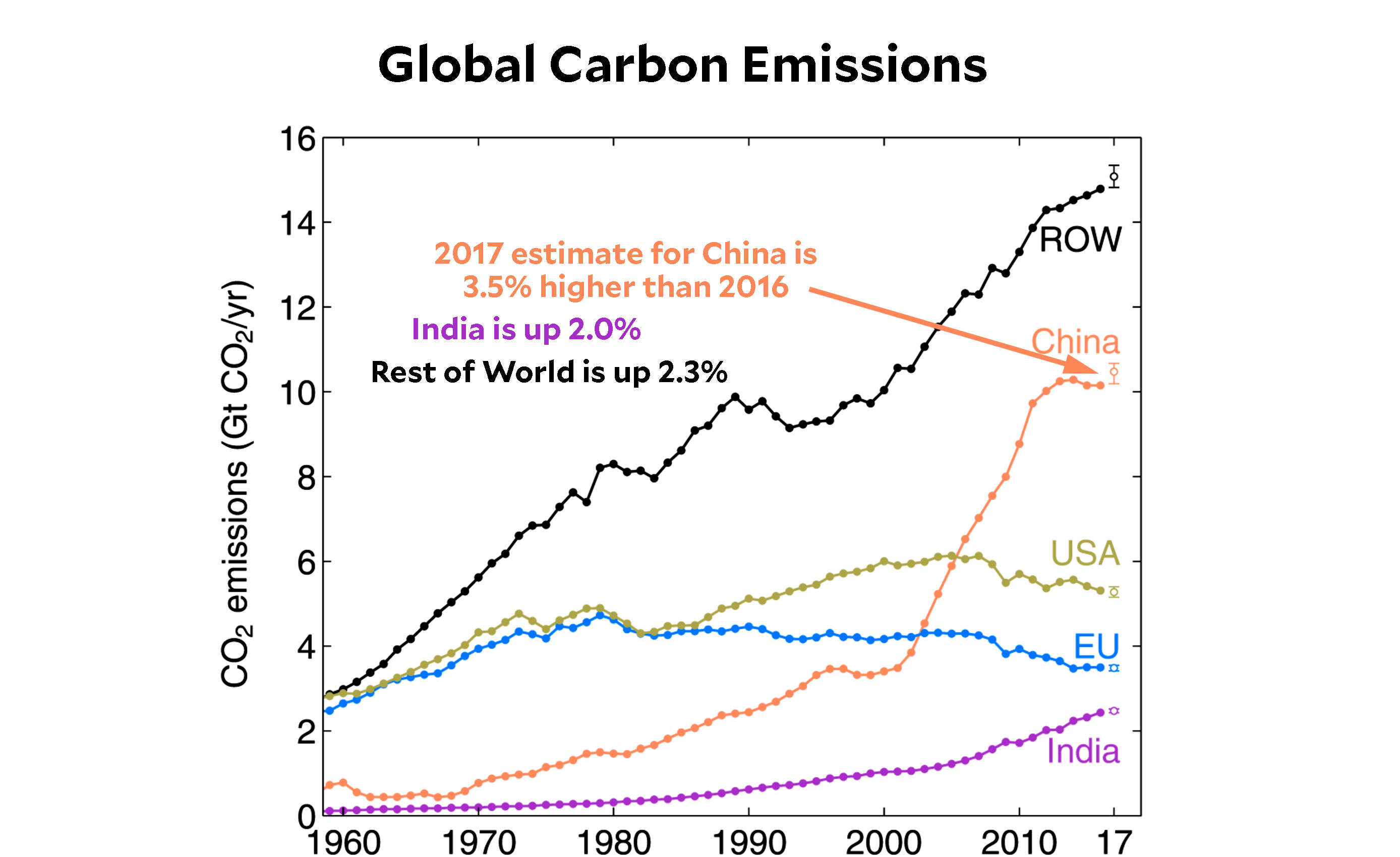
Both the EU and the US have been reducing carbon emissions for the past decade, and so has China for the past couple of years. But China is projected to rise a lot this year, and the combined rise of China, India, and ROW are more than enough to counter the small reductions from the EU and US.
Wimberley thinks this is most likely a blip, and China will return to slow or no growth in the near future. I’m a little less confident, since I read Chinese domestic politics a little differently than he does. But I hope he’s right.
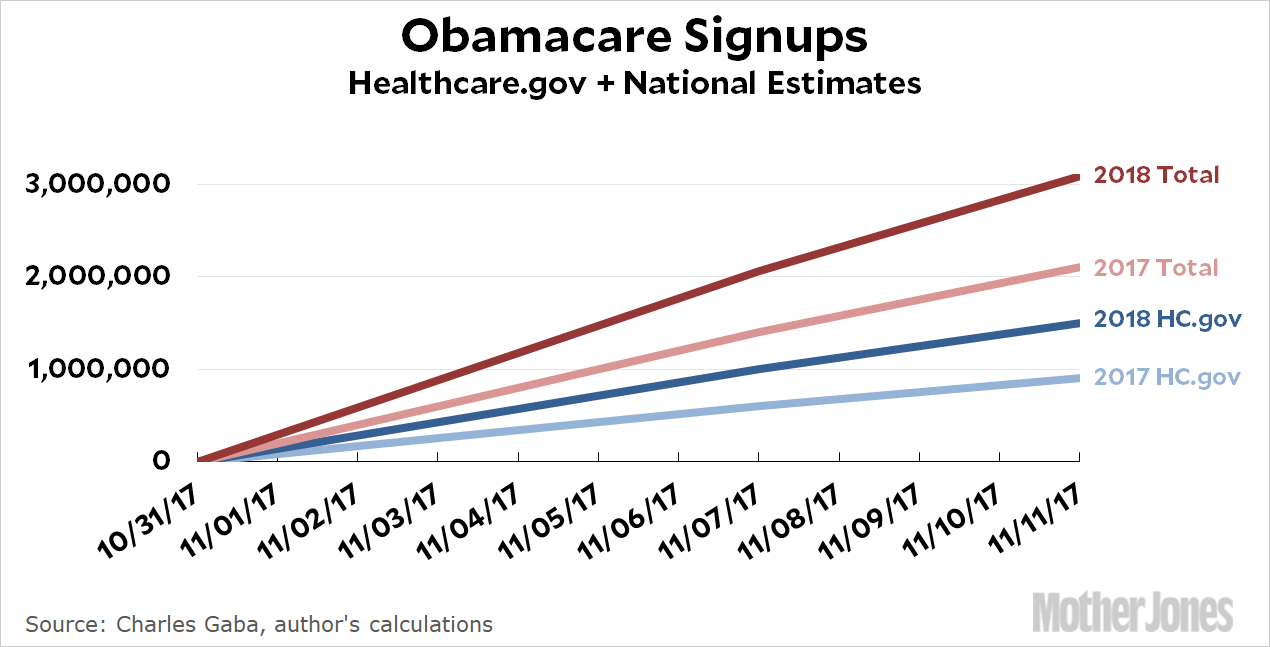
Healthcare.gov enrollment has surged at least 47 percent higher than during the same period last year, CMS announced yesterday. Nearly 1.5 million Americans selected plans on Healthcare.gov in the first 11 days of the sign-up period — a shockingly high number that has surprised just about everyone, given that the administration whittled down the advertising budget touting the open enrollment window by 90 percent.
If you figure that signups on the state exchanges are also up 47 percent from last year, then about 3 million people have signed up so far. I know you’re itching to see this in chart form, so here it is through November 11:
Why are signups so far ahead of last year? No one knows. Maybe word of the shortened signup period was widespread, and lots of people are rushing to enroll quickly. Maybe months of trying to kill Obamacare acted as good advertising (in the “say anything you want, just spell my name right” sense). Maybe liberals are beating the bushes extra hard to sign people up.
The big question is whether this surge is enough to match last year’s enrollment even with the short signup period. It will be a while before we know that.
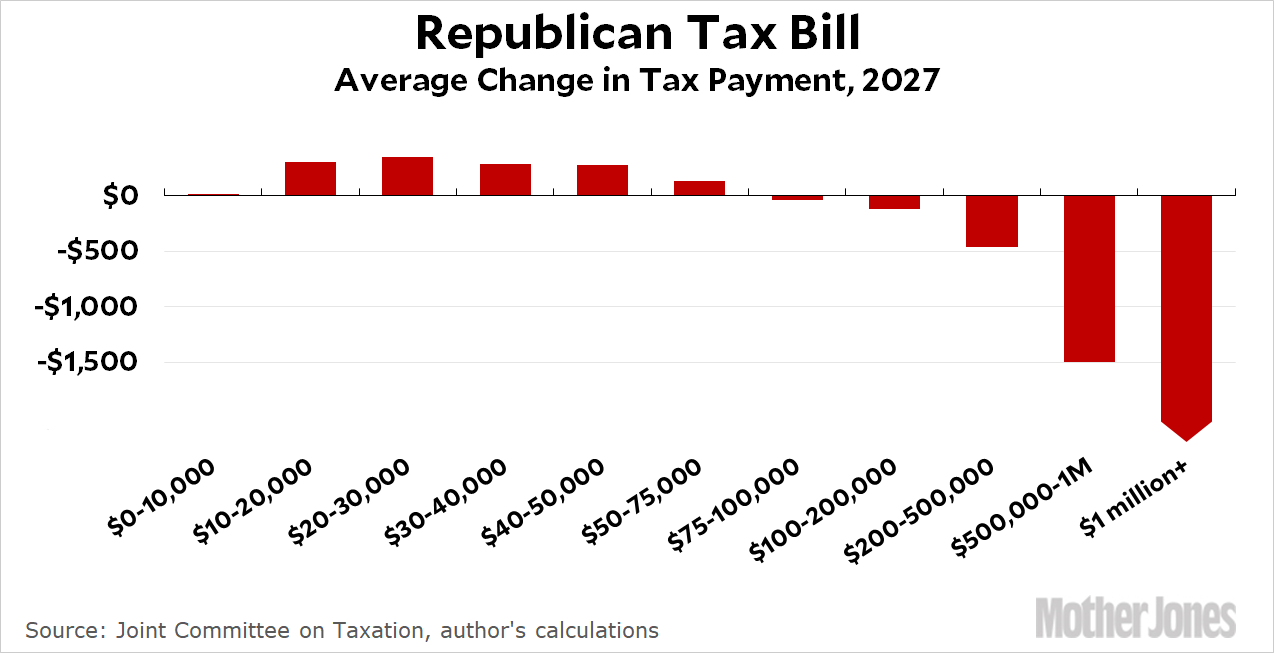
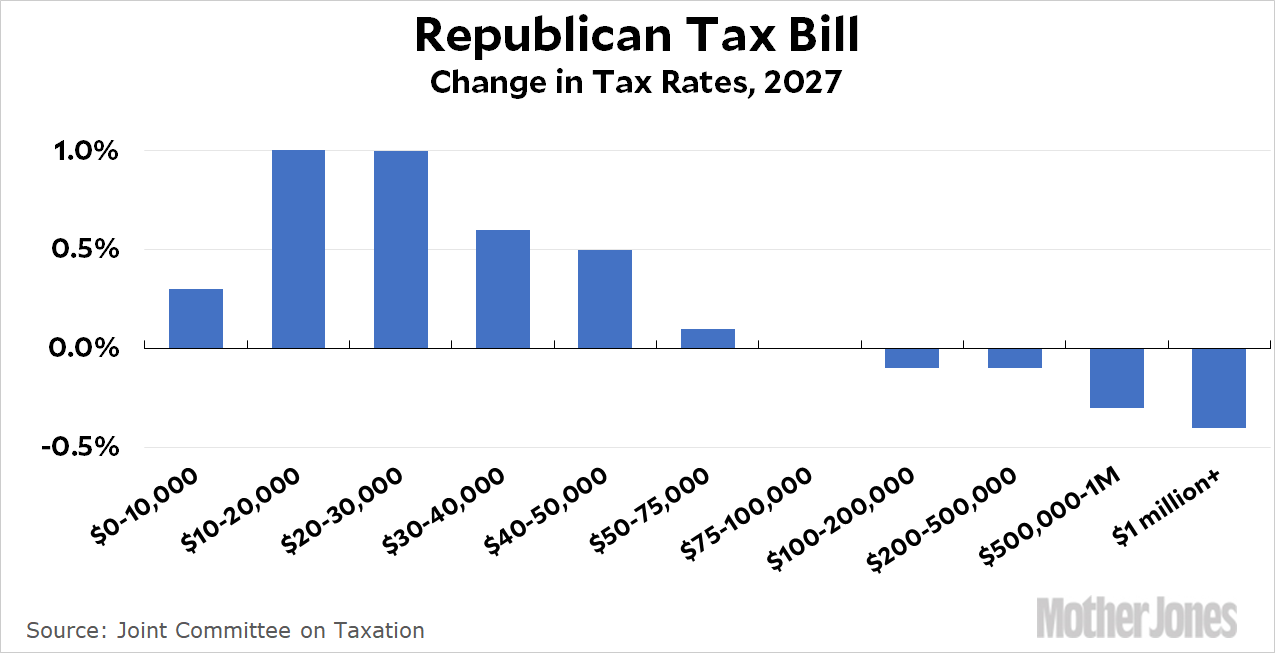
This is not a typo. By 2027, middle-class taxpayers will, on average, pay about $400 more than they would under current law. The rich will pay several thousand dollars less. Here are the changes in tax rates:
Have Republicans gone crazy? They can’t seriously be thinking of passing this thing, can they?
UPDATE: I’ve changed the top chart because it was confusing. JCT calculates the total amount that each income class will pay, and unless you look at the chart closely it appears that a middle-class taxpayer will pay $4-8,000 more in taxes. In fact, they will collectively pay $4-8 billion more. I’ve divided each income class by the number of households in the class to get an average per household.¹ This is what the new chart shows.
¹It’s actually the average per “tax unit,” but it’s pretty much the same thing.
Yesterday I was in a quandary: how, oh how, will Republicans manage to keep their tax bill from increasing the deficit in 2028 and beyond, as required by Senate rules? One possibility has always been to make the tax cuts temporary, like the Bush tax cuts, but that seemed like a nonstarter. After all, it makes no sense to enact temporary corporate tax cuts. Businesses need to plan ahead and they need to know what the tax landscape is going to look like.
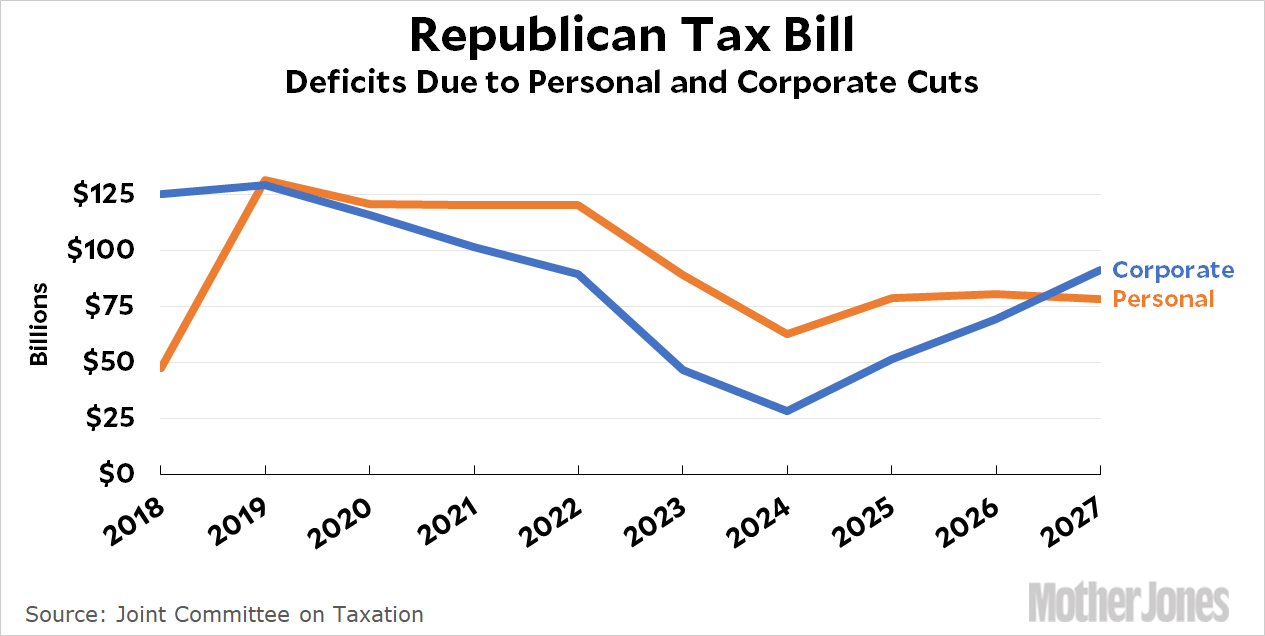
But wait! The tax bill isn’t all corporate tax cuts. There are also personal tax cuts. Here’s what they look like if you disaggregate them:
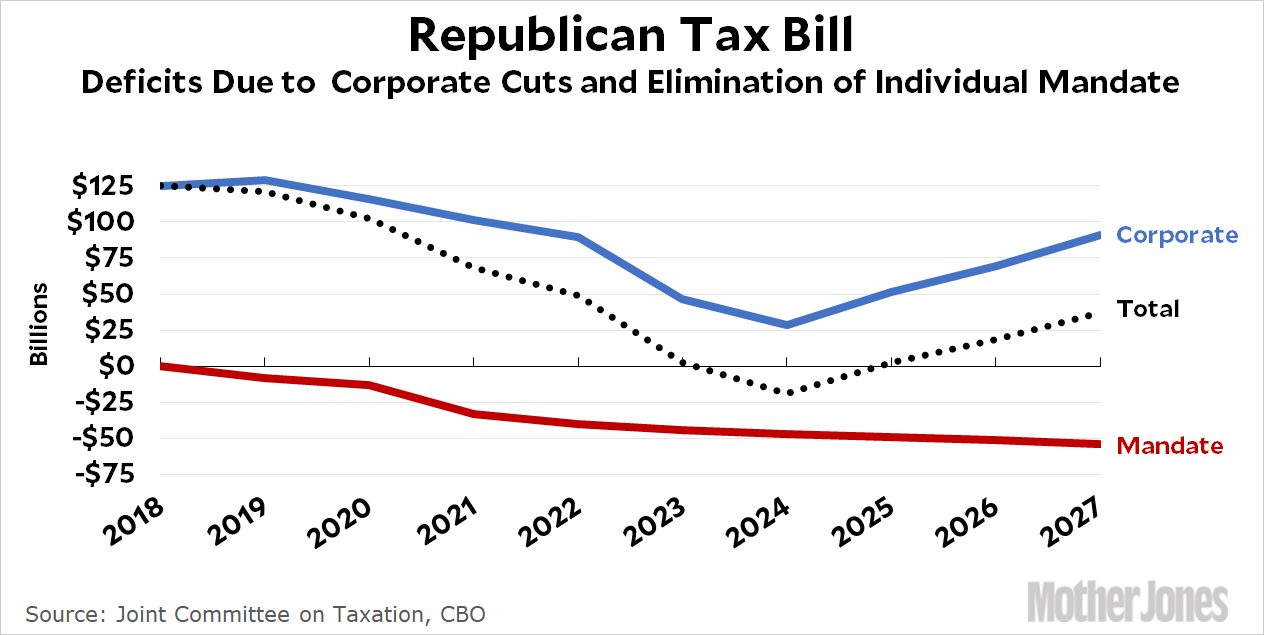
Hmmm. What if you kill off the personal tax cuts in 2026? That cuts your deficit in half. Progress! But we need more. CBO estimates that eliminating Obamacare’s individual mandate would save some money, so let’s pencil that out:
Look at that! Now the total deficit in 2027 is only $37 billion. That’s totally manageable with a bit of creativity. Maybe some spending cuts on the poor would do the trick. Or a bit of fiddling with some of the details of the corporate rate cut. Or some chained-CPI inflation gimmickry.
So that’s where we are. Republicans plan to make the personal tax cuts temporary and to eliminate Obamacare’s individual mandate. This means the middle class goes from getting a pittance to getting nothing to getting actively screwed because their Obamacare premiums will go up. If Republicans are wondering why a large majority of Americans think their tax plan favors the rich at the expense of the middle class, this is why.
UPDATE: The labels on the top chart were switched when this was first posted. They are now correct.
Nelson Peltz has just won election to the board of Procter & Gamble by a margin of 50.001 percent to 49.999 percent. Is this the closest election ever in corporate history? Or in the history of elections altogether?
Whenever we rode the tube in London I snapped pictures of the people sitting directly across from me. The result is “Tube People.” This is humanity in the raw, folks.
“I am no fan of the individual mandate and I very much want to see tax reform,” she said slowly and carefully. “But I believe taking a particular provision from the Affordable Care Act and appending it to the tax bill greatly complicates our efforts. One of my concerns is that it will cause premiums in the individual markets to go up as healthier, younger people drop out.”
“I have new statistics,” Collins added, patting a thick black binder under her arm, “that show that for some middle-income people, it will cancel out their tax cut. The increased premium would be more than the tax reduction they would get from this bill.”
According to CBO, eliminating the individual mandate will increase premiums about 10 percent. Just think of this as the GOP’s little tax increase on everyone with the gall to buy health insurance via Obamacare.
Mnuchin holds a sheet of new $1 bills, the 1st currency bearing his + U.S. Treasurer Jovita Carranza’s signatures, via @Jacquelyn_Mpic.twitter.com/ygSJssM9wq
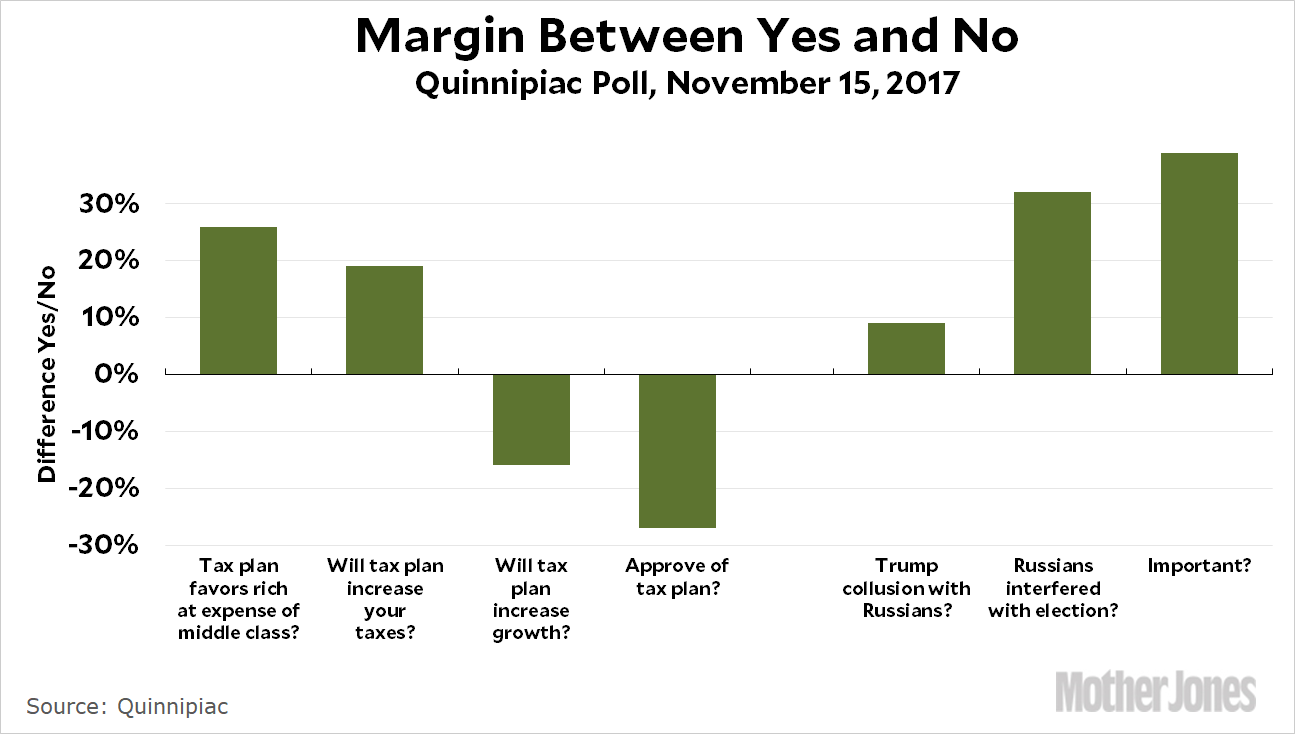
Quinnipiac called the Virginia governor’s race spot on, so it’s worth taking a look at their latest national poll. Here it is:
The Republican Party brand relies on two things: cutting taxes and being tough on national security. According to Quinnipiac, they’re squandering both. By large margins, people think the Republican tax plan favors the rich and will likely increase their own taxes. By equally large margins, they don’t think the tax plan will increase growth and they don’t approve of it.
Similarly, most people think the Russians interfered with the election and most people think it’s important. By itself that’s not a problem, but a smallish majority think the Trump campaign colluded with them. What’s more, people think Trump probably did something either illegal or unethical by a whopping 22 percent margin (57-35). And they think the same about Trump’s advisors by an astonishing 51 percent margin (71-20).
Needless to say, these results are massively partisan. The reason Republicans are losing so badly is because independents mostly side with the Democratic point of view. Republicans are badly losing the middle of the electorate these days.
And we respect that! But maybe you’re of a mind to support our work directly instead? We have until December 31 to raise the last $400,000 we need to keep our nonprofit newsroom running at full strength into 2026. Will you make a gift today?
We noticed you have an ad blocker on. Can you pitch in a few bucks to help fund Mother Jones' investigative journalism?
Billionaires own the media,
but they don’t own us.
At Mother Jones we know these aren’t conventional times, and they require unconventional coverage. That’s what deliver every day: fierce, independent journalism you can’t find elsewhere. Perhaps never in the history of our country has that been more necessary than now. But we can’t do it without reader support—your support. Please chip in today.
Billionaires own the media,
but they don’t own us.
At Mother Jones we know these aren’t conventional times, and they require unconventional coverage. That’s what deliver every day: fierce, independent journalism you can’t find elsewhere. Perhaps never in the history of our country has that been more necessary than now. But we can’t do it without reader support—your support. Please chip in today.