• Why Are Corporations So Damn Profitable These Days?

    This is a fairly long and abstruse post about the increasing market power of corporations, so I want to get it in before it’s Trump O’Clock and our president declares war on penguins or something. So here we go.

    In economics, the “labor share” is the percentage of total national income that goes to compensate employees. It’s been declining in fits and starts since the mid-70s, falling from about 65 percent to 60 percent of total income.

    So this means the capital share of total income is going up, right? Oddly enough, no. As with the labor share, it’s gone up and down in fits and starts, but since the mid-70s it’s declined from about 27 percent to 21 percent.

    Here’s what the sum of labor and capital shares looks like since 1975:
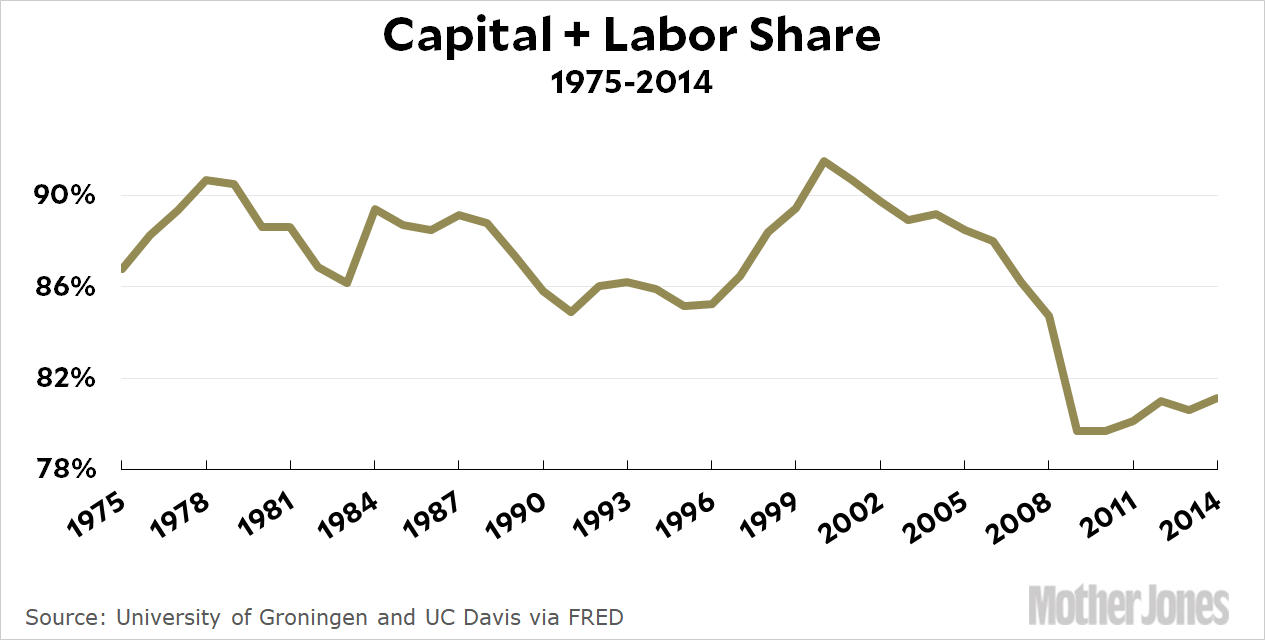
    The fits and starts mostly cancel out, with total capital + labor shares humming along at roughly 87 percent, with a bit of a spike upward during the dotcom boom of the late 90s. But then they both tumble, with the aggregate of both shares falling from about 91 percent to 80 percent. This means that something else has gone up from 9 percent to 20 percent since 2000. What?

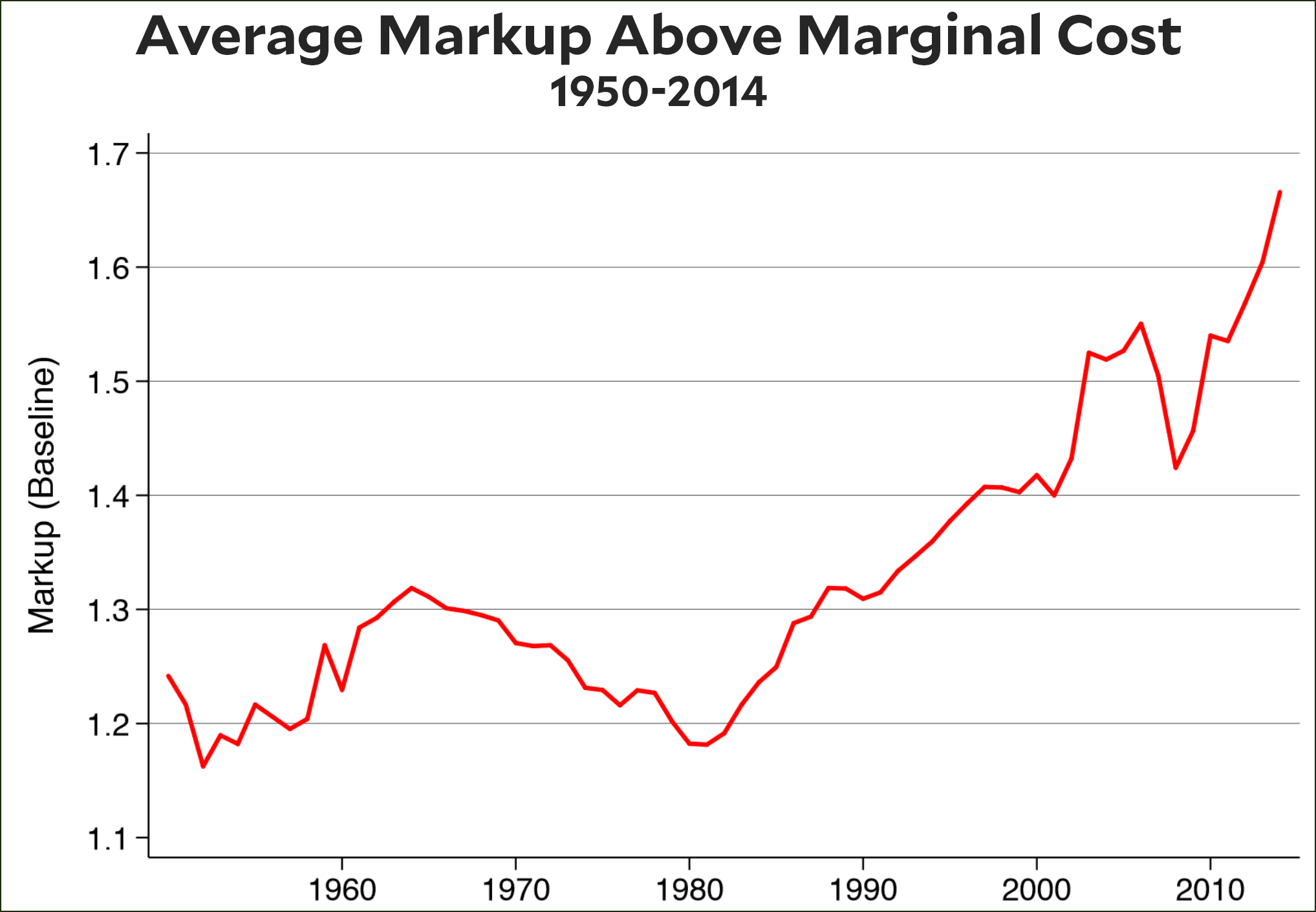
    The profit share. Companies have become immensely more profitable over the past two decades. But how has this happened? In a new paper, a pair of researchers painstakingly reconstruct the size of corporate markups, and they conclude that the average firm now charges 67 percent over its marginal cost compared to 18 percent in 1980:
    You will be unsurprised to learn that higher markups lead to higher profits and hence higher dividend payouts to shareholders:
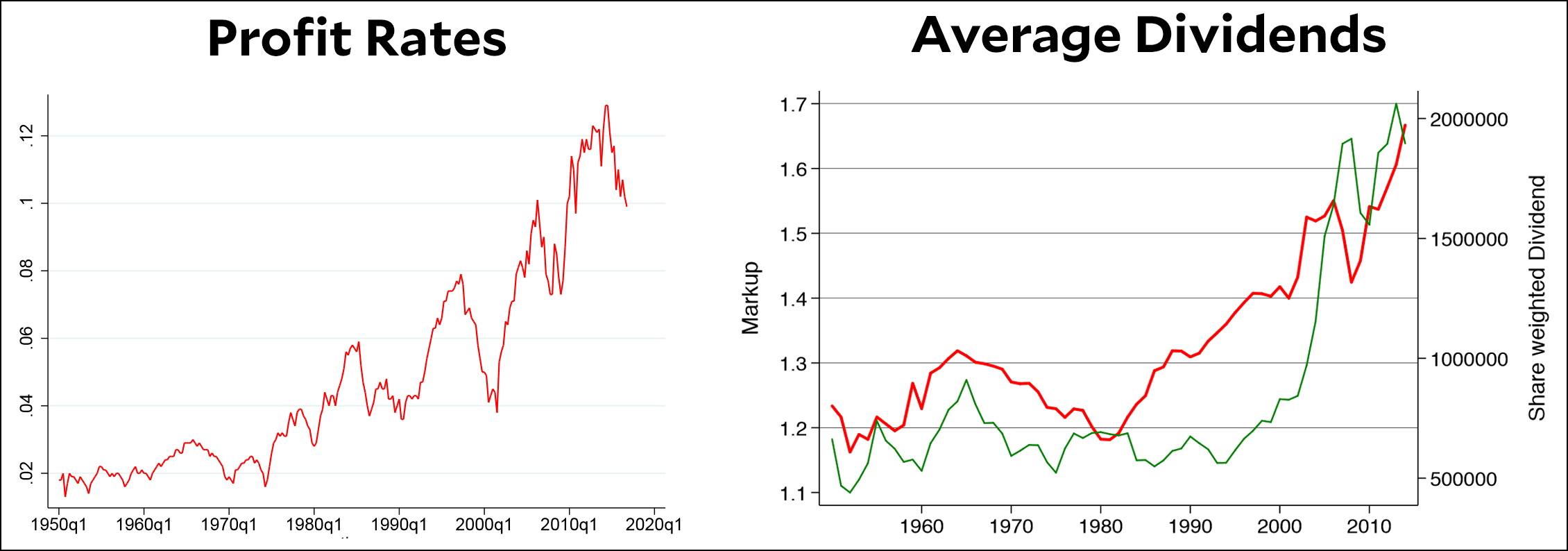
    The rise in profits implies an increase in market power, and the authors suggest that increased market power plus increased markups can explain a lot of recent economic trends:

    • The decline of low-skill wages. “Nominal wages…are lower for higher market power…But real wages are even lower….Even under perfectly elastic labor supply where nominal wages are constant, real wages are decreasing in market power.”
    • The decline in labor force participation. “[The rising number of women in the labor force] leveled off in the mid 1990s, which is consistent with the fact that we start to see the impact of a decrease in the total labor force participation due to the rise in market power.”
    • The decline in labor flows (people switching jobs, or moving from unemployment to employment). The authors note that firms have become less responsive to productivity shocks in recent decades: “If the distribution of idiosyncratic shocks remains unchanged, then the responsiveness of the labor input and therefore the transmission of shocks will lead to a decrease in job flows as market power increases.”
    • The decline in people moving to different regions to find jobs. “If firms are based in different local labor markets and a fixed fraction of all job relocation
      decisions are between local labor markets, then lower job flow rates will automatically give rise to lower migration rates.”
    • The slowdown in GDP growth. The authors say this is an artifact of a mismeasurement of productivity growth: “We find that except for a dip around the great recession, productivity actually increases and hovers around 3 to 4% after the 2000….This indicates that properly accounting for market power, there is no productivity slowdown but instead an increase in productivity.”
    • Higher inflation than we’d otherwise have. “This is surprising given the low inflation rates in the last decades—and particularly low ones since the great recession. Of course, monetary policy is not the appropriate policy tool to remedy that source of inflation. That would be the prerogative of anti-trust policy.”
    • An overvalued stock market. “In the presence of market power, the stock market is therefore not a good gauge of an economy’s output.”

    Why have firms gained so much more market power? The authors offer several possibilities: “The rise of merger & acquisition activity, deregulation, the higher share of network goods, the increase in wholesale transaction, private equity, improved product differentiation, increased vertical and financial integration of competitors. A common factor in each of these is technology. Rapid technological change allows firms to better create and preserve situations of market power.”

    This post has been long and intricate, and I can’t even offer an independent judgment of whether this paper has merit. It’s just too complicated for me. But if the authors are right, it’s yet another reason to be disturbed by the collapse of antitrust and the growth of megafirms over the past few decades. Always remember: Competition is good. Competition is good. Competititon is good.
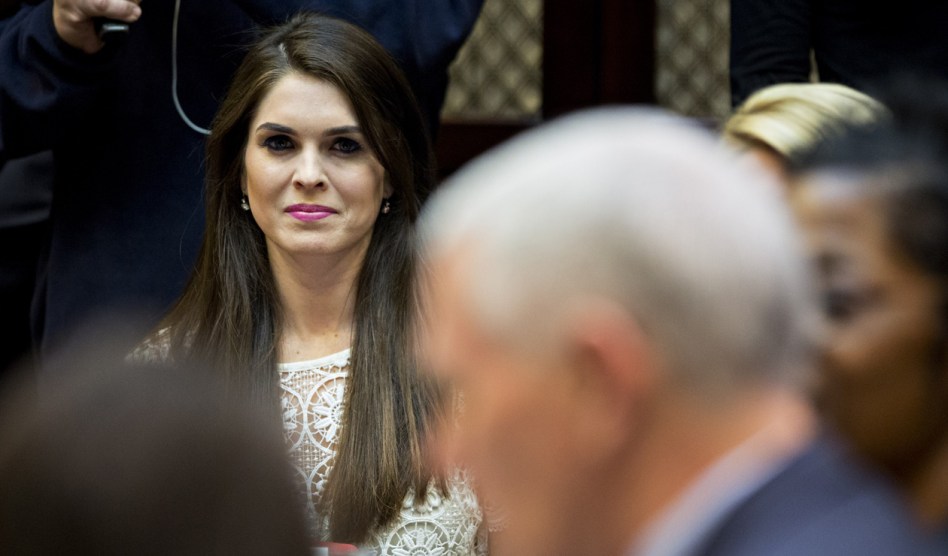
  • Report: Hope Hicks Named New White House Communications Director

    Andrew Harrer/CNP via ZUMA

    The Daily Caller says the White House will soon have a new communications director following the short, ignominious career of Anthony Scaramucci:

    President Trump has offered the job to [Hope] Hicks and she has accepted the position, according to a White House insider. Hicks has been close by Trump’s side since the early days of the campaign and is one of his most trusted staffers. She has been serving on the press team in more of a behind-the-scenes role as the director of strategic communications.

    Trump sure could have saved himself some trouble by just doing this a couple of months ago.

    MORNING UPDATE: The Caller blew it. Hicks is getting the job only on an interim basis while the White House searches for a permanent replacement for Scaramucci.

  • The Real Story Behind All Those Confederate Statues

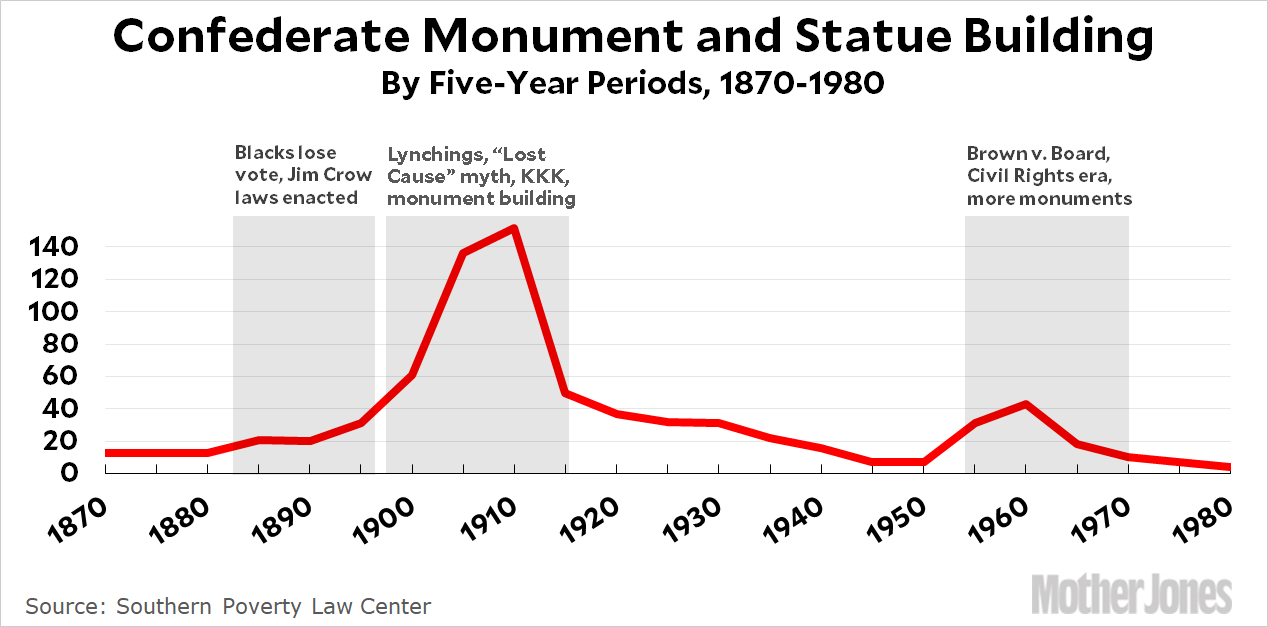
    Vox points me today to some data I was looking for last night. Thanks, Vox! It’s from the Southern Poverty Law Center, and it shows us when all those Confederate monuments and statues were erected:

    This illustrates something that even a lot of liberals don’t always get. Most of these monuments were not erected right after the Civil War. In fact, all the way to 1890 there were very few statues or monuments dedicated to Confederate leaders. Most of them were built much later. And since I’m not an academic, I feel comfortable squeezing this history into a very short, oversimplified summary:

    1861-1865: Civil War.

    1865-1875: Reconstruction Era.

    1875-1895: Reconstruction Era ends. Lynchings skyrocket. Blacks are steadily disenfranchised, allowing Southern whites to enact Jim Crow laws. In 1896, Jim Crow is cemented into place when the Supreme Court rules it constitutional.

    1895-1915: With blacks disenfranchised and Jim Crow laws safely in place, Southern whites continue their campaign of terror against blacks. This era features continued lynchings, the growing popularity of “Lost Cause” revisionist histories, a resurgence of white supremacy organizations like the KKK, and the erection of Confederate statues and monuments in large numbers.

    1915-1955: Jim Crow reigns safely throughout the South.

    1955-1970: The civil rights era starts after the Supreme Court rules in Brown v. Board of Education that Jim Crow laws are unconstitutional. Southern whites mount massive and violent resistance, and start putting up Confederate monuments again.

    Yes, these monuments were put up to honor Confederate leaders and soldiers. But the timing of the monument building makes it pretty clear what the real motivation was: to physically symbolize white terror against blacks. They were mostly built during times when Southern whites were engaged in vicious campaigns of subjugation against blacks, and during those campaigns the message sent by a statue of Robert E. Lee in front of a courthouse was loud and clear.

    No one should think that these statues were meant to be somber postbellum reminders of a brutal war. They were built much later, and most of them were explicitly created to accompany organized and violent efforts to subdue blacks and maintain white supremacy in the South. I wouldn’t be surprised if even a lot of Southerners don’t really understand this, but they should learn. There’s a reason blacks consider these statues to be symbols of bigotry and terror. It’s because they are.

  • Donald Trump Goes Berserk Over Charlottesville, Doubles Down on “Both Sides Are Bad”

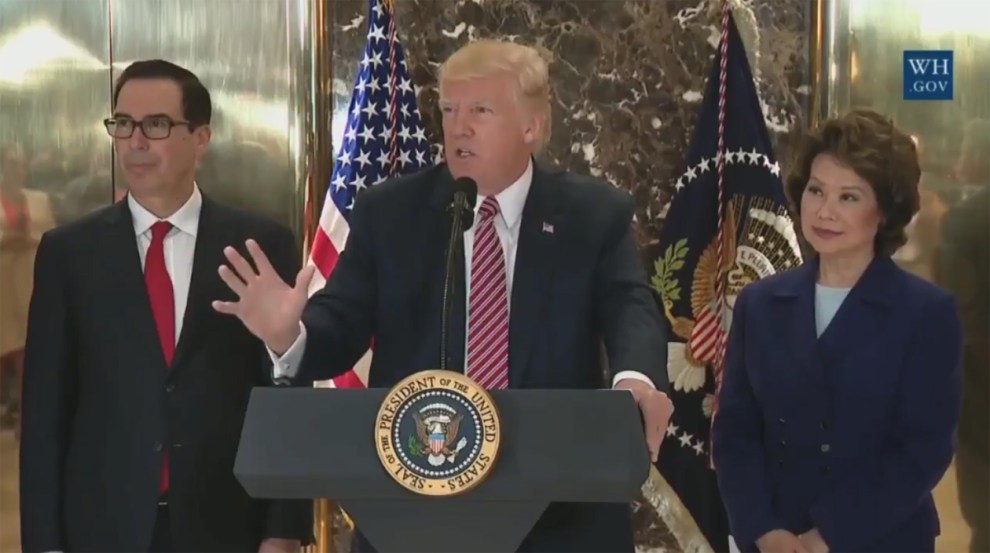
    After being forced to make a statement condemning neo-Nazis yesterday, Donald Trump went berserk today at a press conference that he hoped would be about infrastructure. First up: Why did he wait so long to make a statement?

    I want to know the facts….As I said — remember this, Saturday — “we condemn in the strongest possible terms this egregious display of hatred, bigotry and violence. It has no place in America,” and then I went on from there….So, making the statement when I made it was excellent.

    “And then I went on from there.” Uh huh. Even though he was reading from a printed version of his remarks that he pulled out of his pocket, Trump somehow forgot the part where he said “on many sides, on many sides.” Trump didn’t condemn white nationalists, he just condemned violence and hatred in general. Next question: did he miss an opportunity to bring the country together?

    Not at all. I think the country — look, you take a look. I’ve created over a million jobs since I’m president. The country is booming, the stock market is setting records. We have the highest employment numbers we’ve ever had in the history of our country. We’re doing record business. We have the highest levels of enthusiasm….I had to see the facts, unlike a lot of reporters — unlike a lot of reporters. I didn’t know David Duke was there. I wanted to see the facts, and the facts as they started coming out were very well-stated. In fact, everybody said, “His statement was beautiful. If he would have made it sooner, that would have been good.” I couldn’t have made it sooner because I didn’t know all of the facts.

    The economy is doing great! So who cares if David Duke was there? Next question: what do you think of the alt-right? At this point, Trump is getting pretty red in the face:

    What about the alt-left that came charging at the alt-right? Do they have any semblance of guilt? What about the fact they came charging with clubs in their hand? Do they have any problems? I think they do….Wait a minute, I’m not finished, fake news….You had a group on one side that was bad and you had a group on the other side that was also very violent, and nobody wants to say that.

    Yeah, what about the counter-protesters? Nobody ever wants to say that the people who are against racism are really bad too. Luckily, Donald is around to speak truth to power. Next question: is the alt-left really equivalent to neo-Nazis?

    Not all of those people were neo-Nazis, believe me. Not all of those people were white supremacists, by any stretch. Those people were also there because they wanted to protest the taking down of the statue of Robert E. Lee….So this week it’s Robert E. Lee….I wonder, is it George Washington next week, and is it Thomas Jefferson the week after? You really do have to ask yourself, where does it stop?

    But the neo-Nazis started it, right?

    You had some very bad people in that group. But you also had people that were very fine people, on both sides….You had many people in that group other than neo-Nazis and white nationalists, and the press has treated them absolutely unfairly.

    Um, but what about the rally on Friday night?

    I looked the night before. If you look, there were people protesting very quietly the taking down of the statue of Robert E. Lee….You had a lot of people in that group that were there to innocently protest, and very legally protest, because I don’t know if you know, they had a permit, the other group didn’t have a permit…..There are two sides to a story.

    That rally was organized by Richard Spencer, a leader of the alt-right. Here’s the Washington Post’s report:

    “Stay in formation!” barked an organizer carrying a bullhorn. “Two by two! Two by two!” Within minutes, marchers lit their torches. Additional organizers, wearing earpieces and carrying radios, ran up and down the line shouting directions.

    “Now! Now! Go!” The marchers took off at a brisk pace and immediately began yelling slogans: “Blood and soil!” “You will not replace us!” “Jews will not replace us!”

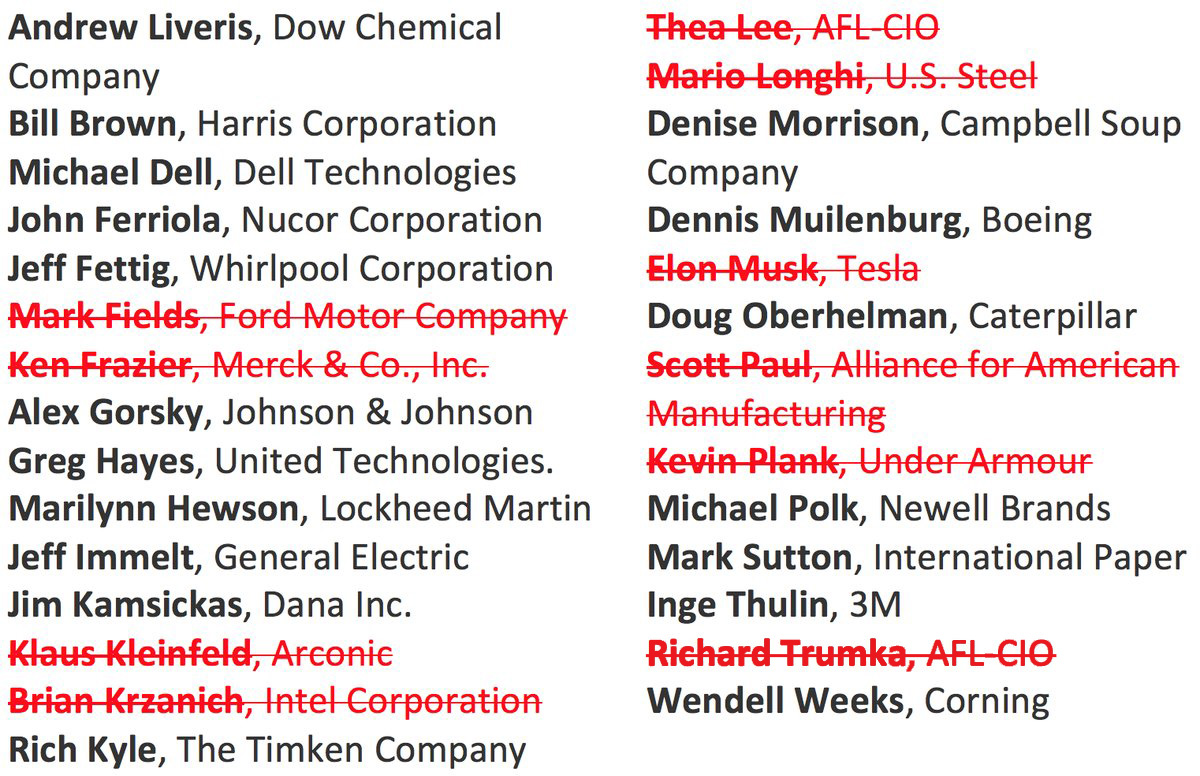
    That sounds pretty quiet and innocent, all right. What a disgrace. And speaking of that, here’s the latest list of CEOs who have quit Trump’s manufacturing council:

    If there’s a single name left on this list by the end of the day, their board should immediately fire them for gross stupidity and obtuseness.

  • Lunchtime Photo

    How about some insect blogging today? My sister is unhappy with this choice, but we had some very handsome praying mantises in the garden a few days ago and I’ve got the pictures to prove it. They’re pretty fascinating critters close up, and they have the good grace to sit still for the camera instead of flitting all over the place. That makes them OK in my book.

  • Chart of the Day: Killing CSR Subsidies Will Cost $194 Billion—But Maybe That’s a Good Thing

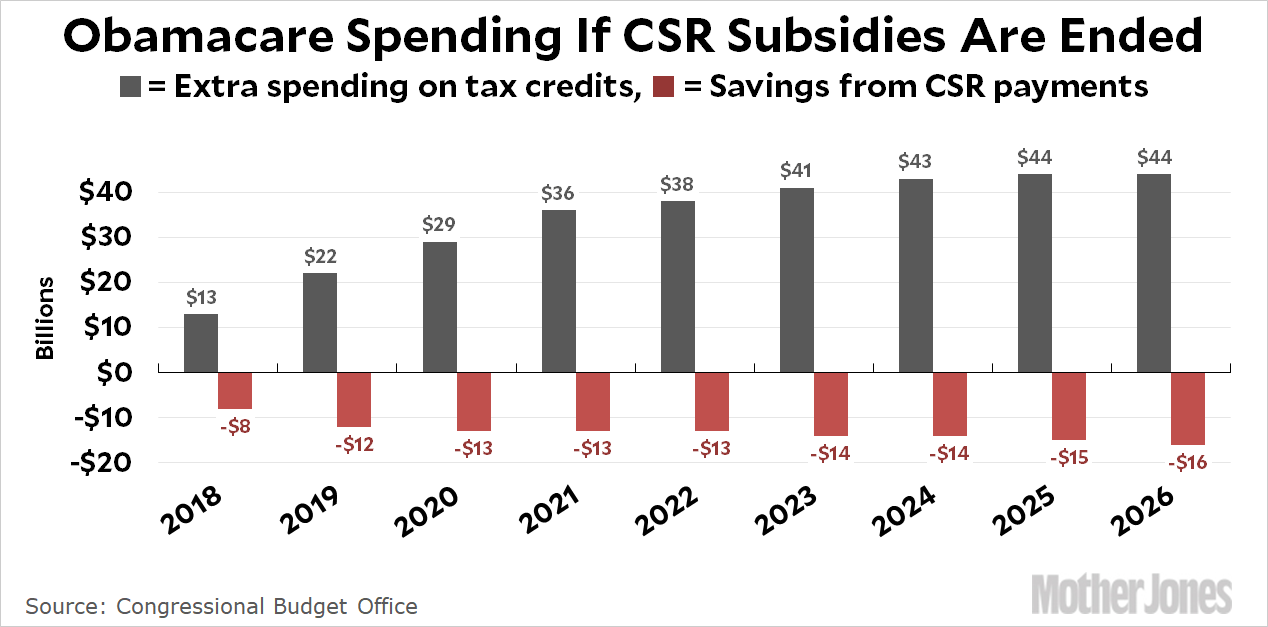
    Here’s one of the most remarkable charts you’re ever likely to see:

    This comes from a new CBO report on the likely effects of eliminating Obamacare’s CSR subsidies. Basically, the federal government would save money by not paying the CSR subsidies but lose money by paying more in tax credits to poor families. The net result would be more spending on Obamacare. Here are the effects that CBO forecasts:

    • Net increased spending over the next decade. Once spending and revenue effects are accounted for, net spending over the next decade would increase by $194 billion.
    • A small and temporary reduction in the number of people covered.
    • A small and temporary increase in the number of areas with no insurers.
    • A variable effect on net premiums within the Obamacare marketplaces. Generally, the cost of a silver plan would go up, while the cost of bronze and gold plans would go down, but tax credits would also go up and down. The overall effect would probably be moderately positive, though there would be both winners and losers at different age and income levels.
    • No effect for people who buy outside the marketplaces: “CBO and JCT expect that silver plans would be offered with gross premiums about the same as those charged under the baseline because insurers would design slightly different products for sale there and could therefore price them differently than the plans sold in the marketplaces. Plans outside the marketplaces could be attractive to younger people whose premiums were not a large enough percentage of their income to qualify them for tax credits.”

    If CBO is correct, the remarkable conclusion is this: maybe we should kill the CSR subsidies. For Donald Trump, threatening to eliminate CSR is a cynical attempt to garner scary headlines about premium increases, which help him pretend that Obamacare is doomed. But as CBO makes clear, Obamacare will continue to work fine with or without CSR payments, and the premiums people actually pay after tax credits wouldn’t change much. In fact, net spending on Obamacare subsidies would increase, and it’s quite likely that more people would benefit than would be hurt.

    POSTSCRIPT: The cynic in me thinks that once Republicans understand what the CBO report actually says, they will suddenly get very enthusiastic about reinstituting CSR subsidies. I will be waiting with bated breath to see if that’s the case.

  • Goldberg: Conservatives Sold Out to Racism In Order to Win

    Jonah Goldberg is fed up:

    Last year around this time (and the year before that), I was arguing with some of my fellow conservatives about the insanity of finding any common cause whatsoever with the so-called alt-right. The issue wasn’t that every avowed nationalist who claimed membership in the alt-right was a Nazi or Klansman. It was that the alt-right was open to Nazis and Klansmen. And why wouldn’t these newly-minted white supremacists welcome such pioneering organizations to their cause? Right-wing cynics, hucksters and opportunists deliberately blurred these distinctions in the name of a right-wing popular front.

    ….The real threat to traditional conservatism is the mind-set that made it possible to form even a theoretical alliance with the alt-right in the first place: the idea that winning and fighting are self-justifying….During the campaign, when Trump attacked the ethnicity of an American judge or the parents of a fallen Muslim U.S. soldier, the response from his defenders on the right was usually “at least he fights!” Such amorality was warranted, many explained, because if Clinton had won, America would be “over.”

    ….I’d point out that such thinking could invite the worst and most opportunistic creatures to infiltrate the movement. Except they already have.

    I don’t expect conservatives to become liberals just because Trump is such an odious creature. Why should they? But I wish there were more like Goldberg who were willing to acknowledge head-on the cynical racial alliances conservatives have made to gain power. It doesn’t start with Trump by any means, but calling out Trump and the alt-right for what they are is at least a start.

  • Sure, There Were Some Obama-Trump Voters. Who Cares?

    Procopio/Fotogramma/Ropi via ZUMA

    Nate Cohn addresses the question of Obama voters who switched to Trump in 2016:

    The story of the 2016 presidential election is simple. Donald J. Trump made huge gains among white voters without a college degree. His gains were large enough to cancel out considerable losses among well-educated white voters and a decade of demographic shifts.

    This is true, but I’m not sure it’s interesting. In every election where the parties switch power, there are some folks who voted for the old party four years ago but decided to vote for the other party this time. This is almost by definition. So sure, there were Obama-to-Trump voters in 2016, just as there were Bush-Obama voters in 2008 and Clinton-Bush voters in 2000.

    Nor was the white vote all that interesting in 2016. Four years ago, as Republicans were passing voter ID laws in a desperate attempt to squeeze the last possible juice out of racial vote mongering, I figured the jig was up. There just wasn’t anything left they could do to get even more white votes. But they sure tried! By nominating Donald Trump, who ran the most overtly race-conscious campaign since Nixon, they hoped to squeeze just a little more out of their white base. But it didn’t work. The problem is the one I and everyone else identified in 2012: as racial appeals get more explicit, you lose as many college-educated whites as you gain working-class whites. In the end, Trump got almost exactly the same percentage of the white vote as Mitt Romney.

    But this doesn’t mean Cohn is wrong. Two things turned the tide for Trump. First, of course, was the Comey letter, which moved 2-3 percent of the vote in every state. Without that, Trump loses. The second is the fact that, to everyone’s surprise—including Trump’s—there were a few states where the gains among working-class whites were bigger than the losses among college-educated whites. Without the Comey letter that wouldn’t have mattered much, but with the Comey letter it did. So those states voted for Trump by razor-thin margins, and they were just enough for him to win the election.

    The question is whether there are any broad lessons to be learned here, and I’m not sure there are. The background of the 2016 election was increased tribalism: at this point, pretty much any Democrat can count on 45 percent of the vote and pretty much any Republican can count on 45 percent of the vote. It doesn’t matter who it is. This is why the race was close even though a buffoon like Trump was running. Every presidential election is balanced on a knife-edge these days: a difference of a few percent in half a dozen states is all it takes to turn victory into defeat.

    The 2016 race was always going to be close. Given the tribalism of politics today; the fact that Democrats had been in power for eight years; and the so-so economy, it was a 50-50 affair from the beginning. It should have tipped Clinton’s way, but it didn’t thanks to the Comey letter and a chance alignment of the white working-class vote in a few states. It’s hard for me to see any big lessons for the future here.

    If it were up to me, we’d never talk about this again. The problem for Democrats isn’t the presidency. The problem for Democrats is everything else. That’s what they should be talking about.

  • Asking For a Friend: What Does It Take to Pull Down a Statue?

    Go Nakamura via ZUMA

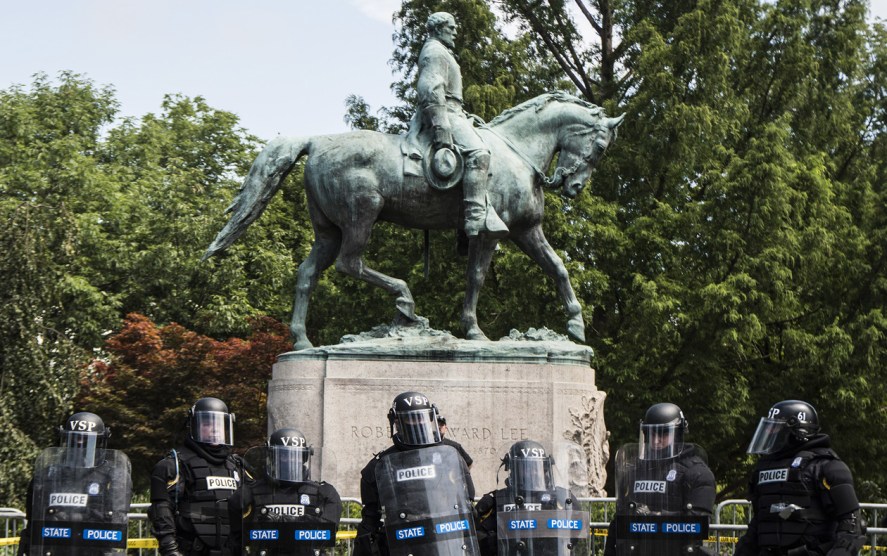
    I have an engineering question. As we all know, the violence this weekend in Charlottesville originated in a proposal to move a statue of Robert E. Lee that was erected in 1924. That got me wondering: what does it take to pull down a statue like that? If I had, say, a big pickup truck, could I tie a cable around the statue, attach it to the trailer hitch, and gun the engine? Would that bring it down? How about two pickup trucks? Or does it take a lot more power than that?

    How about smaller statues? Would it work on them? It would be illegal and potentially dangerous, of course, so probably it’s better for cities to just take down the statues on their own.

    But I’m still curious.

  • What Does It Take For Conservatives to Acknowledge That Donald Trump Is Racist?

    Protesters by Rex Shutterstock via ZUMA

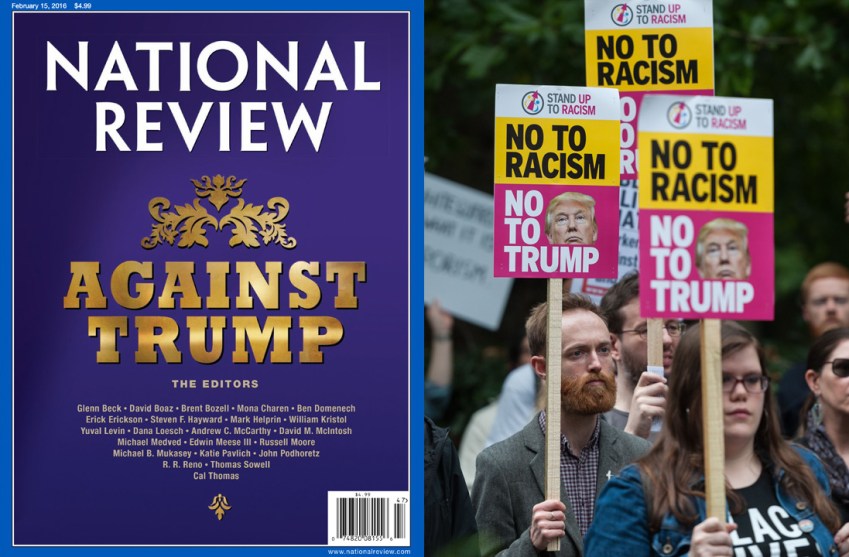
    Last night National Review posted an editorial calling on President Trump to be more forthright in his denunciation of the neo-Nazi violence in Charlottesville: “It is important that he…call this what it is: an act of terrorism conducted under the auspices of a white-supremacist movement that has embraced terrorism and political violence.” That’s fine. But then they added this:

    This is somewhat awkward for President Trump because the cracked and malevolent young men raging about “white genocide” are his people, whether he wants them or not. Let us be clear about what we mean by that: President Trump obviously has defects and shortcomings as a political leader, but we do not believe for a second that those failures include a sneaking anti-Semitism or a secret taste for neo-Confederate revanchism. At the same time, he has made common cause with those who have flirted with those elements for political and financial gain.

    In January of last year, during the Republican primary race, NR famously headlined an entire issue “Against Trump.” But it was a funny thing. The lead editorial laid out all sorts of reasons Trump was unfit for office, but neither his racism nor his tolerance for racism were among them. The issue also included short pieces from 22 well-known conservatives who opposed Trump. Of these 22, only one, libertarian David Boaz, explicitly called out Trump’s racism (“Not since George Wallace has there been a presidential candidate who made racial and religious scapegoating so central to his campaign”).¹

    Since then, we’ve seen Trump repeatedly refuse to condemn David Duke. We’ve watched as he hired Steve “we’re the platform for the alt right” Bannon and then installed him in the West Wing. We listened to him attack a federal judge as unfair because “he’s a Mexican.” And now we’ve all sat agog for two days wondering if he would ever explicitly denounce neo-Nazis and the KKK. Neo-Nazis! And of course, this is all on top of everything Trump had done before last January—things that were obvious enough for David Boaz to note, even if no one else did.

    What, exactly, does it take for conservatives to do more than delicately suggest that Trump has “made common cause with those who have flirted” with racism? What does it take to convince them that Trump is, simply, racist? Or, at the very least, is cheerfully enthusiastic about using racial appeals as a core political tool? What does it take?

    ¹Michael Medved also mentioned the “uncomfortable, unavoidable issue of racism,” but only to note that it gave Democrats a pretext to smear Republicans, and anyway, it wouldn’t do any good since Republicans could hardly win any more of the white vote than they already did.