• Republicans Have Made Obamacare More Popular Than Ever

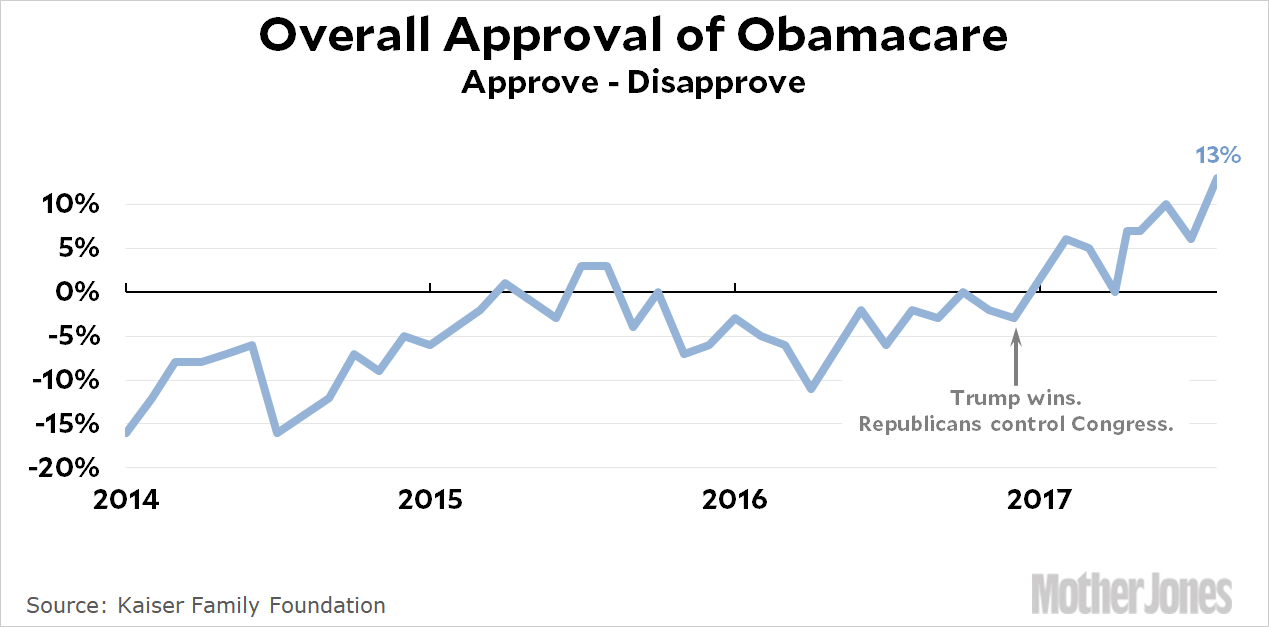
    Here’s the latest Kaiser tracking poll on the popularity of Obamacare:

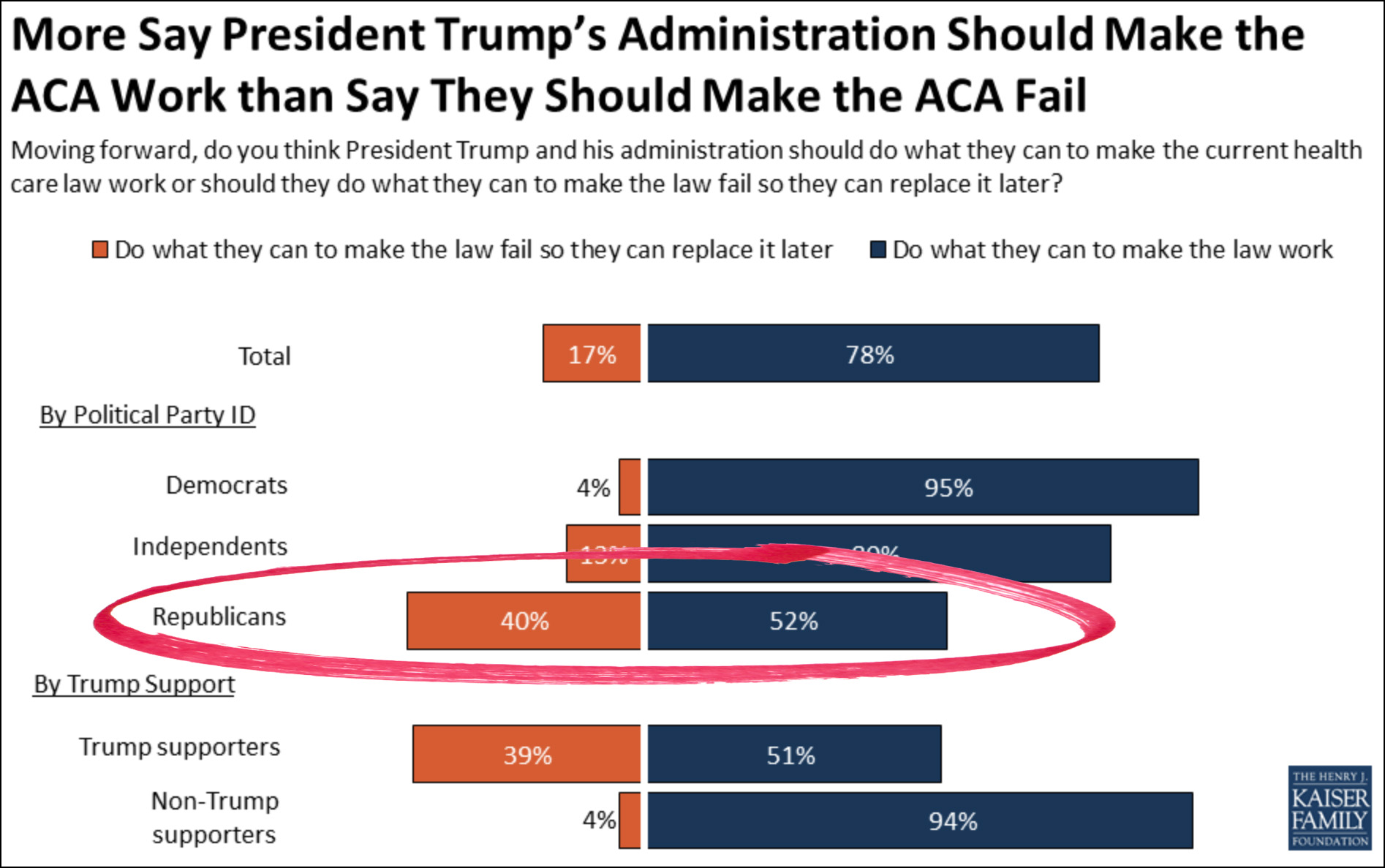
    Approval of Obamacare has been rising steadily ever since Trump won the election. Net approval has now been positive for eight consecutive months, by far the longest stretch of positive approval since the law took effect in January 2014. On the less positive side, however, we also have this:

    It is, I suppose, a relief that a majority of Republicans don’t want Trump to deliberately sabotage Obamacare. At the same time, a full 40 percent of Republicans think this is a great idea. That’s not surprising, perhaps, but it sure is discouraging.

  • How Do We Know Deterrence Works Against North Korea? Because It Already Does.

    Yonhap News/Newscom via ZUMA

    I want to make a quick point that’s pretty obvious, I guess, but that hasn’t been getting much attention. It’s this: North Korea and the United States have been successfully practicing mutually assured destruction against each other for more than half a century. It’s not the same as MAD between the Soviet Union and the US during the Cold War, in which the threat on both sides was the same—nuclear armageddon—but it’s been effective nonetheless:

    • South Korea. The United States keeps about 30,000 troops along the North-South Korea border. This is not because South Korea needs the extra manpower. They have 600,000 active troops and several million more reserves. Our troops are there as a tripwire. If North Korea ever launched an attack, it would kill lots of American troops, guaranteeing that America would respond and North Korea would be wiped off the map.
    • North Korea. The DPRK maintains an immense amount of artillery along its border with South Korea. Since Seoul and other large cities are only 30 miles from the border, North Korea can immediately inflict tremendous loss of life on South Korea if it’s ever attacked.

    So: North Korea can’t attack because they risk being destroyed by an American response. South Korea can’t attack because they risk losing thousands or millions of lives in a North Korean response.

    This is a ghoulish standoff. But despite the alleged madness of North Korea’s leaders, it’s worked. Since 1953 there have been hundreds of fracases and dozens of more serious incidents along the border, but thanks to the grisly logic of deterrence none of them have turned into anything more serious. If North Korea develops the means to launch nuclear missiles at the United States, there’s no reason to think it won’t continue to work. The weapons are different, but the fundamental calculus isn’t.

  • Friday Cat Blogging – 11 August 2017

    Three months ago, I posted a picture of Hilbert playing under the sheets as we made the bed. I intended to post a matching picture of Hopper the next week, but things just kept getting in the way. Today my excuses finally ran out. So here it is, the long-awaited second half of my diptych “Cats Under the Sheets.”

    By the way, I have gotten some queries about why I ignored the so-called International Cat Day earlier this week. Hilbert and Hopper just scoffed when I asked about it. Every day is cat day, after all. Puny human holidays mean nothing to them.

  • House Leaders Working on Obamacare Stabilization

    Caitlin Owens reports that a pair of House Republicans—one a moderate and one an archconservative—are working on a bill to stabilize Obamacare:

    Reps. Tom MacArthur and Mark Meadows are working together on an individual market stabilization package, according to a senior GOP aide. It will include funding for the Affordable Care Act’s cost-sharing reduction payments to insurers, although it’s unclear for how long….One crucial piece, according to a second GOP aide, is an agreement on “very flexible 1332 waiver language” in exchange for CSR funding. The state waivers are an important priority for conservative Republicans.

    This is the most obvious short-term compromise possible. If the CSR subsidies go away, premiums will go up about 15 percent next year. Not only will that be really unpopular, but it would, counterintuitively, cost the government a bundle since the higher premiums will generate higher subsidies. Meanwhile, conservatives have been pushing for a long time for waivers that allow states to run health care systems radically different from Obamacare.

    Needless to say, the devil is in the details. On the CSR side, they key is how long the funding would be guaranteed. Appropriations can only be made for two years, but it’s possible to convert the CSR subsidies into mandatory spending that doesn’t require an appropriation. That would make it permanent. On the waiver side, everything depends on just how far the waivers go. Conservatives want a blank slate. Moderates and liberals want to keep some of the key provisions of Obamacare, like essential benefits and tax subsidies.

    I’m pretty sure that a bill like this can’t be passed under reconciliation (the 1332 waivers wouldn’t qualify), so it would need 60 votes in the Senate. That means it needs to be acceptable to Democrats, not just Republicans.

    It’s possible that something with this at its core could be doable. Stay tuned.

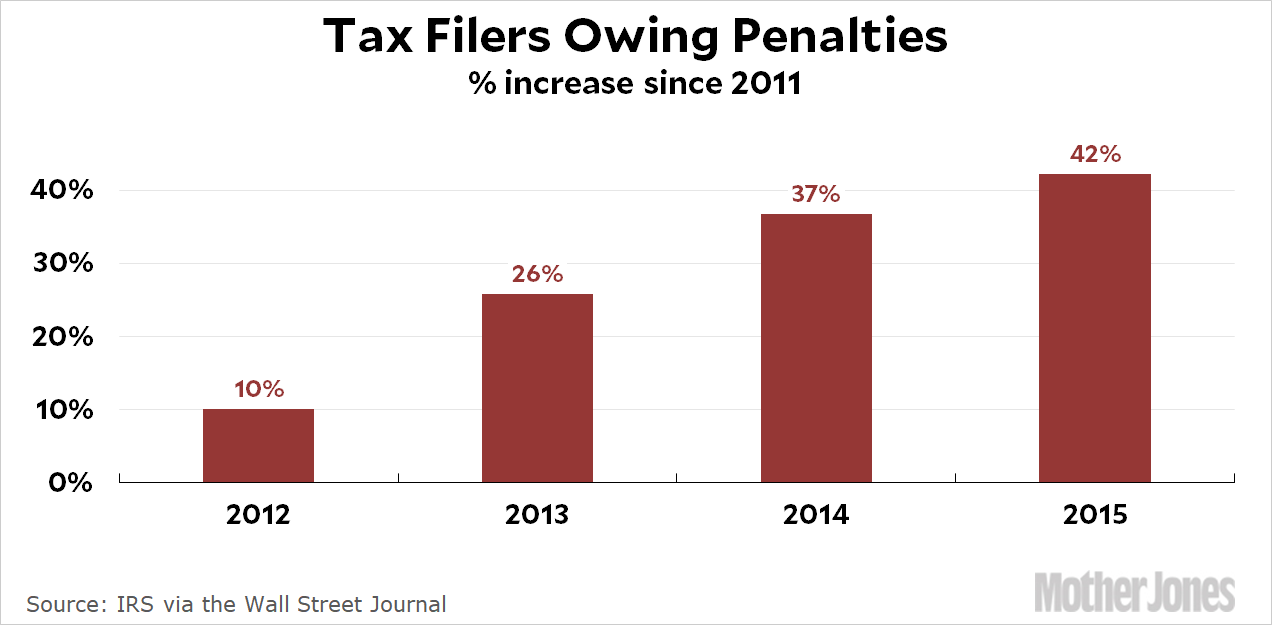
  • Tax Penalties are 40 Percent Higher Than in 2011

    The Wall Street Journal reports today that the number of people who are underpaying their estimated quarterly taxes and incurring IRS penalties is skyrocketing:

    Apparently it’s something of a mystery why this is happening. The number of filers has gone up only slightly. The total penalty amount has stayed about the same. The laws haven’t changed. So what’s going on?

    Beats me. But I do recall looking at this once for a friend who was worried about penalties, and concluding that it hardly made any difference. The penalty amount was pretty small, and not a lot different from the interest you’d earn from underpaying and then paying the penalty. Unless you’re really rich, in which case you have accountants doing this anyway, it didn’t really matter that much.

    So…maybe people have just gotten lazy because they’ve realized that tax penalties aren’t that big a deal?

  • Are Books By Women Just a Bunch of PC Nonsense?

    John Podhoretz is unhappy:

    Even though this Esquire list is more than a year old, I couldn’t help myself. I clicked the link, expecting to find a wild list of obscure femino-socialist tracts that no one in the real world has ever read. Instead I got something…surprisingly ordinary. I’ll break the Esquire list into two lists. Here’s list #1. Every one of them is very well known, and most are part of the standard literary canon:

    1. The Age of Innocence, Edith Wharton
    2. Anna Karenina, Leo Tolstoy
    3. As I Lay Dying, William Faulkner
    4. Beloved, Toni Morrison
    5. The Collected Stories of Katherine Mansfield
    6. The Color Purple, Alice Walker
    7. The Complete Poems, Emily Dickinson
    8. Frankenstein, Mary Shelley
    9. Fun Home, Alison Bechdel
    10. Giovanni’s Room, James Baldwin
    11. The God of Small Things, Arundhati Roy
    12. The Great Gatsby, F. Scott Fitzgerald
    13. The Handmaid’s Tale, Margaret Atwood
    14. Harriet the Spy, Louise Fitzhugh
    15. Heartburn, Nora Ephron
    16. In Cold Blood, Truman Capote
    17. Jane Eyre, Charlotte Bronte
    18. Leaves of Grass, Walt Whitman
    19. The Liars’ Club, Mary Karr
    20. Little Women, Louisa May Alcott
    21. Madame Bovary, Gustave Flaubert
    22. Mason & Dixon, Thomas Pynchon
    23. Middlemarch, George Eliot
    24. Moby-Dick, Herman Melville
    25. The Neapolitan Novels, Elena Ferrante
    26. One Hundred Years of Solitude, Gabriel Garcia Marquez
    27. Parting the Waters, Taylor Branch
    28. Play It As It Lays, Joan Didion
    29. Pride and Prejudice, Jane Austen
    30. The Prime of Miss Jean Brodie, Muriel Spark
    31. Ragtime, E.L. Doctorow
    32. Selected Stories Of Alice Munro
    33. Sense and Sensibility, Jane Austen
    34. The Stories Of Vladimir Nabokov
    35. Slouching Towards Bethlehem, Joan Didion
    36. Sula, Toni Morrison
    37. Their Eyes Were Watching God, Zora Neale Hurston
    38. Things Fall Apart, Chiunia Achebe
    39. To Kill a Mockingbird, Harper Lee
    40. To the Lighthouse, Virginia Woolf
    41. Tristram Shandy, Laurence Sterne
    42. Uncle Tom’s Cabin, Harriet Beecher Stowe
    43. The Warmth of Other Suns, Isabel Wilkerson
    44. The White Album, Joan Didion
    45. Underworld, Don DeLillo
    46. A Wrinkle In Time, Madeleine L’Engle

    Here’s list #2. Some of these are obscure, while some are just lesser-known works by famous authors. Some of them I haven’t heard of, so I can’t judge them:

    1. Autobiography of Red, Anne Carson
    2. Bad Behavior, Mary Gaitskill
    3. The Ballad Of The Sad Café, Carson McCullers
    4. Balm, Dolen Perkins-Valdez
    5. Bastard Out Of Carolina, Dorothy Allison
    6. The Best Of Everything, Rona Jaffe
    7. Birds of America, Lorrie Moore
    8. The Boys of My Youth, Jo Ann Beard
    9. The Brief Wondrous Life Of Oscar Wao, Junot Diaz
    10. Ceremony, Leslie Marmon Silko
    11. The Chronology of Water, Lidia Yuknavitch
    12. Citizen, Claudia Rankine
    13. The Collected Stories of Grace Paley
    14. Forgotten County, Catherine Chung
    15. The Group, Mary McCarthy
    16. Hateship, Friendship, Courtship, Loveship, Marriage Alice Munro
    17. Housekeeping, Marilynne Robinson
    18. Just Kids, Patti Smith
    19. The Leopard, Tomasi di Lampedusa
    20. The Lover, Marguerite Duras
    21. Memoirs of Hadrian, Marguerite Yourcenar
    22. NW, Zadie Smith
    23. Possessing the Secret of Joy, Alice Walker
    24. Redefining Realness, Janet Mock
    25. The Round House, Louise Erdrich
    26. Shadowshaper, Daniel José Older
    27. Silver Sparrow, Tayari Jones
    28. So Long, See You Tomorrow, William Maxwell
    29. Song of Solomon, Toni Morrison
    30. Stone Butch Blues, Leslie Feinberg
    31. A Thousand Years Of Good Prayers, Yiyun Li
    32. An Untamed State, Roxane Gay
    33. Walk Two Moons, Sharon Creech
    34. The Yellow Wallpaper, Charlotte Perkins Gilman

    This list was explicitly put together by eight women as a response to Esquire’s ill-received 2015 “80 Books Every Man Should Read,” which contained exactly one book written by a woman.

    It’s hard for me to find anything either suffocating or PC about this list. There are lots of standard-issue great books, along with the usual smattering of idiosyncratic choices that might or might not be especially widely read. That’s no surprise: every author or critic worth her salt carries around a mental list of personal favorites that they wish more people had read. The list is heavily populated by women, but not nearly so heavily as the original list was populated by men. The themes of these books are considerably different than the themes of the “Every Man” list, which is hardly surprising. And there are fewer pieces of nonfiction than there are on the men’s list.

    Anyway, it’s a list that might not appeal to a lot of men. Them’s the breaks. On the other hand, maybe it provides some good ideas for novels to expand their horizons. You never know til you try.

  • Does Donald Trump Have Anyone Left That He Listens To?

    Ron Sachs/CNP via ZUMA

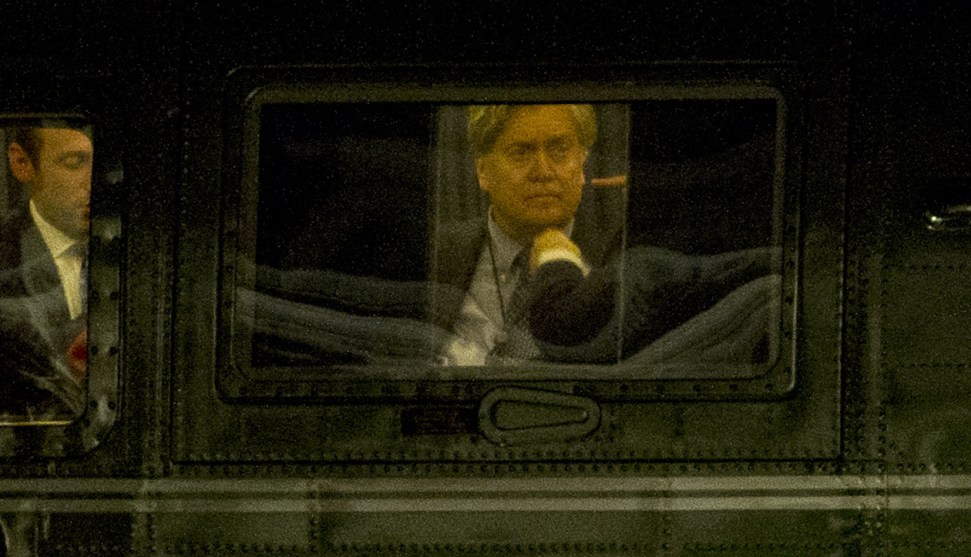
    Politico writes that Stephen Bannon is increasingly isolated within the White House:

    The conservative news site Breitbart has waged a nonstop campaign against national security adviser H.R. McMaster, but so far it seems to have done the most damage to someone else: Steve Bannon. A Wall Street Journal editorial earlier this week accused Bannon of using the right-wing media to go after his ideological foes, questioning his loyalty to the president and placing blame for White House dysfunction squarely on his shoulders.

    ….Bannon has grown more isolated without his ally Priebus in the West Wing….In June, Trump started telling aides that he suspected that Bannon was a source of negative stories, according to aides. After a slew of stories about Bannon “winning” policy wars in the White House—like Trump’s decision to pull out of the Paris climate accord—the president told Bannon to “knock it off,” according to the senior administration official.

    Priebus at one point also warned Bannon. “You’ve got to get people to stop writing this shit, because people know it’s you,” the senior administration official said.

    I’ve recently read that H.R. McMaster is increasingly isolated in the White House. Now Bannon is increasingly isolated. Ivanka Trump is hunkering down and avoiding politics altogether. Anthony Scaramucci was fired after ten days on the job. John Kelly is brand new, but already running afoul of a president who doesn’t like being reined in. At the same time, Rex Tillerson is on the outs, Mitch McConnell is on the outs, Jeff Sessions is on the outs, and Paul Ryan is all but invisible these days.

    So who’s left? Who does Trump still listen to? I guess Jared Kushner is still whispering in his ear. Maybe Kellyanne Conway? Mike Pence? I’m not sure. Who’s left these days who’s still on Trump’s good side?

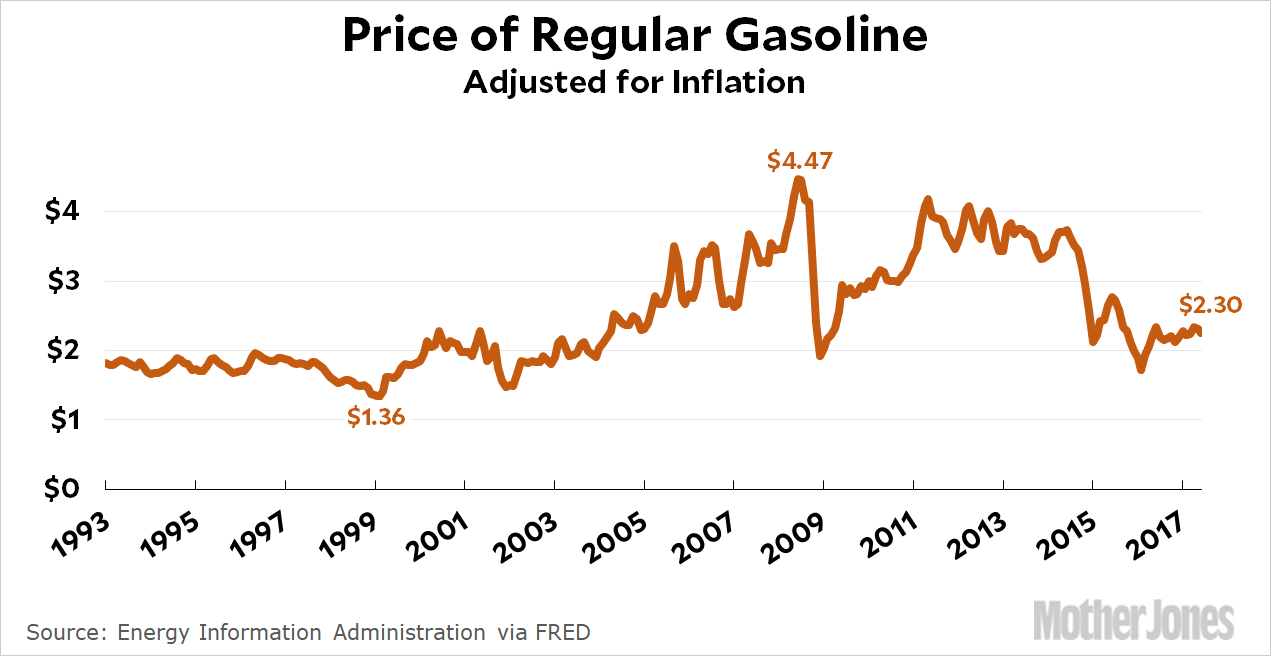
  • Raw Data: Gasoline Prices Over the Past Quarter Century

  • You Should Read the “Maoist Insurgency” Memo. It’s Bananas.

    SIPA Asia via ZUMA

    H.R. McMaster has been cleaning house at the National Security Council recently. In particular, last month he fired a protege of Michael Flynn named Rich Higgins for writing some kind of outrageous memo that eventually found its way to Donald Trump’s desk. Did Higgins deserve this just for an ill-considered bit of analysis? Today we can finally make up our own minds, because someone has leaked the full memo to Foreign Policy. Here’s how it starts:

    POTUS & POLITICAL WARFARE
                        
    May 2017

    BACKGROUND. The Trump administration is suffering under withering information campaigns designed to first undermine, then delegitimize and ultimately remove the President. Possibly confusing these attacks with an elevated interplay of otherwise normal D.C. partisan infighting and adversarial media relations, the White House response to these campaigns reflects a political advocacy mindset that it is intensely reactive, severely under-inclusive and dangerously inadequate to the threat. If action is not taken to re-scope and respond to these hostile campaigns very soon, the administration risks implosion and subsequent early departure from the White House.

    I’d fire Higgins just for his turgid prose style, but maybe you think that’s too harsh. What does Higgins actually have to say? His thesis, it turns out, is that Trump is the target of a lethal, well-funded, and extremely disciplined attack from cultural Marxists who are employing “political warfare as understood by the Maoist Insurgency model.” It’s hard to figure out which part to excerpt to give you a good taste of his John Birch Society mindset, but here’s a bit of it:

    While the attacks on President Trump arise out of political warfare considerations based on non-kinetic lines of effort (as discussed below), they operate in a battle-space prepared, informed and conditioned by cultural Marxist drivers….As used in this discussion, cultural Marxism relates to programs and activities that arise out of Gramsci Marxism, Fabian Socialism and most directly from the Frankfurt School. The Frankfurt strategy deconstructs societies through attacks on culture by imposing a dialectic that forces unresolvable contradictions under the rubric of critical theory….These attack narratives are pervasive, full spectrum and institutionalized at all levels. They operate in social media, television, the 24-hour news cycle in all media, and are entrenched at the upper levels of the bureaucracies and within the foreign policy establishment. They inform the entertainment industry from late night monologues, to situation comedies, to television series memes, to movie themes.

    ….While there is certainly a Marxist agenda and even Islamist motivations that must be seriously addressed in their own right, these motivations alone seem inadequate to explain the scope and magnitude of the effort directed against the president. The economic drivers behind the Marxist and Islamist ideologues are enormously influential and seek to leverage these ideological movements for their own self interests. While beyond the actual scope of this document, the benefactors of these political movements include; Urban Real Estate who depend greatly on immigrant tenants, International Banking who seeks to maintain US debtor status so as to control the application of American power, and elements of the business sector that depend upon immigrant labor or government infrastructure. The overall objective of these economic forces is the forced urbanization of the populace, thereby necessitating a larger, more powerful government. In summary, this is a form of population control by certain business cartels in league with cultural Marxists/corporatists/lslamists who will leverage Islamic terrorism threats to justify the creation of a police state.

    Did you make it all the way through that? No? Shame on you. This is only a couple of paragraphs! There are seven full pages of this stuff in the full memo. Apparently Higgins never got the word that Trump doesn’t read anything longer than three or four bullet points.

    This is bananas. It’s like a memo version of one of Glenn Beck’s chalkboard fantasias except that it was written by an actual White House official who works at the National Security Council. McMaster decided he didn’t want anyone at the NSC whose brain was full of gibberish like this, especially when he himself was pretty clearly one of the targets of Higgins’ conspiracy theorizing. So he fired him. Then he fired a few other people associated with the memo.

    But there’s more. Apparently the memo was circulated widely, and eventually Don Jr. got hold of it. He passed it along to dad, who loved it. When he found out that the author had been fired, Trump was furious. And according to an inside source, “He is still furious.” The upshot of all this, according to the FP story, is that McMaster is isolated in the White House because, I guess, he’s one of the few people there who isn’t crazy:

    Despite Higgins’s firing, McMaster’s difficulties inside the White House aren’t going away anytime soon — though he might. McMaster “doesn’t really have any allies,” said a source familiar with the NSC staff. “It doesn’t seem as though he has the ear of the president, which is obviously essential to his survival.”

    God help us.