Several readers have sent me a link to a Brookings report summarizing three recent studies on lead and crime. Thanks! Two of the studies I’ve already written about, here and here, but the third was new to me. It’s an especially incisive and well-done study.
The authors are Stephen Billings and Kevin Schnepel, who have made clever use of some data from North Carolina. Back in 90s, North Carolina tested children for blood lead levels, and if they were above the CDC guidelines they were tested again. If they were over the limit the second time, they received an intervention designed to lower their lead exposure.
At the time, the CDC limit was 10 micrograms per deciliter. This provided the authors with two groups of kids: those who tested above 10 on both the first and second round and those who tested above 10 on the first round but a little below on the second round. This kind of “discontinuity” study is quite powerful because it produces two groups that are very similar. Since the cutline is arbitrary, it’s very unlikely the groups a little above and a little below the line are different demographically or socially or racially. The only difference between them is that one group received the intervention and the second group didn’t. So what happened?
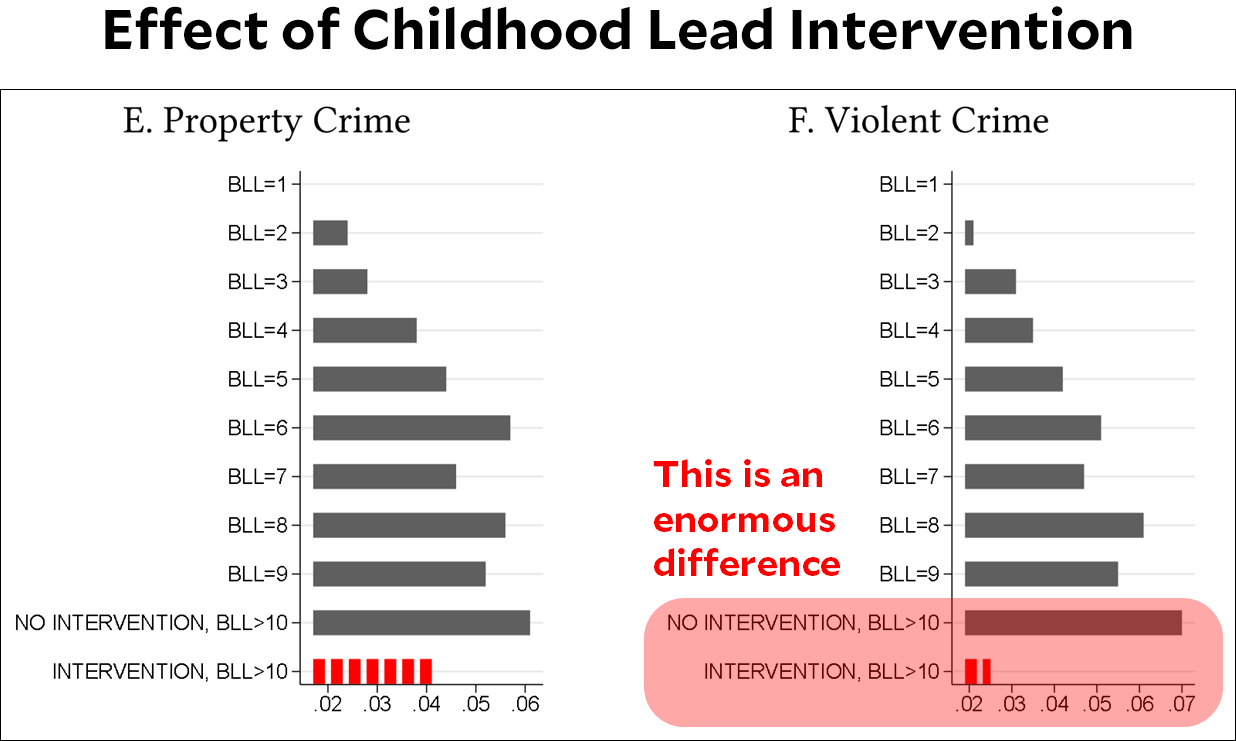
On average, the intervention reduced blood levels from 15 ug/dl to about 5 ug/dl. That’s a big drop. The non-intervention group, obviously, didn’t see any decline at all. Unsurprisingly, then, the intervention group did better than the control group on a variety of educational and behavioral outcomes. The authors also matched up the two groups with arrest records later in life, and by far the biggest effect of intervention was on violent crime:
Violent crime arrests go up along with blood lead levels, which should be no surprise at this point. But the final two bars in the chart are the most dramatic. The control and intervention groups, which were very similar to begin with, diverged substantially. The intervention group, even though it probably started out with slightly higher lead levels, was far, far less likely to be arrested for a violent crime in their teenage years compared to the control group. The statistical significance of the drop is extremely strong.
Because the two groups of kids were so similar, there was barely any need for controls. The authors did them anyway (gender, mother’s education, birth weight, etc.), and they had little effect on the final results.
I don’t really have any criticisms of this study aside from the fact that the sample sizes are fairly modest. If this kind of data is available elsewhere, I’d sure like to see some follow-ups.
UPDATE: I’ve changed the headline. It originally said this study “confirmed” the lead-crime hypothesis, but that goes too far. It’s a good study, but it’s still just one more study.
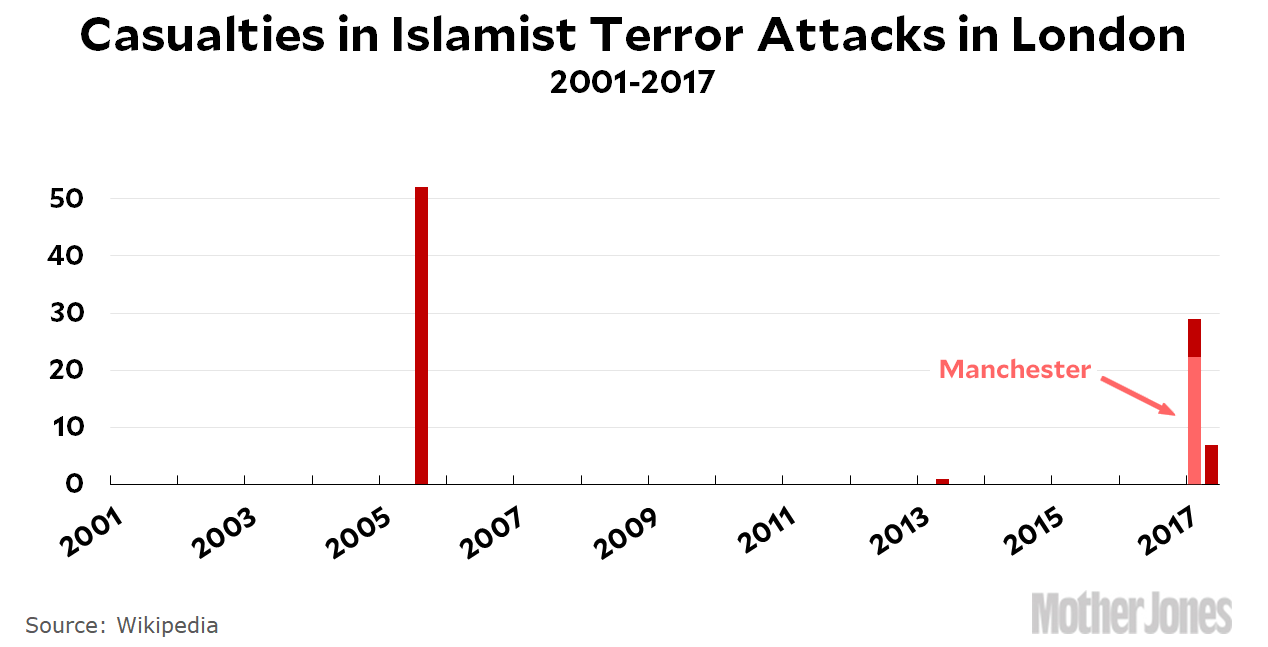
Khan was obviously telling Londoners not to be alarmed about the increased police presence they would see today. Fox News carried it, so I’m sure Trump heard the whole statement.
Five years ago Dick Cheney set a new world record for being an asshole. Donald Trump now holds that record.
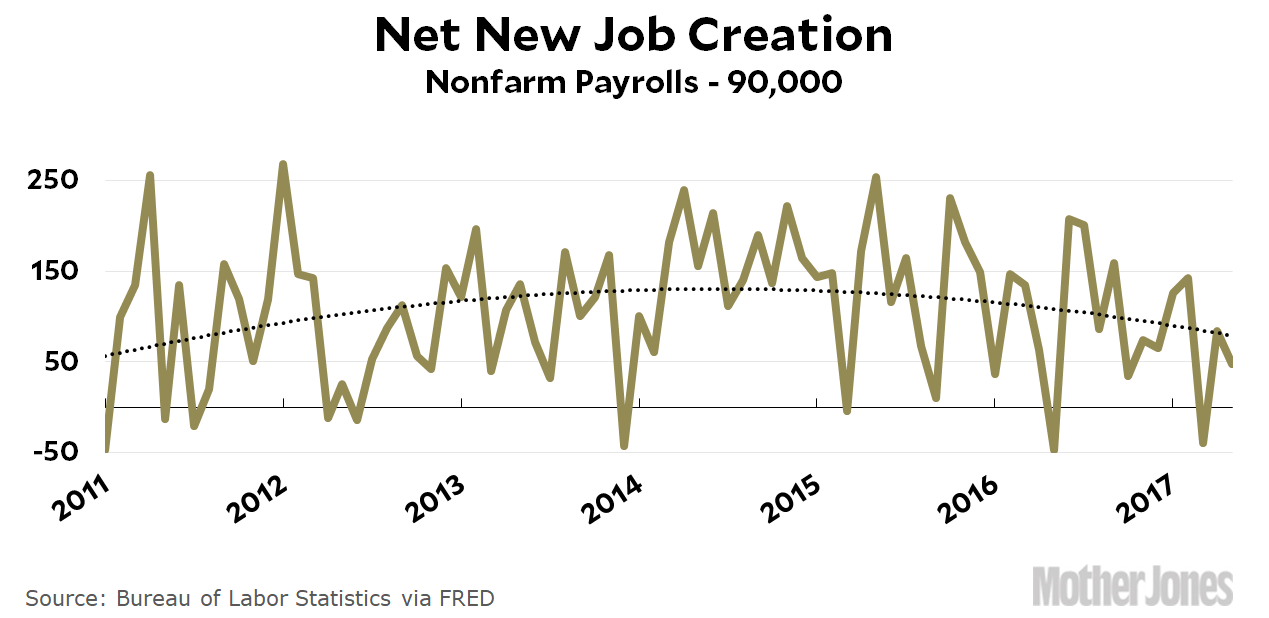
For some reason I was prompted to create this chart yesterday:
There’s a ton of noise in this series, but nonetheless the fitted trendline is fairly clear. Net new job creation1 has been on a steady downward slide for more than two years, declining from a monthly average of 140,000 in 2015 to 100,000 in 2016 to 70,000 so far this year. I don’t know how meaningful this is, but it doesn’t really seem like a good thing, does it?
1We need 90,000 new jobs just to keep up with population growth. Thus, net new job creation is the number of new jobs minus 90,000.
Since leaving office, Barack Obama has made a few veiled criticisms of Donald Trump. Conservatives are pretty unhappy about this. It’s tradition for ex-presidents to maintain a dignified silence about their successors, after all.
This is mostly true, but when did it become a tradition? It certainly hasn’t been one forever. Herbert Hoover was a constant presence on the radio blasting FDR during the Depression, and Harry Truman remained a gadfly after he left office.
Eisenhower changed things up. After beating Hitler and serving two terms as president, he decided to adopt the elder statesman role. Then Kennedy died before leaving office, LBJ slunk back to Texas a broken man, and Nixon resigned in disgrace. By hook or by crook, the “tradition” of ex-presidential silence was two decades old by the time Reagan became president. It’s mostly held ever since.
Is there a good reason for this? The pretense seems kind of precious to me. Why treat sitting presidents like china dolls who can’t take some heat from their predecessors? Ex-presidents are among the greatest politicians alive, and usually the effective leaders of their party, at least for a while. They typically command a throng of admirers. The most natural thing in the world would be for them to maintain a robust political presence if they want to. Why shouldn’t they?
Ditto for losing presidential candidates. This is usually less of an issue, since most people don’t really want to listen to losers. But not always. Hillary Clinton should never run for office again—and she’s said she won’t—but why shouldn’t she stay loudly involved in politics if she can help lead the loyal opposition until Democrats coalesce around a new party leader?
Does anyone know the answer about this tradition? Is it really just an Eisenhower thing that somehow congealed into conventional wisdom? Do other countries have anything similar?
The Environmentalist Left Has to Grapple with Its Failed, Alarmist Predictions
I’m pasting below one of my favorite videos, from a Good Morning America report in 2008….Truly, it’s a stunning piece of work, depicting the deadly dystopia that awaited Americans in . . . 2015. Manhattan is disappearing under rising seas, milk is almost $13 per “carton,” and gas prices skyrocketed to more than $9 per gallon. But if you’re familiar at all with environmentalist predictions, there’s nothing all that unusual about the GMA’s report (except for its vivid visuals).
….As I wrote in early 2016 — after the world allegedly passed Al Gore’s “point of no return” — environmentalist predictions are a target-rich environment. There’s a veritable online cottage industry cataloguing hysterical, failed predictions of environmentalist catastrophe. Over at the American Enterprise Institute, Mark Perry keeps his list of “18 spectacularly wrong apocalyptic predictions” made around the original Earth Day in 1970. Robert Tracinski at The Federalist has a nice list of “Seven big failed environmentalist predictions.” The Daily Caller’s“25 years of predicting the global warming ‘tipping point’” makes for amusing reading, including one declaration that we had mere “hours to act” to “avert a slow-motion tsunami.”
….Is the environmental movement interested in explaining rather than hectoring? Then explain why you’ve been wrong before. Own your mistakes.
I would be a lot more impressed with complaints like this if conservatives had spent the past decade loudly insisting that although climate change was important and needed to be addressed, we shouldn’t panic over it. That would be defensible. Needless to say, that’s not what they’ve done. Instead, for purely partisan reasons, we’ve gone from lots of Republicans supporting cap-and-trade to a nearly unanimous rejection in 2010 of what they now fatuously call cap-and-tax, followed in 2016 by the election of a man who’s called climate change a hoax.
Still, alarmism from activists is nothing new, so I was ready to believe plenty of them had gone overboard. At the same time, I was suspicious because the GMA video was rather oddly cropped. It was a hyperactive promo for a forgettable ABC program called Earth 2100 that aired eight years ago, so I wasted some time watching it. Here it is, so you can watch it too if you want to make sure I describe it accurately:
The program is very clear at the beginning that it’s dramatizing a worst-case dystopia of climate change if we do nothing. That said, the show’s actual depiction of 2015 includes these vignettes: an oil shortage spikes gasoline prices to $5 per gallon; higher oil prices make suburbs less desirable places to live; eating meat uses a lot more oil than eating grain; Congress approves 40 new coal-fired power plants; a huge storm hits Miami; a huge cyclone hits Bangladesh; a drought in China causes wheat shortages; and world leaders fail to reach agreement on greenhouse gas reductions.
That’s…not at all what French describes. And it’s not especially alarmist, either. The big drought was (is) in South Sudan, not China, and the most intense cyclone ever was in the eastern Pacific, not Bangladesh or Miami. It was the Lima conference that produced no climate agreement (that would have to wait for Paris at the tail end of 2015), and for pretty much the reasons described in the program. Extreme weather events have increased and wildfire damage in the western US has intensified. But the show did get a couple of things wrong: there was no oil shortage and no new coal-fired plants.
After I finished my vintage TV watching, I trudged through each of French’s catalogs of ridiculous environmental predictions. First up was Mark Perry’s list of bad prediction from the first Earth Day. I’m not sure why I’m supposed to care about a random assortment of stuff from 50 years ago, but whatever. Perry has a list of 18 items, and of them, (a) six were from Paul Ehrlich, (b) two were vague warnings about humans destroying the planet, which we were certainly doing in 1970, and (c) four were dire predictions of things that might happen if we did nothing. But of course, we didn’t do nothing. That leaves six: two predictions of famine, two predictions of resource shortages, one prediction of mass extinction, and one prediction of an impending ice age. I can’t find any backup for the mass extinction thing, but the guy who allegedly predicted it got a Medal of Freedom from Ronald Reagan, so how bad could he be? Nor could I find any backup for the supposed prediction of a coming ice age, and the data it’s based on makes it seem unlikely.
So if we agree that Paul Ehrlich was just way off base, we’re left with four guys who got some stuff wrong. If this is the best we can find from the entire maelstrom of the environmental movement of 1970, it doesn’t sound like those guys did so badly after all.
Next up was the Federalist list, but it was pretty much the same stuff.
Finally there’s the Daily Caller’s list of bad predictions about a global “tipping point.” I had to trudge through each one and click through to see what it really said, and it turns out the first five cases were all routine statements about how much time we had left until the next climate conference, where we really had to get something done. The sixth was from Prince Charles, so who cares? The seventh was a claim that we needed to do something by 2012 in order to keep climate change from getting out of control. The eighth was a piece about the unsustainability of eating lots of meat. And the ninth was a 1989 prediction that we needed to get moving on climate change by 2000 to avoid catastrophe.
So we have a grand total of two people saying that we need to act fast or else it will be impossible to keep future climate change under 2°C. This is a pretty mainstream view since there’s a lot of inertia built into climate change, so I’m not sure why this list is supposed to be so scandalous in the first place. We do need to act quickly if we want global warming to peak at 2°C or less. What’s wrong with saying that at every opportunity?
When you get done with all this, there’s virtually nothing of substance left. Sure, some people got some stuff wrong. That’s always the case. The whole point of science is not to get everything right, but to have a mechanism for correcting its errors. And if you look at consensus views, instead of cherry picking individuals, I think environmental scientists have as good a track record as anyone. Aside from creating listicles that get passed around forever on the internet by ignorant yahoos, what’s the point of pretending that they’ve been epically wrong for decades and need to offer up abject apologies before we ever listen to them again?
There’s no need to answer that. I think we all know exactly what the point is.
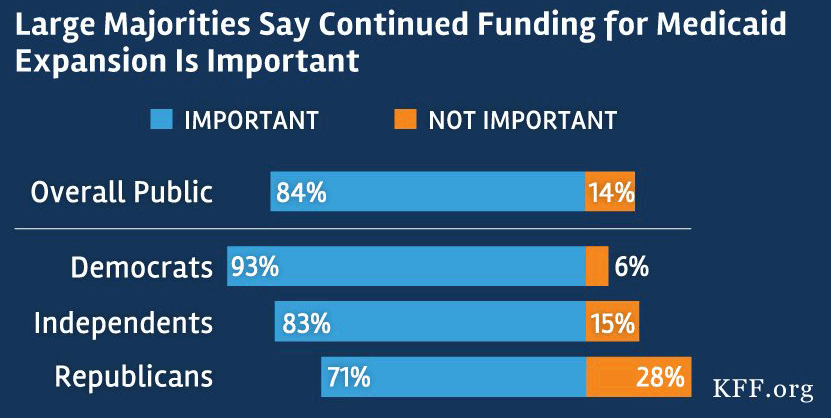
Is it really true that 71 percent of Republicans think it’s important to keep ACA’s Medicaid expansion? Yes it is, though with less intensity than Democrats and Independents. Is it because they’re confused and think this is about Medicare? Nope. The question explicitly starts out, “Now thinking specifically about Medicaid, the program for certain low-income adults and children…”
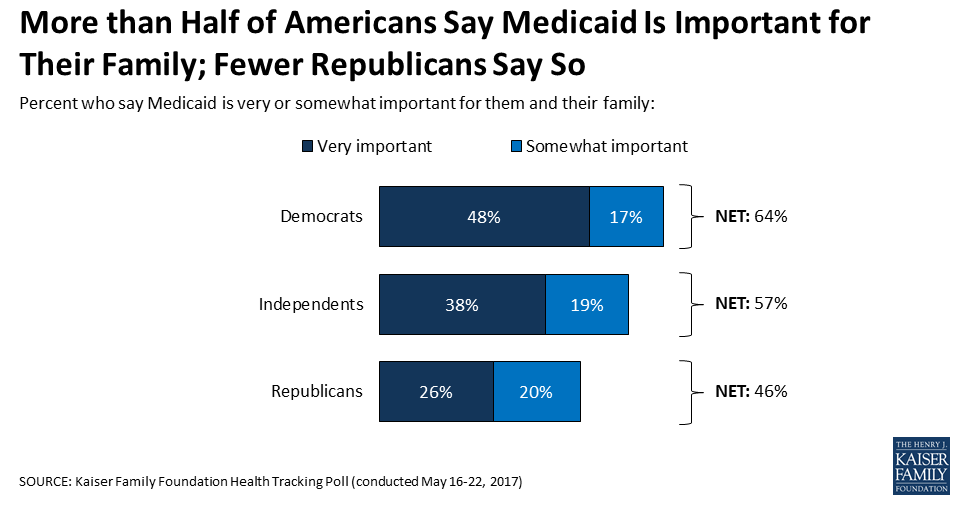
The answer probably lies here:
Even among Republicans, nearly half say Medicaid is personally important to their family. If that’s the case, it’s not really surprising that 71 percent support Medicaid expansion. That includes all the Republicans who think it’s personally important plus another sizeable chunk who have one or more friends who depend on it. (Plus, presumably, some who are unaffected by Medicaid but support it out of ordinary human decency anyway.)
These numbers may seem surprisingly high, but they’re really not. In the Kaiser poll, among all party IDs, 58 percent say that Medicaid is personally important to them and their families. In the US there are, roughly speaking:
68 million Medicaid enrollees
85 million families
If, say, there are 35 million families with one Medicaid enrollee; 10 million with two; and 4 million with three or more; that’s a total of 68 million Medicaid enrollees spread out among 49 million families. And that’s 58 percent of all families.
It’s a big number because Medicaid is the most widely used major benefit program in existence.1 Most people don’t know this.
1I think. It’s more widely used than Social Security (61 million), Medicare (55 million), food stamps (44 million), unemployment insurance (6 million at the height of the recession), the home mortgage deduction (about 60 million), 401(k) plans (about 52 million), IRAs (about 60 million), EITC (26 million), and TANF (about 4 million). Am I missing any major programs?
There is one fly in this ointment: employer health insurance. About 155 million people receive medical coverage through their employers, and they all benefit from the tax advantages of employer health plans. If you count this, then Medicaid is only the second most widely-used benefit program.
The country would be substantially better off if the electorate penalized parties for nominating inexperienced, uninformed, impulsive, corrupt candidates for president.
And we respect that! But maybe you’re of a mind to support our work directly instead? We have until December 31 to raise the last $400,000 we need to keep our nonprofit newsroom running at full strength into 2026. Will you make a gift today?
We noticed you have an ad blocker on. Can you pitch in a few bucks to help fund Mother Jones' investigative journalism?
Billionaires own the media,
but they don’t own us.
At Mother Jones we know these aren’t conventional times, and they require unconventional coverage. That’s what deliver every day: fierce, independent journalism you can’t find elsewhere. Perhaps never in the history of our country has that been more necessary than now. But we can’t do it without reader support—your support. Please chip in today.
Billionaires own the media,
but they don’t own us.
At Mother Jones we know these aren’t conventional times, and they require unconventional coverage. That’s what deliver every day: fierce, independent journalism you can’t find elsewhere. Perhaps never in the history of our country has that been more necessary than now. But we can’t do it without reader support—your support. Please chip in today.