In the two weeks since he sent those tweets, both the media and members of Congress have gone on a fishing expedition to investigate his claims. It’s clear he was lying. But during an interview last night with Tucker Carlson, Trump indicated that he wants to move on….Instead of acknowledging the obvious, he promises to produce (non-existent) evidence that he was right. It will all come to light sometime in the future.
….Trump’s pattern is to pretend that evidence to support his lies is forthcoming and assume that our collective attention span is as short as his when it fails to materialize.
This is a lesson Trump learned during his decades as a B-list celebrity. If you say something outrageous, it will get you attention from the Page Six crowd but it won’t last long. It doesn’t especially matter if it’s true or not true. It’s entertainment, and as long as it drives traffic it’s all good. In a few days it will get eclipsed by something else and everyone will lose interest.
Without giving it much thought, Trump probably figured the same was true of politics. And it is—but only up to a point. Even as a presidential candidate Trump could count on outrages dying out fairly quickly. But not as president. That’s the point where it’s not entertainment anymore.
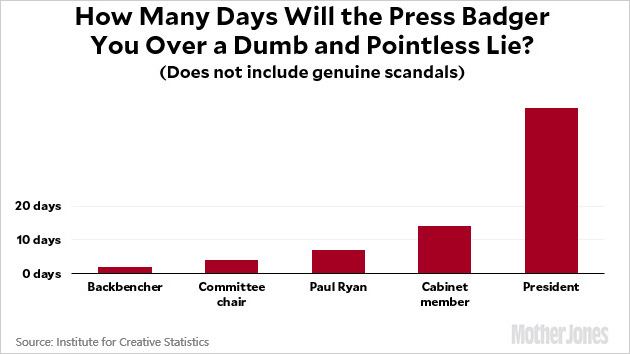
Backbenchers in Congress can count on reporters getting bored with their dumb lies in a day or two. For senators and committee chairs it’s a few days. For Paul Ryan it’s a week. For cabinet members a couple of weeks tops. But for the president? Who knows? Weeks can stretch into months, and you never know when something will pop up years later to remind the press to badger you about it yet again. It’s a whole different world than Page Six.
Over at The Corner, Ericka Andersen writes: “More and more liberal Americans are embracing socialism. Unfortunately, it seems many of them aren’t aware of the realities that citizens in countries like Venezuela face.”
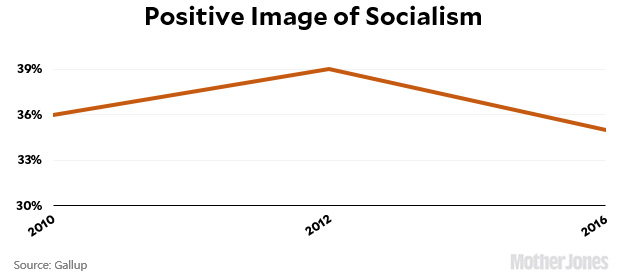
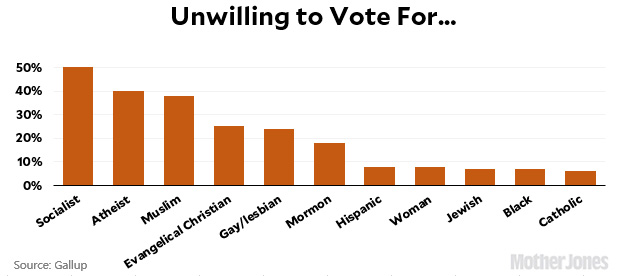
That got me curious. Is it true that more and more liberal Americans are embracing socialism? I couldn’t find a whole lot on the subject, but Gallup has asked a few times recently whether people have a positive image of socialism. And in 2015 they asked whether people would vote for a socialist. Here are the results:
This isn’t much. Maybe ANES has some longer-term trends on this? Still, the Gallup polls don’t suggest any overall recent warming toward socialism. If liberals really are getting seduced by the red menace, some other group must be making up for it.
So what’s going on? A few recent polls have gotten a lot of attention for reporting that millennials prefer socialism to capitalism, but I doubt they really mean much. For one thing, we have no idea if this is anything new. For another, millennials polled in 2016 probably figured that socialist meant “Bernie Sanders.” But Bernie’s no socialist, no matter what he calls himself.1 He’s a European-style social democrat, just like me.
If I hear millennials starting to talk about nationalizing the banks and having the feds take over the steel mills, then it might be time to wonder what’s going on. Until then, I think the answer is: nothing.
1I don’t know what he believes in his heart of hearts, of course. In practice, however, he’s a pretty standard issue social democrat. So are lots of American liberals. Bernie is just more vocal about getting there right now than most of them. That’s one of the benefits of having a safe seat in Vermont.
I’m just having fun with the new camera and some Photoshopping today. Here is Ansel Adams, updated for suburban Southern California:
The next one is the result of some filter or other that I can’t remember, in combination with some random color swapping. It almost seems like Vermont in October instead of Southern California in winter, doesn’t it?
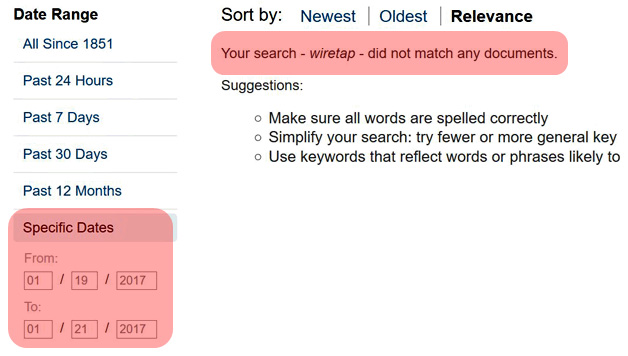
Last night I read Donald Trump’s comment that he had read the word “wiretap” in the New York Times on January 20, so he figured that made it OK on March 4 to accuse President Obama of wiretapping him. I vaguely wondered what article he was talking about, but it was late and life is short, so I went to bed instead of searching for it.
Today, though, I wondered yet again. Here’s what the Times search engine tells me:
I also tried “wire tap” and “wire-tap.” No dice. Does anyone have a clue what he was talking about?
And how about the Bret Baier report “the day previous where he was talking about certain very complex sets of things happening, and wiretapping”? I can’t find that either.
Do either of these things exist? Or is Trump just making stuff up to cover for the fact that he read about it in a Breitbart News summary of a Mark Levin radio rant?
I guess I’m about the thousandth person to post this video, but it’s seriously bananas:
Did you catch all that? Tucker Carlson points out that working-class areas that voted for Trump would be hurt far more by his health care bill than more affluent areas. Trump’s response? “I know, I know.” Then Carlson says that seems inconsistent with Trump’s campaign message. Trump’s response? “A lot of things aren’t consistent.”
Trump spends the rest of the time whining about the GOP’s thin majority in the Senate and the fact that Democrats won’t vote for his bill because they’re selfish and stupid.
Carlson also asked Trump about his wiretapping claim. Remember how we all used to mock Sarah Palin for her word salad? Now we have Donald Trump. Behold:
CARLSON: So on March 4, 6:35 in the morning, you’re down in Florida, and you tweet, the former administration wiretapped me, surveilled me, at Trump Tower during the last election. How did you find out? You said, I just found out. How did you learn that?
TRUMP: Well, I’ve been reading about things. I read in, I think it was January 20 a “New York Times” article where they were talking about wiretapping. There was an article, I think they used that exact term. I read other things. I watched your friend Bret Baier the day previous where he was talking about certain very complex sets of things happening, and wiretapping. I said, wait a minute, there’s a lot of wiretapping being talked about. I’ve been seeing a lot of things.
Now, for the most part, I’m not going to discuss it, because we have it before the committee and we will be submitting things before the committee very soon that hasn’t been submitted as of yet. But it’s potentially a very serious situation.
CARLSON: So, 51,000 people retweeted that. So a lot of people thought that was plausible, they believe you, you’re the President — you’re in charge of the agencies. Every intelligence agency reports to you. Why not immediately go to them and gather evidence to support that?
TRUMP: Because I don’t want to do anything that’s going to violate any strength of an agency. We have enough problems. And by the way, with the CIA, I just want people to know, the CIA was hacked, and a lot of things taken — that was during the Obama years. That was not during us. That was during the Obama situation. Mike Pompeo is there now doing a fantastic job.
But, we will be submitting certain things and I will be perhaps speaking about this next week, but it’s right now before the committee, and I think I want to leave it. I have a lot of confidence in the committee.
CARLSON: Why not wait to tweet about it until you can prove it? Don’t you devalue your words when you can’t provide evidence?
TRUMP: Well, because “The New York Times” wrote about it. Not that I respect “The New York Times.” I call it the failing “New York Times.” But they did write on January 20 using the word wiretap. Other people have come out with —
CARLSON: Right, but you’re the President. You have the ability to gather all the evidence you want.
TRUMP: I do. I do. But I think that frankly we have a lot right now. And I think if you watch — if you watched the Bret Baier and what he was saying and what he was talking about and how he mentioned the word wiretap, you would feel very confident that you could mention the name. He mentioned it. And other people have mentioned it. But if you take a look at some of the things written about wiretapping and eavesdropping —
And don’t forget, when I say wiretapping, those words were in quotes. That really covers, because wiretapping is pretty old fashioned stuff. But that really covers surveillance and many other things. And nobody ever talks about the fact that it was in quotes, but that’s a very important thing. But wiretap covers a lot of different things. I think you’re going to find some very interesting items coming to the forefront over the next two weeks.
A health care bill so gratuitously brutal it seems almost intended to fail.
A budget that’s very plainly just a piece of performance art designed to outrage liberals.
A new immigration order so similar to the first one that Trump must have known it would be blocked in court.
A funding request for a border wall that’s basically a demand for a blank check that Congress will never pass.
A string of conspiracy theories (illegal voting, Trump Tower wiretaps, Obama is masterminding leaks) seemingly designed to waste congressional time.
And, of course, an endless series of hollow executive orders, bombastic tweets, and sob stories about the media mistreating poor Donald.
Incompetence is the obvious explanation for all this, but you gotta wonder. Is Trump trying to fail so he can blame everyone else when things go to hell while he remains a populist hero? Just by accident you’d think he’d do a few things that might actually work.
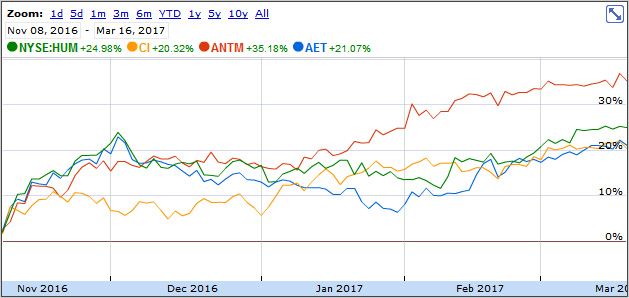
I may need to rethink this whole insurance market stability thing. Granted, the individual market is only a small part of the health insurance industry, but if people were afraid of it being obliterated by the Republican health plan, you’d still think it would show up in sluggish or falling stock prices. Quite the opposite, though. Big health insurers have been on a roll since the election. They’re not doing quite as well as Wall Street, but they’re doing pretty well. A rise of 20-30 percent in four months is nothing to sneeze at.
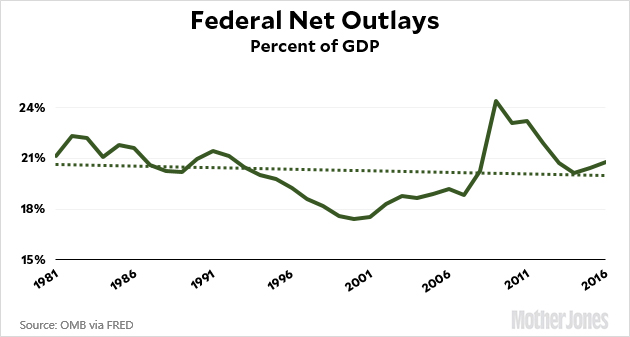
Since the federal budget is in the news today, I figured everybody might like to see how much our government has been spending over the years. So here it is. As Republicans like to say, it’s clear that spending is spiraling out of control:
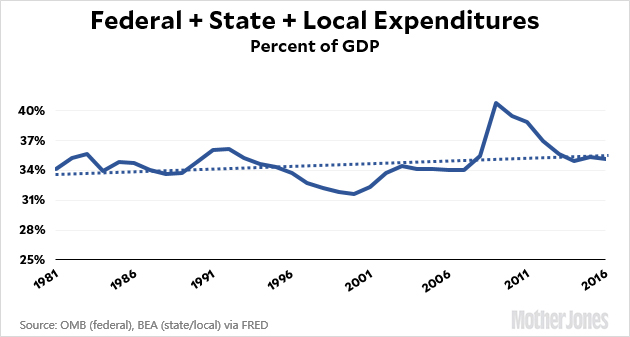
UPDATE: Someone is going to demand total government spending at all levels, so I might as well get ahead of the curve. Here it is:
Just a quick note to repeat something I said a few days ago: don’t pay any more attention to President Trump’s budget than you do to his tweets. It’s not meant as a serious proposal. It’s just a way for him to send a message to his fans that he hates the EPA and the State Department and loves vets and the Pentagon.
The real action is in Congress. They won’t pay any attention to Trump’s budget, and he knows it.
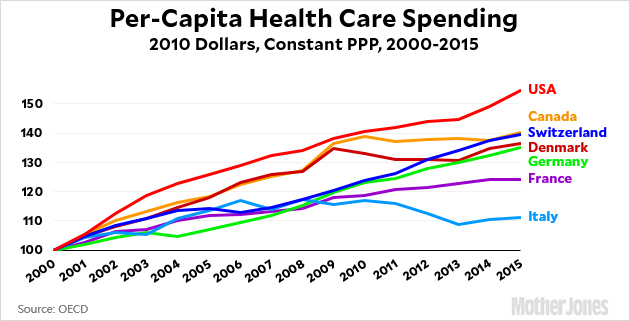
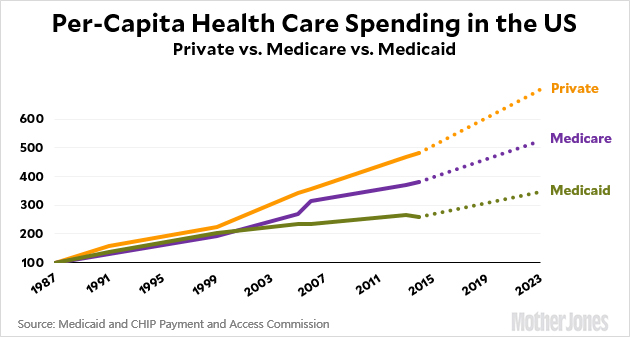
I got into a conversation today about my contention from last night that national health care systems are better at controlling costs than the private sector. We all know that US health care costs are the highest in the world, but are they growing faster than the rest of the world? And how about different health care sectors in the US?
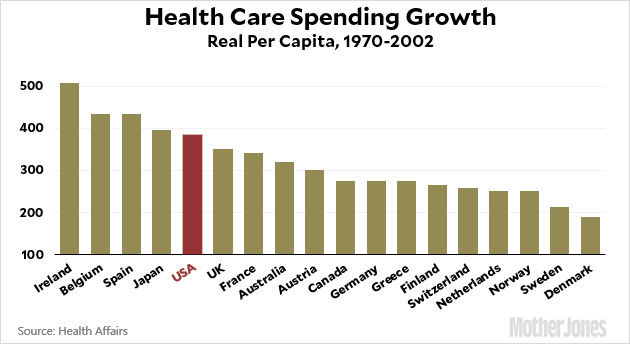
I haven’t looked at this in years, so I decided to dig up the data and see. First off, here is growth in health care spending among a representative group of rich countries during recent decades:
This data is a little tricky because some countries changed the way they calculated health care spending in the past few years. I didn’t use any of them, and it’s possible that one or two might have grown faster than us. But the US is certainly in the top two or three, if not at the very top.
One problem with international comparisons of health care spending is that some countries are aging faster than others, and it stands to reason that countries with older populations will spend more than those with younger populations. Here’s a look at spending growth during the period 1970-2002 that controls for aging:
During these earlier decades there are several countries with higher growth rates than the US. I’m a little surprised there weren’t more, given that postwar European countries were still catching up to the US during the first half of this period.
The data here tells a pretty consistent story. Despite starting at a higher base, the US is in the top two or three in the world—maybe at the very top—for health care spending growth over the past half century or so. Within the US, private health care spending growth has outpaced both Medicare and Medicaid. Both internationally and in the US, government-run health care programs appear to be better at controlling costs than the private sector.
Of course, there are other sources of data and other ways of doing comparisons, so don’t take this as the last word. If I come across any other studies that seem to have interesting ways of slicing the data, I’ll follow up.
Billionaires own the media,
but they don’t own us.
At Mother Jones we know these aren’t conventional times, and they require unconventional coverage. That’s what deliver every day: fierce, independent journalism you can’t find elsewhere. Perhaps never in the history of our country has that been more necessary than now. But we can’t do it without reader support—your support. Please chip in today.
Billionaires own the media,
but they don’t own us.
At Mother Jones we know these aren’t conventional times, and they require unconventional coverage. That’s what deliver every day: fierce, independent journalism you can’t find elsewhere. Perhaps never in the history of our country has that been more necessary than now. But we can’t do it without reader support—your support. Please chip in today.