• Trump Still Blowing Off Intelligence Briefings


    A few years ago, conservatives raised an alarm over the fact that President Obama didn’t receive an in-person intelligence briefing every day. Sometimes, it turned out, he met with the briefer, but other times he just read the briefing material. This was deemed a major threat to national security.

    So how about Donald Trump?

    President-elect Donald Trump is receiving an average of one presidential intelligence briefing a week, according to U.S. officials familiar with the matter, far fewer than most of his recent predecessors….Trump has asked for at least one briefing, and possibly more, from intelligence agencies on specific subjects, one of the officials said. The source declined to identify what subjects interested the president-elect, but said that so far they have not included Russia or Iran.

    My guess is that Trump (a) thinks he already knows everything he needs to know, and (b) is afraid the briefings might force him to acknowledge things he doesn’t want to believe. In any case, he’s going to be president pretty shortly, and surely Republicans are deeply concerned about his apparent lack of interest in the intelligence community’s reports.

    Right?

  • Who Will Write Us a Syllabus for Sneerology 101?


    Paul Krugman notes today that all of us coastal elites actually do more for the recently famous white working class than Republicans do, but the working class folks still don’t like us because they think we look down on them. He’s a little puzzled about this:

    Do the liberals sneer at the Joe Sixpacks? Actually, I’ve never heard it — the people I hang out with do understand that living the way they do takes a lot more money and time than hard-pressed Americans have, and aren’t especially judgmental about lifestyles. But it’s easy to see how the sense that liberals look down on regular folks might arise, and be fanned by right-wing media.

    I’m not here to get into a fight with Krugman, but come on. Sure, the right-wing media fans the flames of this stuff, but is there really any question that liberal city folks tend to sneer at rural working-class folks? I’m not even talking about stuff like abortion and guns and gay marriage, where we disagree over major points of policy. I’m talking about lifestyle. Krugman talks about fast food, and that’s a decent example. Working-class folks like fast food,1 which explains why Donald Trump liked to show pictures of himself eating McDonald’s or KFC. It’s a sign that he’s one of them. Ditto for Trump’s famous trucker hat. (Did you even know that it’s a trucker hat, not a baseball cap? He did.)

    If I felt like this was something that actually needs evidence, I could produce a million examples in a very short time. But everyone gets this, don’t they? We sneer at their starchy food. We sneer at their holy-roller megachurches. (But not at black churches; never that.) We sneer at their favorite TV shows. We sneer at their reading habits. We sneer at their guns. We sneer at their double-wides. We sneer at the tchotchkes that litter their houses. We sneer at their supermarket tabloids. We sneer at their music. We sneer at their leisure activities. We sneer at their blunt patriotism. We sneer at—

    Again: come on. Maybe you personally don’t do it—though judging from the comments here, a lot of you do—but you hardly need to be an anthropologist to recognize that this kind of sneering shows up on TV, in newspapers, on Twitter, in books, on Facebook, and in private conversations all the time. It’s hard to believe that anyone is really blind to this.

    Now, it’s true that they also sneer at us. Fair enough. But as all good liberals know, there’s a big difference between a powerful group sneering at a vulnerable group, and vice versa. The former is a far bigger problem. And we educated city folks are, on average, far richer and more powerful than ruralish working-class folks. Our sneering has a power component that theirs doesn’t. I confess that it’s fun, and I enjoy my share of sneering in private, but I also accept that this attitude has political costs.

    Anyway, I’m curious: do you accept this? Is it as obvious to you as it is to me? Or do you think I’m overstating things? Do I really need to make my case in more detail?

    1So do I. Except for McDonald’s.

  • American Media Suffering From Desperate Lack of Pro-Trump Voices


    It turns out that a lack of manufacturing jobs is not America’s only problem. There’s also a lack of columnists willing to defend Donald Trump:

    As they discovered during the long campaign season, the nation’s newspapers and major digital news sites — the dreaded mainstream media — are facing a shortage of people able, or more likely willing, to write opinion columns supportive of the president-elect. Major newspapers, from The Washington Post to the New York Times, have struggled to find and publish pro-Trump columns for months. So have regional ones, such as the Des Moines Register and Arizona Republic, which have a long history of supporting Republican candidates.

    Here’s the problem: these folks are not looking for writers who will defend particular Trump policies from time to time. They want columnists who will regularly defend all Trump policies. And here’s the catch: they want people who are non-insane.

    That’s hard. But perhaps it’s a business opportunity for me. I could do this, I think, if I put my mind to it, but for obvious reasons of self-respect and the loss of all friends and family, the pay would have to be very high. So the question is, just how desperate is the media for a seemingly rational pro-Trump voice? Are they willing to pool their efforts to make me a highly-paid syndicated columnist who defends Trump no matter what he does?

    Let’s see how serious they are. Show me the money, people.

  • Swamp Watch – 9 December 2016


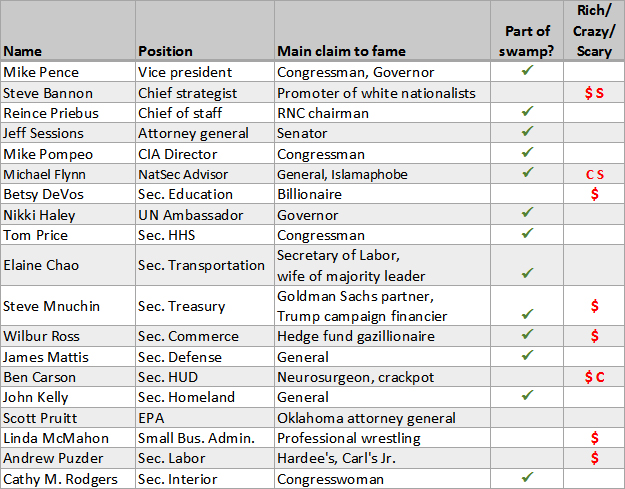
    According to reports, Trump will nominate Rep. Cathy McMorris Rodgers (R–Wash.) as Secretary of the Interior. After a run of three outsiders, this means we’re back to the swamp for Trump’s cabinet. McMorris Rodgers is a fairly standard issue Republican by contemporary standards, and naturally she hates any environmental regulations that might actually save our interior for future generations.

    UPDATE: Nope, it’s not going to be Rodgers. Instead, Trump settled on Rep. Ryan Zinke (R–Mont.) Apparently he got along better with Trump’s kids.

  • Prediction: Terrorism in the Middle East Will Decline By Half Between 2020 and 2040


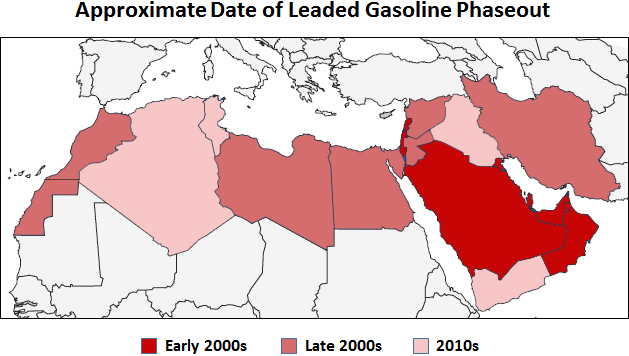
    You guys are way too smart. I posted my mystery map of the Middle East yesterday morning, and in less than an hour you had figured out what it represented. For the rest of you, here’s the map with its real title:
    I’m going to make an obvious point about this, but I want to make it carefully. Ever since I wrote my piece about the link between violent crime and leaded gasoline, I’ve gotten periodic questions about whether lead might be responsible for other things. The most common answer is maybe—but it’s unlikely we’ll ever have the data to prove it. For that reason, I try to stay pretty restrained about exactly what lead might and might not be responsible for.

    That said, there’s a lot of evidence that leaded gasoline produced a wave of violent crime between 1960-1990 in the developed world, and that the introduction of unleaded gasoline eliminated that wave and eventually brought crime rates down nearly to 1960 levels. In most developed countries, leaded gasoline was phased out starting in the 70s and 80s, which benefited children born after that. When those children reached their late teenage years in the 90s and aughts, they were much less prone to impulsiveness and aggression, which led to lower crime rates.

    But not every part of the world followed that timetable. In particular, leaded gasoline continued to be used in the Middle East up through the late 90s. Egypt began phasing it out in 1998, and most other countries followed over the next decade or so. Only a few—including Iraq and Afghanistan—still sell significant amounts of leaded gasoline.

    Since lead poisoning affects infants, its affects show up about 18-20 years later. What this means is that in the bright red countries, the cohort of kids who reach their late teen years around 2020 should be significantly less aggressive and violent than previous cohorts. Around 2025 the countries in lighter red will join them. Around 2030 the countries in pink will join. By 2040 or so, the process will be complete.

    Obviously this means that crime rates in the Middle East should decline steadily between 2020-40. But there’s more. Given the effects of lead, it seems almost certain that reducing lead poisoning in teenagers and young adults should lead to a decline in terrorism as well.

    This is where I want to be careful. Obviously terrorism, like crime, has a lot of causes. What’s more, you could eliminate every molecule of lead in the world and you’d still have plenty of crime and plenty of terrorism. But you’d have less. If terrorism follows the path of violent crime, eliminating leaded gasoline could reduce the level of terrorism by 50 percent or more.

    It’s also possible—though this is much more speculative—that effective terrorism requires a minimum critical mass of people who are drawn to it. If you fall below that minimum, it might wither away. In other words, it’s possible that removing lead from gasoline could reduce terrorism by even more than 50 percent.

    In any case, this leads to a concrete prediction: Between 2020 and 2040, the level of terrorism emanating from the Middle East will drop by at least half. Ditto for violence more generally, including civil wars. In a decade or so, we should begin to get hints of whether this prediction is correct.


  • In Flint, 99% of Homes Are Safe As Long As They Have a Water Filter


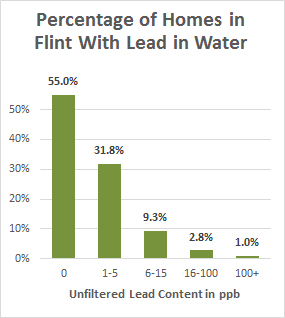
    Here’s another look at the current state of water in Flint. Instead of an average, it shows the number of homes with different levels of lead in their tap water. The data (here) is for the entire month of November (11/3 through 12/1) and covers 493 homes. The testing is done with unfiltered water.
    About 87 percent of homes have lead content of 5 parts per billion or less. This is safe for anyone, even small children. Another 9 percent have lead content of 6-15 ppb. This is probably safe for adults, and safe for children if it’s filtered. Another 3 percent have lead levels between 16-100 ppb. This is unsafe unless filtered. Finally, about 1 percent of homes have lead levels above 100 ppb, which might be unsafe even if it’s filtered.

    The filters are critical here. About 99 percent of Flint homes have safe water as long as a filter is properly installed and maintained. Replacing Flint’s service lines will take a long time, and in the meantime the emphasis should be almost exclusively on making sure everyone has a working filter. Only a tiny percentage of houses still need to be using bottled water.

  • Hoo Boy, Democrats Sure Do Hate Trump’s Cabinet


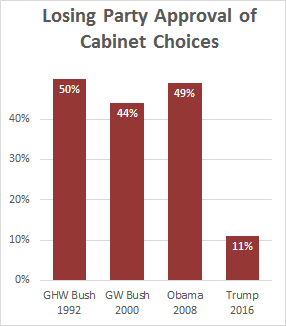
    Polls from Pew Research always have lots of interesting tidbits, and today’s is no exception. One question was about approval of cabinet choices, and Donald Trump ranks the lowest of any recent president. But you have to dig down a bit to get the real news.
    It turns out this doesn’t represent disapproval across the board. Members of Trump’s party approve of his picks at roughly the same rate as members of the winning party always have. However, members of the opposing party are usually mildly positive toward a new president’s picks. Not this year. Among Democrats, only 11 percent approve of Trump’s cabinet choices. This is pretty remarkable. Trump starts out with the most intense disapproval among the opposite party of any new president in recent memory. By far the most intense.

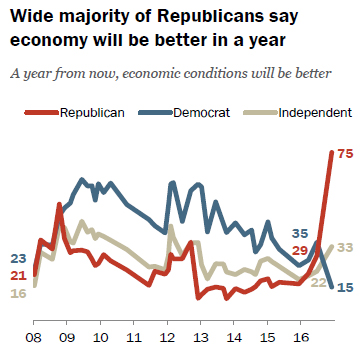
    A second result is also interesting—as well as sort of amusing. In pretty much every poll ever taken, members of the president’s party think the economy is stronger than members of the out party. Members of the president’s party are also more likely to be optimistic about the future of the economy. This is hardly surprising, but Trump has hypercharged it. Take a look at the chart on the right.
    Republicans are over the moon. A full 75 percent think the economy will be better in a year. Meanwhile, Democrats, who were already pessimistic, have cratered. Only 15 percent think the economy will be better a year from now.

    Personally, I think this is too easy. Instead of blathering about something vague like “economic conditions,” you should be willing to name exactly what you think will be better. For example:

    • The unemployment rate is currently 4.6 percent. Higher or lower in November 2017?
    • Real GDP growth averaged (approximately) 1.6 percent in 2016. Higher or lower in 2017?
    • Real weekly wages of production and nonsupervisory employees were up (approximately) 0.41 percent in 2016. Higher or lower in 2017?

    You can pick your own examples. But they should be specific and measurable, regardless of whether you think Trump is going to supercharge the economy or destroy it.

  • Apparently the World Just Wants the Trains to Run on Time


    I seriously don’t have the courage to click on this link, so I’ll just share the tweet:

    Looking for a silver lining? The US is moving toward authoritarianism slower than the other countries. And Germany, which has some recent experience with this sort of thing, remains pretty committed to elections and so forth.

    Then again, Russia, Spain, and China have some recent experience with authoritarian governments too, and that’s not stopping them from losing faith in democracy.

  • How Many Generals Is Too Many?


    Over at the Washington Examiner, Jamie McIntyre makes a fair point about Trump’s military-heavy cabinet:

    “I am concerned that so many of the President-Elect’s nominees thus far come from the ranks of recently retired military officers,” Rep. Steny Hoyer, D-Md., said in a statement Wednesday evening….Yet when President Obama assembled his Cabinet in 2009, he also ended up with three retired four-stars in his inner circle: [Jim] Jones as his national security adviser, retired Army Gen. Eric Shinseki as veterans affairs secretary, and retired Navy Adm. Dennis Blair as director of national intelligence. That’s 12 stars to Trump’s 11.

    Technically, DNI isn’t a cabinet-level position, but it’s hard to argue that it’s less important than, say, Secretary of the Interior. Of course, Trump still has some positions to fill, including DNI, so we might not be done with the generals yet. Still, if Trump sticks with the three he’s got, it’s not out of the ordinary.

    The real issue with Trump seems to be that he’s chosen a retired general to run the Department of Defense. It’s reasonable to object to this, but let’s just object to it, instead of claiming that Trump’s cabinet is unusually heavy with ex-generals.